Edge Computing in Industrial Automation is changing the way modern factories collect, process, and use machine data. Instead of sending every piece of information to a distant cloud platform, edge computing allows industrial systems to process important data closer to the machines that generate it. As a result, factories can respond faster, reduce unnecessary network traffic, and keep critical operations running with greater consistency.
Industrial environments generate enormous amounts of data every second. Sensors monitor temperature, pressure, vibration, speed, flow, position, and other operating conditions. At the same time, PLCs control machines, HMIs display process information, and industrial networks move data between different devices. Traditionally, much of this information could be forwarded to central servers or cloud platforms for analysis. However, that approach can create delays and increase dependence on network connectivity.
Edge computing introduces a smarter approach. It places computing resources near the production floor so that data can be analyzed where it is created. Consequently, automation engineers can build systems that react to events in near real time without waiting for a remote service to process every request.
This guide explains the concept from the ground up and shows where edge computing fits within an industrial automation environment. It also explores how edge devices interact with PLCs, sensors, SCADA systems, industrial networks, and cloud platforms.
What Is Edge Computing in Industrial Automation?
At its core, edge computing means moving data processing closer to the source of the data. In an industrial facility, that source might be a machine, production line, sensor network, PLC panel, robot, or local control cabinet.
Imagine a production machine generating temperature readings every few milliseconds. A traditional cloud-centered design may send a large volume of readings through the network before software processes them. With an edge-based design, a local computing device can receive those readings, analyze them, identify abnormal conditions, and forward only the useful results to another system.
This does not mean that the cloud becomes unnecessary. Instead, edge computing and cloud computing can work together. The edge handles time-sensitive or local processing, while the cloud can handle centralized storage, large-scale analytics, reporting, and long-term data management.
The main idea is simple: process the right data in the right place at the right time.
Why Industrial Automation Needs Edge Computing
Modern automation systems are becoming more connected than ever. A single manufacturing line may contain dozens or hundreds of sensors, controllers, drives, cameras, robots, and monitoring devices. Each component can produce valuable operational data.
Sending everything directly to a remote platform may not always be practical. Network bandwidth has limits, and some industrial decisions cannot wait for a remote response. For example, a local system may need to detect an abnormal vibration pattern and trigger an immediate response. Even a small communication delay can become undesirable when the process requires rapid action.
Edge computing addresses this challenge by bringing processing power closer to the equipment.
More importantly, local processing can reduce the amount of raw information that travels across the network. An edge device can filter unnecessary values, calculate useful indicators, detect unusual patterns, and transmit summarized information instead of forwarding every raw measurement.
As a result, the overall automation architecture can become more efficient.
How Edge Computing Fits Into an Industrial Automation System
To understand the concept clearly, it helps to look at the typical flow of industrial data.
Sensors first capture physical conditions from the production process. They may measure temperature, pressure, current, vibration, level, flow, speed, or position. These signals then reach controllers such as PLCs, which use programmed logic to operate machines and manage process sequences.
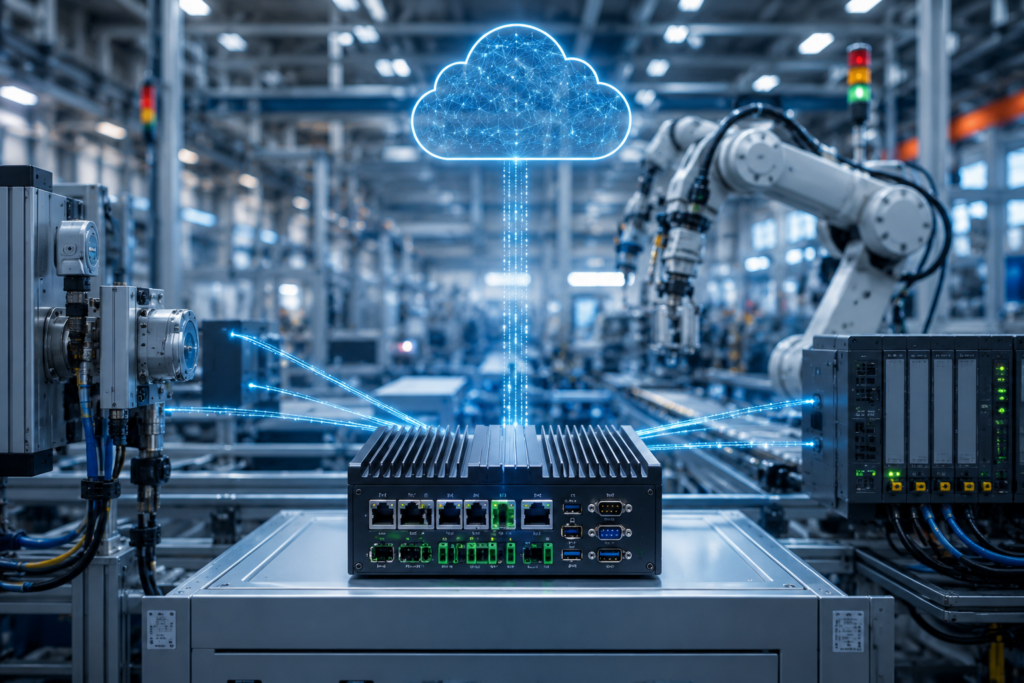
An edge device can sit alongside this automation layer. It can collect selected data from PLCs, drives, sensors, industrial gateways, or other connected equipment. The device then performs local processing before passing selected information to SCADA software, a manufacturing application, or a cloud platform.
This creates a layered architecture in which each level has a specific role.
The field devices focus on measurement and operation. PLCs focus on deterministic control. Edge devices focus on local data processing and intelligent analysis. SCADA and supervisory platforms focus on monitoring and higher-level visualization. Cloud platforms can then provide centralized analytics, historical storage, remote access, and broader business intelligence.
This separation can make the system easier to manage because each layer handles the tasks it is best suited for.
Edge Devices in Industrial Automation
An edge device is the computing hardware or software platform that performs processing near the source of industrial data. It can take different forms depending on the application.
In some installations, the edge device may be a rugged industrial computer designed to operate in harsh environments. In other cases, it could be an industrial gateway, an embedded controller, or a specialized computing platform connected to an existing automation network.
The important feature is not its physical shape. The important feature is where it processes data and how closely it operates to the production environment.
A suitable edge device may collect information from multiple industrial protocols, convert data into a common format, run local applications, store temporary records, and communicate with higher-level systems.
For example, an edge computer may read selected values from a PLC, calculate machine operating trends, detect an unusual condition, and then send a compact result to a central monitoring platform. The PLC can continue controlling the machine while the edge device handles additional analysis.
That distinction is important because data analysis should not interfere with the core control logic of a machine.
Edge Computing vs Traditional Cloud Processing
The difference becomes easier to understand when we compare where the work happens.
In a cloud-first design, data typically travels from the machine to a remote service before more advanced processing takes place. This architecture can work very well for centralized analytics and large datasets. However, it depends more heavily on network communication.
With edge computing, a portion of the processing happens locally. Therefore, the system can react to local information without sending every request to a remote platform.
Consider a machine that produces continuous vibration data. An edge device can examine those readings locally and identify a developing abnormal pattern. Instead of transmitting every raw sample, it can send an event such as an abnormal vibration condition together with the relevant measurements.
This approach can significantly reduce unnecessary traffic while preserving the information that matters.
At the same time, the cloud can still receive selected results for long-term analysis. Therefore, edge computing does not replace cloud computing. Rather, it creates a more balanced relationship between local processing and centralized services.
How Edge Computing Works With PLCs
PLCs remain one of the most important components in industrial automation, and edge computing does not remove their role.
A PLC is designed to execute control logic reliably and repeatedly. It reads inputs, evaluates programmed conditions, and updates outputs according to the control application. Edge computing serves a different purpose by adding local computing capabilities around that control system.
For instance, a PLC may control a conveyor motor based on sensors and process conditions. At the same time, an edge device can collect motor current, speed, temperature, and runtime information. The edge application can analyze these values and identify patterns that the PLC program does not need to handle directly.
This separation allows engineers to keep control logic focused while using additional computing resources for monitoring and analysis.
Furthermore, edge systems can collect information from multiple PLCs at once. That makes them useful in production environments where several machines operate as part of the same manufacturing process.
The Role of Local Data Processing
One of the biggest advantages of edge computing is local data processing. Instead of treating every sensor value equally, an edge system can decide what deserves immediate attention.
For example, normal operating values may not require constant transmission. However, a sudden temperature increase, an unusual vibration pattern, or an unexpected motor current may require immediate analysis.
An edge application can evaluate those conditions locally and respond according to the application's design.
This approach is especially useful when industrial systems generate high-frequency data. Rather than moving all raw information through the network, the edge layer can transform large streams of data into meaningful events, summaries, or calculated values.
Consequently, engineers can use network resources more efficiently while still maintaining access to important information.
A Simple Example of Edge Computing in a Factory
Consider a packaging machine operating continuously on a production floor. The machine contains sensors that monitor motor temperature, operating speed, vibration, and current consumption.
The PLC controls the machine sequence and ensures that the equipment performs its programmed operations. An edge computer receives selected readings from the PLC and connected devices.
During normal operation, the edge device records local measurements and calculates operating trends. If vibration gradually increases beyond a defined pattern, the edge application can identify the change before the machine reaches a critical condition.
The system can then send the event to a monitoring platform while retaining the detailed information locally for further investigation.
This workflow shows the practical value of edge computing. The PLC continues handling control tasks, the edge system performs local analysis, and higher-level platforms receive useful information without processing every raw signal directly.
What Makes Edge Computing Different From a Basic Industrial Gateway?
An industrial gateway typically focuses on communication between devices, protocols, or networks. It may collect data and transfer it from one system to another.
An edge platform can do much more.
In addition to communication, it can run applications, perform calculations, filter information, analyze patterns, manage local storage, and make decisions based on incoming data.
Therefore, the difference is mainly about capability.
A gateway helps move information.
An edge system can move, process, interpret, and act on information close to the production environment.
That additional processing capability is what makes edge computing especially valuable for modern industrial applications.
Architecture of Edge Computing in Industrial Automation
The architecture of Edge Computing in Industrial Automation connects field devices, controllers, edge systems, supervisory platforms, and cloud services into a coordinated data environment. Each layer performs a different job, so the system can process information efficiently without placing every task on one device.
At the lowest level, sensors and actuators interact directly with the physical process. Sensors collect values such as temperature, pressure, vibration, flow, position, and electrical current. At the same time, actuators operate motors, valves, cylinders, relays, and other equipment.
Above this field layer, PLCs execute the main control logic. They respond to inputs, evaluate conditions, and control outputs according to the programmed sequence. Because PLCs are designed specifically for industrial control, they remain responsible for time-critical machine operations.
The edge layer sits close to these devices. An industrial computer, gateway, or edge controller can collect selected data from several machines and perform additional processing locally. For example, it can calculate trends, detect unusual values, filter unnecessary information, and prepare useful data for higher-level applications.
Next, SCADA or other supervisory systems can use processed information for monitoring and visualization. Finally, cloud or enterprise platforms can store selected data for long-term analysis, reporting, optimization, and remote access.
As a result, the architecture creates a practical division of responsibilities. Control remains close to the machine, local analysis happens at the edge, and broader analytics can take place at centralized platforms.
How Edge Computing in Industrial Automation Processes Data
Data processing is one of the most important functions of an edge system. Instead of forwarding every raw value immediately, the edge layer can evaluate data before sending it elsewhere.
For example, imagine a motor that produces thousands of vibration measurements during normal operation. Sending every measurement to a remote platform may consume unnecessary bandwidth. However, an edge application can examine the readings locally and identify changes that deserve attention.
First, the edge system receives the data from a PLC, sensor, drive, or industrial gateway. Next, it can clean or organize the information so that temporary noise does not create misleading results. After that, the application can calculate values such as averages, rates of change, operating trends, or threshold conditions.
Furthermore, the system can classify the information. Normal measurements may remain in local storage, while abnormal events can receive higher priority. Because of this approach, the network can carry more meaningful information instead of a continuous stream of unnecessary raw data.
This local processing model also supports faster decision-making. When an event occurs, the edge device does not always need to wait for a distant server to analyze it.
Industrial Communication Protocols Used With Edge Computing
Communication is essential because edge systems must exchange information with equipment from different parts of a factory. Fortunately, industrial environments already use many established communication technologies.
An edge platform may communicate with PLCs through protocols such as OPC UA, Modbus TCP, or other industrial communication methods supported by the equipment. The exact protocol depends on the manufacturer, controller, network structure, and application requirements.
OPC UA is particularly useful when different systems need structured and interoperable industrial data. It can help an edge application obtain information from controllers and organize that information for higher-level software.
Modbus TCP can also appear in simpler industrial environments where devices exchange register-based data over Ethernet.
In addition, some installations use MQTT when edge systems need to publish selected information to local or cloud-based applications. Because MQTT follows a lightweight publish-and-subscribe model, it can be useful for transmitting event data and telemetry.
However, the protocol alone does not determine the quality of an edge architecture. Engineers must also consider data security, network reliability, device compatibility, update mechanisms, and overall system design.
Edge Computing in Industrial Automation and SCADA
SCADA systems provide operators with a visual view of industrial processes. They display alarms, trends, status information, measurements, and other operational details. Edge computing can strengthen this environment by preparing data before it reaches the supervisory layer.
For example, an edge device can gather information from several PLCs and present calculated values to SCADA instead of sending every raw reading individually. This can make the supervisory system more focused on meaningful process information.
Moreover, edge processing can support local event detection. Suppose several sensors begin showing unusual behavior. The edge layer can evaluate those readings and generate a useful event for the SCADA system.
As a result, SCADA operators can receive clearer information while the edge system handles some of the computational work in the background.
This arrangement also helps separate control from supervision. The PLC can continue controlling the process, while SCADA monitors the operation and the edge layer performs additional analysis.
Edge Computing in Industrial Automation for Predictive Maintenance
Predictive maintenance is one of the most practical applications of Edge Computing in Industrial Automation. Machines often provide warning signs before a serious failure occurs. Those signs may appear through vibration, temperature, current consumption, pressure, or operating behavior.
An edge system can continuously examine these signals and search for unusual changes.
For example, a motor may gradually consume more current than it normally does under the same operating conditions. At the same time, its vibration level may begin increasing. An edge application can combine these values and identify a pattern that deserves inspection.
Because the analysis happens near the equipment, the system can evaluate the machine continuously without sending every measurement to a remote platform.
Furthermore, the edge layer can send only important events and summaries to a central system. Maintenance teams can then use those results to investigate equipment before a minor problem develops into a major production interruption.
The result is a more proactive maintenance strategy. Instead of reacting only after equipment fails, engineers can use operational data to identify developing issues earlier.
Edge Computing in Industrial Automation for Quality Monitoring
Product quality can also benefit from local processing. Modern production systems may generate large amounts of data from sensors, cameras, instruments, and machine parameters.
An edge computer can process some of this information close to the production line. For instance, it can compare measured process values against acceptable operating conditions and identify unusual behavior.
Suppose a packaging process depends on accurate temperature and pressure. If these values move outside their expected patterns, the edge system can detect the change and notify the supervisory system.
In some applications, industrial vision systems can also provide large volumes of image data. Processing selected information locally can reduce the need to transfer every image to a remote server.
Consequently, factories can react to quality-related events faster while reducing unnecessary network traffic.
Edge Computing in Industrial Automation for Real-Time Monitoring
Real-time monitoring is another strong use case. Operators and engineers often need current information about machine performance rather than waiting for a delayed report.
An edge platform can collect values from connected equipment, process them locally, and make the resulting information available to monitoring applications.
For example, an edge system can calculate production speed, machine runtime, energy consumption, downtime, and operating trends. Because these calculations happen close to the data source, the system can update information quickly.
In addition, local monitoring can continue during temporary communication problems with a remote platform. The edge device may keep collecting and processing information locally until the higher-level connection becomes available again.
Therefore, edge computing can improve operational visibility without making the entire monitoring process dependent on continuous cloud communication.
Edge Computing in Industrial Automation and Cloud Computing
Edge and cloud computing are not competing technologies. In many modern factories, they work together.
The edge handles tasks that benefit from local processing, while the cloud provides centralized computing and storage capabilities. For example, an edge system may identify abnormal machine behavior and transmit only relevant events to the cloud.
The cloud can then store those events over a long period and compare information from multiple production sites.
This creates a useful balance. Local systems receive quick processing, while centralized platforms gain access to selected operational information.
Furthermore, cloud analytics can help engineers identify patterns across large datasets. Edge systems can then apply updated models or rules closer to the machines.
Because of this relationship, a hybrid architecture can provide both local responsiveness and centralized intelligence.
Security Considerations for Edge Computing in Industrial Automation
Adding connected computing devices to a factory also introduces security responsibilities. Every new device creates another point that engineers must protect.
Edge systems should therefore use appropriate authentication, access control, network segmentation, secure communication, software updates, and monitoring practices.
For example, an edge computer that connects to a PLC network should not automatically receive unrestricted access to every industrial device. Its permissions should match its actual role.
Similarly, communication between an edge device and higher-level services should use suitable security mechanisms. Strong credentials, controlled access, and secure configuration can reduce unnecessary exposure.
Furthermore, engineers should maintain a clear inventory of edge devices. Knowing which devices exist, where they are installed, what software they run, and how they communicate makes security management much easier.
Security should not be treated as an extra feature added at the end of a project. Instead, it should become part of the edge architecture from the beginning.
Reliability and Offline Operation With Edge Computing
Industrial production cannot always depend on a perfect internet connection. A factory may experience network interruptions, maintenance activity, or temporary loss of access to an external service.
An important advantage of edge computing is that essential local processing can continue during such situations.
For example, an edge device may continue collecting machine information, performing calculations, storing important events, and supporting local applications even when a cloud connection is temporarily unavailable.
Once communication becomes available again, the system can synchronize selected information with the central platform.
This approach improves resilience because the production environment does not have to stop simply because a remote connection has been interrupted.
However, engineers must clearly define which functions can operate independently and which functions require higher-level services. Safety-critical machine control should remain appropriately designed within the automation control architecture rather than relying on a cloud connection.
Benefits of Edge Computing in Industrial Automation
The practical benefits of Edge Computing in Industrial Automation become easier to understand when viewed as part of the complete factory architecture.
Local processing can reduce the amount of data sent across industrial networks. As a result, network resources can be used more efficiently.
At the same time, nearby computing can support faster responses to operational events. This is especially valuable for applications where timely detection matters.
Edge processing can also improve data quality by filtering noise, organizing measurements, and generating useful information before transmission.
Moreover, local computing can support greater resilience during temporary network interruptions. The system can continue performing selected tasks even when a remote platform is unavailable.
Another advantage is scalability. As factories add more sensors and machines, an edge architecture can process information closer to each production area instead of sending every raw signal to one centralized destination.
Taken together, these advantages can help manufacturers build more responsive and efficient digital systems.
Challenges of Edge Computing in Industrial Automation
Although edge computing offers many advantages, it is not a universal solution for every industrial problem.
One challenge is device management. A factory may eventually contain many edge computers, and each device requires configuration, software updates, security controls, and monitoring.
Another challenge involves interoperability. Industrial equipment can use different communication standards, data structures, and vendor-specific interfaces. Engineers must therefore design suitable connections between the equipment and the edge platform.
There is also a maintenance requirement. Edge devices operate in real industrial environments, so hardware selection must account for temperature, vibration, electrical conditions, and available space.
Furthermore, local processing does not eliminate the need for good network design. Instead, it adds another layer that must communicate reliably with the rest of the automation system.
Therefore, successful deployment requires careful architecture rather than simply installing an edge computer and connecting it to a PLC.
When Should a Factory Use Edge Computing?
The best use cases usually involve large amounts of data, the need for quick local analysis, limited bandwidth, or applications that should continue working during temporary connectivity problems.
For example, a production line with hundreds of sensors may benefit from local data filtering and analysis. Similarly, a machine monitoring application that needs rapid event detection can benefit from nearby processing.
On the other hand, a small system with very little data may not need a complex edge architecture. In that situation, a simpler automation network may provide everything the application requires.
Therefore, the correct approach depends on the process, the amount of data, response requirements, security model, existing infrastructure, and long-term goals.
Edge Computing in Industrial Automation: Future Potential
As industrial systems become more connected, edge computing is likely to play an increasingly important role in local data processing.
Factories are generating more information from sensors, machines, robots, vision systems, energy meters, and connected controllers. At the same time, manufacturers want faster insights without creating unnecessary network and cloud costs.
Edge platforms can help bridge that gap by bringing computing closer to industrial equipment.
Furthermore, advances in machine learning and intelligent analytics can allow edge systems to perform more sophisticated analysis locally. Instead of transmitting large datasets for every decision, selected models can operate directly near the production process.
This can support applications such as anomaly detection, machine condition monitoring, quality analysis, and energy optimization.
The long-term value will not come from edge computing alone. Rather, it will come from combining edge processing with reliable PLC control, industrial communication, SCADA, secure networking, and centralized analytics.
Conclusion
Edge Computing in Industrial Automation is becoming an important part of modern manufacturing because it brings data processing closer to machines, sensors, and control systems. Instead of sending every piece of information to a remote platform, edge systems can analyze important data locally and provide faster insights.
Throughout this guide, we saw how edge computing works with PLCs, SCADA systems, industrial communication protocols, and cloud platforms. We also explored practical uses such as predictive maintenance, quality monitoring, real-time monitoring, and local data processing.
Most importantly, edge computing does not replace traditional automation technologies. Instead, it adds another layer of intelligence that can help factories process data more efficiently. As industrial systems continue to generate more information, local processing can help reduce unnecessary network traffic while supporting faster and more reliable decision-making.
For manufacturers, the right approach is to use edge computing where it solves a real operational need. With proper architecture, security, and device management, it can become a valuable part of a connected industrial automation environment.
As Industry 4.0 continues to evolve, edge computing can help bridge the gap between machines, operational data, and intelligent digital systems.

Pingback: TSN in Industrial Automation: Beginner’s Guide