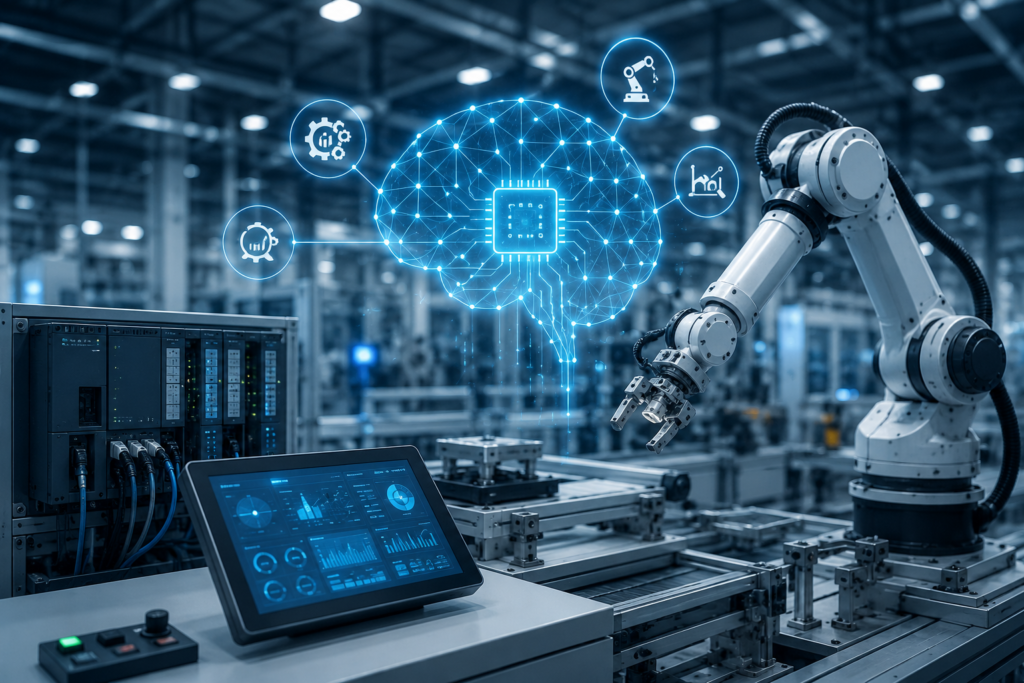
AI in Industrial Automation is changing how modern factories monitor machines, analyze production data, detect problems, and improve manufacturing processes. Unlike traditional automation, which mainly follows predefined instructions, AI can recognize patterns in industrial data and support more adaptive decisions. As a result, manufacturers are increasingly combining artificial intelligence with automation systems to make operations more intelligent, flexible, and efficient.
Industrial automation has traditionally depended on technologies such as PLCs, HMIs, SCADA systems, sensors, drives, robots, and industrial communication networks. These technologies remain essential. However, AI adds another layer of intelligence that can help engineers understand what is happening inside a production system rather than simply controlling what happens next.
This shift is becoming more visible across the manufacturing sector. The World Economic Forum's 2026 outlook describes industrial operations as moving from traditional automation toward intelligent, connected, and increasingly autonomous systems, with AI and physical AI playing an important role in that transition.
The important point is that AI does not simply replace existing automation. Instead, it can work alongside PLCs, SCADA platforms, robots, sensors, and human operators. This combination allows factories to use existing control infrastructure while adding advanced analytics, pattern recognition, forecasting, and decision support.
In this guide, we will explore how AI works with industrial automation, where it can be applied, what technologies support it, what benefits it provides, and what challenges engineers should consider before deploying it in a real industrial environment.
What Is AI in Industrial Automation?
AI in industrial automation refers to the use of artificial intelligence technologies to analyze industrial information, identify patterns, predict events, optimize processes, and support operational decisions.
A conventional automation system usually behaves according to programmed logic. For example, a PLC may start a motor when a sensor reaches a certain condition and stop that motor when another condition occurs. This approach is highly reliable for well-defined processes.
AI introduces a different capability. Instead of relying only on fixed logic, an AI system can analyze historical and real-time data to find relationships that may not be obvious from simple control rules.
For example, consider a production motor that normally operates within a specific temperature and vibration range. A traditional control system can trigger an alarm when the temperature exceeds a fixed limit. An AI-based system can go further by analyzing temperature, vibration, load, speed, and historical operating patterns together. It may detect a gradual change that indicates the motor is beginning to develop a problem before a conventional alarm limit is reached.
This difference makes AI particularly useful for complex processes where large amounts of data are generated continuously.
How AI Differs From Traditional Industrial Automation
Traditional automation and AI-based automation should not be treated as competing technologies. They solve different parts of the industrial problem.
Traditional automation is excellent at deterministic control. A PLC can execute the same sequence repeatedly with predictable timing. Safety systems can respond to defined conditions. HMIs can display process information. SCADA systems can supervise equipment and record operational data.
AI is more focused on understanding patterns within that information.
For instance, a PLC may know that a conveyor motor is running. An AI system can analyze historical operating data and determine whether the current motor behavior resembles previous conditions that resulted in overheating, excessive vibration, or failure.
Therefore, a practical industrial architecture often uses both technologies. The automation layer handles real-time control, while the AI layer can provide analysis, prediction, optimization, or decision support.
This separation is especially important in critical applications. An AI prediction should not automatically override a safety function simply because a model produces a particular result. Engineers need clearly defined boundaries between intelligent recommendations and deterministic control.
Why AI Is Becoming Important in Modern Factories
Factories generate enormous amounts of operational information through sensors, PLCs, drives, robots, vision systems, quality equipment, historians, and manufacturing software. Historically, much of this information was used mainly for monitoring, reporting, and troubleshooting.
AI makes it possible to extract additional value from that data.
A well-designed AI system can examine production patterns continuously and help answer questions such as why a process is becoming unstable, when equipment may require attention, which operating conditions produce better quality, or where energy consumption is increasing.
The industry is also moving from isolated AI experiments toward production-focused implementations. The World Economic Forum reported in 2026 that AI adoption in industrial environments is moving beyond pilots and becoming embedded in production systems, with human oversight remaining important.
At the same time, manufacturers are exploring more advanced forms of industrial AI. These include systems that can coordinate workflows, interpret operational information, and assist employees with complex tasks. Siemens, for example, has been developing industrial AI systems that connect industrial data, workflows, and AI agents while keeping human involvement within the operating process.
AI in Industrial Automation: Core Technologies
AI-based industrial systems do not operate independently of the factory's existing infrastructure. They usually depend on several technologies working together.
Industrial Sensors and Data Collection
Sensors provide the raw information required for analysis. Depending on the process, this information can include temperature, pressure, flow, vibration, current, speed, position, humidity, torque, and other operational measurements.
The quality of AI results depends heavily on the quality of this data. A model cannot provide reliable predictions when sensors are poorly calibrated, data is incomplete, or important operating conditions are missing.
PLCs and Industrial Controllers
PLCs remain central to most industrial control systems. They collect signals, execute control logic, communicate with field devices, and manage machine sequences.
AI can use information generated by PLC-based systems without replacing the PLC itself. For example, production values collected by a PLC can be transferred to a higher-level analytics platform where an AI model evaluates equipment behavior.
This creates a useful division of responsibility: the PLC performs deterministic control, while AI provides additional intelligence above the control layer.
SCADA and HMI Systems
SCADA platforms collect and visualize process information across industrial facilities. HMIs allow operators to interact with machines and processes.
AI can extend these systems by providing more advanced analysis. Instead of showing only current temperature or pressure values, an AI-enabled system could identify unusual trends, estimate future conditions, or help operators investigate recurring process problems.
However, AI recommendations should remain understandable to operators. A prediction without context may create confusion rather than improve decision-making.
Industrial Databases and Historians
AI applications need historical information to recognize patterns and evaluate changes over time. Industrial historians and databases can provide this information.
Historical production data can be used to study machine behavior, compare different production conditions, investigate quality issues, and develop predictive models.
The combination of historical and real-time data is particularly useful because many industrial problems develop gradually rather than appearing suddenly.
Machine Vision
Machine vision is one of the most practical areas for industrial AI. Cameras can capture images of products, components, packaging, welds, surfaces, labels, or assemblies.
AI-based vision systems can analyze these images and identify visual characteristics associated with defects or incorrect assembly. This approach can support quality inspection while maintaining consistent inspection criteria across high-volume production.
Robotics
AI can make industrial robots more adaptable. Traditional robots generally perform carefully programmed movements. AI can help robotic systems interpret changing environments, recognize objects, optimize movements, or respond to variations in production conditions.
Siemens has highlighted AI-driven flexible robotics as part of the movement toward more adaptive automation, particularly where machines need to respond to changing production requirements.
The Relationship Between AI and PLC-Based Automation
One of the most important concepts for automation engineers is understanding that AI does not make PLC programming irrelevant.
PLCs are designed for reliable and deterministic industrial control. They are responsible for tasks such as sequencing, interlocking, timing, logic execution, and communication with field devices.
AI has a different role. It can analyze information and provide predictions or recommendations based on patterns in the available data.
Imagine a pump station controlled by a Siemens PLC. The PLC can maintain pressure, start and stop pumps, monitor sensors, and activate protection logic. An AI application can analyze historical pump current, pressure, flow, vibration, and runtime data to identify patterns associated with reduced pump performance.
The PLC continues to control the equipment. AI adds intelligence around that control system.
This architecture provides a practical path for modernizing existing plants because manufacturers do not necessarily need to replace their complete automation infrastructure to begin using AI.
A Simple Example of AI-Based Industrial Automation
Consider a manufacturing line with several electric motors.
The PLC controls motor start and stop commands. Sensors continuously provide temperature, current, speed, and vibration measurements. SCADA displays the process and stores historical information.
An AI application receives selected operational data from these systems and learns the normal behavior of each motor.
Over time, the system detects that one motor is showing a combination of rising vibration, increasing current, and slightly higher operating temperature.
No individual value may have exceeded a traditional alarm threshold. However, the combined pattern may indicate that the motor is developing a mechanical or electrical issue.
The AI system can then alert maintenance personnel and provide a risk assessment for further investigation.
An engineer still needs to inspect the equipment and confirm the cause. AI supports the decision; it does not automatically replace engineering judgment.
What Makes Industrial AI Different From General AI?
Industrial environments require a different approach from consumer-facing AI applications.
A chatbot can produce an incorrect answer and still remain relatively harmless. A wrong recommendation in a factory can affect equipment, product quality, worker safety, or production continuity.
Industrial AI therefore needs reliable data, clear operating boundaries, validation, cybersecurity, monitoring, and human oversight.
The World Economic Forum's 2026 work on human-machine collaboration also emphasizes that as intelligent systems take on more tasks, human judgment, accountability, exception handling, and governance remain important.
For that reason, successful industrial AI is not simply about installing an AI model. It requires thoughtful integration with the automation architecture and the people who operate it.
How AI Is Used in Industrial Automation
AI becomes especially valuable when a factory collects more data than engineers can reasonably analyze manually. Instead of looking at individual values one by one, an AI system can examine relationships between multiple signals and identify patterns over time.
For example, a machine may produce normal temperature readings while its vibration gradually increases. At the same time, its power consumption may rise slightly and production speed may become less consistent. None of these changes may be serious on its own. However, when AI analyzes them together, the combined pattern can indicate that the machine is moving away from its normal operating condition.
Because of this ability, manufacturers can use AI for several practical purposes. These include equipment monitoring, predictive maintenance, quality inspection, production optimization, energy analysis, process improvement, and intelligent decision support.
Predictive Maintenance With AI
Predictive maintenance is one of the strongest applications of AI in industrial environments. Traditional maintenance often follows a fixed schedule or begins after a failure occurs. Predictive maintenance takes a more data-driven approach.
First, sensors collect information from equipment such as motors, pumps, compressors, gearboxes, fans, and conveyors. Then, historical data provides a reference for normal operating behavior. AI can analyze this information and identify patterns associated with wear or developing faults.
For example, suppose a conveyor motor normally operates with a stable current and vibration pattern. Over several weeks, the vibration gradually increases while the motor experiences slightly higher loads. Because these changes occur together, an AI model may recognize a possible developing problem before the motor reaches a critical condition.
As a result, maintenance teams can investigate the equipment earlier. This can reduce unexpected downtime and make maintenance planning more organized.
However, AI should not be treated as a replacement for physical inspection. A prediction indicates a possibility rather than proving the exact cause. Therefore, technicians still need to verify the condition of the equipment before taking corrective action.
AI-Based Quality Inspection
Quality control is another important area where industrial AI can provide practical value. In many factories, cameras and inspection equipment already capture large numbers of product images. However, manually reviewing every image can become difficult as production volumes increase.
AI-powered machine vision can analyze these images and identify characteristics that may indicate a defect. Depending on the application, the system can evaluate dimensions, surface conditions, assembly positions, labels, packaging, color variations, or other visual properties.
For instance, a production line may manufacture metal components with a specific surface finish. A vision system can capture each component as it moves through the inspection area. AI can then compare the captured image with patterns learned from acceptable and defective products.
Because the system evaluates products consistently, it can support faster inspection at high production volumes. Furthermore, inspection data can be stored and analyzed to identify recurring quality problems.
Still, the performance of an AI vision system depends on several factors. Lighting, camera position, product variation, image quality, and training data can all influence the result. Consequently, engineers need to test the system under realistic production conditions rather than relying only on laboratory performance.
AI for Process Optimization
Industrial processes often involve many variables that influence one another. Temperature, pressure, flow, speed, material properties, load, and production settings can all affect the final result.
Traditional control logic handles these variables according to predefined rules. However, AI can examine historical process data and identify combinations that are associated with better performance.
Imagine a heating process where engineers need to maintain a particular product quality while controlling temperature and energy consumption. An AI model can study previous production cycles and compare operating conditions with the resulting quality.
Over time, the system may identify patterns showing that slightly different operating conditions produce the desired quality with less energy. As a result, engineers can use these findings to improve the process.
This does not necessarily mean that AI should directly control every process parameter. Instead, AI can first provide recommendations that engineers validate before applying them to the control strategy.
AI for Energy Management in Industrial Automation
AI in Industrial Automation can also help factories understand and manage energy consumption more intelligently. Modern plants often operate hundreds of motors, pumps, compressors, heaters, conveyors, and production machines. As a result, even a small inefficiency in one area can contribute to significant energy use over time.
Traditionally, engineers monitor energy meters and review reports to identify unusual consumption. However, this approach can become difficult when a facility generates large amounts of data throughout the day. Because of this, AI can provide a more detailed view of how equipment behaves under different operating conditions.
For example, an AI system can compare motor power consumption with load, speed, runtime, temperature, and production output. If energy consumption rises while production remains unchanged, the system can identify the condition as something worth investigating. Similarly, if a machine consumes more energy than it normally does under the same load, AI can help highlight that deviation.
Moreover, AI in Industrial Automation can compare energy patterns across different shifts, machines, and production periods. Therefore, engineers can identify when equipment is operating efficiently and when unnecessary consumption may be occurring.
Nevertheless, AI does not automatically reduce energy usage. Instead, it helps engineers understand where improvements may be possible. After that, the engineering team can adjust operating schedules, maintenance practices, machine settings, or process conditions based on verified findings.
AI-Based Anomaly Detection
Another important application of AI in Industrial Automation is anomaly detection. In a conventional automation system, engineers often define alarm limits for temperature, pressure, current, flow, or vibration. These limits work well when operating conditions remain predictable.
However, industrial equipment does not always operate under identical conditions. A pump may run at different speeds, a motor may carry different loads, and a process may use different production recipes. Consequently, one fixed threshold may not describe every normal situation accurately.
AI can approach this problem differently. Instead of looking at only one value, an AI system can examine several variables together and learn the normal behavior of an asset or process.
For example, imagine a motor that usually operates at different current levels depending on production load. During one production cycle, the current may still be within the normal range, but vibration and temperature may both increase slightly. Individually, these values may not trigger an alarm. However, when AI analyzes them together, the combined pattern may appear unusual.
As a result, the system can alert engineers to investigate the equipment before the problem becomes more serious.
Furthermore, anomaly detection can help reduce unnecessary alarms. Rather than reacting to every small variation, the system can focus attention on patterns that are more unusual compared with historical behavior.
Even so, engineers should validate important alerts before taking corrective action. AI identifies patterns, but physical inspection and engineering judgment are still essential.
AI in Industrial Automation for Quality Control
Quality control is another area where AI in Industrial Automation can provide significant value. Factories produce large numbers of components every day, and inspecting every item manually can become time-consuming.
For this reason, many industrial facilities use machine vision systems to capture images of products during production. AI can then analyze those images and identify patterns associated with acceptable or defective products.
For example, an AI vision system may inspect a metal component for scratches, incorrect dimensions, missing holes, surface defects, or incorrect positioning. Similarly, it can evaluate labels, packaging, assembly positions, or other visual characteristics.
Because AI can examine many images consistently, it can support high-volume inspection processes. In addition, the system can store inspection results so engineers can later review defect patterns.
However, accurate AI vision depends on more than the software model. Lighting conditions, camera angle, image quality, product variation, and background interference can all affect the result. Therefore, engineers must test the system under realistic production conditions.
Moreover, the quality of training data matters greatly. If the model sees only ideal products during training, it may struggle when real-world defects appear. Consequently, industrial teams should include representative examples of both acceptable and defective products.
AI and Industrial Data Preparation
Successful AI in Industrial Automation depends heavily on data quality. Even a sophisticated AI model cannot produce reliable results from poor or inconsistent information.
Industrial systems often contain missing values, communication gaps, duplicate records, incorrect timestamps, sensor errors, and inconsistent naming conventions. Furthermore, data may come from several machines or software platforms that were installed at different times.
For example, one system may identify a motor using one tag name while another database uses a different name for the same equipment. Similarly, one source may record time in a different format from another source.
Because of these differences, engineers need to prepare the data before building an AI application.
This process may involve cleaning invalid records, synchronizing timestamps, checking sensor quality, standardizing units, and selecting useful variables.
Moreover, engineers should understand the physical meaning of the data. A numerical value is not automatically useful simply because it is available.
Therefore, the first question should not be “How much data do we have?” Instead, it should be “Which data helps solve the industrial problem?”
AI Model Training for Industrial Applications
After preparing the data, the next stage involves model development and training. At this point, the AI system learns patterns from historical examples.
For example, if the goal is predictive maintenance, engineers may provide data from normal equipment operation as well as records associated with known maintenance events.
However, training data must represent realistic industrial conditions. If the model learns from only one operating mode, it may perform poorly when the machine runs at another speed or load.
Similarly, seasonal changes, production recipes, raw material differences, and equipment modifications can affect machine behavior.
Therefore, industrial AI models should be trained using data that reflects a broad range of real operating conditions.
Furthermore, teams should test models against data that was not used for training. This helps determine whether the model can generalize to new situations rather than simply memorizing previous examples.
AI Model Validation and Human Oversight
Validation is an essential stage of AI in Industrial Automation. A model can appear accurate during development and still produce unexpected results after deployment.
Industrial environments change continuously. Machines are repaired, sensors are replaced, production recipes change, and operating conditions vary. As a result, model performance can also change over time.
Because of this, AI systems should be monitored after deployment.
Engineers can review false alarms, missed events, prediction accuracy, and changes in operating conditions. If the model begins producing weaker results, the team can investigate whether the data or equipment conditions have changed.
Moreover, human oversight should remain part of the system. AI can analyze information quickly, but engineers understand the physical process and its practical limitations.
Therefore, the best AI in Industrial Automation applications generally support human decisions rather than remove humans from important engineering responsibilities.
AI and Industrial Cybersecurity
Cybersecurity becomes increasingly important when AI systems connect with industrial infrastructure.
An AI application may require data from PLCs, SCADA servers, historians, sensors, databases, or other systems. However, not every application should have unrestricted access to industrial equipment.
For this reason, organizations should carefully define communication paths, permissions, authentication, and system boundaries.
Similarly, industrial networks should be protected from unnecessary external connections. Credentials should be managed securely, software should be maintained, and communication should be monitored.
Because AI in Industrial Automation often introduces additional connectivity, cybersecurity must be considered during the design stage rather than after deployment.
Practical Architecture of AI in Industrial Automation
A practical AI in Industrial Automation architecture can use several connected layers.
At the field level, sensors and machines generate operational data. Next, PLCs and controllers collect signals and perform deterministic control. Above this layer, SCADA and historians provide supervision, visualization, event recording, and historical storage.
The AI layer then receives selected data for analysis, prediction, classification, or optimization.
Finally, operators and engineers review the AI results and decide whether an operational response is appropriate.
This architecture is useful because each layer keeps a clear responsibility. PLCs continue handling deterministic control, while AI provides additional analysis and intelligence.
As a result, manufacturers can introduce AI without necessarily replacing their existing automation infrastructure.
A Simple Step-by-Step AI Implementation Approach
Organizations should begin AI in Industrial Automation with a clearly defined problem rather than choosing technology first.
For example, a factory may select one critical motor that frequently requires maintenance. Engineers can then identify the available sensor data and determine whether enough historical information exists to support an AI application.
Next, the team can prepare the data, establish a baseline, and develop a suitable model. After that, the model can be tested under realistic operating conditions.
If the results demonstrate meaningful value, the company can deploy the solution gradually and continue monitoring performance.
Furthermore, the same methodology can later be applied to additional machines or production lines.
This gradual approach reduces unnecessary complexity and gives engineering teams an opportunity to learn from the first implementation.
Common Mistakes in AI in Industrial Automation
One common mistake is starting with an AI platform instead of a business or engineering problem. As a result, teams may build advanced dashboards without solving an important operational issue.
Another mistake is assuming that more data automatically leads to better AI. In reality, irrelevant or poor-quality information can reduce model performance.
Similarly, ignoring operators can create adoption problems. If an AI alert is difficult to understand, operators may simply ignore it.
Furthermore, organizations sometimes focus heavily on model accuracy while overlooking cybersecurity, maintenance, system integration, and long-term monitoring.
Because of these risks, successful AI in Industrial Automation requires cooperation between automation engineers, data specialists, maintenance teams, operators, and management.
Benefits of AI in Industrial Automation
When implemented correctly, AI in Industrial Automation can provide several practical benefits.
AI can help engineers detect unusual equipment behavior earlier. In addition, it can support predictive maintenance by identifying patterns linked with developing problems.
Similarly, AI-powered inspection can improve consistency in quality control. Process analytics can also help engineers understand production variation and identify optimization opportunities.
Moreover, AI can assist energy analysis by revealing unusual consumption patterns. At the same time, intelligent robotics and machine vision can make selected applications more flexible.
However, these benefits depend on proper implementation. AI does not create value simply because a model exists. The system must address a meaningful problem, use reliable data, and fit the operational environment.
Limitations of AI in Industrial Automation
Despite its advantages, AI in Industrial Automation also has limitations.
First, AI depends heavily on data quality. If the input information is inaccurate or incomplete, the resulting analysis may be unreliable.
Second, AI models can produce false positives or false negatives. Therefore, engineers should never assume that every prediction is correct.
Third, implementation can require integration between legacy equipment, databases, industrial networks, and modern software systems. Consequently, technical complexity may increase.
In addition, industrial AI requires ongoing monitoring. A model that performs well today may require adjustment after equipment or process conditions change.
Finally, AI should not replace safety systems or critical deterministic control functions. Instead, it should operate within clearly defined engineering boundaries.
Where AI Fits Best in Industrial Automation
AI in Industrial Automation is most valuable when the industrial problem involves patterns, large datasets, prediction, classification, optimization, or complex relationships.
For example, predictive maintenance is well suited to AI because equipment generates continuous operating data. Likewise, machine vision is suitable because AI can analyze large numbers of images.
Process optimization is another strong application because many variables can influence production results simultaneously.
On the other hand, a simple ON/OFF control task may not need AI at all. A traditional PLC solution may be faster, simpler, easier to maintain, and more predictable.
Therefore, the right technology should always depend on the actual engineering requirement.
The Future of AI in Industrial Automation
The future of AI in Industrial Automation is likely to involve deeper cooperation between intelligent software and physical production systems.
As industrial AI becomes more capable, manufacturers may use it for advanced predictive analysis, adaptive process optimization, machine vision, robotics, maintenance planning, engineering assistance, and production decision support.
Furthermore, AI may become increasingly integrated with industrial software platforms and engineering workflows.
However, future progress will still depend on basic engineering principles. Reliable sensors, strong control systems, cybersecurity, data quality, safety practices, and human expertise will remain essential.
In other words, AI is not replacing the foundations of industrial automation. Instead, it is building an intelligence layer on top of those foundations.
Frequently Asked Questions About AI in Industrial Automation
What is AI in Industrial Automation?
AI in Industrial Automation means using artificial intelligence to analyze industrial data, identify patterns, detect anomalies, support prediction, optimize processes, and assist engineering decisions.
Can AI replace PLCs?
No. PLCs perform deterministic real-time control, while AI focuses mainly on analysis, prediction, classification, or optimization. Therefore, the two technologies can work together rather than directly replace one another.
How does AI help predictive maintenance?
AI analyzes equipment data such as vibration, temperature, current, pressure, and operating history. Because it can recognize patterns across multiple variables, it may identify developing equipment problems earlier than simple threshold-based monitoring.
Is AI useful with SCADA?
Yes. AI can analyze SCADA data and help identify unusual trends, relationships between process values, and possible operational problems. However, AI should complement SCADA rather than make the operator interface unnecessarily complicated.
Does industrial AI require new PLC hardware?
Not necessarily. In many cases, existing PLCs can continue controlling the equipment while selected data is transferred to an AI application for analysis. However, the exact requirements depend on the existing automation architecture.
What industries can use AI in Industrial Automation?
AI can support many sectors, including manufacturing, food processing, automotive production, pharmaceuticals, water treatment, energy, packaging, chemical processing, and other industries where industrial data is available.
Is AI safe for industrial systems?
AI can be used safely when it is designed with appropriate boundaries, validation, cybersecurity, and human oversight. However, critical safety functions should remain under properly engineered safety systems rather than depending solely on AI predictions.
Conclusion
AI in Industrial Automation represents an important development in modern manufacturing because it allows industrial systems to make better use of the enormous amount of data they already generate.
From predictive maintenance and machine vision to process optimization, anomaly detection, energy analysis, and intelligent robotics, AI can support many different industrial applications. More importantly, it can help engineers move beyond simple monitoring and gain deeper insight into how machines and processes behave over time.
However, successful implementation requires more than installing an AI model. Reliable data, appropriate system architecture, cybersecurity, validation, operator involvement, and engineering judgment all play important roles.
For this reason, companies should begin with a clearly defined problem and introduce AI gradually. After proving value in one application, they can expand the approach to additional machines, processes, or production lines.
Ultimately, the strongest approach is not to replace traditional automation with AI. Instead, manufacturers can combine the reliability of PLCs and industrial control systems with the analytical capabilities of artificial intelligence. In this way, AI in Industrial Automation can become a practical tool for creating smarter, more efficient, and more responsive industrial operations.