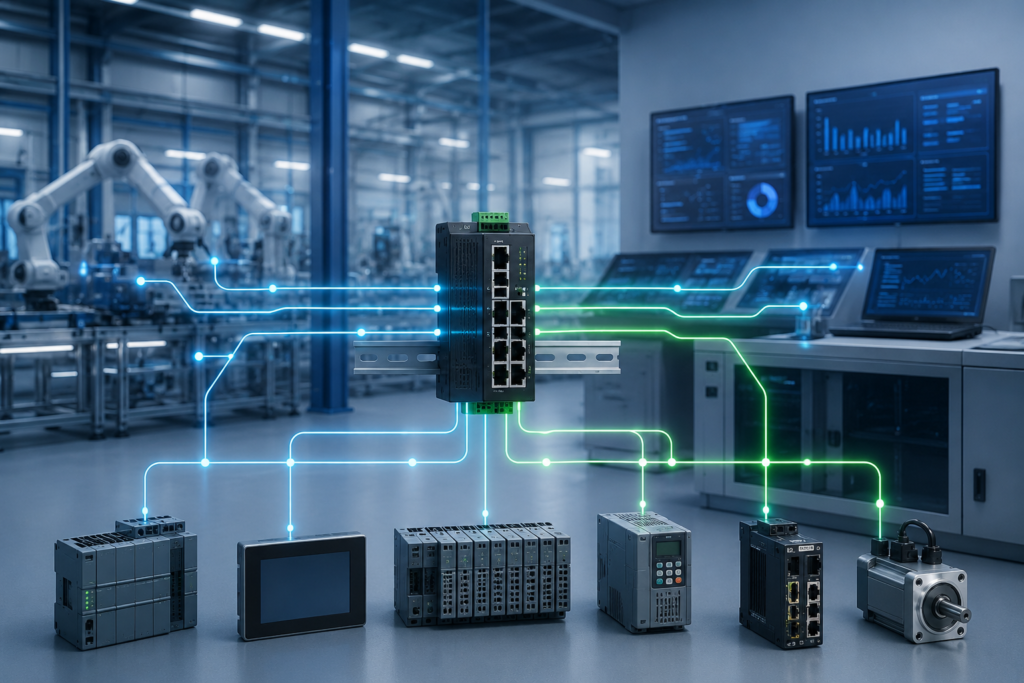
Time-Sensitive Networking (TSN) in Industrial Automation is becoming an important approach for modern factories that need predictable and reliable communication. As machines become more connected, industrial networks must move data at the right time. A normal Ethernet network can carry large amounts of information. However, industrial control systems often need more than simple data delivery. They may also need precise timing, low communication delays, and predictable network behavior.
Today, factories connect PLCs, controllers, drives, robots, sensors, HMIs, and other automation equipment through industrial networks. As a result, communication traffic can become more complex. Some messages may contain routine monitoring data, while other messages may control a machine or coordinate a fast process. Therefore, the network must handle these different types of traffic without allowing important control data to suffer unnecessary delays.
This is where TSN in Industrial Automation becomes useful. TSN adds a set of networking technologies that help Ethernet networks manage time-critical traffic more predictably. Instead of treating every packet in exactly the same way, TSN can coordinate network traffic according to timing and priority requirements. Because of this approach, industrial systems can use Ethernet while gaining stronger control over when important data travels across the network.
Moreover, TSN fits well with the direction of modern industrial automation. Factories are moving toward connected machines, integrated control systems, higher data visibility, and more flexible production. Consequently, industrial communication needs to support both traditional control tasks and newer digital applications. TSN can help bridge these requirements by bringing deterministic communication concepts into Ethernet-based networks.
What Is TSN in Industrial Automation?
TSN in Industrial Automation refers to the use of Time-Sensitive Networking technologies to provide predictable and time-aware communication across industrial Ethernet networks. In simple terms, TSN helps a network deliver important data within controlled timing conditions. This can be especially useful when machines need to coordinate actions with very little variation in communication timing.
Traditional Ethernet was designed as a general-purpose networking technology. It works extremely well for many applications, including computers, servers, cameras, and business systems. Nevertheless, industrial control can introduce stricter communication requirements. A machine may need a control message at a specific moment. A robotic system may also need synchronized information from several devices. Therefore, communication timing can become just as important as communication speed.
TSN addresses this challenge by introducing mechanisms that organize network traffic more carefully. For example, the network can synchronize device clocks so that connected equipment shares a common understanding of time. It can also schedule certain traffic and give time-critical data controlled access to network resources. As a result, communication becomes more predictable.
Importantly, TSN does not represent a completely separate replacement for Ethernet. Instead, it extends Ethernet with features designed for applications where timing matters. This makes TSN attractive for industrial environments because existing Ethernet concepts can remain part of the overall network architecture. At the same time, engineers can introduce time-sensitive communication where the application actually needs it.
Why Timing Matters in Industrial Automation
In industrial automation, sending data quickly is not always enough. The system also needs to know whether the data arrived at the expected time. For instance, a controller might receive sensor information after a delay. Even when the information is accurate, that delay could affect the machine response. Therefore, predictable timing can be critical for certain control processes.
This issue becomes more noticeable when several devices must work together. Consider a production machine with multiple drives, controllers, and sensors. If each device receives important data at slightly different times, the system may experience timing variation. In addition, repeated variation can make coordinated operations more difficult. TSN can reduce this uncertainty by providing mechanisms for synchronized and scheduled communication.
Furthermore, modern machines often carry different types of traffic over the same physical network. Control messages may share network resources with diagnostics, monitoring information, engineering traffic, and other data. Without suitable traffic management, less important communication can interfere with time-sensitive messages. TSN helps address this problem by providing methods for controlling how different traffic flows use the network.
How TSN Improves Industrial Ethernet
TSN in Industrial Automation improves Ethernet communication through several coordinated capabilities. One major capability is time synchronization. Devices on the network can align their clocks with a common time reference. Consequently, controllers and other equipment can perform actions according to a shared timing model.
Another important capability involves traffic scheduling. Instead of allowing critical traffic to compete freely with every other packet, the network can organize transmission opportunities for selected data flows. This approach can make communication behavior more predictable. Therefore, engineers can design networks with clearer timing expectations.
TSN also supports traffic prioritization and resource management. When different applications use the same network, critical messages need suitable treatment. For example, a high-priority control stream may require stricter timing than a routine diagnostic stream. By managing traffic according to application requirements, TSN can help protect time-sensitive communication.
However, TSN is not simply about making Ethernet faster. The main goal is predictability. A network that always performs within known timing limits can be more useful for industrial control than a network that occasionally provides extremely fast communication but produces unpredictable delays. Therefore, TSN focuses on controlled communication behavior rather than speed alone.
TSN and Modern Industrial Networks
Industrial networks are changing as factories combine automation, data collection, analytics, and connected devices. Traditionally, different systems often used separate communication technologies for different tasks. For example, one network could support machine control while another handled monitoring or business communication. Today, however, organizations increasingly look for greater integration.
Because of this shift, TSN in Industrial Automation can play an important role in converged network designs. A single Ethernet-based infrastructure can potentially carry multiple types of traffic when the network is properly engineered. Time-critical control data can receive predictable treatment, while less critical information can use the remaining network resources.
At the same time, this convergence can simplify network planning. Fewer separate infrastructures may reduce physical complexity and make data exchange easier. Nevertheless, engineers still need to evaluate application requirements carefully. Not every industrial application requires TSN, and adding advanced networking features should always solve a real communication challenge.
The Main Idea Behind TSN
The easiest way to understand TSN is to think about controlled timing over Ethernet. Ordinary networking mainly focuses on moving packets from one endpoint to another. TSN adds a stronger focus on when those packets should arrive and how the network should behave while transporting them.
For industrial automation, this distinction can be valuable. A controller does not only need correct information. It may also need that information within a predictable time window. Therefore, TSN creates a networking environment where time-sensitive communication can receive more controlled handling.
As industrial systems continue to become more connected, this concept is becoming increasingly relevant. Machines must coordinate with one another, controllers must exchange data reliably, and industrial applications must share network infrastructure. Consequently, understanding TSN in Industrial Automation gives engineers and beginners a useful foundation for understanding the next generation of industrial Ethernet.
What Makes TSN Different?
The biggest difference is that TSN introduces a structured way to handle communication timing. Conventional Ethernet can provide high performance, but its behavior may vary depending on traffic conditions. TSN, on the other hand, uses synchronization, scheduling, and traffic management techniques to create more predictable communication.
This difference becomes important when the network supports demanding control applications. A simple monitoring system may tolerate occasional timing variation. In contrast, coordinated motion or tightly synchronized machine operations may require more consistent communication. Therefore, TSN is most valuable when timing predictability directly affects system performance.
In addition, TSN can support the idea of a shared industrial network. Rather than designing completely separate networks for every type of application, engineers can use suitable TSN mechanisms to manage different traffic classes. As a result, control and other data services can coexist more effectively when the architecture is designed correctly.
How Does TSN Work?
To understand TSN in Industrial Automation, it helps to look beyond the basic idea of predictable Ethernet communication. TSN works through several networking mechanisms that operate together. Each mechanism handles a different part of the timing problem. As a result, the network can coordinate devices, organize traffic, and reduce unexpected delays.
A TSN network begins with accurate time synchronization. After that, the network can use this shared time to coordinate communication between devices. Traffic can then follow planned transmission windows, while critical data receives the treatment required by the application. Therefore, TSN is best understood as a collection of coordinated features rather than a single networking function.
For example, imagine a production line where several servo drives must respond together. If every device uses a different clock, even a small timing difference can affect coordination. However, when the devices share a common time reference, the control system can schedule actions more precisely. This creates a stronger foundation for synchronized automation.
Time Synchronization in TSN
Time synchronization is one of the most important ideas behind TSN in Industrial Automation. A TSN network can synchronize the clocks of connected devices so that controllers, switches, drives, and other endpoints share a common understanding of time.
This shared clock allows the network to coordinate events with much greater consistency. Instead of each device making timing decisions independently, devices can follow a common schedule. Consequently, the network can determine when certain communication should occur and when specific devices should process time-sensitive information.
A common approach for industrial environments is based on the IEEE 802.1AS timing framework, which provides mechanisms for synchronizing clocks across a TSN network. The exact implementation can vary between products and architectures. Nevertheless, the central idea remains the same: network devices need a reliable common time base for coordinated communication.
This synchronization can become especially useful in applications where multiple devices must act together. Robotics, synchronized motion, packaging systems, and other coordinated processes can benefit from predictable timing. Therefore, precise clock alignment becomes a key building block for advanced industrial Ethernet.
Traffic Scheduling
Once devices understand the same time reference, the network can organize traffic more effectively. Traffic scheduling allows selected data flows to use planned transmission opportunities instead of competing randomly for network access.
Consider a network that carries control commands, machine diagnostics, engineering data, and monitoring traffic. All of these messages are useful, but they do not have identical timing requirements. A critical control message may need predictable delivery, while a diagnostic report can tolerate a little more delay. Therefore, the network should not handle both streams in exactly the same way.
TSN scheduling helps create this distinction. The network can reserve or organize transmission opportunities for selected traffic flows. As a result, time-sensitive data can travel through the network with less interference from other communication.
This approach becomes even more useful when several machines share the same physical infrastructure. Instead of allowing traffic to compete without a clear timing plan, the network can coordinate important transmissions. Consequently, the behavior of the system becomes easier to predict.
Traffic Prioritization
Scheduling is important, but industrial networks also need traffic prioritization. Not every message has the same level of urgency. TSN technologies can identify different traffic classes and provide suitable handling for each one.
For instance, a motion-control stream may require tighter timing than a machine status message. Similarly, an alarm or safety-related communication path may have different requirements from routine monitoring data. Therefore, network engineers need a way to distinguish between these traffic types.
Priority mechanisms help the network make better decisions when multiple messages compete for resources. However, priority alone does not create deterministic communication. A high-priority packet can still experience delays if the network has no suitable timing and scheduling strategy. This is why TSN in Industrial Automation combines multiple mechanisms instead of depending on a single feature.
By using prioritization together with synchronization and scheduling, the network can create a more controlled environment. Consequently, critical traffic receives the attention it needs without requiring every packet on the network to follow the same rules.
Reducing Communication Jitter
Another important concept in TSN is jitter. Jitter refers to variation in packet timing. A message may reach its destination quickly during one cycle and slightly later during another cycle. While the difference may seem small, repeated timing variation can affect tightly coordinated industrial processes.
Imagine two machine axes that should move together. If communication timing changes from one cycle to another, the controllers may receive information at slightly different moments. Over time, this variation can reduce coordination accuracy. Therefore, reducing jitter can be important for applications that depend on consistent timing.
TSN mechanisms are designed to make communication behavior more predictable. They do not simply attempt to reduce average latency. Instead, they work toward controlling the variation in transmission timing. As a result, engineers can design systems around clearer timing expectations.
This distinction is important because average performance does not always describe industrial network quality. A network may have excellent average latency while still producing occasional delays. For demanding automation tasks, those occasional delays can matter. Therefore, predictable worst-case behavior can be more valuable than a low average number alone.
Frame Preemption
Another useful concept within TSN is frame preemption. In a conventional Ethernet environment, a large frame may already be passing through a network device when a more urgent frame arrives. The urgent frame may have to wait until the current transmission finishes.
Frame preemption can reduce this waiting time. A lower-priority frame can be interrupted so that a higher-priority frame can be transmitted sooner. Afterward, the interrupted frame can continue. This creates more flexibility when urgent traffic needs controlled access to the network.
In industrial automation, this can help protect critical communication from unnecessary blocking. However, frame preemption is only one part of the larger TSN architecture. Its benefits depend on how the network is configured and how the connected devices support the relevant standards.
Therefore, engineers should view frame preemption as a supporting mechanism rather than the complete solution. Time synchronization, traffic scheduling, queue management, and other TSN features must work together to achieve the desired communication behavior.
Scheduled Traffic in Industrial Networks
One of the most interesting aspects of TSN in Industrial Automation is scheduled traffic. Instead of allowing all data to travel whenever the network becomes available, selected traffic can follow a predefined schedule.
For example, a production controller may need to send commands at regular intervals. Several devices may also need to exchange information during specific communication cycles. With a suitable TSN configuration, the network can coordinate these transmissions around shared timing information.
This approach can make communication more predictable because engineers know when certain traffic should be transmitted. In addition, planned communication can reduce competition between important data streams. As a result, the network becomes easier to analyze and optimize.
However, scheduled traffic requires careful planning. Engineers need to understand the timing requirements of the application, the capabilities of network switches, and the expected communication paths. Therefore, TSN should be implemented as part of a complete network design rather than added without a clear timing strategy.
How TSN Switches Help
Industrial Ethernet switches are an important part of TSN in Industrial Automation because they help manage how data moves across the network. A TSN-enabled switch does more than simply forward Ethernet frames between connected devices. Depending on the supported TSN features, it can help synchronize network timing, organize time-sensitive traffic, manage data queues, and control when specific messages are transmitted. As a result, the switch can contribute to more predictable communication across the industrial network.
The switch must understand how different traffic types should be handled. It may also need to follow a shared timing schedule so that communication happens at the planned moment. Consequently, TSN switches become an active part of the timing architecture.
This is different from simply connecting devices with ordinary unmanaged switches. A TSN-based network typically requires compatible components across the communication path. Therefore, engineers must check whether PLCs, controllers, switches, drives, and other devices support the required TSN features.
Compatibility also matters because not every TSN product supports every feature in the same way. As a result, network planning should begin with application requirements and then move toward product selection.
Example of TSN in a Factory
To make the concept easier to understand, consider an automated packaging line. The system includes a PLC, servo drives, sensors, an HMI, and several industrial switches. The servo system requires highly consistent communication, while the HMI mainly displays machine information.
In this environment, the network carries both time-sensitive motion data and ordinary monitoring traffic. Without careful traffic management, the different data streams could compete for network resources. However, TSN in Industrial Automation can organize these flows according to their timing requirements.
The network can synchronize device clocks first. Next, critical traffic can follow scheduled transmission windows, while less time-sensitive communication uses other available network capacity. As a result, the motion system receives more predictable communication while the HMI and monitoring functions continue to operate over the same infrastructure.
This example also shows why TSN should not be viewed only as a technology for faster networking. The real advantage comes from controlling communication behavior. When the timing requirements of the machine are known, the network can be designed around those requirements.
TSN Standards and the IEEE 802.1 Family
TSN is not based on one isolated standard. Instead, it includes a family of IEEE 802.1 standards that address different aspects of time-sensitive communication.
For example, IEEE 802.1AS addresses time synchronization. IEEE 802.1Qbv is associated with scheduled traffic through time-aware shaping. IEEE 802.1Qbu and IEEE 802.3br are related to frame preemption. Other standards address traffic streams, reliability, resource management, and additional network behavior.
The important point for beginners is that these standards solve different problems. One standard can provide timing synchronization, while another can control scheduled transmission. Together, they create the broader TSN framework.
Therefore, learning TSN in Industrial Automation does not require memorizing every standard immediately. It is more useful to understand the role each major mechanism plays and then study the specific standards required by the target application.
Why TSN Is Becoming Important
Industrial systems continue to demand better coordination, stronger connectivity, and more flexible networking. At the same time, factories increasingly want shared infrastructure that can support both control and data applications. Consequently, predictable Ethernet communication is becoming more valuable.
TSN can support this direction by allowing Ethernet networks to handle time-sensitive traffic with greater control. It can also help different industrial applications share common infrastructure when the network is properly engineered.
Moreover, TSN supports the broader movement toward integrated industrial systems. As machines, controllers, and digital applications become more connected, communication networks need to carry different kinds of traffic without sacrificing critical timing requirements. Therefore, TSN in Industrial Automation has become an important concept for engineers exploring modern industrial Ethernet.
Benefits of TSN in Industrial Automation
One of the main benefits of TSN in Industrial Automation is predictable communication. Traditional Ethernet can deliver data effectively, but network traffic can change from one moment to another. TSN introduces mechanisms that make important communication more controlled. Therefore, automation engineers can build systems around clearer timing expectations.
Another important benefit is better coordination between devices. Modern machines often depend on several controllers, drives, sensors, and other components working together. When these devices share a common timing reference, they can coordinate their operations more consistently. As a result, synchronized processes can become easier to manage.
TSN can also support the use of a shared network infrastructure. In older industrial environments, different applications may rely on separate networks because their communication requirements are not the same. However, a properly designed TSN network can carry different traffic types while giving time-sensitive data suitable treatment. Consequently, organizations may reduce unnecessary network separation.
In addition, TSN can improve network visibility and architecture flexibility. When control, monitoring, and other industrial data travel through a more integrated Ethernet environment, engineers can manage communication through a common infrastructure. This can simplify future expansion, although proper planning remains essential.
Where TSN Is Used
TSN in Industrial Automation is particularly useful in applications where communication timing directly affects system behavior. Motion control is a strong example because multiple servo systems may need to exchange data in a coordinated cycle. Even small timing variations can influence synchronization between axes. Therefore, predictable communication can provide an important advantage.
Robotics is another area where TSN can be useful. A robot may communicate with controllers, drives, sensors, and other machines while performing coordinated tasks. When these devices share a common communication framework, the system can maintain more consistent timing. As a result, complex robotic processes can become easier to synchronize.
TSN can also support high-speed production lines. Packaging, printing, assembly, and material-handling systems often depend on repeated machine cycles. In such environments, predictable communication can help controllers exchange information according to known timing requirements.
Furthermore, TSN can be relevant to machine vision systems when vision data needs to interact with control processes. Cameras may generate large amounts of information, while controllers still need to receive important control messages on time. With suitable traffic management, the network can handle these different communication requirements more effectively.
TSN for Motion Control
Motion control deserves special attention because it places strict demands on communication timing. A multi-axis machine may contain several servo drives that must respond together. If one device receives information later than another, the machine can experience timing differences.
With TSN in Industrial Automation, a shared time base can help coordinate communication between controllers and motion devices. Scheduled traffic can also provide controlled transmission opportunities. Therefore, the network can support more consistent communication cycles.
However, TSN does not automatically guarantee perfect machine performance. The motion controller, servo drives, network topology, and application software must all work together. Consequently, the complete system still requires careful engineering and testing.
TSN and Industrial Robotics
Industrial robots often operate with precise movement patterns and repeated cycles. Their control systems may communicate with servo drives, encoders, safety equipment, and other automation components. As the number of connected devices increases, communication planning becomes more important.
TSN can help organize this communication by providing synchronization and traffic-management mechanisms. For example, time-sensitive control data can receive predictable treatment while less urgent diagnostic traffic uses other available network capacity.
This approach can become especially useful when robots operate alongside other automated machines. Instead of creating completely separate infrastructures for every system, engineers can evaluate whether a converged TSN-based network can satisfy the timing requirements of the entire production environment.
TSN vs Traditional Industrial Ethernet
Traditional industrial Ethernet remains highly useful and continues to serve many automation applications. Therefore, TSN should not be viewed as a technology that makes every existing network obsolete.
The main difference is the level of control over timing. Conventional Ethernet can provide excellent performance, yet the exact transmission timing may vary under changing network conditions. TSN adds mechanisms designed to reduce this uncertainty.
For simple monitoring, basic machine communication, or applications with flexible timing requirements, traditional Ethernet may be completely sufficient. However, applications that require synchronized and predictable communication can gain more value from TSN.
Therefore, the right choice depends on the application rather than the technology trend alone. Engineers should first identify timing requirements, communication loads, and system constraints. After that, they can decide whether TSN provides a meaningful advantage.
Hardware Required for a TSN Network
A TSN network requires compatible devices across the communication path. Depending on the application, these devices can include PLCs, industrial Ethernet switches, motion controllers, servo drives, sensors, HMIs, and engineering systems.
TSN-enabled switches are particularly important because they can provide functions related to scheduling, synchronization, traffic management, and other supported capabilities. However, not every switch supports the same TSN features. Therefore, engineers need to review the capabilities of each device before building the network.
Controllers and field devices also need suitable TSN support. A network may contain a mixture of devices, but the required timing behavior depends on where time-sensitive communication travels. Consequently, compatibility should be checked at the architecture stage rather than after installation.
Network cabling also remains important. TSN does not eliminate the need for proper Ethernet design. Cable quality, connection reliability, electromagnetic conditions, network topology, and installation practices can all influence communication performance.
Steps to Implement TSN
Implementing TSN in Industrial Automation should begin with application requirements rather than hardware selection. First, engineers should identify which communication streams are genuinely time-sensitive. This prevents unnecessary complexity and keeps the network focused on real operational needs.
Next, the team should determine the timing requirements of each critical data flow. Some applications may require strict synchronization, while others may tolerate more variation. By identifying these differences early, engineers can select suitable TSN mechanisms.
After that, the network architecture can be planned. Engineers should consider switches, controllers, field devices, physical connections, topology, traffic flows, and clock synchronization. In addition, they should verify that the selected devices support the required TSN features.
The next stage involves configuration and testing. Traffic schedules, priorities, synchronization parameters, and other settings must match the application. Engineers should then test the network under realistic operating conditions rather than relying only on basic connectivity checks.
Finally, the system should be monitored after deployment. Production traffic can change over time as machines are added or applications are modified. Therefore, regular review helps ensure that the TSN architecture continues to meet its timing requirements.
Common Challenges of TSN
Although TSN provides significant benefits, implementation can introduce new engineering challenges. One challenge is device compatibility. Different manufacturers may support different combinations of TSN features. Therefore, engineers must examine product documentation carefully before selecting components.
Another challenge is network complexity. A basic Ethernet network can be relatively simple to configure. TSN may require additional planning for synchronization, scheduling, traffic classes, and network resources. As a result, engineering teams may need stronger networking knowledge.
Testing can also require more attention. A network can appear healthy during normal operation while still failing to meet strict timing requirements under heavy traffic. Therefore, validation should include realistic loads and application-level testing.
Furthermore, TSN may not be necessary for every industrial project. Adding advanced networking technology without a clear requirement can increase cost and complexity. Consequently, the best approach is to use TSN where predictable timing provides a practical benefit.
TSN Security Considerations
Networking performance should never be considered separately from cybersecurity. As industrial Ethernet becomes more connected, the communication infrastructure becomes an important part of the overall control environment.
TSN in Industrial Automation does not automatically make a network secure. Authentication, access control, segmentation, device management, monitoring, and secure configuration still require separate attention. Therefore, TSN should be deployed as part of a broader industrial cybersecurity strategy.
Engineers should also control who can modify network schedules and configuration settings. Unauthorized changes could affect communication behavior and potentially disrupt production. For this reason, configuration management and restricted administrative access remain important.
The Role of TSN in Industry 4.0
Industry 4.0 depends heavily on connected machines, integrated systems, real-time information, and flexible production. As factories bring more devices and applications onto common networks, communication requirements become increasingly diverse.
This is where TSN in Industrial Automation can become valuable. TSN can provide a framework for carrying time-sensitive control traffic alongside other Ethernet-based communication. Therefore, it can support more integrated industrial architectures.
Moreover, TSN fits the broader movement toward converged networks. Control systems, monitoring applications, engineering tools, and data services can potentially share infrastructure when the network is designed with clear requirements. As a result, organizations can move toward more connected and flexible production environments.
Future of TSN in Industrial Automation
The future of TSN is closely connected to the continuing evolution of industrial Ethernet. As factories become more connected, the demand for predictable communication is likely to remain important. Consequently, TSN can continue to attract attention in motion systems, robotics, machine control, and other time-sensitive applications.
At the same time, industrial networks are becoming more intelligent. Controllers and network devices are increasingly expected to support detailed traffic management and advanced diagnostics. Therefore, TSN may become part of broader automation architectures rather than remaining limited to specialized applications.
The growth of connected manufacturing also creates opportunities for shared network infrastructure. As more systems depend on Ethernet, engineers may look for ways to combine deterministic control with other data services. TSN provides one possible path toward that goal.
However, adoption will depend on practical factors such as device support, engineering expertise, project cost, application requirements, and interoperability. Therefore, TSN should be evaluated carefully rather than adopted simply because it is a modern technology.
Frequently Asked Questions About TSN
What is TSN in Industrial Automation?
TSN in Industrial Automation is a group of Ethernet-based networking technologies designed to provide more predictable communication timing. It can help industrial devices exchange time-sensitive information in a controlled and synchronized manner.
Is TSN faster than normal Ethernet?
Not necessarily. The primary purpose of TSN is not simply higher speed. Instead, TSN focuses on predictable timing, synchronization, scheduling, and controlled traffic behavior.
Does every industrial network need TSN?
No. Many industrial applications work well with conventional Ethernet or established industrial networking technologies. TSN becomes more valuable when an application has strict timing, synchronization, or deterministic communication requirements.
Can TSN work with PLC systems?
Yes. TSN can be used in industrial architectures that include compatible PLCs, controllers, switches, drives, and other Ethernet-based devices. However, the actual capabilities depend on the products and TSN features supported by the system.
Is TSN only useful for robots?
No. TSN can be relevant to motion control, robotics, packaging, assembly, machine vision, production lines, and other applications where predictable communication timing matters.
Does TSN replace existing industrial Ethernet?
TSN does not automatically replace existing industrial Ethernet networks. Instead, it extends Ethernet with capabilities for time-sensitive communication. Existing technologies may remain appropriate for applications that do not require deterministic timing.
Conclusion
TSN in Industrial Automation represents an important development in the evolution of industrial Ethernet. Its main value comes from making communication more predictable rather than simply making networks faster. Through time synchronization, traffic scheduling, prioritization, and other mechanisms, TSN can help automation systems coordinate time-sensitive data more effectively.
As industrial environments become more connected, a single network may need to support many different communication requirements. Control traffic, monitoring data, engineering information, and machine services can all compete for network resources. Therefore, predictable network behavior is becoming increasingly valuable.
At the same time, TSN is not a universal solution. A successful implementation depends on the application, device compatibility, network design, configuration, and testing. For that reason, engineers should first understand the real communication requirements and then choose the technology that best fits the system.
Ultimately, TSN provides a practical way to bring stronger timing control into Ethernet-based industrial networks. For engineers, students, and automation professionals, understanding this technology is useful because it connects traditional industrial networking with the more integrated and time-aware architectures emerging in modern factories.