Industrial IoT Gateways are an important part of modern connected factories. They help industrial machines, PLCs, sensors, controllers, and software systems exchange useful data. As a result, gateways have become increasingly important in Industrial IoT, smart manufacturing, and connected automation.
For example, a production machine may use a PLC to control motors and sensors. Meanwhile, a monitoring application may need machine temperature, production counts, or operating status. The gateway can collect the required information from the industrial network and then deliver it to the appropriate application.
Moreover, an Industrial IoT Gateway can do more than simply transfer data. Depending on the device and application, it may convert protocols, filter unnecessary information, process data locally, manage device connections, and support secure communication. Because of these capabilities, gateways can play a central role in industrial data integration.
This guide explains Industrial IoT Gateways from the ground up. First, we will understand what a gateway is and why factories use one. Then, we will look at its architecture, communication process, major functions, connectivity options, and common industrial applications.
What Is an Industrial IoT Gateway?
An Industrial IoT Gateway is a device or software platform that connects industrial equipment with another network, application, server, or cloud service. In simple terms, it acts as a bridge between field-level devices and higher-level systems.
For instance, a factory may have PLCs controlling conveyors, motors, pumps, and packaging machines. At the same time, management may want production information inside a monitoring dashboard. The gateway can collect selected data from the PLC network and make that information available to the dashboard.
However, the gateway is not simply a cable between two systems. It can understand communication protocols and organize incoming data. Therefore, it can help systems exchange information even when they were not designed to communicate directly.
An Industrial IoT Gateway can also connect older industrial equipment with newer digital platforms. This is especially useful because many factories continue to operate machines that were installed years ago. Replacing every machine simply to introduce modern connectivity would often be expensive and impractical.
Instead, a gateway can provide an intermediate connection. As a result, existing equipment may continue operating while the factory gradually adds modern monitoring and data services.
Why Do Industrial IoT Gateways Matter?
Industrial environments are different from typical office networks. They often contain PLCs, HMIs, drives, sensors, robots, meters, controllers, SCADA systems, and production software. Furthermore, these devices can come from different manufacturers.
Because of this variety, communication can become difficult. One device may support one protocol, while another expects a completely different communication method. Therefore, a central integration layer can make the overall system easier to manage.
Industrial IoT Gateways can provide that layer.
For example, imagine a factory with several machines. Each machine sends temperature, speed, pressure, and production data. Instead of sending every raw value directly to an external platform, a gateway can collect the information first. It can then select important values and forward them to the required destination.
As a result, the gateway can help organize industrial data before that data reaches business or cloud applications.
Moreover, local processing can be useful when a factory has limited bandwidth or needs quick decisions. In some applications, the gateway can analyze incoming information locally. Consequently, only important results may need to be transmitted to another system.
Industrial IoT Gateway in a Factory Environment
To understand the concept more clearly, consider a simple automated production line.
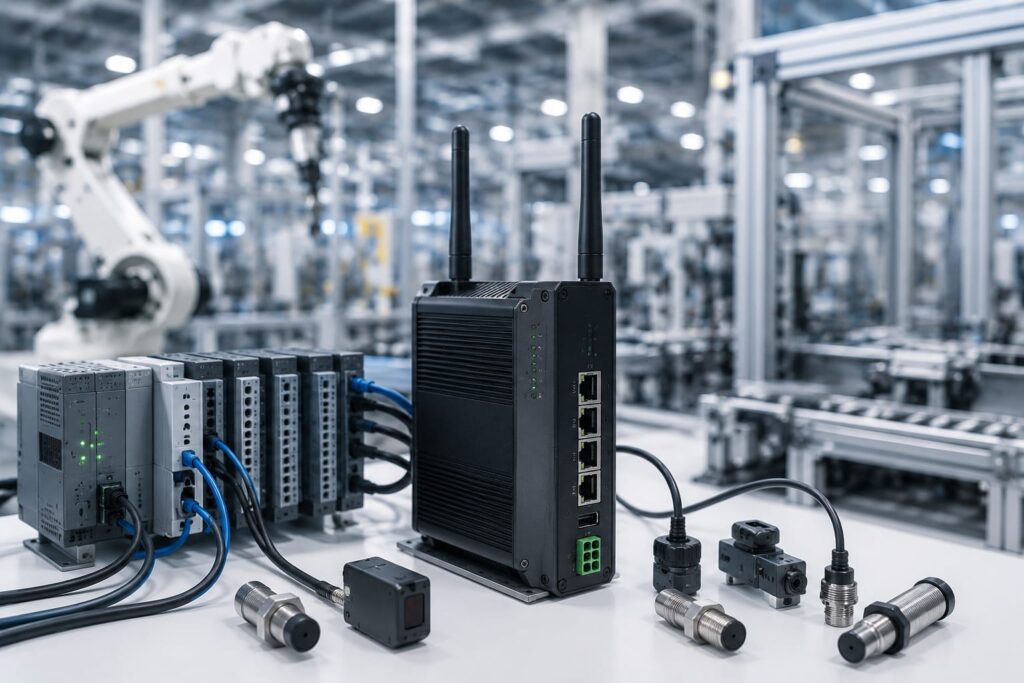
The line may contain proximity sensors, temperature sensors, motors, variable frequency drives, and a PLC. The PLC controls the machine according to the programmed logic. Meanwhile, an HMI allows an operator to view machine conditions and change operating settings.
The line may contain proximity sensors, temperature sensors, motors, variable frequency drives, and a PLC. The PLC controls the machine according to the programmed logic. Meanwhile, an HMI allows an operator to view machine conditions and change operating settings.
Now suppose the factory wants to send selected production information to an analytics platform.
The Industrial IoT Gateway can sit between the industrial network and the higher-level data platform. First, it receives information from the PLC or other connected equipment. Next, it interprets the incoming data. Then, it may filter or transform the information. Finally, it sends the required data to the destination system.
Therefore, the communication path may look like this:
Sensors and Machines → PLCs and Controllers → Industrial IoT Gateway → Local Server, SCADA, MES, or Cloud Platform
This architecture is useful because each layer has a clear role.
The sensors collect physical measurements. The PLC or controller handles machine control. The gateway manages connectivity and data exchange. Meanwhile, software platforms can use the resulting information for monitoring, analysis, reporting, or decision-making.
How Does an Industrial IoT Gateway Work?
The exact operation depends on the gateway model and industrial application. Nevertheless, the basic process can be understood through several connected stages.
Industrial IoT Gateway Protocol Communication
Industrial IoT Gateways depend heavily on communication protocols because industrial devices rarely use exactly the same communication method. Therefore, understanding protocol communication is essential when learning how Industrial IoT Gateways connect machines, controllers, and software platforms.
In an industrial environment, a gateway may communicate with PLCs, sensors, meters, drives, and other controllers through different protocols. Some devices may use serial communication, while others may use industrial Ethernet. In addition, modern applications may require communication with cloud or enterprise platforms.
Because of this variety, Industrial IoT Gateways need to support the communication methods required by the specific installation. A suitable gateway can receive information from one protocol and then make that information available through another compatible interface.
For example, a PLC may provide machine data through Modbus TCP. At the same time, a higher-level application may require structured information through another communication method. In this situation, the Industrial IoT Gateway can receive the PLC data and prepare it for the destination system.
Furthermore, a gateway may communicate with several devices at the same time. Therefore, one Industrial IoT Gateway can sometimes act as a central communication point for multiple machines or production areas.
This capability becomes particularly useful in older factories. Many existing machines were designed before cloud platforms and modern Industrial IoT systems became common. However, a gateway can provide an integration layer without requiring every machine to be replaced.
As a result, Industrial IoT Gateways can help factories modernize their data infrastructure while continuing to use existing industrial equipment.
How Industrial IoT Gateways Handle Different Protocols
Protocol handling is one of the most useful functions of Industrial IoT Gateways. A protocol defines how devices exchange information. Therefore, when two systems use different protocols, some form of conversion or integration may be required.
For example, a PLC might communicate using Modbus, while a software platform may use MQTT for data delivery. In this case, the Industrial IoT Gateway can collect the required PLC values and publish suitable information through MQTT.
Similarly, a gateway may connect an industrial Ethernet network to another system that uses a different communication structure. Because the gateway understands both sides of the communication, it can act as an intermediary.
Moreover, protocol support is not identical across every gateway. Therefore, engineers should check the supported protocols before selecting an Industrial IoT Gateway for a particular project.
Data Conversion in Industrial IoT Gateways
Data conversion is another important function of Industrial IoT Gateways. Industrial devices often provide raw values, while modern applications require structured and understandable information.
For example, a PLC register may contain a numerical value representing temperature. However, the receiving software may need that value to be identified as a temperature measurement with a specific engineering unit.
Therefore, an Industrial IoT Gateway may convert or organize the information before forwarding it.
The same principle can apply to machine status. A controller may provide a simple numeric value, while the monitoring application may need meaningful states such as Running, Stopped, Idle, or Fault.
As a result, Industrial IoT Gateways can make industrial data easier for software systems to consume.
In addition, data conversion can help different generations of equipment work together. Older machines often produce information in formats that modern applications do not directly understand. Therefore, the gateway can provide the required translation layer.
Why Data Conversion Matters
Without proper data conversion, connected industrial systems can become difficult to maintain. A monitoring platform may receive data, but that data may not have the structure or meaning required by the application.
Because of this, Industrial IoT Gateways can organize values before they move to another system. Consequently, engineers can build cleaner data flows between machines and software.
For example, a gateway may read several PLC registers, identify the relevant values, apply scaling, and then send the resulting information to a database or cloud platform.
This process can make industrial information more consistent and easier to analyze.
Data Filtering with Industrial IoT Gateways
Modern machines can generate a large amount of information. However, not every value needs to be transmitted to another system.
This is where data filtering becomes useful. Industrial IoT Gateways can be configured to select the information that matters for a particular application.
For example, a production line may produce values for motor speed, current, temperature, pressure, alarms, cycle counts, and many internal control signals. Nevertheless, a cloud dashboard may only need a small portion of that information.
Therefore, an Industrial IoT Gateway can filter unnecessary values before sending data to the next system.
This approach can provide several practical benefits. First, it can reduce unnecessary network traffic. Second, it can make the receiving application easier to manage. Finally, it can improve the overall quality of the data being analyzed.
Moreover, filtering rules can be designed around application requirements. A gateway might send a value only when it changes, or it may transmit information when a defined condition occurs.
As a result, Industrial IoT Gateways can help create more efficient data communication.
Local Data Processing
Another major capability of modern Industrial IoT Gateways is local data processing. Instead of sending every raw value to a remote server, the gateway can process selected information close to the equipment.
This approach is useful when a system generates frequent measurements. For example, a gateway may receive temperature readings every second. Sending every raw value to a cloud platform may not always be necessary.
Instead, the Industrial IoT Gateway could calculate an average value, identify an unusual change, or determine whether the measurement has crossed a configured threshold.
Therefore, local processing can reduce the amount of information that must travel across the network.
Furthermore, local processing can support applications that require relatively fast responses. Because the gateway performs the operation near the machine, it does not always need to send the request to a remote platform and wait for a response.
However, the exact capabilities depend on the gateway hardware and software. Some gateways provide basic filtering and calculations, while more advanced platforms can support larger edge applications.
Examples of Local Processing
Consider a motor monitoring application. A gateway may receive current, speed, and temperature data from the machine controller. It can then compare these values against predefined conditions.
For example, if temperature rises significantly while motor speed remains high, the gateway may classify the situation as unusual. It can then send an event or alert to the monitoring platform.
Similarly, a gateway can calculate production totals locally. Instead of transferring every individual machine event, it can provide an accumulated production count at regular intervals.
Therefore, Industrial IoT Gateways can help transform raw machine information into more useful industrial data.
Data Forwarding Through Industrial IoT Gateways
Once information has been collected, processed, and filtered, the Industrial IoT Gateway needs to send it to the appropriate destination.
The destination can vary depending on the industrial architecture. For example, data may be sent to a SCADA system, local database, MES platform, analytics application, enterprise software, or cloud service.
Some systems require continuous data transmission. Meanwhile, others may send information only when a machine state changes or a specific event occurs.
Therefore, the forwarding strategy should match the application requirements.
Because of this flexibility, Industrial IoT Gateways can support different data communication patterns within the same industrial environment.
Main Components of Industrial IoT Gateways
The internal design of Industrial IoT Gateways can vary from one manufacturer to another. Nevertheless, most gateways contain several important functional components.
Communication Interfaces
Communication interfaces allow an Industrial IoT Gateway to connect with industrial devices and external networks.
Depending on the model, these interfaces may include Ethernet, serial ports, USB, Wi-Fi, or cellular connectivity. Some industrial gateways may also provide specialized interfaces for particular automation requirements.
Because every factory has different networking conditions, interface selection is important.
For example, a machine network may require Ethernet connectivity, while a legacy controller may still use a serial interface. Therefore, a gateway with multiple interface options can simplify integration.
Processing Unit
The processing unit controls the main operations of the gateway.
It may handle protocol communication, data conversion, filtering, calculations, logging, and local applications. Furthermore, processing requirements can vary greatly between simple monitoring systems and advanced edge applications.
Therefore, an Industrial IoT Gateway should have enough processing capability for the intended workload.
Memory and Storage
Memory allows the gateway to run its software and temporarily handle incoming information. Meanwhile, storage can be used for configurations, logs, applications, and selected industrial data.
For example, if an external connection becomes temporarily unavailable, some Industrial IoT Gateways can store selected information locally.
Once communication is restored, the gateway may forward the stored information according to the configured system behavior.
As a result, local storage can support more reliable data handling in certain industrial applications.
Gateway Software
Hardware alone does not determine the capabilities of an Industrial IoT Gateway. The software platform is equally important.
Gateway software may manage communication drivers, protocol services, data mapping, security settings, logging, and remote configuration. In addition, some systems provide web-based interfaces for easier management.
Because software controls many gateway functions, engineers should consider software support, compatibility, updates, and configuration options before deployment.
Where Are Industrial IoT Gateways Used?
Industrial IoT Gateways can be used across many automation and manufacturing environments. Their exact role depends on the machines, networks, and applications involved.
In manufacturing plants, gateways can collect machine information and deliver it to monitoring or analytics systems. Therefore, production teams can obtain a clearer view of equipment conditions.
Similarly, gateways can connect energy meters with energy monitoring platforms. In this case, the gateway may collect electrical measurements and forward useful information for analysis.
Water treatment facilities can also use Industrial IoT Gateways to connect sensors, controllers, and monitoring applications. Furthermore, packaging systems, food processing equipment, material handling systems, and utility installations can use gateway-based architectures.
In each case, the gateway provides a communication and data integration layer.
Industrial IoT Gateway vs Traditional Communication Device
A traditional communication device may primarily provide a network connection between systems. An Industrial IoT Gateway, however, can perform additional data-related functions.
For example, a simple communication link may transfer information without modifying it. In contrast, an Industrial IoT Gateway may receive the information, interpret it, filter it, convert it, process it, and then forward it.
Moreover, modern gateways may support local applications, data storage, remote management, and security capabilities. Therefore, their role can be much broader than basic network connectivity.
In simple terms, a traditional communication device may help systems connect, while an Industrial IoT Gateway can help systems connect and understand the data flowing between them.
Why Industrial IoT Gateways Are Useful for Existing Factories
One major advantage of Industrial IoT Gateways is their ability to support gradual modernization.
Many factories have equipment that cannot easily be replaced. Some machines may be operational for many years, and replacing them solely for connectivity can be costly.
However, an Industrial IoT Gateway can sometimes connect existing equipment with newer software systems. Therefore, a factory can add monitoring, analytics, or cloud connectivity without rebuilding the entire automation system.
For example, a legacy PLC may continue controlling a machine exactly as before. Meanwhile, the gateway can collect selected information from that PLC and make it available to a modern monitoring platform.
As a result, factories can introduce Industrial IoT capabilities in stages rather than changing every system at once.
Practical Guide to Industrial IoT Gateways
Understanding the basic functions of Industrial IoT Gateways is useful, but choosing and applying them correctly requires a little more practical knowledge. A gateway may look like a small networking device; however, it can have a major role in the overall industrial data architecture.
Therefore, engineers should consider the machines, protocols, network design, security requirements, data volume, and final destination before selecting a gateway. In addition, the gateway should fit the existing automation environment instead of forcing the entire system to change unnecessarily.
Industrial IoT Gateway and PLC Connectivity
PLCs are one of the most common sources of industrial data. They control machines, processes, motors, valves, conveyors, pumps, and many other systems. Therefore, PLC connectivity is an important function of Industrial IoT Gateways.
A gateway can collect selected values from a PLC and provide them to another application. For example, a PLC may contain information about motor speed, production count, machine status, temperature, pressure, and alarm conditions.
However, the gateway should not interfere with the PLC's main control function. The PLC should continue handling real-time machine control according to the automation design. Meanwhile, the Industrial IoT Gateway can focus on data collection, integration, and communication with other systems.
This separation is useful because control and data services have different requirements. A PLC may require predictable control behavior, while an analytics platform may require historical and operational information.
Therefore, using a gateway as a separate integration layer can help keep these functions organized.
Industrial IoT Gateways and Modbus
Modbus is widely encountered in industrial communication, particularly in equipment such as PLCs, meters, sensors, drives, and controllers. Because of this, Modbus support can be valuable when selecting an Industrial IoT Gateway.
Modbus can appear in different physical and network forms. For example, Modbus RTU is commonly associated with serial communication, while Modbus TCP operates over Ethernet networks.
A gateway can connect to compatible Modbus devices, read the required registers, and make that information available to another system.
For example, an energy meter may expose voltage, current, power, and energy values through Modbus. The gateway can collect those values and then forward them to a monitoring application.
Furthermore, a single gateway may communicate with multiple compatible devices. Therefore, it can provide a centralized data collection point for a group of machines or instruments.
However, engineers should always verify register mapping, data types, addressing, communication settings, and device documentation before configuring the connection.
Industrial IoT Gateways and OPC UA
OPC UA is another important technology in industrial data integration. It is designed to support structured and interoperable communication between industrial systems and applications.
An Industrial IoT Gateway may use OPC UA to exchange information between PLC environments, software applications, SCADA systems, or other industrial platforms.
The major advantage of structured industrial data is that applications can work with meaningful information rather than only raw numerical values. For example, instead of receiving an unexplained value, a system may receive a tagged value representing motor speed or machine temperature.
Therefore, OPC UA can be useful when a project needs organized industrial information and interoperability between different systems.
In addition, a gateway may help connect devices that do not natively provide the required OPC UA functionality. As a result, the gateway can become part of the integration architecture.
Industrial IoT Gateways and MQTT
MQTT is commonly used when industrial data needs to move toward distributed applications or cloud-based systems. Industrial IoT Gateways can collect data from local equipment and publish selected information through MQTT.
For example, a gateway may read production values from PLCs and publish them using MQTT topics. A receiving application can then subscribe to the relevant topics and process the incoming information.
This approach can be useful because industrial devices and cloud applications do not always communicate directly. Therefore, the gateway can provide the connection between the operational side and the application side.
However, MQTT itself does not replace PLC control communication. Instead, it can work alongside industrial protocols. The gateway decides how data from the industrial environment should be collected and delivered to the receiving system.
This distinction is important because it prevents confusion between machine control protocols and data-distribution technologies.
Industrial IoT Gateways and Ethernet Connectivity
Industrial Ethernet has become an important part of connected automation. Consequently, Ethernet connectivity is a common feature in many Industrial IoT Gateways.
Ethernet can provide the physical and network connection needed to communicate with PLCs, SCADA systems, servers, switches, and other devices.
However, Ethernet alone does not define the complete communication behavior. Different industrial protocols can operate over Ethernet, and each one has different characteristics and application requirements.
Therefore, engineers should distinguish between the physical network connection and the communication protocol running through that connection.
For example, a gateway may have an Ethernet port, but its actual usefulness depends on the protocols and services it supports.
Edge Computing in Industrial IoT Gateways
Edge computing is closely related to modern Industrial IoT Gateways. The basic idea is to process data closer to where it is generated instead of sending every operation to a remote system.
For example, a gateway installed near a production line can receive sensor values locally. It can then calculate averages, detect unusual patterns, or prepare summarized information before sending the results to another platform.
Therefore, edge processing can reduce unnecessary data movement.
It can also be useful when connectivity to a remote system is limited. If the gateway can perform important local tasks, the industrial application may continue collecting or processing information even when an external connection is temporarily unavailable.
However, the gateway should not automatically be treated as a replacement for every edge-computing platform. The actual capabilities depend on its processing power, software environment, storage, and application support.
Industrial IoT Gateway Security
Security is one of the most important considerations when connecting industrial systems to modern networks.
An Industrial IoT Gateway can become an important connection point between operational equipment and external systems. Therefore, unauthorized access to the gateway could potentially affect the communication path or expose industrial information.
For this reason, gateway deployments should use appropriate security controls.
Authentication can help ensure that only authorized users or systems can access gateway functions. Similarly, access permissions can restrict administrative operations.
Moreover, encrypted communication can protect suitable data flows against unauthorized interception. Network segmentation can also help separate industrial equipment from less-trusted networks.
In addition, gateway software should be maintained according to the manufacturer's supported update process. Unnecessary services should also be disabled where appropriate.
However, security should not be treated as a single gateway setting. The gateway is only one part of a larger industrial cybersecurity architecture.
The surrounding PLC networks, switches, servers, remote-access systems, user accounts, and cloud services also require appropriate protection.
Data Storage and Temporary Connectivity Problems
Industrial networks are not always perfectly connected. Network interruptions can occur because of maintenance, equipment faults, communication issues, or infrastructure changes.
Therefore, some Industrial IoT Gateways can provide temporary local storage or buffering.
For example, a gateway may continue collecting selected machine values while an external server is unavailable. Once communication is restored, the gateway can forward the stored information according to its configuration.
This feature can be valuable for applications where losing every data point would create an incomplete production record.
However, local buffering should not be confused with unlimited storage. Every gateway has a specific storage capacity and operating behavior.
Therefore, the expected amount of data, retention period, and recovery strategy should be evaluated during system design.
Choosing the Right Industrial IoT Gateway
Selecting an Industrial IoT Gateway should begin with the application rather than the product name.
First, identify the devices that need to communicate with the gateway. These may include PLCs, sensors, meters, drives, robots, or other controllers.
Next, determine the protocols used by those devices. This step is essential because a gateway is only useful when it supports the required communication methods.
After that, consider the destination systems. The gateway may need to communicate with a SCADA platform, database, MES, analytics software, or cloud service.
Furthermore, check the available interfaces. A project may require Ethernet, serial ports, cellular connectivity, Wi-Fi, or several combinations.
Processing capability should also be considered. A basic data-collection application may not require the same hardware as an edge-computing application.
Similarly, storage requirements should be reviewed if the gateway needs local logging or buffering.
Security support is another important consideration. Management access, authentication, encrypted communication options, software updates, and network integration should all be reviewed.
Finally, consider long-term maintenance. A gateway is part of an industrial system that may operate for years. Therefore, documentation, vendor support, configuration tools, replacement options, and software support can matter just as much as the initial purchase.
Common Mistakes When Using Industrial IoT Gateways
A gateway can simplify industrial integration, but poor planning can still create problems.
One common mistake is selecting a gateway without checking the exact protocols required by the machines. A device may have the correct physical ports but still lack the required protocol support.
Another mistake is collecting too much data without defining a clear purpose. More data does not automatically mean better information. Therefore, it is usually better to identify the measurements that the application actually needs.
Network design is another important area. A gateway should be placed where communication paths are practical and secure.
In addition, engineers should avoid treating the gateway as a complete cybersecurity solution. Security needs to be considered across the full industrial environment.
Finally, poor documentation can create long-term maintenance problems. Gateway mappings, tags, addresses, communication settings, and data rules should be documented clearly.
Real-World Example: Factory Machine Monitoring
Consider a factory with several automated machines.
Each machine uses a PLC to control its process. The PLCs provide information such as machine status, production count, motor temperature, operating time, and alarms.
The factory wants this information on a central monitoring dashboard.
Instead of modifying the complete control logic, an Industrial IoT Gateway can be placed between the machine network and the monitoring system.
First, the gateway connects to the PLCs. Next, it reads selected values. Then, it maps and organizes those values. After that, it forwards the information to the monitoring application.
Because the gateway handles data integration separately, the PLCs can continue performing their main control responsibilities.
Furthermore, the gateway can apply filtering rules. For example, it may send machine status changes immediately while sending less important measurements at longer intervals.
As a result, the monitoring system receives useful information without requiring every internal PLC value.
Real-World Example: Energy Monitoring
Energy monitoring is another practical application.
Suppose a factory has several electrical meters installed across different production areas. Each meter provides information about electrical consumption and related measurements.
The Industrial IoT Gateway can communicate with these meters and collect the required values.
The gateway may then organize the readings by production area and send them to an energy monitoring platform.
Consequently, engineers and managers can review energy usage from a centralized application.
Furthermore, the collected information can support comparisons between production areas and operating periods. This can help organizations understand energy behavior and identify areas that may require further investigation.
Benefits of Industrial IoT Gateways
Industrial IoT Gateways can provide several practical benefits when they are correctly designed and deployed.
They can simplify communication between equipment that uses different protocols. They can also collect data from multiple devices and provide it to centralized applications.
Furthermore, gateways can support local processing. Because of this, they may reduce unnecessary data transmission and improve the usefulness of collected information.
Another benefit is integration with existing equipment. Instead of replacing every older device, a gateway can sometimes provide the connectivity needed for modern applications.
In addition, gateways can support data organization. They can filter, map, convert, and forward information according to application requirements.
As a result, they can help create a structured path between operational technology and modern digital systems.
Limitations of Industrial IoT Gateways
Although Industrial IoT Gateways provide many advantages, they are not a universal solution.
A gateway cannot automatically make incompatible equipment fully compatible in every situation. Proper protocol support, configuration, and device-specific integration may still be required.
Furthermore, gateways introduce another component that needs to be configured, monitored, secured, and maintained.
If the gateway fails and no redundancy or recovery strategy exists, the affected data flow may stop.
In addition, advanced gateway features may require more complex configuration. Therefore, the engineering team should understand the application's requirements before selecting a solution.
Most importantly, a gateway should be treated as part of an overall architecture rather than as a standalone answer to every industrial connectivity problem.
Frequently Asked Questions About Industrial IoT Gateways
What is an Industrial IoT Gateway used for?
An Industrial IoT Gateway is used to connect industrial devices with other networks, software systems, and data platforms. It can collect, convert, filter, process, and forward industrial information.
Can an Industrial IoT Gateway connect to a PLC?
Yes. Many Industrial IoT Gateways can communicate with PLCs through supported industrial protocols. The exact connection depends on the PLC model, communication interface, and gateway capabilities.
Do Industrial IoT Gateways replace PLCs?
No. A gateway and a PLC usually serve different purposes. A PLC primarily performs control operations, while an Industrial IoT Gateway generally focuses on communication, integration, and data handling.
Can an Industrial IoT Gateway connect old machines?
Yes, in many cases. A gateway can sometimes provide an integration layer between legacy equipment and newer digital systems. However, compatibility depends on the communication interfaces and protocols available on the older machine.
Are Industrial IoT Gateways used with cloud platforms?
Yes. Many Industrial IoT Gateways can forward selected industrial data to cloud or remote software platforms. The exact method depends on the gateway, communication protocol, network architecture, and cloud service.
What protocols can Industrial IoT Gateways support?
Protocol support varies by gateway. Common industrial technologies can include Modbus, OPC UA, MQTT, Ethernet-based communication, and serial communication. Therefore, the supported protocol list should always be checked before deployment.
Are Industrial IoT Gateways secure?
Security depends on the gateway design, configuration, software, network architecture, and maintenance practices. Proper authentication, access control, secure communication, network segmentation, and software maintenance can help improve protection.
What is the difference between an IoT gateway and an edge device?
An IoT gateway mainly focuses on connecting devices and transferring or transforming data between systems. An edge device can also perform local computing and application processing. However, the exact capabilities can overlap, and some modern gateways provide both gateway and edge-computing functions.
Conclusion
Industrial IoT Gateways have become an important building block for connected industrial environments. They provide a practical path between machines that generate operational data and software systems that need to use that information.
A well-designed gateway can collect data from PLCs, sensors, meters, drives, and other industrial devices. It can then convert, filter, process, store, and forward that data according to the application's needs.
Moreover, gateways can support communication across different technologies. They can work with industrial networks, PLC connections, local servers, SCADA environments, MES platforms, analytics systems, and cloud services.
Their value is especially clear in factories that need gradual digital transformation. Instead of replacing every existing machine, an organization can sometimes add a suitable gateway and connect useful machine information to modern applications.
At the same time, a gateway should not be treated as a magic solution. Proper engineering remains essential. Protocol compatibility, network architecture, cybersecurity, data requirements, hardware capacity, and maintenance all influence the success of an Industrial IoT project.
Ultimately, Industrial IoT Gateways help turn isolated machine data into connected industrial information. When they are selected and configured correctly, they can support better monitoring, easier integration, more flexible data management, and a stronger foundation for modern Industrial IoT systems.

Pingback: TSN in Industrial Automation: Beginner’s Guide