Table of Contents
ToggleIntroduction
PLC Safety Systems protect people, machines, and industrial processes from dangerous situations. They help factories operate safely while maintaining high productivity. Modern industries rely on automation, robotics, and intelligent control systems. However, these technologies also increase safety risks if machines operate without proper protection.
A PLC Safety System monitors safety devices, checks machine conditions, and reacts immediately when danger appears. If an operator presses an emergency stop button or opens a safety gate, the system quickly moves the machine into a safe state. This fast response reduces accidents, protects expensive equipment, and limits production downtime.
Today, manufacturers use PLC Safety Systems in automotive plants, food processing facilities, pharmaceutical factories, packaging lines, warehouses, power stations, and many other industrial environments. These systems support international safety standards while improving machine reliability and workplace safety.
This guide explains everything you need to know about PLC Safety Systems. You will learn how they work, why they matter, where industries use them, and how they improve industrial automation. Whether you are a beginner, technician, engineering student, or automation professional, this article will help you understand modern machine safety.
PLC Safety Systems: What Are PLC Safety Systems?
PLC Safety Systems are advanced industrial control systems that protect workers, equipment, and manufacturing processes from hazardous conditions. Unlike standard PLCs, they focus on safety instead of only controlling machine operations.
A safety PLC constantly checks safety devices such as emergency stop buttons, safety light curtains, gate interlocks, laser scanners, and pressure-sensitive mats. It analyzes every safety signal in real time. When it detects a dangerous condition, it immediately performs a safe machine shutdown.
Modern industries choose PLC Safety Systems because they reduce workplace accidents, protect valuable equipment, and improve production reliability. They also help companies comply with international safety standards and industry regulations.
As factories continue to adopt Industry 4.0 technologies, the demand for PLC Safety Systems continues to grow. Manufacturers now combine safety automation with robotics, industrial networks, and smart monitoring systems to create safer and more efficient production environments.
PLC Safety Systems: Why Are They Important?
Industrial machines operate at high speed and often handle heavy materials, electrical power, hydraulic pressure, and robotic movement. Even a small mistake can create a dangerous situation. PLC Safety Systems reduce these risks by monitoring every critical safety function throughout machine operation.
When an operator enters a restricted area or activates an emergency stop device, the safety controller reacts immediately. Instead of waiting for manual action, it safely stops hazardous machine movement before someone gets injured.
PLC Safety Systems also protect expensive production equipment. A controlled shutdown prevents severe mechanical damage and reduces unexpected maintenance costs. As a result, factories experience fewer breakdowns and higher production efficiency.
Another major advantage is legal compliance. Many industries must follow international functional safety standards before operating automated equipment. A properly designed safety system helps companies meet these requirements while creating a safer workplace.
PLC Safety Systems: How Do They Work?
PLC Safety Systems operate through a continuous monitoring cycle. The system receives information from safety devices, evaluates programmed safety logic, and controls machine outputs without delay.
Every safety device sends its status to the safety PLC. The controller checks each signal and verifies that every operating condition remains safe. If every condition is normal, the machine continues running.
When the controller detects an unsafe condition, it immediately activates the programmed safety response. It disconnects hazardous outputs, stops dangerous machine movement, and protects both operators and equipment.
After technicians remove the hazard, the system performs additional safety checks before allowing production to restart. This process prevents accidental machine startup and keeps workers protected during maintenance activities.
Because every action follows certified safety logic, PLC Safety Systems provide reliable protection throughout the production cycle.
PLC Safety Systems: Main Components
Every PLC Safety System combines several hardware and software components that work together to create a safe industrial environment.
The safety PLC controller acts as the central processing unit. It receives safety signals, executes certified safety logic, and controls all safety-related outputs.
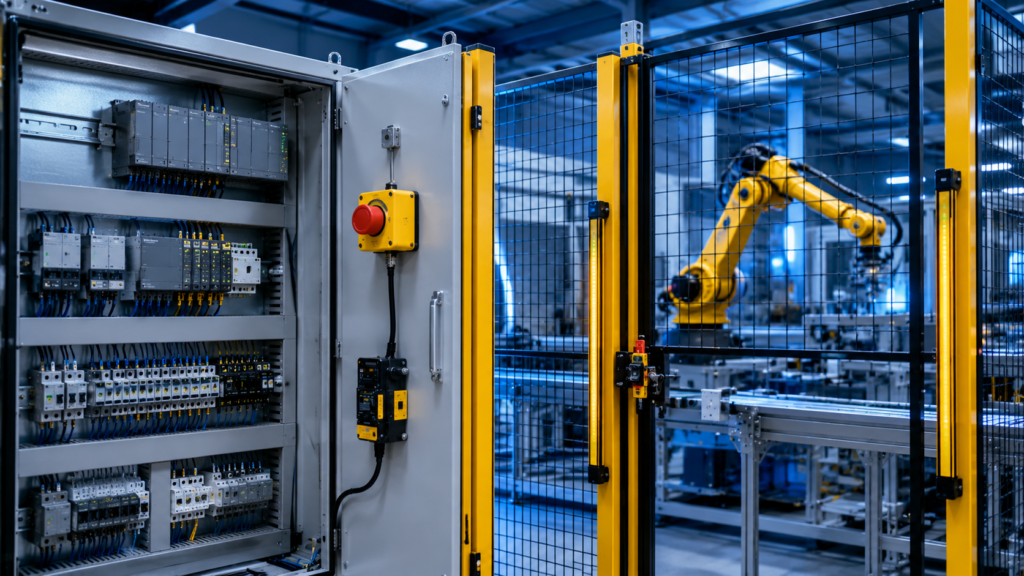
Safety input modules collect information from protective devices installed throughout the machine. They continuously monitor emergency stop buttons, safety gates, light curtains, laser scanners, and other protective equipment.
Safety output modules disconnect hazardous energy whenever the controller detects danger. They safely stop motors, servo drives, conveyors, robotic systems, hydraulic valves, and pneumatic equipment.
Safety relays provide an additional protection layer in many industrial applications. Although programmable safety controllers have become more common, safety relays still play an important role in simple machine safety systems.
Communication networks also support modern PLC Safety Systems. Industrial protocols allow safety controllers, remote I/O stations, HMIs, and robotic systems to exchange safety information quickly and reliably.
Together, these components create a complete safety architecture that protects workers while maintaining efficient production.
PLC Safety Systems: Types of Safety Devices
PLC Safety Systems rely on intelligent safety devices to detect hazards before accidents occur.
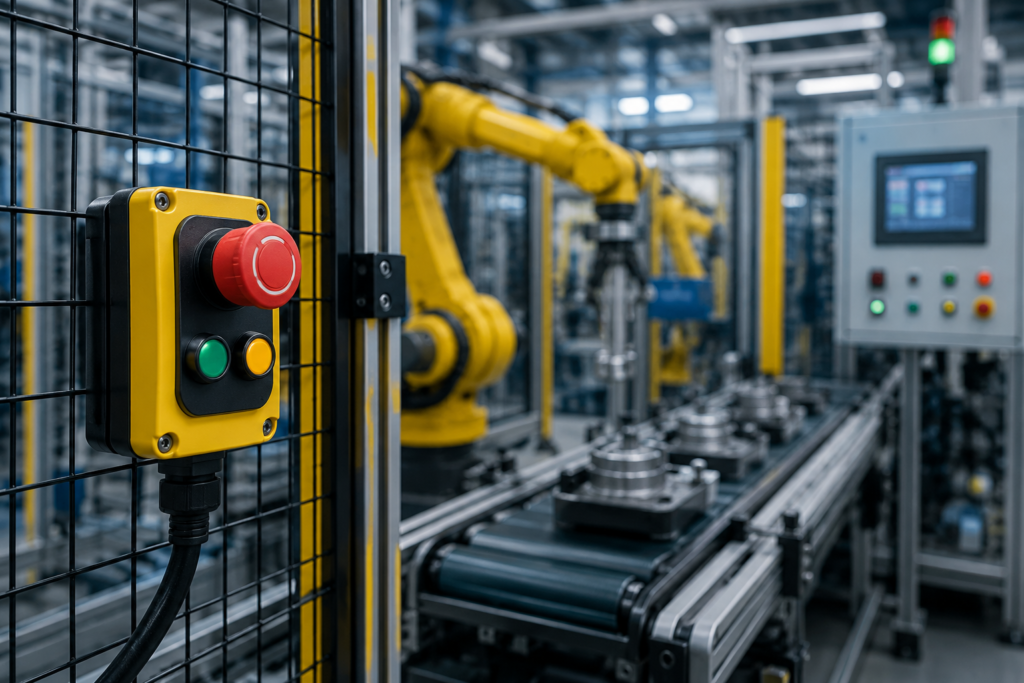
Emergency stop buttons allow operators to stop machine operation instantly whenever they notice danger.
Safety light curtains create an invisible protective barrier around hazardous areas. If someone enters the protected zone, the system immediately stops machine movement.
Safety gate interlocks prevent machines from operating while protective doors remain open. They also stop dangerous motion if an operator opens a safety gate during production.
Laser safety scanners monitor larger work areas without physical barriers. They detect people or objects entering restricted zones and activate protective actions.
Pressure-sensitive safety mats detect human presence in hazardous locations. Once someone steps onto the protected area, the safety controller immediately stops machine operation.
Two-hand control devices require operators to press two buttons at the same time before dangerous equipment starts. This design keeps both hands away from moving machine parts.
Modern factories combine several of these devices to achieve higher levels of machine protection and operational safety.
PLC Safety Systems: Benefits of PLC Safety Systems
Every factory wants two things. The first is worker safety. The second is smooth production. PLC Safety Systems help achieve both goals. They protect people while keeping machines running in a safe way.
Let's look at the biggest benefits.
PLC Safety Systems Improve Worker Safety
Worker safety is the main purpose of every safety system.
Machines can move very fast. A small mistake can cause a serious accident. A safety PLC reacts within milliseconds. It stops dangerous movement before someone gets hurt.
As a result, workers can perform their jobs with greater confidence.
PLC Safety Systems Reduce Machine Damage
Machine repairs often cost a lot of money.
A sudden crash can damage motors, conveyors, robots, sensors, or production equipment. However, a safety PLC shuts the machine down in a controlled way.
This action reduces damage and lowers repair costs.
PLC Safety Systems Reduce Downtime
Every minute of downtime costs money.
When a machine stops because of an accident, production also stops. This delay affects delivery schedules and customer satisfaction.
PLC Safety Systems lower this risk. They help prevent many problems before they become serious.
Therefore, factories can keep production running more smoothly.
PLC Safety Systems Improve Product Quality
Stable machines produce better products.
Unsafe machine movement can create defects during production. A reliable safety system keeps machines operating under safe conditions.
As a result, product quality stays consistent.
PLC Safety Systems Support Safety Standards
Many industries must follow safety rules.
PLC Safety Systems help companies meet international standards. These standards improve workplace safety and reduce legal risks.
Because of this, many manufacturers use safety PLCs in modern production lines.
PLC Safety Systems Increase Production Efficiency
Safety and productivity can work together.
A good safety system allows operators to work with confidence. It also reduces unexpected shutdowns.
Therefore, the factory achieves better efficiency without sacrificing safety.
PLC Safety Systems vs Standard PLC
Many beginners think every PLC works the same way.
That is not true.
A standard PLC controls machines. A safety PLC protects people and machines at the same time.
Both controllers look similar. However, their purpose is very different.
Purpose
A standard PLC controls automation tasks.
It starts motors, controls valves, manages conveyors, and performs production logic.
A safety PLC focuses on safety.
It monitors dangerous situations and reacts immediately.
Reliability
A standard PLC does not include advanced safety functions.
A safety PLC contains extra diagnostic features and fault detection.
These features increase system reliability.
Safety Monitoring
A standard PLC reads normal input signals.
A safety PLC monitors certified safety devices such as emergency stop buttons, light curtains, and safety door switches.
This continuous monitoring improves workplace protection.
System Response
A standard PLC follows production commands.
A safety PLC stops hazardous machine movement whenever danger appears.
This quick response helps prevent accidents.
Industrial Applications
Factories use standard PLCs for normal automation.
However, industries install safety PLCs whenever workers interact with dangerous machines.
This includes robotic cells, automated production lines, and heavy industrial equipment.
PLC Safety Systems in Different Industries
Modern industries depend on safe automation.
Because of this, PLC Safety Systems appear in many production environments.
PLC Safety Systems in Automotive Plants
Automotive factories use hundreds of robots.
These robots weld, paint, lift, and assemble vehicle parts.
Safety PLCs monitor every robotic cell and protect workers during operation.
PLC Safety Systems in Food Processing
Food factories contain conveyors, mixers, filling machines, and packaging equipment.
Operators work close to moving machines every day.
Safety PLCs help create a safer workplace without reducing production speed.
PLC Safety Systems in Pharmaceutical Manufacturing
Medicine production requires clean and controlled environments.
Machine safety is just as important as product quality.
Safety PLCs protect operators while keeping production stable.
PLC Safety Systems in Packaging Lines
Packaging machines move at very high speed.
Workers often load materials or clear jams.
Safety systems stop dangerous movement before injuries happen.
This improves both safety and efficiency.
PLC Safety Systems in Oil and Gas
Oil and gas facilities contain high pressure, flammable materials, and hazardous equipment.
Safety PLCs monitor critical processes and reduce operational risks.
Because of this, they play an important role in plant safety.
PLC Safety Systems in Power Plants
Power stations operate around the clock.
Even a small fault can affect the entire process.
Safety PLCs help protect equipment, operators, and essential systems.
PLC Safety Systems in Smart Factories
Smart factories use robotics, IIoT devices, machine vision, and automated production systems.
These technologies increase productivity.
However, they also increase safety requirements.
PLC Safety Systems connect all safety devices into one intelligent control system.
As a result, factories become safer, smarter, and more reliable.
PLC Safety Systems Best Practices
A good safety system needs proper planning.
Following best practices improves both safety and machine performance.
Perform a Risk Assessment First
Study every machine carefully.
Find possible hazards before installing safety devices.
A proper risk assessment creates a stronger safety system.
Choose Certified Safety Components
Always use certified safety devices.
High-quality components provide better reliability and longer service life.
Test the Safety System Regularly
Testing is very important.
Check emergency stop buttons, safety gates, light curtains, and safety sensors on a regular schedule.
Routine testing helps find problems early.
Train Machine Operators
Even the best safety system cannot replace proper training.
Teach every operator how the safety system works.
Clear instructions reduce human error.
Keep Software Updated
Modern safety controllers receive software improvements.
Install approved updates whenever needed.
Updated systems often provide better performance and security.
Schedule Preventive Maintenance
Inspect cables, sensors, connectors, and safety devices regularly.
Small maintenance tasks prevent larger failures later.
A simple inspection today can avoid expensive downtime tomorrow.
PLC Safety Systems: Safety Standards
Safety is not only a good practice. It is also a legal and technical requirement in many industries. Companies follow international standards to design safe machines and reduce risks. These standards help engineers build reliable PLC Safety Systems that protect both people and equipment.
The following standards are the most important in industrial automation.
IEC 61508 and PLC Safety Systems
IEC 61508 is one of the most important functional safety standards. It explains how to design, test, and maintain safety-related electrical and electronic systems.
Many manufacturers build safety PLCs according to this standard. As a result, industries can trust these systems in critical applications.
ISO 13849 and PLC Safety Systems
ISO 13849 focuses on machine safety. It helps engineers select the correct safety components and design reliable control systems.
This standard is widely used in factories with robots, conveyors, and automated machines.
IEC 62061 and PLC Safety Systems
IEC 62061 applies to machine control systems. It provides guidance for designing safe electrical control systems in industrial environments.
Many large manufacturing plants follow this standard because it supports complex automation projects.
Why Safety Standards Matter
Safety standards improve more than compliance. They also create safer workplaces.
A factory that follows international standards can reduce accidents, improve machine reliability, and lower maintenance costs.
In addition, certified safety systems increase customer confidence and support long-term business growth.
PLC Safety Systems: Common Mistakes to Avoid
Even the best hardware cannot provide complete protection if the system is designed incorrectly.
Understanding common mistakes helps engineers build safer automation systems.
Ignoring Risk Assessment
Some companies install safety devices without studying machine hazards.
This approach creates safety gaps.
Always complete a risk assessment before designing the control system.
Choosing the Wrong Safety Device
Every machine has different risks.
A light curtain may work well for one application, while another machine may need a safety laser scanner or a gate interlock.
Selecting the correct device improves protection.
Skipping Regular Testing
Safety devices need regular inspections.
Emergency stop buttons, safety gates, and light curtains should work every time.
Routine testing helps detect hidden faults before they become serious.
Poor Maintenance
Dust, vibration, damaged cables, and loose connections can reduce system performance.
Regular maintenance keeps the safety system reliable.
Lack of Operator Training
Operators should understand how the safety system works.
Simple training helps workers respond correctly during normal operation and emergency situations.
Well-trained operators also reduce the chance of human error.
PLC Safety Systems: Future Trends
Industrial safety continues to improve every year.
New technologies make factories smarter, faster, and safer.
Smart Safety Monitoring
Modern safety PLCs collect real-time machine data.
Engineers can monitor system health and identify problems before they cause downtime.
This approach supports predictive maintenance.
AI in PLC Safety Systems
Artificial intelligence is becoming part of industrial automation.
AI can analyze machine behavior, detect unusual patterns, and provide early safety warnings.
This helps maintenance teams solve problems faster.
Industrial IoT Integration
Many factories connect safety PLCs with Industrial IoT platforms.
This connection allows engineers to monitor machine status from a central dashboard.
It also improves production planning and maintenance scheduling.
Safer Human-Robot Collaboration
Collaborative robots work close to people.
Because of this, advanced safety systems become even more important.
Safety PLCs monitor robot movement and help create a safe working environment.
Real-World Example of PLC Safety Systems
Imagine an automated packaging factory.
A robotic arm picks products from a conveyor and places them into boxes.
The PLC Safety System receives the signal and stops the robot within milliseconds.
While the robot is running, an operator reaches into the protected zone.
The operator checks the machine, closes the safety gate, and performs the approved reset procedure.
This simple process protects both the worker and the equipment without causing unnecessary damage.
Frequently Asked Questions About PLC Safety Systems
What are PLC Safety Systems?
PLC Safety Systems are special industrial control systems that protect workers and machines by monitoring safety devices and stopping hazardous operations when necessary.
How is a safety PLC different from a standard PLC?
A standard PLC controls machine operations. A safety PLC controls machines and also performs certified safety functions to reduce risk.
Where are PLC Safety Systems used?
They are widely used in automotive plants, food processing, pharmaceuticals, packaging, oil and gas, power generation, logistics, and smart factories.
Can a safety PLC improve production?
Yes. It reduces accidents, lowers downtime, protects equipment, and improves overall production reliability.
Which safety devices work with PLC Safety Systems?
Common devices include emergency stop buttons, safety light curtains, safety laser scanners, safety gates, pressure mats, and two-hand control stations.
Do small factories need PLC Safety Systems?
Yes. Any factory with moving machinery can benefit from a properly designed safety system.
How often should a safety system be tested?
Most manufacturers recommend scheduled inspections and routine functional testing based on the machine's operating conditions and maintenance plan.
Why are international safety standards important?
They help companies design reliable safety systems, reduce workplace risks, and meet industry requirements.