Table of Contents
TogglePLC Sensors: Complete Guide to Industrial Automation
Introduction
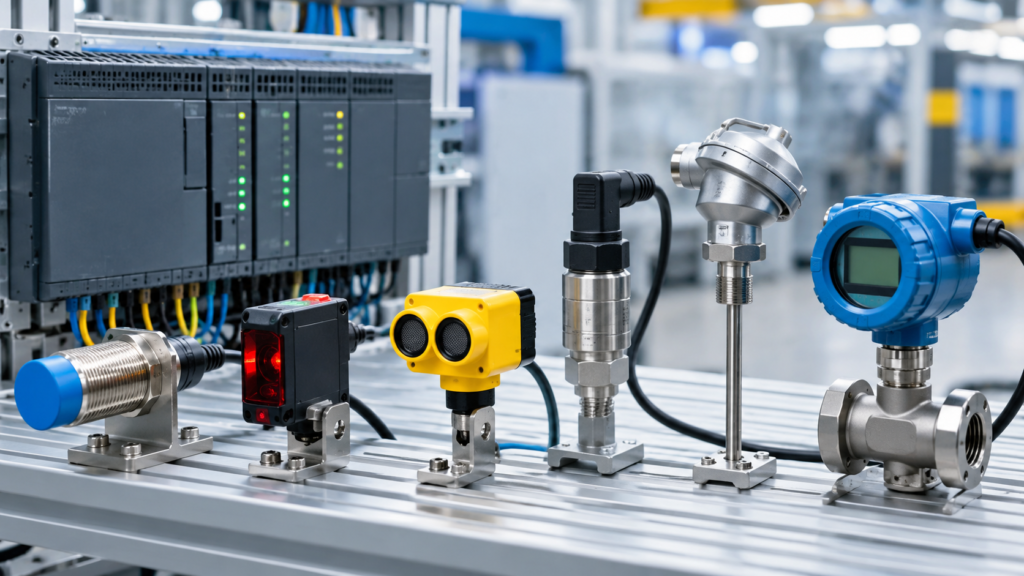
PLC Sensors are one of the most important parts of any industrial automation system. They detect physical changes in a machine or process and send that information to a Programmable Logic Controller (PLC). The PLC then processes the data and controls the connected equipment. As a result, factories can automate complex operations with greater speed, accuracy, and safety.
Modern industries rely on automation to improve productivity and maintain consistent quality. However, no PLC can make the right decision without accurate input data. For this reason, sensors serve as the starting point of every automated process. They collect information from the real world and help the controller respond at the right time.
Today, industries use different sensing technologies to monitor temperature, pressure, position, speed, liquid level, flow rate, and object movement. Consequently, production lines become more reliable while reducing manual work and unexpected downtime. Whether you are learning PLC programming or working in industrial automation, understanding sensors will help you design better control systems and troubleshoot equipment more effectively.
In this guide, you will learn how industrial sensors work with PLC systems, why they are essential, where they are used, and how to choose the right sensor for different applications. Furthermore, you will discover practical examples that explain how sensing technology improves efficiency, safety, and production quality in modern factories.
What Are Industrial Sensors?
Industrial sensors are electronic devices that detect physical conditions and convert them into electrical signals. These signals allow a PLC to understand what is happening inside a machine or production process. Instead of making decisions on their own, sensors continuously provide real-time information that helps the controller execute the programmed logic.
For example, a sensor can detect the arrival of a product on a conveyor belt. Immediately afterward, the PLC receives that signal and activates the next operation. In another application, a temperature sensor monitors a heating system and reports changes every second. If the measured temperature reaches the programmed limit, the controller reacts instantly.
Unlike ordinary consumer sensors, industrial sensors are designed for demanding environments. They continue operating even when exposed to dust, vibration, electrical noise, moisture, or extreme temperatures. Therefore, they provide reliable performance in factories where equipment runs for long hours every day.
Why Sensors Matter in Industrial Automation
Automation depends on accurate information. Without reliable input devices, even the most advanced PLC program cannot control a machine correctly. Therefore, sensors play a critical role in every automated system.
Every production line changes continuously. Products move from one station to another, motors start and stop, tanks fill and empty, and temperatures rise or fall. Sensors detect these changes instantly. Then, the PLC processes the information and controls the required outputs without unnecessary delay.
As a result, manufacturers achieve better product quality, lower operating costs, and improved process stability. In addition, automation reduces human error because machines respond to real-time conditions instead of manual instructions.
Modern industries also focus on workplace safety. Therefore, sensing devices monitor dangerous situations before they become serious problems. When abnormal conditions appear, the PLC can stop the machine or trigger an alarm immediately. Consequently, companies protect both employees and valuable equipment.
How Sensors Communicate with a PLC
Every automated process follows a simple sequence. First, a sensor detects a physical event. Next, it converts that event into an electrical signal. After that, the PLC reads the signal through its input module. Finally, the controller executes the programmed logic and controls the connected outputs.
For instance, consider an automated packaging machine. A sensor detects the arrival of a package at the filling station. Next, the PLC confirms the signal and starts the filling process. After filling is complete, another sensing device verifies the operation. Finally, the conveyor moves the package to the next production stage.
This communication happens thousands of times every hour. Nevertheless, the entire process usually takes only a few milliseconds. Because of this high speed, automated systems can maintain excellent production accuracy while reducing delays.
The Role of Sensors in Smart Manufacturing
Manufacturing technology continues to evolve every year. Therefore, industries now expect automation systems to collect more data than ever before. Modern sensors do much more than detect simple ON or OFF conditions. Instead, many devices measure precise values that help engineers monitor production in real time.
For example, a pressure sensor can identify small changes inside a hydraulic system before equipment fails. Likewise, a flow sensor can monitor liquid movement and maintain consistent production quality. Because these devices provide continuous feedback, maintenance teams can solve problems early instead of waiting for unexpected breakdowns.
Furthermore, sensor technology supports predictive maintenance, energy efficiency, and production optimization. As factories adopt Industry 4.0 technologies, reliable sensing becomes even more valuable. Therefore, understanding sensor operation is an essential skill for engineers, technicians, automation professionals, and students.
How This Guide Will Help You
Choosing the right sensor is not always easy because every industrial process has different requirements. Some applications need high-speed object detection, while others require extremely accurate temperature or pressure measurement. Therefore, understanding the strengths of each sensing technology helps engineers make better decisions.
Throughout this guide, you will explore the major sensor categories used in industrial automation. You will also learn how each type works, where it performs best, and what factors influence its selection. In addition, practical industrial examples will help connect theory with real-world applications.
By the end of this article, you will have a clear understanding of industrial sensing technology and its role in reliable PLC-based automation systems.
Types of Industrial Sensors Used in Automation
Industrial automation uses many sensing technologies because every process has different operating conditions. A sensor that performs well on a conveyor may not work inside a chemical plant. Likewise, a device designed for measuring liquid level cannot accurately monitor temperature or pressure. For this reason, engineers select sensors according to the application instead of using one solution for every system.
Modern factories often install multiple sensors on a single machine. Each device performs a specific task and sends information to the PLC. The controller combines all input signals before making a decision. As a result, the entire process operates with greater accuracy, stability, and safety.
Although hundreds of industrial sensors are available today, most of them belong to a few major categories. Understanding these categories makes it easier to design reliable automation systems and choose suitable equipment for future projects.
Digital Sensors
Digital sensors produce only two output states. The signal is either ON or OFF, also known as HIGH or LOW. Because of this simple operation, digital sensors are widely used in PLC-controlled machines.
When the required condition becomes true, the sensor changes its output state immediately. The PLC reads this signal through a digital input module and executes the programmed instruction. Since only two signal states exist, digital sensors are fast, reliable, and easy to troubleshoot.
For example, a proximity sensor can detect whether a metal object is present. If the object enters the sensing range, the output changes to ON. Once the object leaves the detection area, the signal returns to OFF. This simple operation allows the PLC to start or stop equipment at exactly the right moment.
Factories use digital sensors for many everyday tasks. They detect products on conveyor belts, monitor safety doors, confirm cylinder positions, count production items, and verify that machine parts are correctly installed before the next operation begins.
Another advantage is their fast response time. Many industrial machines perform hundreds of operations every minute. Therefore, digital sensors provide quick feedback that helps maintain production speed without sacrificing accuracy.
Because of their reliability and simple installation, digital sensors remain one of the most common input devices in industrial automation.
Analog Sensors
Unlike digital devices, analog sensors measure continuously changing values instead of simple ON or OFF conditions. They send proportional electrical signals that represent real-world measurements.
For example, instead of reporting whether a tank is simply full or empty, an analog level sensor can measure the exact liquid level at any moment. Similarly, a temperature sensor continuously reports changing temperatures instead of waiting until a fixed limit is reached.
The PLC receives these signals through analog input modules. It then converts the electrical values into engineering units such as degrees Celsius, bar, liters, meters, or flow rate. This allows operators to monitor the process with much greater precision.
Analog sensing is especially valuable in industries where maintaining stable operating conditions is critical. Food processing, pharmaceutical manufacturing, water treatment, oil and gas facilities, and chemical plants all depend heavily on accurate analog measurements.
Because analog sensors provide continuous information, the PLC can make smooth adjustments instead of sudden changes. As a result, production quality improves while reducing waste and unnecessary equipment wear.
Contact Sensors
Contact sensors operate only after making physical contact with an object. These devices have been used in industrial automation for many years because they are simple, dependable, and economical.
A common example is a mechanical limit switch. When a moving machine component reaches a specific position, it presses the switch and changes its electrical state. The PLC immediately detects this input and continues the programmed sequence.
Contact sensors are often installed where machine movement is predictable and repeated frequently. They help verify that cylinders have fully extended, machine guards have closed correctly, or mechanical components have reached their final positions.
Although these sensors offer excellent reliability, continuous physical contact eventually causes mechanical wear. Therefore, engineers inspect them regularly during preventive maintenance to maintain consistent performance.
Many modern factories still use contact sensors in applications where their durability and simplicity outweigh the disadvantages of mechanical movement.
Non-Contact Sensors
Non-contact sensors detect objects without touching them. Instead of relying on mechanical movement, they use technologies such as electromagnetic fields, light, sound waves, or magnetic detection.
Because there is no physical contact, these sensors experience very little mechanical wear. Consequently, they often provide a longer service life and higher operating speed than contact devices.
Non-contact sensing has become increasingly popular in automated production because it allows equipment to operate faster while reducing maintenance requirements. High-speed packaging machines, robotic systems, automated warehouses, and assembly lines frequently depend on this technology.
Another advantage is improved cleanliness. Industries such as food processing and pharmaceuticals often avoid physical contact whenever possible to reduce contamination risks. Therefore, non-contact sensors help maintain hygienic production environments.
As industrial automation continues to advance, non-contact sensing technologies are replacing traditional mechanical switches in many modern applications.
Understanding Sensor Output Signals
Every industrial sensor communicates with a PLC through an electrical output signal. However, not every sensor uses the same signaling method. Therefore, understanding output signals is essential before connecting any device to a control system.
Digital sensors usually transmit either an ON or OFF signal. Analog sensors, on the other hand, provide continuously changing electrical values that represent actual process conditions.
The PLC input module interprets these electrical signals and transfers the information to the CPU for processing. If the signal type does not match the input module, communication problems may occur even when both devices operate correctly.
For this reason, engineers always verify electrical compatibility before installing new sensors. Correct signal matching improves reliability and prevents unnecessary troubleshooting during system commissioning.
Choosing the Right Sensor for an Application
Selecting the correct sensor involves much more than choosing a device that detects an object. Every industrial environment presents unique operating conditions that influence sensor performance.
The first consideration is the type of material being detected. Metal, plastic, glass, wood, liquids, powders, and transparent objects often require different sensing technologies. Choosing the wrong device may result in unstable operation or missed detections.
The surrounding environment also plays an important role. Dust, oil, vibration, humidity, steam, chemicals, and extreme temperatures can reduce sensor performance if the device is not designed for those conditions. Therefore, environmental protection should always be considered during system design.
Detection distance is another important factor. Some applications require sensing within only a few millimeters, while others need reliable detection over several meters. Selecting an appropriate sensing range improves both accuracy and long-term reliability.
Engineers also evaluate response speed, installation space, maintenance requirements, and electrical compatibility before making a final decision. A careful selection process reduces downtime, improves equipment performance, and extends service life.
Why Proper Sensor Selection Improves Automation
Many automation problems begin with incorrect sensor selection rather than PLC programming errors. Even a perfectly written control program cannot compensate for unreliable input data.
When engineers select the right sensing technology, machines operate more consistently, maintenance costs decrease, and production quality becomes easier to maintain. Furthermore, operators spend less time troubleshooting unexpected machine behavior.
Reliable sensing also improves workplace safety because the PLC receives accurate information before making control decisions. This allows the automation system to respond quickly whenever operating conditions change.
For this reason, experienced automation engineers always consider sensor selection as one of the most important stages of project planning. A well-chosen sensor not only improves current production but also supports long-term system reliability and future expansion.
Understanding the Most Common Industrial Sensors
After learning the basic categories of industrial sensors, the next step is understanding how individual sensing technologies work. Every manufacturing process has different requirements. Therefore, engineers choose sensors based on the material being detected, the surrounding environment, the required accuracy, and the operating speed.
Some sensors are designed to detect metal objects, while others identify transparent materials, liquids, or even small changes in pressure and temperature. Because no single device is suitable for every application, modern automation systems often combine several sensor types within the same PLC-controlled machine.
The following sections explain the most widely used industrial sensors and show how each one contributes to reliable automation.
Proximity Sensors
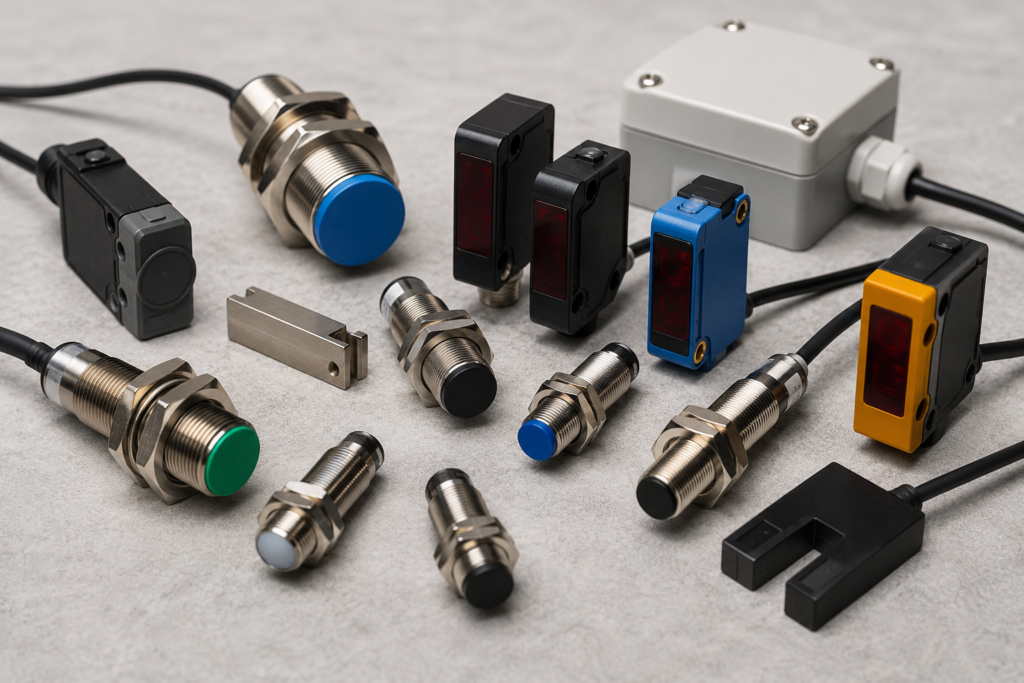
Proximity sensors are among the most frequently used devices in industrial automation. They detect the presence or absence of an object without making physical contact. As a result, they provide reliable operation while reducing mechanical wear.
Most production lines use proximity sensors to determine whether a workpiece has reached a specific position before the PLC starts the next operation. Since these sensors respond within milliseconds, they are ideal for high-speed manufacturing systems.
Inductive proximity sensors detect only metallic objects. They generate an electromagnetic field around the sensing face. When a metal object enters this field, the sensor changes its output and immediately informs the PLC.
Factories commonly install inductive sensors on conveyor systems, robotic cells, CNC machines, packaging equipment, and automated assembly stations. Their excellent resistance to dust, oil, and vibration makes them one of the most dependable industrial sensing technologies.
Capacitive proximity sensors operate differently. Instead of detecting only metal, they can identify plastic, glass, wood, paper, powders, liquids, and many other materials. Therefore, they are frequently used where non-metallic objects must be monitored.
Although capacitive sensors are highly versatile, they usually require careful adjustment because environmental conditions such as humidity and dust may influence sensitivity.
For many industrial applications, proximity sensors offer an excellent balance between reliability, speed, and long service life.
Photoelectric Sensors
Photoelectric sensors detect objects by transmitting and receiving light. Instead of using magnetic fields, these sensors monitor changes in a light beam. Whenever an object interrupts or reflects the light, the sensor sends a signal to the PLC.
Because they can detect almost any material, photoelectric sensors are widely used throughout manufacturing industries.
Packaging systems rely on them to count products moving along conveyor belts. Automated warehouses use them to identify cartons before sorting. Food processing plants monitor bottles, containers, and packages without physical contact. Likewise, pharmaceutical production lines use them where hygienic operation is essential.
Different photoelectric sensing methods are available for different applications. Through-beam systems provide long sensing distances and excellent reliability. Retro-reflective models simplify installation while maintaining good performance. Diffuse sensors detect reflected light directly from the target object, making them suitable for many general automation tasks.
Proper alignment is important because dirt on the optical surface may reduce sensing performance. Fortunately, routine cleaning usually restores normal operation.
Thanks to their flexibility and high operating speed, photoelectric sensors remain one of the most widely installed devices in modern automation systems.
Ultrasonic Sensors
Ultrasonic sensors detect objects by using high-frequency sound waves that cannot be heard by the human ear. The sensor sends an ultrasonic pulse toward the target and measures the time required for the reflected signal to return. Using this information, it calculates the distance accurately.
Unlike optical sensing technologies, ultrasonic sensors are generally unaffected by object color or surface finish. Therefore, they perform well when detecting transparent materials, dark objects, shiny surfaces, or irregular shapes.
Industries often install ultrasonic sensors for liquid level monitoring, distance measurement, automated storage systems, robotic positioning, and material handling equipment.
Water treatment facilities frequently use ultrasonic sensors to monitor tank levels continuously. Similarly, automated warehouses use them to determine the distance between robotic vehicles and storage racks.
Although these sensors provide excellent measurement accuracy, environmental conditions such as strong air turbulence or excessive dust can influence performance. Consequently, proper installation improves measurement consistency.
Their ability to measure distance without physical contact makes ultrasonic sensors valuable in applications where traditional sensing methods may struggle.
Temperature Sensors
Temperature is one of the most important process variables in industrial automation. Even small temperature variations can affect product quality, machine efficiency, and production safety. Therefore, PLC-controlled systems continuously monitor temperature throughout many manufacturing processes.
Temperature sensors convert heat into electrical signals that the PLC can interpret. The controller then compares the measured value with programmed limits and controls heaters, cooling systems, or alarms whenever necessary.
Food manufacturing depends on accurate temperature monitoring to maintain product quality. Chemical processing requires stable temperatures to ensure safe reactions. Plastic molding machines carefully regulate barrel temperatures for consistent production. Likewise, pharmaceutical facilities maintain strict temperature control during manufacturing and storage.
Two technologies dominate industrial temperature measurement. Resistance Temperature Detectors (RTDs) provide excellent measurement accuracy over a wide operating range. Thermocouples tolerate much higher temperatures and perform well in demanding industrial environments.
Choosing between these technologies depends on process requirements, operating temperature, required accuracy, and installation conditions.
Pressure Sensors
Pressure sensors monitor gases and liquids by measuring the force applied within pipes, tanks, hydraulic systems, or pneumatic equipment. They provide continuous information that allows the PLC to maintain stable operating conditions.
Hydraulic presses depend on pressure sensors to verify correct operating force before beginning production. Pneumatic systems monitor compressed air pressure to maintain consistent machine performance. Water treatment plants use pressure measurement to regulate pumps and distribution systems.
Continuous pressure monitoring also improves equipment protection. If pressure rises beyond safe operating limits, the PLC can stop pumps, open relief valves, or activate warning alarms before equipment damage occurs.
Many industries also use pressure information for predictive maintenance. A gradual pressure change often indicates filter blockage, pipeline restrictions, or developing mechanical problems. Early detection allows maintenance teams to resolve issues before unexpected downtime occurs.
For this reason, pressure sensors contribute not only to process control but also to long-term equipment reliability.
Level Sensors
Level sensors determine how much material is stored inside tanks, silos, reservoirs, and containers. They help the PLC monitor liquid or bulk material levels automatically, eliminating the need for manual inspection.
Manufacturing plants use these sensors to control filling operations, prevent overflow, and maintain continuous production. Whenever the liquid reaches a programmed level, the PLC automatically starts or stops pumps, opens valves, or changes operating sequences.
Different sensing technologies support different applications. Float-based systems provide simple level detection, while ultrasonic, radar, and capacitive technologies offer continuous measurement for more demanding industrial processes.
Water treatment facilities, beverage manufacturers, chemical plants, and oil storage terminals all depend on reliable level measurement to maintain efficient operation.
Accurate level monitoring reduces product waste, improves safety, and ensures uninterrupted production throughout the manufacturing process.
Flow Sensors
Flow sensors measure the movement of liquids or gases through pipelines. Instead of simply detecting whether material is present, they determine how much fluid moves during a specific period.
Many industrial processes require precise flow control to maintain consistent product quality. Therefore, the PLC continuously receives flow measurements and adjusts pumps, valves, or motors whenever process conditions change.
Food production uses flow sensors during beverage filling. Chemical plants regulate mixing ratios through continuous flow measurement. Water treatment facilities monitor distribution systems, while pharmaceutical manufacturers maintain precise liquid dosing throughout production.
Unexpected flow changes may indicate pump failure, pipeline blockage, valve malfunction, or leakage. Consequently, continuous monitoring allows operators to identify problems before they become serious production issues.
Flow sensors therefore improve efficiency, reduce waste, and support stable manufacturing operations across many industrial sectors.
Installing and Integrating Sensors with PLC Systems
Selecting the right sensor is only one part of a successful automation project. Proper installation and integration are equally important because even a high-quality sensor may produce unreliable results if it is mounted incorrectly or connected to the wrong PLC input. For this reason, engineers pay close attention to installation methods, wiring practices, and system configuration before a machine enters production.
A well-installed sensing system improves machine performance, reduces maintenance requirements, and minimizes unexpected downtime. Furthermore, correct installation helps the PLC receive accurate information throughout the entire production cycle.
Sensor Wiring in PLC Systems
Every sensor communicates with a PLC through electrical wiring. Although wiring methods vary depending on the sensor type and manufacturer, the overall objective remains the same. The sensor must deliver a clean and reliable signal to the PLC input module.
Most industrial sensors receive power from a 24 V DC supply. They also include one or more output wires that transmit signals to the controller. During installation, engineers verify the wiring diagram provided by the manufacturer and confirm compatibility with the PLC input specifications.
Proper cable routing is also essential. Signal cables should remain separated from high-voltage power lines because electrical interference may affect sensor performance. In addition, shielded cables are often used in environments with heavy electrical noise to maintain stable communication between the sensor and the controller.
Before starting the machine, technicians usually inspect every connection, confirm correct polarity, and test each input through the PLC monitoring software. This verification process helps prevent unexpected faults during operation.
Choosing the Best Installation Location
Sensor performance depends greatly on its installation position. Even a reliable sensor may produce incorrect readings if it is installed too far from the target, placed at an incorrect angle, or exposed to unnecessary obstacles.
Engineers carefully evaluate the sensing distance before mounting any device. The target object should remain within the recommended operating range throughout the machine cycle. If the object moves outside that range, the PLC may receive inconsistent signals.
The surrounding environment also influences installation decisions. Excessive dust, vibration, moisture, oil, or chemical exposure may reduce sensing accuracy over time. Therefore, protective housings or specially rated industrial sensors are often selected for demanding environments.
Accessibility is another important consideration. Maintenance personnel should be able to inspect, clean, and replace sensors without disassembling large sections of the machine. This simple design approach reduces service time and improves long-term reliability.
PLC Input Configuration
After installation, the PLC must correctly interpret every incoming signal. Engineers configure each input according to the connected sensor and verify that the controller recognizes every signal during operation.
Digital inputs detect simple ON and OFF conditions, while analog inputs process continuously changing values such as temperature, pressure, flow, or liquid level. Selecting the correct input type ensures accurate communication between field devices and the PLC.
During system commissioning, technicians activate each sensor individually and observe the corresponding PLC input status. If the controller responds correctly, the installation can proceed to functional testing. If not, engineers investigate wiring, configuration, or hardware compatibility before continuing.
Careful input verification significantly reduces startup problems and improves confidence before full production begins.
Common Industrial Applications
Industrial sensors support almost every automated manufacturing process. Their ability to monitor changing conditions allows the PLC to make accurate decisions in real time.
Conveyor systems rely on sensors to detect products, monitor spacing, and control movement between workstations. Packaging machines verify container positions before filling and sealing operations begin. Robotic assembly cells use sensing technology to confirm part locations before automated handling starts.
Water treatment facilities continuously monitor liquid levels, pressure, and flow to maintain stable operation. Likewise, food and beverage manufacturers depend on accurate sensing to control filling, mixing, heating, and packaging processes while maintaining product quality.
Chemical processing plants also use industrial sensors to monitor operating conditions that directly affect production safety. Continuous feedback allows the PLC to respond immediately whenever process values move outside acceptable limits.
These examples demonstrate how sensing technology supports both production efficiency and operational reliability across many industries.
Common Installation Mistakes
Many automation problems originate during installation rather than programming. Fortunately, careful planning helps avoid most of these issues.
One common mistake is selecting a sensor without considering the surrounding environment. A device designed for clean indoor conditions may perform poorly when exposed to dust, moisture, or vibration.
Incorrect mounting distance is another frequent problem. If the sensing target remains outside the recommended operating range, detection may become unreliable and cause intermittent machine faults.
Electrical interference can also affect signal quality. Running sensor cables alongside high-power motor cables increases the possibility of electrical noise. Therefore, proper cable separation and shielding improve long-term system stability.
Another mistake involves ignoring routine inspection after installation. Loose connectors, damaged cables, or contaminated sensing surfaces often develop gradually. Regular maintenance allows technicians to identify these issues before production is affected.
By avoiding these common errors, engineers improve machine reliability and reduce unnecessary troubleshooting.
Troubleshooting Sensor Problems
Even well-designed automation systems occasionally experience sensor-related issues. However, systematic troubleshooting usually identifies the root cause quickly.
The first step is verifying the power supply because many problems result from missing or unstable voltage. Next, technicians inspect cable connections for loose terminals, damaged insulation, or incorrect wiring.
After confirming electrical connections, engineers observe the PLC input status while activating the sensor manually. If the controller detects the signal correctly, the problem may exist elsewhere in the machine sequence.
If the PLC does not receive the expected input, the sensing distance, alignment, and operating environment should be examined carefully. Dirt, oil, or physical damage can reduce detection performance, especially in optical sensing devices.
Modern PLC programming software also provides valuable diagnostic information. Live input monitoring allows technicians to verify signal changes instantly, making fault isolation much faster than manual testing alone.
A structured troubleshooting approach saves valuable production time and prevents unnecessary replacement of properly functioning components.
Best Practices for Long-Term Reliability
Reliable automation depends on more than selecting quality equipment. Regular inspection and preventive maintenance help sensors maintain consistent performance throughout their service life.
Cleaning optical surfaces, checking cable condition, tightening electrical connections, and verifying mounting positions should become part of every maintenance schedule. These simple activities reduce unexpected failures and improve overall system reliability.
Environmental changes should also be monitored. Increased dust, vibration, moisture, or chemical exposure may require additional protection or a different sensing technology. Reviewing operating conditions regularly ensures that installed sensors continue performing as expected.
Finally, documenting installation details, wiring information, and maintenance history simplifies future troubleshooting and system upgrades. Well-maintained documentation benefits both maintenance teams and future automation projects.
When proper installation, regular inspection, and preventive maintenance work together, industrial sensing systems deliver accurate information for many years while supporting safe, efficient, and dependable PLC-controlled operations.
Future of Industrial Sensors in Automation
Industrial sensing technology continues to improve as manufacturing becomes more connected and data-driven. Modern sensors are becoming more accurate, faster, and easier to integrate with PLC systems, industrial networks, and smart monitoring platforms. As a result, manufacturers can collect real-time process data, improve production efficiency, and reduce unexpected downtime.
Many advanced sensors now include built-in diagnostic features that help identify potential problems before equipment fails. This supports predictive maintenance strategies, allowing maintenance teams to schedule repairs at the right time instead of reacting to unexpected breakdowns. Consequently, businesses can reduce maintenance costs while increasing machine availability.
As Industry 4.0 continues to grow, industrial sensors will play an even greater role in intelligent factories. Their ability to provide accurate and continuous information will remain essential for improving productivity, product quality, energy efficiency, and workplace safety.
Frequently Asked Questions
What are PLC sensors?
PLC sensors are industrial devices that detect physical conditions such as position, temperature, pressure, level, or flow and send electrical signals to a Programmable Logic Controller for processing.
Which sensor is most commonly used in industrial automation?
Proximity sensors are among the most widely used because they provide fast, reliable, and non-contact object detection in many industrial applications.
What is the difference between digital and analog sensors?
Digital sensors provide ON/OFF signals, while analog sensors measure continuously changing values such as temperature, pressure, or liquid level.
Why are sensors important in PLC systems?
Sensors provide the input data required for a PLC to make accurate control decisions. Without reliable sensor information, an automation system cannot operate correctly.
How do engineers choose the right industrial sensor?
They evaluate the application, sensing distance, target material, environmental conditions, required accuracy, response speed, and compatibility with the PLC before selecting a sensor.