Table of Contents
ToggleIntroduction
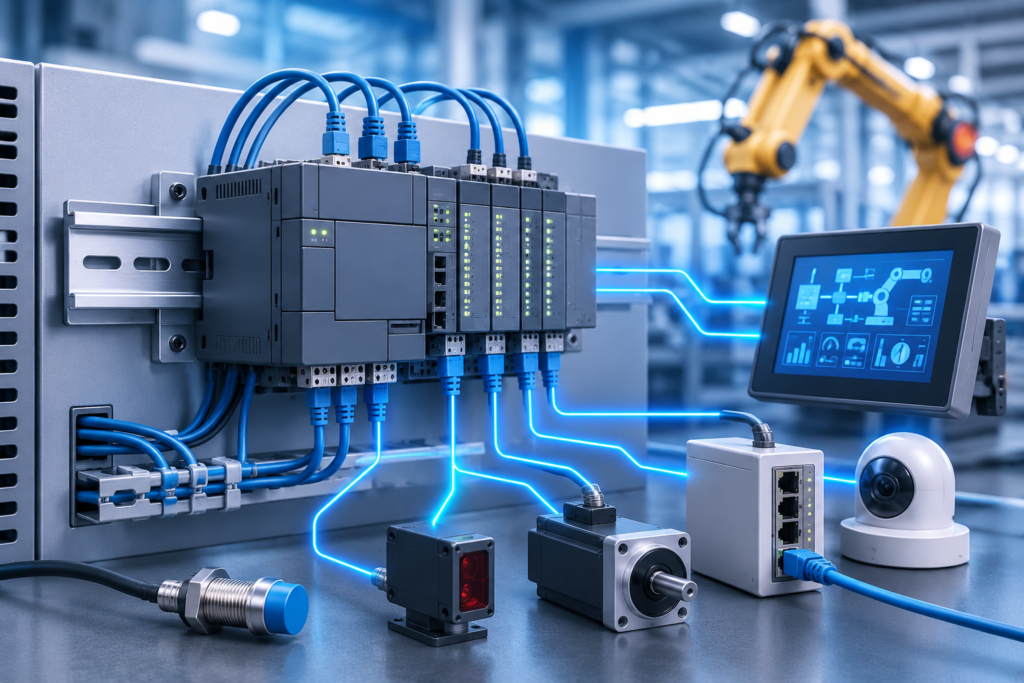
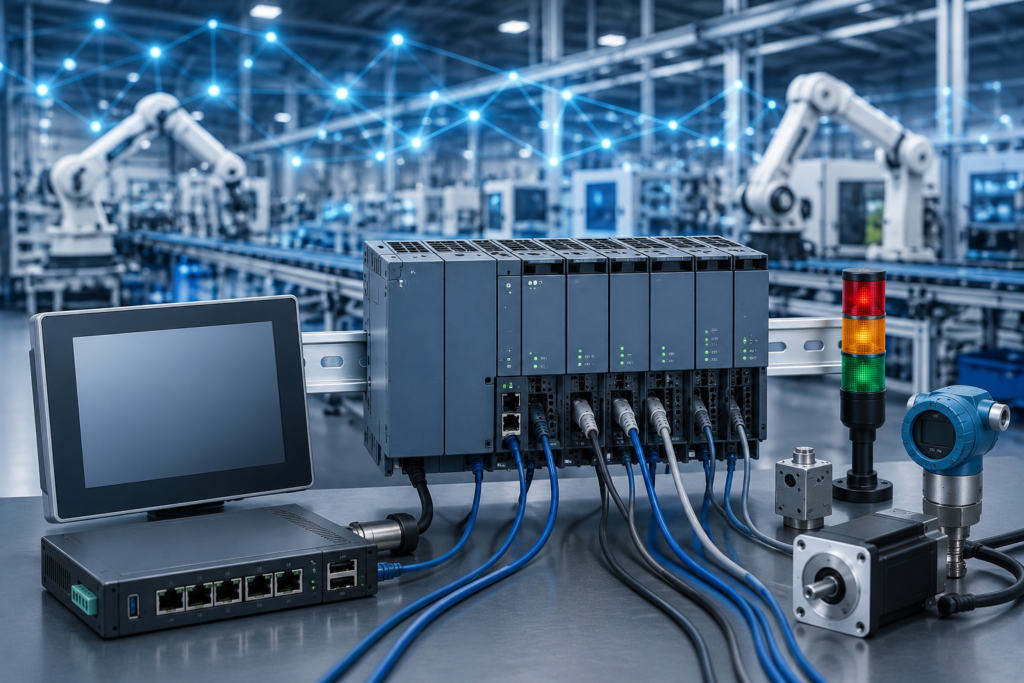
PLC Communication Protocols are essential in modern industrial automation. They allow Programmable Logic Controllers (PLCs) to exchange data with sensors, Human Machine Interfaces (HMIs), SCADA systems, Variable Frequency Drives (VFDs), and other industrial devices. Without reliable PLC Communication Protocols, machines cannot share information correctly. As a result, production becomes slower, troubleshooting takes more time, and system performance decreases.
Today, almost every automated factory depends on communication between multiple devices. Therefore, understanding PLC Communication Protocols is an important skill for automation engineers, technicians, students, and beginners. Whether you are designing a new control system or maintaining an existing production line, the right communication protocol helps devices exchange information quickly, accurately, and securely.
Different industries use different communication protocols because every automation project has unique requirements. For example, a small machine may only need simple serial communication. However, a large manufacturing plant often requires high-speed Ethernet communication between several PLCs, HMIs, SCADA systems, and smart field devices.
In this guide, you will learn what PLC Communication Protocols are, why they matter, how they work, and which protocols industries use most often. You will also discover their advantages, common applications, and practical examples that make each concept easier to understand.
What Are PLC Communication Protocols?
PLC Communication Protocols are a set of standard rules that allow a PLC to exchange information with other industrial devices. These rules define how devices send data, receive messages, verify information, and respond to communication requests. Because every device follows the same rules, communication remains accurate and reliable.
A simple example makes this easier to understand. Imagine two people speaking different languages. Even if both want to share information, they cannot understand each other without a common language. Industrial devices work in the same way. A PLC, an HMI, a motor drive, or a sensor must use a compatible communication protocol before they can exchange data successfully.
For example, a temperature sensor sends its current reading to the PLC. The PLC processes that information according to the control program. Next, it sends a command to start or stop a cooling fan. At the same time, the PLC may also send production data to an HMI so the operator can monitor the system. All of these actions happen through PLC Communication Protocols.
Because industrial communication has become more advanced, factories now connect hundreds or even thousands of devices through a single communication network. Consequently, selecting the correct protocol has become more important than ever.
Why Are PLC Communication Protocols Important?
Modern manufacturing depends on continuous communication between machines. Every production line contains different devices that must exchange information quickly and accurately. If communication fails, production slows down, machine faults increase, and maintenance becomes more difficult.
Reliable PLC Communication Protocols help automation systems perform efficiently every second. They allow controllers to receive real-time information from field devices and respond immediately whenever production conditions change. As a result, machines operate more safely and production quality remains consistent.
In addition, communication protocols reduce unnecessary wiring because several devices can share the same network. This approach lowers installation costs and also makes future expansion much easier. Furthermore, engineers can monitor equipment remotely, collect production data, and identify faults before they become serious problems.
Another important advantage is compatibility. Many factories use equipment from different manufacturers. Standard communication protocols allow these devices to work together without replacing the entire automation system. Therefore, companies can upgrade their production lines while protecting their existing investment.
How Do PLC Communication Protocols Work?
The communication process begins when industrial devices collect information from the production environment. Sensors measure variables such as temperature, pressure, level, flow, or position. Immediately after collecting this information, they send the data to the PLC through a communication network.
The PLC receives the incoming information and compares it with the logic stored inside its program. It then decides what action should happen next. If a motor needs to start, the PLC sends the appropriate command. If a tank reaches its maximum level, the PLC stops the filling process. Likewise, if an abnormal condition appears, the PLC activates an alarm and informs the operator.
At the same time, the PLC shares important production data with an HMI or a SCADA system. Operators can monitor machine performance, check alarms, view historical trends, and adjust process settings whenever necessary. Because communication happens continuously, the entire automation system responds within milliseconds.
This constant exchange of information keeps industrial processes stable, efficient, and reliable. Consequently, communication protocols play a critical role in every automated production line.
Devices That Use PLC Communication Protocols
Almost every industrial automation system includes several intelligent devices that communicate with one another. The PLC serves as the central controller, but it depends on information from many other components.
Sensors continuously send process data to the PLC so it can make accurate control decisions. Meanwhile, motor drives receive speed commands from the PLC and regulate motor performance. HMIs display machine status, operating values, and alarms so operators can monitor production easily. In larger factories, SCADA software collects information from multiple PLCs and provides complete supervision of the entire plant.
Modern robots, barcode scanners, energy meters, industrial printers, remote I/O modules, and smart instruments also communicate through industrial networks. Because these devices exchange information every second, reliable PLC Communication Protocols ensure that the complete automation system operates without communication errors.
Types of PLC Communication
Industrial automation mainly uses two communication methods. The first method is serial communication, while the second is Ethernet communication.
Serial communication has been part of industrial automation for many years. It transfers data over communication cables in a simple and reliable way. Although it offers lower communication speeds, many industries still use it because it performs well over long distances and works with older automation equipment. Protocols such as Modbus RTU and Profibus commonly operate on serial communication networks.
Ethernet communication has become the preferred choice for modern factories. It provides higher communication speeds, supports larger networks, and allows devices to exchange much more information in real time. Moreover, Ethernet networks simplify remote monitoring, cloud connectivity, and Industry 4.0 applications. For this reason, protocols such as Profinet, Modbus TCP/IP, EtherNet/IP, OPC UA, and MQTT continue to grow in popularity across different industries.
Choosing the Right PLC Communication Protocol
Every automation project has different communication requirements. Therefore, engineers must evaluate several factors before selecting a communication protocol. They usually consider network speed, communication distance, system reliability, expansion plans, equipment compatibility, and maintenance requirements. In addition, they think about future upgrades because a flexible communication network can reduce long-term costs.
Selecting the correct PLC Communication Protocols improves production efficiency, reduces machine downtime, simplifies troubleshooting, and increases overall system reliability. For this reason, communication protocols are no longer just a technical feature. Instead, they have become one of the most important parts of every modern industrial automation system.
In the next section, we will explore the most widely used PLC Communication Protocols, including Modbus, Profibus, Profinet, EtherNet/IP, OPC UA, and MQTT. You will also learn how each protocol works, where industries use it, and how to choose the best option for different automation projects.
Common Types of PLC Communication Protocols
After understanding the basics, the next step is to learn the most popular PLC Communication Protocols used in industrial automation. Every protocol has its own features, strengths, and applications. Some work better in older systems, while others support modern smart factories and high-speed communication.
Choosing the right protocol depends on the machine, the communication speed, the number of connected devices, and the factory environment. Therefore, engineers always study the project requirements before selecting a communication protocol.
Modbus RTU
Modbus RTU is one of the oldest and most widely used PLC Communication Protocols. It was introduced in 1979 and is still common in factories around the world. Because it is simple and reliable, many industries continue to use it for communication between PLCs and field devices.
Modbus RTU works through serial communication, usually over an RS-485 network. One device acts as the master, while the other devices work as slaves. The master sends requests, and the slaves reply with the required information.
Many sensors, temperature controllers, energy meters, and motor drives support Modbus RTU. As a result, engineers can connect equipment from different manufacturers without major compatibility issues.
Although Modbus RTU is reliable, it transfers data more slowly than Ethernet-based protocols. Therefore, it is a better choice for small and medium-sized automation systems where high communication speed is not essential.
Modbus TCP/IP
Modbus TCP/IP is the modern version of Modbus. Instead of using serial cables, it works over an Ethernet network. Because of this improvement, communication becomes much faster and more efficient.
Many factories prefer Modbus TCP/IP because it supports larger networks and allows multiple devices to exchange data at the same time. In addition, installation becomes easier since many industrial facilities already use Ethernet infrastructure.
Engineers often use Modbus TCP/IP to connect PLCs with HMIs, SCADA software, industrial computers, and remote I/O stations. It also supports remote monitoring, which makes maintenance easier.
However, although Modbus TCP/IP offers higher speed, it does not always provide the advanced real-time performance required for every high-speed production line.
Profibus
Profibus is another important member of the PLC Communication Protocols family. Siemens developed this protocol for industrial automation, and many manufacturing plants still depend on it today.
Profibus communicates through a serial network and provides reliable communication between PLCs, remote I/O modules, sensors, and actuators.
One reason for its success is its stability. Even in harsh industrial environments, Profibus delivers reliable communication with very few errors. Therefore, industries such as food processing, chemical production, and manufacturing have used Profibus for many years.
Although Profibus remains popular, many companies now upgrade to Profinet because Ethernet technology provides faster communication and easier network expansion.
Profinet
Profinet is one of the fastest-growing PLC Communication Protocols in modern industrial automation. It is based on Industrial Ethernet and offers high-speed communication with excellent reliability.
Many Siemens PLC systems use Profinet as their primary communication protocol. It allows PLCs, HMIs, VFDs, robots, cameras, and remote I/O devices to exchange data almost instantly.
Because Profinet supports real-time communication, it performs very well in applications where timing is critical. Packaging machines, robotic systems, conveyor lines, and automated assembly stations often rely on Profinet to maintain smooth production.
Another advantage is flexibility. Engineers can expand the network without making major changes to the existing system. Consequently, Profinet has become one of the preferred solutions for Industry 4.0 applications.
EtherNet/IP
EtherNet/IP is another widely used protocol in industrial automation. Despite its name, it is different from the standard internet protocol used for office networks. Instead, it is designed specifically for industrial communication.
Rockwell Automation strongly supports EtherNet/IP, and many Allen-Bradley PLCs use this protocol in manufacturing plants.
EtherNet/IP allows PLCs to communicate with drives, sensors, robots, barcode scanners, safety devices, and other smart equipment through a single Ethernet network.
The protocol offers fast communication, simple installation, and excellent compatibility with modern industrial devices. Therefore, many automotive and manufacturing companies use EtherNet/IP for large automation systems.
DeviceNet
DeviceNet was developed for connecting smaller field devices. It works well with sensors, switches, push buttons, motor starters, and similar equipment.
Many older production lines still use DeviceNet because it reduces wiring and simplifies installation. Instead of connecting every device separately, engineers can connect many devices through one communication cable.
Although DeviceNet remains reliable, Ethernet-based solutions now replace it in many new automation projects.
CANopen
CANopen is another industrial communication protocol that supports reliable communication between controllers and intelligent devices.
Machine builders often use CANopen in mobile equipment, packaging machines, medical equipment, and transportation systems. The protocol offers stable communication while keeping installation costs relatively low.
Because CANopen supports distributed control, engineers can design flexible automation systems with multiple intelligent devices.
OPC UA
OPC UA has become one of the most important PLC Communication Protocols for Industry 4.0. Unlike traditional protocols, OPC UA focuses on secure data sharing between different software platforms and automation systems.
Many factories use OPC UA to exchange information between PLCs, SCADA software, Manufacturing Execution Systems (MES), cloud platforms, and business management software.
One of its biggest strengths is security. OPC UA includes encryption and authentication features that help protect industrial data from unauthorized access.
As industries continue moving toward digital transformation, the demand for OPC UA continues to increase.
Why Different PLC Communication Protocols Exist
No single communication protocol can solve every automation challenge. Some factories need extremely fast communication, while others focus on reliability or long communication distances. Similarly, older production lines often require compatibility with existing equipment, whereas modern factories need cloud connectivity and real-time data exchange.
For this reason, different PLC Communication Protocols continue to exist. Each protocol solves a specific communication problem and supports different industrial applications. Understanding these differences helps engineers build automation systems that are efficient, reliable, and ready for future expansion.
Comparing PLC Communication Protocols
After learning about the most common PLC Communication Protocols, the next step is to understand how they differ. Every protocol has its own purpose. Some focus on speed, while others focus on reliability or compatibility. Therefore, engineers always compare different options before making a final decision.
For example, Modbus RTU is a good choice for simple automation systems because it is easy to install and supports many industrial devices. On the other hand, Profinet delivers much higher communication speeds and works well in modern factories where machines exchange large amounts of data every second.
Similarly, EtherNet/IP performs well in manufacturing plants that use Allen-Bradley controllers. Meanwhile, OPC UA focuses on secure data sharing between industrial equipment and software platforms. MQTT, however, is designed for cloud communication and Industrial Internet of Things (IIoT) applications.
Instead of asking which protocol is the best, engineers usually ask which protocol is the best for a specific project. The correct answer always depends on the application.
Serial Communication vs Ethernet Communication
Many beginners wonder whether serial communication or Ethernet communication is the better option. The truth is that both have important advantages.
Serial communication has served industrial automation for many years. It offers stable performance, simple installation, and reliable communication over long distances. Because of these benefits, many older production lines still use serial-based PLC Communication Protocols.
However, Ethernet communication has become the preferred solution for modern factories. It transfers data much faster, supports larger networks, and connects many intelligent devices through a single infrastructure.
Another advantage of Ethernet is flexibility. Engineers can expand the network more easily without replacing the complete communication system. In addition, Ethernet supports remote monitoring, cloud connectivity, and Industry 4.0 technologies.
As industrial automation continues to evolve, more companies choose Ethernet communication for new projects while maintaining serial communication in existing systems.
How to Choose the Right PLC Communication Protocol
Choosing the right PLC Communication Protocols requires careful planning. Every automation project has different technical requirements, so engineers must evaluate several important factors before selecting a protocol.
The first consideration is communication speed. High-speed packaging machines, robotic systems, and automated assembly lines need very fast communication. Therefore, Ethernet-based protocols usually provide the best solution.
The second factor is compatibility. Many factories already have existing equipment installed. If the current devices support Modbus RTU or Profibus, replacing the entire communication network may not be necessary.
Another important factor is future expansion. A factory may start with a small production line today, but it could add more machines later. Choosing a flexible communication protocol makes future upgrades easier and more cost-effective.
Security also plays an important role. Modern factories exchange valuable production data every day. Consequently, communication protocols with strong security features help protect industrial networks from unauthorized access.
Finally, engineers consider maintenance requirements. A communication network should be easy to diagnose and repair because quick troubleshooting reduces machine downtime.
Common Problems in PLC Communication Protocols
Even the most reliable communication network can experience problems. Fortunately, most communication faults follow common patterns and are easy to identify with a systematic approach.
One common problem is communication loss between the PLC and another device. This issue often appears because of damaged cables, loose connectors, incorrect network settings, or power supply problems.
Another frequent problem is incorrect device addressing. Every device on the network needs a unique communication address. If two devices use the same address, communication errors may occur.
Network noise is another challenge in industrial environments. Large motors, welding machines, and high-voltage equipment can create electrical interference. As a result, communication signals become unstable.
Engineers also encounter software configuration errors. Sometimes the communication protocol is correct, but the baud rate, IP address, subnet mask, or communication parameters do not match between devices.
Firmware compatibility can also create unexpected communication failures. If one device uses outdated firmware while another uses a newer version, they may not communicate correctly.
Although these problems sound serious, proper installation and regular maintenance reduce most communication failures.
Troubleshooting PLC Communication Problems
Effective troubleshooting always begins with a simple inspection. Engineers first check cable connections because loose or damaged cables cause many communication failures.
Next, they verify the power supply of every connected device. A communication network cannot operate correctly if one device loses power.
After that, engineers examine communication settings. They compare device addresses, baud rates, IP addresses, subnet masks, and protocol configurations to make sure every setting matches.
Diagnostic software also plays an important role. Many PLC manufacturers provide tools that display communication status, error messages, and network health information. These tools help engineers identify problems much faster.
If communication still fails, engineers inspect network switches, communication modules, and interface cards. Replacing a faulty hardware component often restores normal communication immediately.
Finally, engineers test the complete communication network before returning the machine to production. This final verification ensures that every connected device exchanges data correctly.
Best Practices for PLC Communication Protocols
Following good engineering practices improves communication reliability and reduces unexpected failures.
A well-designed network begins with high-quality industrial communication cables. Cheap cables may reduce installation costs, but they often create communication problems later.
Proper cable routing is equally important. Communication cables should remain separate from high-voltage power cables whenever possible. This simple practice reduces electrical interference and improves signal quality.
Regular software backups also protect valuable communication settings. If hardware fails, engineers can restore the original configuration quickly.
Keeping firmware updated improves compatibility, stability, and cybersecurity. However, updates should always be tested before installation on production equipment.
Finally, regular preventive maintenance helps identify small communication problems before they become major production issues.
Real-World Applications of PLC Communication Protocols
Today, PLC Communication Protocols support almost every manufacturing industry. Automotive factories use high-speed communication networks to coordinate robotic assembly lines. Food processing plants rely on PLC communication to monitor temperature, filling systems, and packaging equipment.
Chemical industries use communication protocols to control pumps, valves, and process instruments safely. Water treatment plants depend on PLC communication to monitor water levels, pressure, and pump operation across large facilities.
Similarly, pharmaceutical manufacturers use industrial communication networks to maintain product quality and meet strict production standards. Energy plants also depend on reliable communication between PLCs, protection systems, and monitoring software.
As Industry 4.0 continues to expand, communication protocols connect factory equipment with cloud platforms, artificial intelligence systems, and predictive maintenance software. Therefore, strong communication has become one of the most valuable parts of every modern automation system.
Understanding PLC Communication Protocols not only improves technical knowledge but also helps engineers design automation systems that are faster, smarter, and more reliable.
Frequently Asked Questions About PLC Communication Protocols
What are PLC Communication Protocols?
PLC Communication Protocols are standard rules that allow a Programmable Logic Controller to exchange data with industrial devices such as sensors, HMIs, SCADA systems, motor drives, and remote I/O modules. These protocols ensure that every device communicates accurately and reliably.
Which PLC Communication Protocol is the most commonly used?
There is no single protocol that fits every application. However, Modbus RTU, Modbus TCP/IP, Profinet, Profibus, EtherNet/IP, OPC UA, and MQTT are among the most widely used PLC Communication Protocols in modern industrial automation.
What is the difference between Modbus and Profinet?
Modbus is simple, reliable, and easy to implement. It is often used in small and medium-sized automation systems. Profinet, on the other hand, uses Industrial Ethernet and offers much higher communication speeds. Therefore, Profinet is better for applications that require real-time communication and large industrial networks.
Why do factories use different PLC Communication Protocols?
Every factory has different production requirements. Some systems need high-speed communication, while others focus on long communication distances or compatibility with existing equipment. Because of these differences, engineers select the protocol that best matches the application.
Can different PLC brands communicate with each other?
Yes. Many PLC manufacturers support common communication standards. If both controllers support the same protocol, they can exchange data successfully. In some situations, engineers also use communication gateways to connect devices that use different protocols.
Are PLC Communication Protocols important for Industry 4.0?
Yes. Industry 4.0 depends on continuous data exchange between machines, software, and cloud platforms. Modern PLC Communication Protocols such as Profinet, OPC UA, EtherNet/IP, and MQTT make this communication faster, smarter, and more secure.
How can communication problems be prevented?
Proper network design, high-quality communication cables, correct device configuration, regular maintenance, and updated firmware reduce most communication problems. In addition, routine inspections help engineers identify small issues before they affect production.