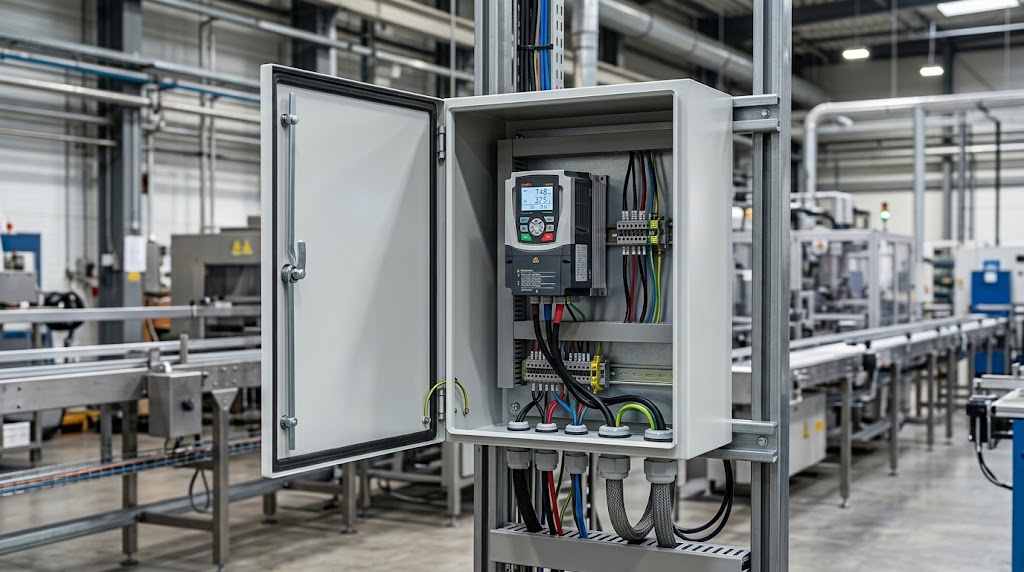
Variable Frequency Drives (VFDs) are widely used in industrial automation to control motor speed and improve system efficiency. However, a VFD must also be protected from the environment where it operates. Dust, moisture, chemicals, and other industrial conditions can affect its performance and service life.
This is where VFD Enclosure Ratings become important. IP and NEMA ratings are used to describe the level of protection provided by an electrical enclosure. Therefore, the correct enclosure should be selected according to the installation environment.
What Are VFD Enclosure Ratings?
VFD enclosure ratings indicate how well the enclosure protects the drive and its internal components from external conditions. In industrial applications, this protection is especially important because electrical equipment can be exposed to dust, water, oil, and other contaminants.
Two common systems are used for enclosure protection: IP ratings and NEMA ratings. Although both describe enclosure protection, they use different classification methods.
As a result, engineers should understand both systems before selecting a VFD enclosure.
Why Enclosure Protection Matters
A VFD can be affected when dust or moisture enters its enclosure. Over time, electrical components may be contaminated, cooling performance can be reduced, and unwanted faults can occur.
For this reason, suitable enclosure protection should be considered during VFD installation. Moreover, the right enclosure can help reduce environmental exposure and support more reliable operation.
However, the highest rating is not always necessary. Instead, the enclosure should be matched to the actual operating environment.
What Is an IP Rating?
An IP rating, or Ingress Protection rating, is used to describe protection against the entry of solid particles and water.
The rating normally contains two digits. The first digit relates to protection against solid objects and dust, while the second digit relates to protection against water.
For example, an enclosure with a higher first digit generally provides greater protection against dust. Similarly, a higher second digit indicates greater resistance to certain types of water exposure.
Therefore, IP ratings can be useful when a VFD is installed in environments where dust or moisture is a concern.
Common IP Protection Levels
Different industrial environments require different levels of protection. For example, a relatively clean electrical room may require less protection than a manufacturing area where dust and moisture are regularly present. Therefore, the appropriate IP rating should be selected according to the conditions around the VFD.
An IP20 enclosure provides basic protection against solid objects, but it does not provide protection against water. As a result, it is generally more suitable for clean and controlled indoor environments where moisture exposure is not expected.
An IP54 enclosure provides limited protection against dust and protection against water splashes. Similarly, IP55 provides better protection against dust and can protect the enclosure against water jets. These ratings can therefore be considered for industrial areas where moderate dust or moisture may be present.
An IP65 enclosure is dust-tight and provides protection against water jets. Because of this, it can be suitable for environments where greater protection from dust and water is required. However, the final rating should always be selected according to the actual installation conditions and the VFD manufacturer's specifications.
What Is a NEMA Rating?
NEMA ratings are another method used to classify electrical enclosures. Unlike IP ratings, NEMA classifications consider broader environmental conditions, including factors such as corrosion and certain types of hazardous exposure.
NEMA enclosure types are commonly used in North American industrial applications. They help engineers determine whether an enclosure is suitable for indoor, outdoor, wet, dusty, or other specific environments.
Therefore, when VFD Enclosure Ratings are being evaluated, both the installation location and the applicable enclosure standard should be considered.
IP vs NEMA Protection
IP and NEMA ratings should not be treated as identical systems. They classify protection differently and use different testing and classification methods.
As a result, an IP rating should not automatically be converted into a specific NEMA rating without checking the relevant standards and manufacturer's documentation.
For VFD installations, the practical goal is simple: select an enclosure that provides appropriate protection for the actual environment while meeting the required installation standards.
Understanding NEMA Enclosure Types
NEMA enclosure types are commonly used to identify the environmental protection provided by electrical enclosures. While IP ratings mainly describe protection against solid particles and water, NEMA classifications can also consider other environmental factors. Therefore, NEMA ratings can be useful when a VFD is installed in demanding industrial conditions.
For example, NEMA 1 enclosures are generally intended for indoor locations where protection from accidental contact and falling dirt is required. However, they are not designed for significant exposure to water or outdoor conditions.
NEMA 3R enclosures are designed for certain indoor and outdoor applications where protection from rain, sleet, snow, and falling dirt is needed. Because of this, they can be considered for suitable outdoor electrical installations.
NEMA 4 provides protection against windblown dust and water, including water directed toward the enclosure. Similarly, NEMA 4X provides comparable protection while also offering additional resistance to corrosion. Consequently, these enclosure types can be considered for harsh industrial environments where moisture, dust, or corrosive conditions may be present.
Choosing the Right VFD Enclosure
The correct enclosure should be selected according to the environment in which the VFD will operate. First, the presence of dust and moisture should be considered. Then, factors such as temperature, chemicals, oil, corrosion, and outdoor exposure should also be evaluated.
For example, a VFD installed inside a clean control room may not require the same enclosure protection as a drive installed near a production process. Similarly, equipment located outdoors may need protection from rain and changing weather conditions.
Therefore, VFD Enclosure Ratings should never be selected based only on the rating number. Instead, the actual environmental conditions and installation requirements should be reviewed before the enclosure is chosen.
VFD Cooling and Enclosure Protection
Enclosure protection is important, but cooling must also be considered. A sealed enclosure can reduce the movement of outside air around the VFD. As a result, heat generated by the drive may need to be removed through an appropriate cooling system.
If excessive heat is allowed to build up, the VFD may experience thermal protection trips or reduced component life. Therefore, the enclosure design should provide suitable heat dissipation while maintaining the required environmental protection.
Depending on the application, ventilation, filtered cooling, heat exchangers, or air-conditioning systems may be used. However, the selected cooling method should be compatible with the required enclosure rating.
Common Mistakes When Selecting an Enclosure
One common mistake is selecting an enclosure with insufficient protection for the installation environment. For instance, an enclosure designed for a clean indoor area may not be suitable where heavy dust or water exposure is present.
Another mistake is choosing a very high protection rating without considering heat management. Although greater protection can reduce environmental exposure, it can also make heat removal more challenging.
For this reason, the enclosure rating, cooling method, installation location, and VFD manufacturer's requirements should all be considered together.
VFD Enclosure Ratings for Indoor Applications
Indoor VFD installations can have very different environmental conditions. A clean control room usually exposes the drive to less dust and moisture than a production floor. Therefore, engineers should evaluate the actual location instead of selecting an enclosure based only on the fact that the installation is indoors.
In a clean electrical room, a basic enclosure may provide sufficient protection. However, manufacturing areas can contain airborne dust, oil mist, moisture, or other contaminants. As a result, a higher level of protection may be required to keep the VFD components clean and reliable.
The enclosure should also provide enough space around the VFD for proper airflow and maintenance access. Even when the enclosure offers excellent environmental protection, poor installation can restrict cooling and increase the operating temperature of the drive.
VFD Enclosure Ratings for Outdoor Installation
Outdoor VFD installations require additional attention because the equipment can face rain, sunlight, dust, humidity, and temperature changes. Therefore, the enclosure should provide suitable protection for the expected weather conditions.
Water exposure presents a particular concern. Rain can enter through poorly sealed doors, cable openings, or other enclosure gaps. For this reason, installers should maintain the enclosure's sealing system and use suitable cable glands and entry methods.
Temperature also matters outdoors. Direct sunlight can significantly increase the temperature inside an enclosure. Consequently, the VFD may require additional cooling or a suitable shade arrangement to maintain an acceptable operating temperature.
VFD Enclosure Ratings in Dusty Environments
Dust can create serious problems for electrical equipment when it enters sensitive components. Fine dust may collect around electronic parts and cooling areas, while conductive or combustible dust can create additional risks.
For dusty industrial environments, engineers should consider an enclosure with appropriate dust protection. However, enclosure selection alone does not solve every problem. The installation should also prevent unnecessary openings and maintain proper sealing around cables and access doors.
Regular inspection should be carried out as well. If dust accumulation is found around the enclosure or cooling system, the cause should be investigated rather than simply cleaning the surface.
VFD Enclosure Ratings in Wet Areas
Moisture can damage electrical components and may contribute to corrosion, insulation problems, and electrical faults. Therefore, VFD Enclosure Ratings become especially important when drives are installed near washdown areas, pumps, processing equipment, or other wet locations.
The required VFD Enclosure Rating should match the type of water exposure expected at the installation site. Occasional splashes require different protection from direct water jets or continuous moisture. For this reason, engineers should evaluate the environment carefully before selecting an enclosure.
Furthermore, correct installation plays an important role in maintaining VFD Enclosure Ratings. Water can still reach internal components through cable entries, damaged seals, or incorrectly positioned doors, even when the enclosure has an appropriate rating.
VFD Enclosure Ratings for Corrosive Industrial Environments
Some industrial facilities contain chemicals, salt, cleaning agents, or other substances that can accelerate corrosion. In these environments, VFD Enclosure Ratings should be considered together with the enclosure material and the substances present around the equipment.
NEMA classifications can provide useful information because certain enclosure types address corrosion resistance in addition to protection from dust and water. For example, NEMA 4X is commonly associated with applications where additional corrosion resistance is required.
However, the enclosure material should still be checked against the specific chemicals present at the installation site. A particular VFD Enclosure Rating does not automatically guarantee compatibility with every chemical or corrosive substance.
VFD Enclosure Ratings and Maintenance
Even a correctly selected enclosure requires regular maintenance. Seals can deteriorate, doors can become misaligned, and cable-entry points can lose their original protection over time. Therefore, maintenance helps preserve the protection provided by the VFD Enclosure Ratings.
Maintenance personnel should periodically inspect enclosure doors, gaskets, cable glands, cooling equipment, and visible signs of corrosion or damage. If a sealing component becomes damaged, it should be replaced according to the manufacturer's recommendations.
In addition, maintenance work should not reduce the original enclosure protection. When technicians add cable entries, modify the enclosure, or replace components, they should use methods that maintain the required VFD Enclosure Rating.
Checking Manufacturer Specifications for VFD Enclosure Ratings
Before installing a VFD, always check the manufacturer's documentation for the required enclosure conditions. The manufacturer may specify acceptable temperature ranges, installation clearances, cooling requirements, enclosure types, and environmental limits.
This step is important because the same VFD model may be available with different enclosure configurations. Consequently, the VFD Enclosure Rating should be verified for the complete installation rather than assumed from the VFD model alone.
By selecting suitable VFD Enclosure Ratings and combining them with proper installation, cooling, sealing, and maintenance practices, industrial facilities can provide better environmental protection for their drives and support reliable operation over time.
How to Maintain VFD Enclosure Protection
Proper maintenance helps preserve the protection provided by VFD Enclosure Ratings. Even a strong enclosure can lose its effectiveness when seals become damaged, doors remain open, or cable entries develop gaps.
Therefore, maintenance teams should inspect the enclosure regularly. They should check door seals, hinges, cable glands, ventilation equipment, and visible signs of corrosion. In addition, they should remove accumulated dust from external surfaces and cooling areas according to the manufacturer's cleaning instructions.
Technicians should also inspect the enclosure after major maintenance work. If someone modifies the enclosure or adds a new cable entry, the modification should maintain the original protection level. Otherwise, a small opening can allow dust or moisture to enter the VFD.
VFD Enclosure Ratings and Cable Entries
Cable entries often receive less attention than the enclosure itself. However, an unsuitable cable gland or poorly sealed entry can reduce the overall environmental protection.
For this reason, installers should select cable glands and accessories that suit the required VFD Enclosure Rating. They should also ensure that unused openings receive appropriate sealing components.
Furthermore, cables should enter the enclosure in a way that prevents unnecessary water or dust exposure. Proper cable management can therefore help maintain the protection expected from the complete installation.
VFD Enclosure Ratings and Temperature Control
Environmental protection and temperature control must work together. A highly sealed enclosure can limit natural airflow, while a VFD continuously produces heat during operation.
As a result, engineers should calculate the expected heat load and select an appropriate cooling method. Depending on the application, the system may use ventilation, filtered fans, heat exchangers, or air-conditioning.
However, the cooling solution should not reduce the required VFD Enclosure Ratings. For example, an improperly designed ventilation opening can create a path for dust or moisture to enter the enclosure.
Therefore, the enclosure design should balance environmental protection with effective heat management.
How to Select the Right VFD Enclosure Rating
Selecting the correct VFD Enclosure Rating starts with understanding the installation environment. First, identify the level of dust, water, humidity, chemicals, oil, and corrosion present around the drive.
Next, determine whether the VFD will operate indoors or outdoors. Outdoor installations usually require additional consideration for rain, sunlight, temperature changes, and weather exposure.
After that, evaluate the cooling requirements. The selected enclosure must protect the drive while also allowing enough heat removal for reliable operation.
Finally, check the manufacturer's documentation and applicable installation standards. By following these steps, engineers can select protection that matches the actual application instead of relying on assumptions.
Frequently Asked Questions
What are VFD Enclosure Ratings?
VFD Enclosure Ratings describe the level of environmental protection provided around a variable frequency drive. IP and NEMA systems commonly identify protection against conditions such as dust, water, and other environmental factors.
What is the difference between IP and NEMA ratings?
IP ratings mainly classify protection against solid particles and water. NEMA classifications consider a broader range of environmental conditions and enclosure characteristics. Therefore, engineers should use the appropriate standard for the specific application.
Is IP65 suitable for a VFD?
IP65 provides dust-tight protection and protection against water jets. However, suitability depends on the actual installation environment, cooling requirements, and the VFD manufacturer's specifications.
Which VFD enclosure rating should I use outdoors?
Outdoor applications require protection against the specific weather and environmental conditions at the installation site. Rain, dust, sunlight, humidity, and temperature changes should all be considered before selecting the VFD Enclosure Rating.
Does a higher enclosure rating always mean better protection?
Not necessarily. A higher rating can provide greater environmental protection, but it may also affect heat dissipation and cooling requirements. Therefore, the correct VFD Enclosure Rating should match the application rather than simply being the highest available rating.
How does cooling affect VFD enclosure selection?
A VFD generates heat during operation, and a sealed enclosure can make heat removal more difficult. Consequently, the cooling system should be designed alongside the enclosure so that thermal performance and environmental protection remain suitable.
Can maintenance affect the VFD Enclosure Rating?
Yes. Damaged seals, incorrect cable glands, new openings, or poor modifications can reduce the enclosure's protection. Therefore, maintenance and modifications should follow the manufacturer's requirements and preserve the original VFD Enclosure Rating.
Conclusion
VFD Enclosure Ratings play an important role in protecting variable frequency drives from environmental conditions. IP ratings help describe protection against solid particles and water, while NEMA classifications provide a broader approach to enclosure protection for different environments.
However, the rating alone does not guarantee reliable operation. Proper installation, cable sealing, cooling, inspection, and maintenance also matter. Therefore, engineers should consider the complete installation when selecting an enclosure.
When the correct enclosure protection matches the operating environment, the VFD can remain better protected from dust, moisture, corrosion, and other external conditions. Consequently, a well-planned enclosure can support reliable drive operation and help reduce avoidable environmental problems.