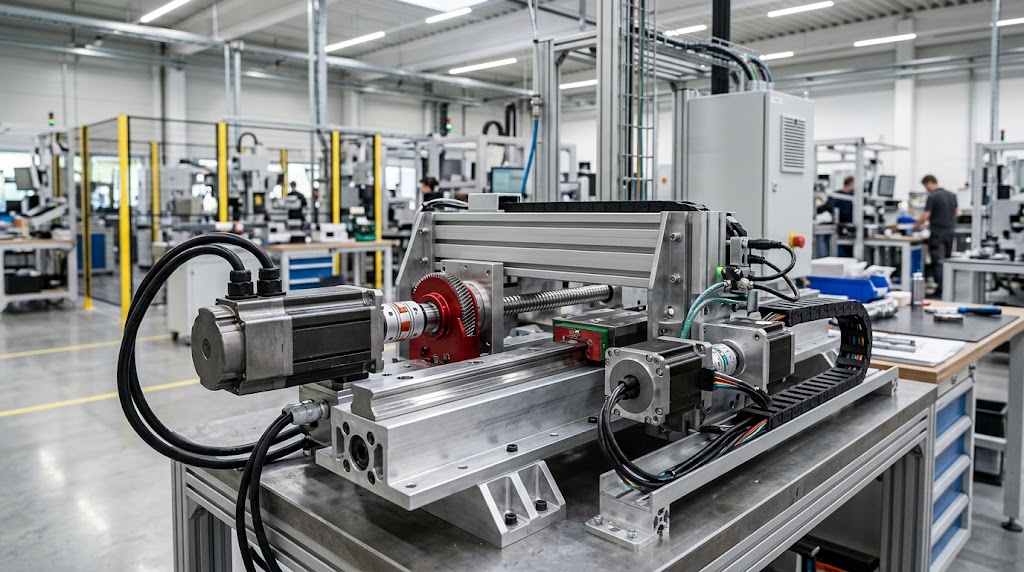
Modern industrial automation depends heavily on precise motion control. Machines used in packaging, CNC machining, robotics, assembly, and material handling often need motors that can move accurately, respond quickly, and maintain reliable operation. Among the most widely used motion-control technologies are servo motors and stepper motors.
Understanding the Servo Motor vs Stepper Motor difference is important because both motor types are designed for controlled motion, yet they operate differently and perform better under different conditions. Therefore, selecting the right motor requires more than simply comparing speed or price.
What Is a Servo Motor?
A servo motor is a closed-loop motion-control motor designed to provide precise control over position, speed, and torque. Unlike a basic motor that may operate primarily according to applied voltage, a servo system continuously monitors the motor's actual movement and compares it with the desired position.
Typically, a servo system includes the motor, a feedback device such as an encoder, and a servo drive. The encoder sends position or speed information back to the controller. As a result, the system can detect movement errors and make rapid corrections during operation.
Because of this feedback mechanism, servo motors are commonly used where high accuracy, fast response, and dynamic performance are essential. For example, CNC machines, robotic arms, automated assembly equipment, and high-speed packaging machines often rely on servo technology.
What Is a Stepper Motor?
A stepper motor is an electronically controlled motor that moves in precise angular steps. Instead of continuously rotating like a conventional motor, it receives electrical pulses that command the motor to move through defined increments.
Stepper motors are generally simpler than servo systems because many applications can operate without an external position encoder. Consequently, they are often easier to configure and can provide accurate positioning at relatively low cost.
However, their performance depends strongly on the application. As speed increases or the mechanical load becomes demanding, a stepper motor can lose torque and may potentially miss steps. For this reason, stepper motors are commonly selected for applications where moderate speed, predictable movement, and cost efficiency are more important than extremely high dynamic performance.
Why the Difference Matters in Industrial Automation
Although both technologies can control machine movement, their operating characteristics are not identical. A servo motor generally provides continuous feedback and active correction, whereas a conventional stepper system typically relies on commanded steps.
Therefore, the choice between them should be based on factors such as required accuracy, operating speed, load characteristics, acceleration, duty cycle, control requirements, and overall system cost.
Servo Motor vs Stepper Motor: How Their Control Systems Differ
The biggest difference between these two motor technologies is how motion is controlled and monitored. In a typical servo system, feedback is continuously returned to the controller. The system can therefore compare the commanded position with the actual motor position and correct deviations when necessary.
A conventional stepper system, on the other hand, usually operates according to the number of electrical pulses supplied to the motor. Each pulse represents a commanded movement. As a result, the controller can determine the expected position without necessarily receiving continuous position feedback.
This difference becomes particularly important when a machine experiences changing loads. A servo system can respond to an error detected through feedback, while an open-loop stepper system may continue following the commanded sequence even if the motor cannot physically complete every step.
Speed and Torque Performance
Speed and torque are also important when evaluating a Servo Motor vs Stepper Motor application. Stepper motors can produce useful holding torque at low speeds, making them suitable for many positioning tasks. However, their available torque generally decreases as operating speed increases.
Servo motors are designed for a wider range of dynamic operating conditions. Their feedback system allows the drive to regulate motor operation according to changing speed and load requirements. Consequently, servos are often preferred for high-speed machinery that requires rapid acceleration, deceleration, and precise movement.
For instance, a packaging machine that repeatedly accelerates and stops a mechanical axis may benefit from servo technology because the motor and drive can actively manage these changing conditions.
Positioning Accuracy
Both motor types can achieve accurate positioning when properly selected and configured. However, the method used to maintain that position is different.
A stepper motor moves according to commanded steps, so its theoretical position can be calculated from the pulse count and motor configuration. Nevertheless, excessive load, acceleration, resonance, or insufficient torque can cause missed steps in an open-loop system.
A servo system uses feedback to determine the motor's actual position. If the measured position differs from the commanded position, the drive can adjust the motor's operation. Therefore, servo systems are particularly useful when the application demands consistent positioning under changing mechanical conditions.
Efficiency and Heat Generation
Energy efficiency and thermal performance should also be considered during motor selection. A stepper motor can consume significant current while holding a stationary load because it may need to maintain electromagnetic torque continuously.
Servo systems can behave differently because the drive regulates motor current according to the actual operating requirement. When properly sized, this can reduce unnecessary energy consumption during portions of the operating cycle.
However, efficiency depends on the complete system, including the motor, drive, mechanical load, speed profile, and duty cycle. Therefore, neither technology should be selected solely on motor efficiency specifications.
When Should You Choose a Servo Motor?
Servo motors are generally considered when an application requires high dynamic response, precise feedback-based control, rapid acceleration, or reliable operation under changing loads.
They are commonly found in CNC equipment, robotics, automated production lines, high-speed packaging systems, and precision positioning machinery. In these environments, the additional complexity of a servo system can be justified by the performance and control it provides.
When Is a Stepper Motor More Suitable?
Stepper motors can be a practical choice for applications with moderate speed and predictable loads where cost, simplicity, and straightforward positioning are important.
They are frequently used in small automation equipment, laboratory machinery, 3D printers, indexing mechanisms, and other motion systems. Moreover, their simpler control architecture can make them attractive when continuous feedback is not essential.
Ultimately, the right choice in a Servo Motor vs Stepper Motor comparison depends on the machine's actual operating requirements rather than on one motor type being universally better than the other.
Servo Motor vs Stepper Motor: Application-Based Selection
Choosing between these motor technologies becomes easier when the machine's actual operating conditions are examined. Instead of focusing only on motor specifications, engineers normally consider the complete motion profile, including load, speed, acceleration, positioning requirements, and operating cycle.
For this reason, the Servo Motor vs Stepper Motor decision should begin with the mechanical requirements of the application.
Load Characteristics and Inertia
The type of mechanical load has a major influence on motor selection. A system with a relatively constant and predictable load may be suitable for a stepper motor, particularly when the required speed remains within its practical operating range.
However, applications involving rapidly changing loads or significant rotational inertia can place greater demands on the motion system. In such cases, a servo motor can provide better dynamic control because the drive continuously responds to feedback from the motor.
Furthermore, the relationship between motor inertia and load inertia should be considered during system design. Poorly matched inertia can affect acceleration, settling time, and overall motion stability.
Acceleration and Deceleration Requirements
Machines that frequently start, stop, and change direction require motors capable of handling repeated acceleration and deceleration.
Stepper motors can perform these movements effectively when the required acceleration remains within their available torque range. Nevertheless, aggressive acceleration profiles can increase the possibility of losing synchronization in an open-loop system.
Servo systems are generally better suited to demanding motion profiles because the drive can monitor actual motor behavior and adjust output during operation. Consequently, high-speed indexing, robotic movement, and precision positioning systems often use servo technology.
Duty Cycle and Continuous Operation
The machine's duty cycle should also be evaluated before selecting a motor. A motor operating intermittently may have very different thermal requirements from one running continuously under load.
Step-by-step analysis of operating time, load percentage, acceleration periods, and idle periods helps determine whether the selected motor can remain within acceptable thermal limits.
In addition, the drive and motor should be considered as a complete system rather than as isolated components. Proper sizing can improve reliability and reduce unnecessary heating during long production cycles.
Frequently Asked Questions
Which is better, a servo motor or a stepper motor?
Neither motor is universally better. The correct choice depends on the machine's speed, torque, accuracy, load, acceleration, and control requirements.
What is the main difference between a servo motor and a stepper motor?
A servo system normally uses feedback to monitor actual motor movement, while a conventional stepper system usually moves according to commanded electrical pulses.
Are stepper motors suitable for industrial automation?
Yes. Stepper motors can suit industrial applications that require controlled positioning, moderate speed, and predictable loads.
Why do industrial machines use servo motors?
Industrial machines use servo motors when they need precise motion, rapid acceleration, high dynamic response, and feedback-based control.
Can a stepper motor replace a servo motor?
In some applications, yes. However, the machine must meet the stepper motor's available torque, speed, acceleration, and positioning requirements.
How do I select between a servo motor and a stepper motor?
Start by calculating the required torque and speed. Then evaluate acceleration, load inertia, duty cycle, positioning accuracy, environmental conditions, and controller compatibility.
Conclusion
The Servo Motor vs Stepper Motor comparison shows that both technologies can solve different motion-control requirements. Servo motors suit applications that demand high speed, dynamic response, feedback, and precise control. Stepper motors can work well for simpler positioning tasks where moderate speed and predictable loads meet the machine requirements.
Therefore, engineers should select the motor according to torque, speed, acceleration, load inertia, duty cycle, positioning accuracy, control architecture, and budget. Proper motor sizing remains essential for achieving reliable performance and long-term machine operation.