Table of Contents
ToggleIntroduction
HMI vs SCADA is one of the most common comparisons in industrial automation. Many beginners think both technologies perform the same job. In reality, they serve different purposes while working together to improve industrial operations. Understanding HMI vs SCADA helps engineers, technicians, plant managers, and students choose the right solution for monitoring and controlling automated systems.
Modern factories depend on reliable automation to maintain productivity, quality, and safety. Operators need accurate information to make quick decisions. At the same time, supervisors require a complete view of production across the entire facility. This is where the comparison of HMI vs SCADA becomes important. An HMI allows operators to interact directly with machines, while a SCADA system collects, manages, and displays information from multiple machines, production lines, or even different plant locations.
Although both technologies communicate with PLCs and industrial devices, their responsibilities are different. An HMI focuses on local machine control. A SCADA system provides centralized monitoring, historical data, alarms, reports, and remote supervision. Together, they create an efficient automation environment that supports faster decision-making and better operational performance.
This guide explains HMI vs SCADA in simple language. You will learn how each system works, where they differ, and why most modern industries use both instead of choosing only one.
What Is HMI vs SCADA?
A Human Machine Interface (HMI) is a graphical interface that allows people to communicate with industrial machines and automation systems. It acts as the bridge between the operator and the equipment. Instead of reading complex PLC code, operators use a touchscreen or display that presents information in a clear and visual format.
A modern HMI displays machine status, process values, alarms, production data, and operating conditions in real time. Operators can also start or stop equipment, adjust settings, acknowledge alarms, and monitor production without accessing the PLC program directly.
For example, consider a water treatment plant. The HMI may display tank levels, pump status, flow rates, valve positions, and system alarms on a single screen. If a tank reaches its maximum level, the operator immediately receives a visual alarm and can respond within seconds.
Unlike traditional control panels filled with physical switches and indicators, HMIs provide a clean digital interface that improves efficiency and reduces operator errors.
What Is HMI in HMI vs SCADA?
When discussing HMI vs SCADA, it is important to understand HMI first. Human Machine Interface (HMI) is the interface that allows people to communicate with industrial machines. Instead of reading electrical signals or programming code, operators interact with a visual display that presents important information in an easy-to-understand format.
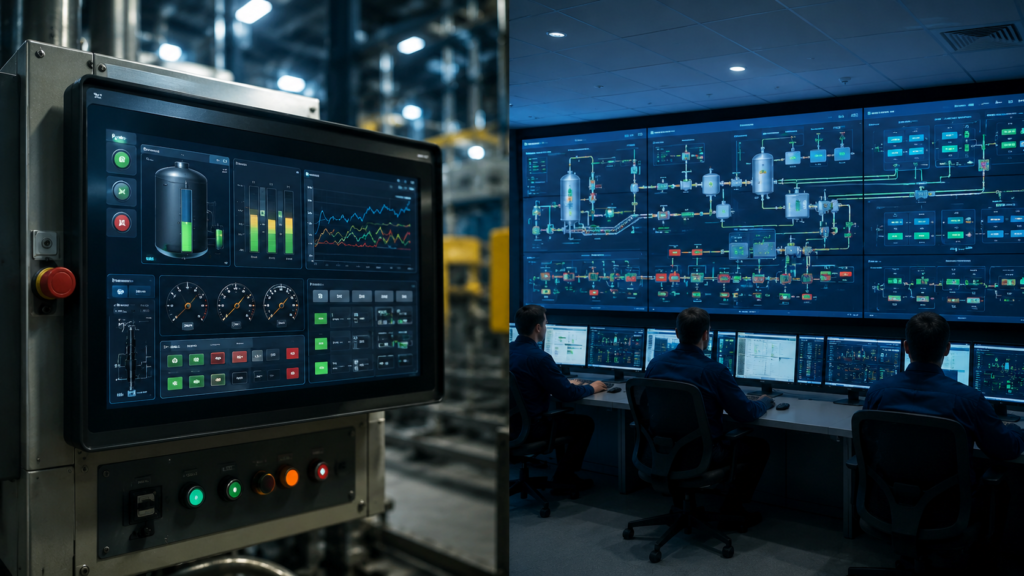
An HMI typically includes a touchscreen installed near a machine or production line. It displays operating data, machine status, alarms, process values, and control buttons. Operators use the screen to start or stop equipment, change settings, monitor production, and troubleshoot problems without opening electrical control panels.
A modern HMI transforms complex machine information into clear graphics. Tanks, motors, valves, pumps, sensors, and conveyors appear as visual objects instead of raw numerical values. This approach helps operators understand the current machine condition within seconds.
If the water level becomes too low, the operator immediately notices the alarm on the HMI screen and can respond before production stops. This quick response reduces downtime and improves operational efficiency.
HMIs also improve workplace safety. Operators no longer need to access electrical cabinets or manually inspect every machine. They can control most operations directly from the interface while remaining in a safe working area.
Today's industrial HMIs offer many advanced features, including alarm management, recipe handling, user authentication, multilingual interfaces, trend charts, and maintenance notifications. These capabilities make daily machine operation faster and more reliable.
Within the HMI vs SCADA discussion, remember that an HMI usually focuses on one machine or one production area. It provides local monitoring and local control rather than supervising an entire facility.
What Is SCADA in HMI vs SCADA?
Understanding SCADA is the next step in comparing HMI vs SCADA. Supervisory Control and Data Acquisition (SCADA) is a complete industrial monitoring and supervisory system designed to collect information from multiple machines across an entire facility.
Unlike an HMI, which mainly communicates with a nearby PLC, a SCADA system gathers data from many PLCs, Remote Terminal Units (RTUs), intelligent sensors, and industrial controllers. It processes this information in one centralized platform where operators can monitor the entire production process from a control room.
A SCADA system does much more than display live values. It records historical information, generates reports, manages alarms, analyzes trends, and helps engineers improve production performance over time.
Imagine a beverage manufacturing plant with several production lines. Each line has its own PLC and HMI. Instead of visiting every machine individually, supervisors can monitor all production lines from a single SCADA workstation. They instantly know which machines are running, which alarms require attention, and where maintenance may soon be needed.
SCADA systems often include redundant servers, secure databases, alarm management, remote access, and advanced reporting tools. These features help organizations maintain reliable operations while making better business decisions through accurate production data.
Because SCADA stores historical information, engineers can compare today's performance with previous weeks or months. This historical analysis helps identify recurring faults, reduce energy consumption, and improve production efficiency.
Within the HMI vs SCADA comparison, SCADA acts as the central monitoring platform for an entire facility rather than focusing on one machine. It connects people, machines, and industrial data into one integrated system.
HMI vs SCADA: Understanding the Core Difference
The simplest way to understand HMI vs SCADA is to think about their responsibilities.
An HMI provides direct interaction between an operator and a machine. It allows operators to control equipment, monitor live process values, acknowledge alarms, and adjust machine settings at the local level.
A SCADA system supervises many HMIs, PLCs, and industrial devices from one central location. Instead of controlling only one machine, it manages the complete production environment while collecting valuable operational data for analysis.
Imagine a modern automobile factory. Every robotic workstation may include its own HMI for local operation and maintenance. At the same time, the factory control room uses SCADA software to monitor every workstation, production line, utility system, and alarm across the entire facility.
This relationship explains why HMI vs SCADA should never be viewed as a competition. In many industrial applications, both technologies work together to create an efficient automation system. The HMI improves machine operation, while SCADA provides centralized visibility, long-term data collection, and plant-wide supervision.
As industrial automation continues to evolve through Industry 4.0 and the Industrial Internet of Things (IIoT), the integration between HMI and SCADA has become even stronger. Modern factories depend on both systems to improve productivity, reduce downtime, increase safety, and support data-driven decision-making.
HMI vs SCADA: Key Differences Explained
Understanding HMI vs SCADA becomes much easier when you compare their real responsibilities in an industrial environment. Both technologies support automation, but they solve different problems. They often work together instead of replacing each other.
An HMI focuses on direct interaction with a machine. It gives operators a simple screen where they can start or stop equipment, change process values, acknowledge alarms, and watch live data. Everything happens close to the machine. The goal is to make operation safe, quick, and simple.
A SCADA system works at a much higher level. It gathers information from many PLCs, HMIs, sensors, and controllers across an entire plant. It brings all this data into one central location. Engineers and supervisors can then monitor every production area without walking from one machine to another.
Another important difference in HMI vs SCADA is data storage. Most HMIs only display current operating values. Some models save a small amount of history, but their storage remains limited. A SCADA system records large amounts of production data. This information helps companies analyze performance, reduce downtime, and improve efficiency.
The number of connected devices also separates these systems. An HMI usually communicates with one PLC or one machine. A SCADA system can communicate with hundreds or even thousands of industrial devices at the same time. This makes it suitable for large manufacturing facilities, power plants, water treatment stations, and oil and gas operations.
Remote access is another major advantage of SCADA. Plant managers can monitor production from a central control room or from secure remote locations. Most HMIs remain dedicated to local machine operation, although some advanced models now include limited remote features.
Alarm handling also differs. An HMI informs the operator about problems on the local machine. A SCADA system collects alarms from the entire facility. It organizes them by priority and records every event. This helps maintenance teams respond faster and identify recurring issues.
Scalability is equally important. A company can install an HMI for one production machine. As the business grows, it can add a SCADA system to supervise the complete factory. This flexibility allows manufacturers to expand without replacing their existing automation equipment.
The comparison between HMI vs SCADA shows that each system has a different purpose. One provides local control. The other delivers complete plant visibility.
HMI vs SCADA System Architecture
The architecture of HMI vs SCADA explains how information moves through an industrial automation system.
A basic HMI architecture is simple. Sensors collect information from the machine. The PLC processes that information according to its program. The HMI then displays the results on a touchscreen. When an operator presses a button, the HMI sends the command back to the PLC. The PLC performs the requested action almost instantly.
This simple communication path works well for individual machines. It reduces wiring complexity and allows operators to control equipment without touching the PLC program.
SCADA architecture includes several additional layers. Data starts at field devices such as sensors, valves, motors, and transmitters. PLCs or RTUs collect this information and send it through an industrial communication network. The SCADA server receives the data, stores it in a database, and displays it on operator workstations.
Every operator can view the same process information at the same time. Supervisors can monitor production, while maintenance engineers analyze alarms and historical trends. Managers can also review reports that summarize production performance.
Modern SCADA systems often include redundant servers. If one server fails, another server continues operating. This design increases system reliability and reduces production interruptions.
Many industries also connect SCADA systems with Manufacturing Execution Systems (MES) and Enterprise Resource Planning (ERP) software. This integration allows production information to support inventory management, maintenance planning, and business reporting.
When comparing HMI vs SCADA, architecture clearly shows the difference in scale. HMI connects people to one machine. SCADA connects an entire industrial operation.
How HMI and SCADA Work Together
Many people think they must choose between HMI vs SCADA. In reality, most modern factories use both technologies together.
Consider a food processing plant. Each packaging machine has its own HMI. Machine operators use these touchscreens during daily production. They adjust speed settings, monitor temperatures, acknowledge alarms, and restart equipment after maintenance.
At the same time, every PLC sends information to the SCADA system. The SCADA software combines data from all production lines into one complete view. Supervisors immediately know which machines are running, which lines have stopped, and where maintenance is required.
This combination improves communication across the entire factory. Operators focus on their machines. Supervisors focus on production. Maintenance teams focus on equipment health. Managers focus on overall performance.
Historical records provide another advantage. SCADA continuously stores production data. Engineers can compare today's results with previous weeks or months. They can identify repeated faults and improve production planning.
Many factories also configure automatic notifications. If a critical alarm appears, the SCADA system immediately alerts maintenance personnel. This quick response helps reduce downtime and protects valuable equipment.
The relationship between HMI vs SCADA creates a complete automation solution. HMI handles local interaction. SCADA delivers centralized monitoring, reporting, and analysis.
Communication Between HMI, PLC, and SCADA
Communication is the foundation of every industrial automation system. Without reliable data exchange, neither HMI nor SCADA can operate correctly.
The PLC acts as the central controller. It receives signals from sensors, executes its program, and controls industrial equipment. The HMI communicates directly with the PLC to display process values and accept operator commands.
When an operator presses the Start button on the HMI, the instruction travels to the PLC. The PLC verifies the operating conditions and starts the machine if all safety requirements are satisfied. The updated machine status then appears on the HMI within moments.
SCADA also communicates with the PLC. However, its purpose is different. Instead of controlling one machine directly, SCADA collects operating information from many PLCs across the plant. It records process values, generates alarms, stores historical data, and displays the complete production process on large monitoring screens.
Industrial communication protocols make this exchange possible. Modern automation systems commonly use Ethernet-based communication because it provides high speed and reliable performance. Many facilities also continue using proven industrial protocols that match their existing equipment.
Reliable communication improves production quality, increases equipment availability, and supports better operational decisions. For this reason, communication networks remain one of the most important parts of the HMI vs SCADA relationship.
The better these systems communicate, the more efficient the entire factory becomes.
Benefits of HMI in Industrial Automation
When comparing HMI vs SCADA, it is important to understand the value that an HMI brings to daily operations. An HMI makes machines easier to use. It gives operators a clear view of the process. They can check machine status, change settings, and respond to alarms from one screen.
A modern HMI also reduces mistakes. Operators no longer need to remember every process value or machine sequence. The interface displays important information in a simple format. This saves time and improves confidence during production.
Another benefit is faster troubleshooting. When a fault occurs, the HMI highlights the affected area. Operators can identify the problem quickly instead of checking every sensor or cable. As a result, machines return to normal operation sooner.
An HMI also improves workplace safety. Operators can control machines without opening electrical panels. This reduces unnecessary exposure to high-voltage equipment. Safety messages and warnings also appear on the display, helping users make better decisions.
Training new employees becomes easier as well. Most HMIs use clear graphics and simple navigation. New operators learn the system faster because they can see the machine status in real time.
Many industries also use HMIs to improve product quality. Operators can monitor temperatures, pressures, speeds, and other process values. If one value moves outside the desired range, they can correct it before product quality is affected.
Within the HMI vs SCADA discussion, an HMI remains the best choice for local machine operation. It gives operators direct control while keeping the process simple and efficient.
Benefits of SCADA in Industrial Automation
The benefits of SCADA become clear when a factory grows beyond a few machines. A SCADA system gives engineers and managers a complete view of the entire operation. Instead of checking each machine separately, they can monitor everything from one location.
One major advantage is centralized monitoring. Production data from different areas appears on a single screen. Supervisors can quickly identify delays, equipment faults, or production losses.
Another important benefit is historical data. SCADA records process values throughout the day. Engineers can review this information later to understand what happened during production. This helps them solve recurring problems and improve future performance.
SCADA also supports better alarm management. Every alarm is recorded with the exact time and location. Maintenance teams can see which equipment needs attention first. This organized approach reduces response time and prevents small issues from becoming major failures.
Energy monitoring is another valuable feature. Many companies use SCADA to track electricity, water, compressed air, and gas consumption. These reports help reduce operating costs and improve efficiency.
Remote monitoring adds even more flexibility. Authorized users can view production data from secure locations without being physically present at the factory. This feature supports faster decision-making, especially for large industrial sites.
When discussing HMI vs SCADA, SCADA clearly stands out as the best solution for plant-wide supervision, reporting, and long-term process improvement.
Real-World Applications of HMI vs SCADA
The comparison of HMI vs SCADA becomes easier when you look at real industrial examples. Almost every automated industry uses one or both technologies.
In a water treatment plant, operators use an HMI to control pumps and monitor tank levels. The SCADA system collects information from every pumping station. It also records water flow, pressure, and equipment status across the entire facility.
A food processing factory uses HMIs on individual production lines. Operators adjust machine settings and monitor product quality through touchscreens. At the same time, the SCADA system tracks production output, machine efficiency, and alarm history for the whole plant.
Automotive manufacturers also depend on both systems. Robotic stations have local HMIs for maintenance and daily operation. Engineers in the control room use SCADA software to monitor every production line and maintain smooth workflow.
Power generation facilities use SCADA to supervise turbines, generators, transformers, and electrical distribution equipment. Local HMIs remain available for technicians who work directly with each machine.
Oil and gas companies often monitor equipment spread across large distances. SCADA gathers information from remote stations and sends it to a central control room. Field technicians still use HMIs for local equipment control during maintenance.
Pharmaceutical companies rely on accurate process control. HMIs help operators monitor individual machines. SCADA stores production records and supports quality documentation required by industry regulations.
These examples show that HMI vs SCADA is not a question of choosing one over the other. Both technologies work together to improve productivity, safety, and process reliability.
Choosing Between HMI and SCADA
The right choice depends on the size of your project and your business goals.
If you need to operate one machine or a small production line, an HMI is usually enough. It provides local control, displays live process data, and helps operators manage daily tasks without unnecessary complexity.
If your facility contains many PLCs, multiple production lines, or remote equipment, a SCADA system offers much greater value. It combines information from different areas and presents everything in one place. This improves visibility and supports better operational decisions.
Many companies begin with HMIs because they are simple to install and easy to manage. As production expands, they add a SCADA system to achieve centralized monitoring and historical reporting. This approach protects existing investments while supporting future growth.
Budget also plays a role. Small automation projects often require only an HMI. Large industrial facilities usually benefit from the additional features provided by SCADA.
When evaluating HMI vs SCADA, think about your long-term plans instead of only your current needs. A solution that supports future expansion often delivers better value over time.
Best Practices for HMI and SCADA Implementation
Successful automation depends on good planning as much as good technology.
Design HMI screens with simple layouts. Operators should find important information without searching through multiple menus. Clear graphics and consistent colors improve usability and reduce operator errors.
Keep alarm messages short and meaningful. Every alarm should tell the operator what happened and where the problem exists. Too many unnecessary alarms can create confusion during production.
Use secure communication between PLCs, HMIs, and SCADA systems. Strong passwords, user access levels, and regular software updates help protect industrial networks from unauthorized access.
Create regular backups for HMI projects and SCADA databases. A recent backup allows the system to recover quickly after hardware failure or software issues.
Review historical production data on a regular basis. Trend analysis helps engineers identify small changes before they become expensive problems.
Finally, train operators and maintenance staff. Even the best automation system performs better when users understand its features and follow standard operating procedures.
Following these practices helps companies get the maximum value from both HMI and SCADA while maintaining safe and reliable industrial operations.
Future Trends in HMI and SCADA
Industrial automation continues to evolve every year. As factories become smarter, both HMI and SCADA systems are gaining new features that improve efficiency, safety, and productivity.
One of the biggest trends is cloud connectivity. Modern SCADA platforms can securely send production data to cloud services. Engineers and managers can review reports from almost anywhere with an internet connection. This makes decision-making faster and more flexible.
Artificial intelligence is also becoming part of industrial automation. AI can analyze large amounts of production data and identify patterns that people may miss. It can predict equipment failures, improve maintenance schedules, and help reduce downtime.
Industrial Internet of Things (IIoT) technology is another major development. Smart sensors now collect more information than ever before. HMI and SCADA systems use this data to provide better process visibility and more accurate performance analysis.
Cybersecurity has also become a top priority. Modern automation systems include stronger user authentication, encrypted communication, and better network protection. These improvements help protect industrial operations from cyber threats.
Mobile monitoring is growing in popularity as well. Many SCADA platforms now support smartphones and tablets. Authorized users can receive alarms, check machine status, and review reports without being inside the control room.
Another important trend is digital twins. A digital twin is a virtual model of a real machine or production process. Engineers use these models to test changes before applying them to the actual equipment. This reduces risk and improves planning.
As Industry 4.0 continues to expand, HMI and SCADA will become even more connected. Future systems will provide faster communication, better data analysis, and greater automation across every level of production.
Common Mistakes When Using HMI and SCADA
Even advanced automation systems can perform poorly if they are not designed correctly.
One common mistake is creating complicated HMI screens. Too many colors, animations, or unnecessary graphics can distract operators. A clean and simple interface helps users understand process conditions more quickly.
Another mistake is ignoring alarm management. Some facilities generate hundreds of alarms every day. If operators receive too many notifications, they may overlook important warnings. Well-organized alarms improve safety and reduce response time.
Poor communication network design can also create problems. Slow or unreliable communication affects data accuracy and system performance. Choosing the right industrial network and maintaining it properly helps prevent these issues.
Many companies also forget to update software. Regular updates improve stability, fix security weaknesses, and add new features. Keeping HMI and SCADA software current supports long-term reliability.
Insufficient operator training is another challenge. Even the best automation system cannot deliver good results if users do not understand its functions. Regular training helps operators work more confidently and safely.
Frequently Asked Questions (FAQs)
What is the main difference between HMI and SCADA?
The main difference is that an HMI controls and monitors a local machine, while a SCADA system supervises multiple machines or an entire industrial plant from one central location.
Can HMI work without SCADA?
Yes. Many standalone machines use only an HMI connected to a PLC. Small automation projects often do not require a full SCADA system.
Does SCADA include HMI?
Many SCADA systems include HMI-style graphical screens. However, SCADA provides many additional features such as historical data, centralized monitoring, reporting, and remote access.
Which industries use HMI and SCADA?
Manufacturing, food processing, pharmaceuticals, oil and gas, water treatment, mining, power generation, chemical processing, and many other industries use these technologies every day.
Is SCADA more expensive than HMI?
In most cases, yes. SCADA systems require additional software, servers, communication infrastructure, and licensing. An HMI is usually more affordable for small automation projects.
Can one SCADA system monitor multiple PLCs?
Yes. A SCADA system is designed to communicate with many PLCs, RTUs, and industrial devices at the same time.
Which communication protocols are commonly used?
Industrial systems commonly use protocols such as Modbus, PROFINET, EtherNet/IP, OPC UA, and MQTT, depending on the application and equipment.
Should I choose HMI or SCADA?
The answer depends on your project. If you need local machine control, an HMI is often enough. If you need centralized monitoring, historical reporting, and plant-wide supervision, SCADA is the better solution. Many factories successfully use both together.