Table of Contents
ToggleWhat Is a PLC?
What Is a PLC? This is one of the first questions every beginner asks when learning industrial automation. A Programmable Logic Controller (PLC) is a rugged industrial computer that controls machines and automated processes. It receives signals from input devices, processes them according to a program, and then controls output devices such as motors, relays, valves, and alarms. As a result, factories can automate repetitive tasks with greater speed, accuracy, and safety.
Today, PLCs are used in almost every modern industry. They help businesses improve productivity while reducing manual work and human error. In addition, PLC systems are reliable because they are designed to work in harsh environments where ordinary computers cannot perform well. This guide explains What Is a PLC, how it works, its main components, and why it is one of the most important technologies in industrial automation.
Why Is a PLC Important?
Industrial machines must work continuously without frequent interruptions. Therefore, companies use PLCs to control production processes automatically. A PLC can make decisions within milliseconds, allowing machines to respond quickly to changing conditions.
Moreover, automation improves product quality because every operation follows the same programmed instructions. As a result, manufacturers reduce waste, increase production speed, and improve workplace safety.
Another major advantage is flexibility. If production requirements change, engineers can simply update the PLC program instead of replacing large amounts of electrical wiring. Consequently, maintenance becomes easier and operating costs remain lower over time.
How Does a PLC Work?
Understanding What Is a PLC becomes much easier after learning its basic operating cycle. Every PLC follows a process called the scan cycle. This cycle repeats continuously while the controller is running.
Step 1: Reading Input Signals
First, the PLC checks all connected input devices. These devices send electrical signals whenever a condition changes.
Common input devices include:
- Push buttons
- Limit switches
- Temperature sensors
- Proximity sensors
- Pressure sensors
- Float switches
For example, when an operator presses a Start button, the PLC immediately detects that input.
Step 2: Processing the Program
Next, the controller executes the program stored in its memory. The program contains logical instructions created by an automation engineer.
For example, the program may contain rules such as:
- Start the motor when the Start button is pressed.
- Stop the motor if the Emergency Stop button is activated.
- Turn on a cooling fan when the temperature becomes too high.
- Stop the water pump when the storage tank is full.
Because the PLC processes instructions very quickly, machines respond almost instantly.
Step 3: Controlling Output Devices
Finally, the PLC sends commands to output devices.
Typical outputs include:
- Electric motors
- Solenoid valves
- Contactors
- Alarm sirens
- Indicator lights
- Cooling fans
As a result, the complete automation process continues smoothly without constant human supervision.
Main Components of a PLC
Every PLC contains several important components. Each one performs a specific function within the automation system.
Central Processing Unit (CPU)
The CPU is the brain of the PLC. It processes input information, executes the control program, and manages communication between different hardware modules.
Power Supply
The power supply delivers stable electrical power to the controller. A reliable power source helps the PLC operate continuously without unexpected interruptions.
Input Modules
Input modules receive signals from field devices installed throughout the factory.
Examples include:
- Digital inputs
- Analog inputs
- Temperature inputs
- High-speed counter inputs
These signals tell the PLC what is happening in the system.
Output Modules
Output modules send control signals to industrial equipment.
Common output devices include:
- AC motors
- DC motors
- Relay coils
- Solenoid valves
- Signal lamps
- Buzzers
The PLC activates these devices according to the programmed logic.
Memory
Memory stores the operating system, user program, configuration settings, and process data. Therefore, the PLC can continue performing the same automation tasks repeatedly and accurately.
Communication Ports
Modern PLCs include communication ports that allow them to exchange information with other industrial devices.
For example, a PLC can communicate with:
- HMI panels
- SCADA systems
- Variable Frequency Drives (VFDs)
- Industrial sensors
- Other PLC controllers
Consequently, engineers can monitor and control complete production lines from a central location.
Types of PLCs
Different automation projects require different PLC designs. Therefore, manufacturers produce several PLC types.
Compact PLC
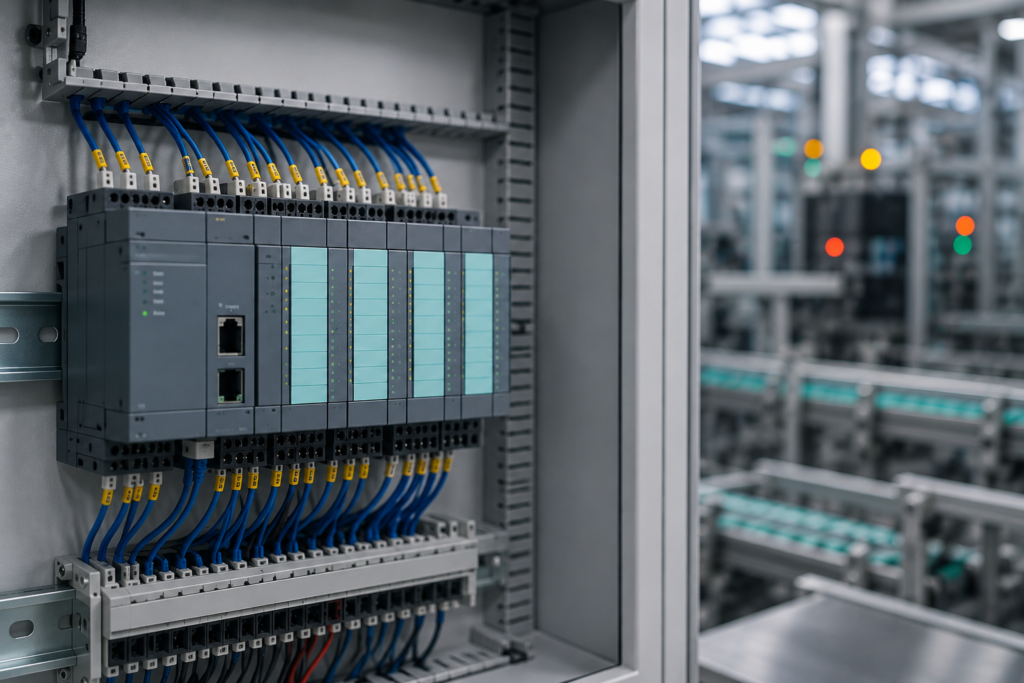
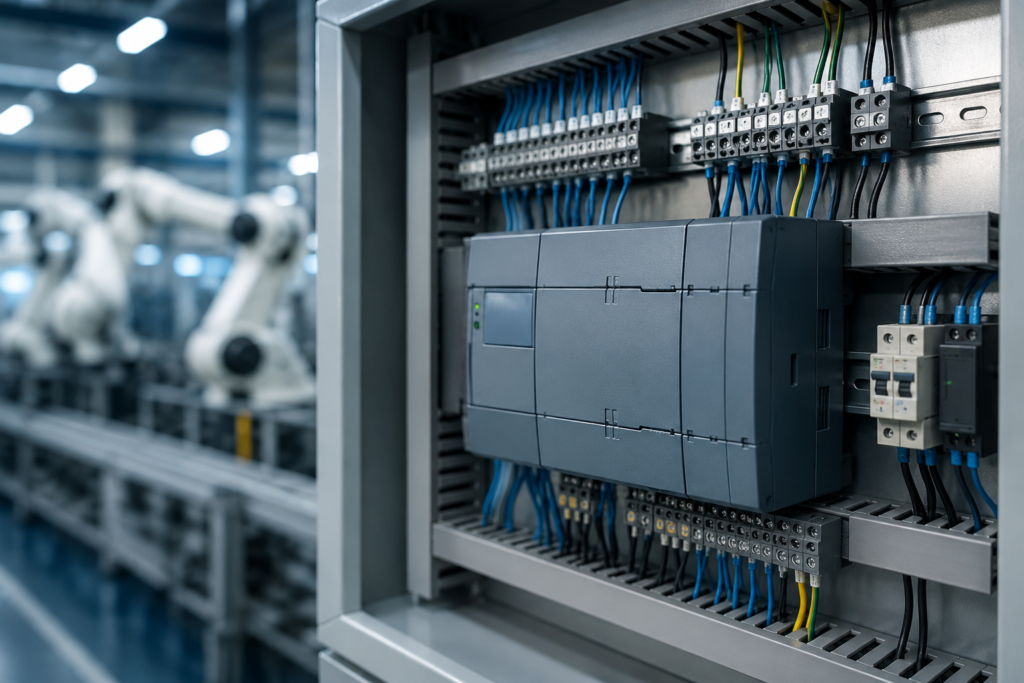
A compact PLC combines the CPU, power supply, and input/output modules into one unit. It is suitable for small machines and simple automation systems.
Modular PLC
A modular PLC allows engineers to add additional input and output modules whenever production requirements increase. Because of this flexibility, modular PLCs are widely used in medium-sized factories.
Rack PLC
Rack PLCs support a large number of modules and communication options. As a result, they are commonly installed in large industrial plants where thousands of input and output signals must be managed efficiently.
Where Are PLCs Used?
After understanding What Is a PLC, it becomes easier to recognize its importance across many industries.
Today, PLCs are commonly used in:
- Manufacturing plants
- Food processing factories
- Packaging machines
- Water treatment systems
- Conveyor belt systems
- Oil and gas facilities
- Pharmaceutical production
- Textile industries
- Building automation
- Power generation plants
Overall, PLC technology plays a major role in improving efficiency, reliability, and safety in modern industrial environments.
What Is a PLC Programming Language?
After learning What Is a PLC, the next step is understanding how engineers program a PLC. A PLC cannot perform any task until someone creates a control program. Therefore, programming is an important part of every automation project.
The most popular PLC programming languages include:
- Ladder Diagram (LD)
- Function Block Diagram (FBD)
- Structured Text (ST)
- Sequential Function Chart (SFC)
- Instruction List (IL)
Among these, Ladder Diagram is the most widely used because it is simple and easy to understand. As a result, many beginners start learning PLC programming with Ladder Logic.
What Is a PLC Used For?
Many industries rely on PLC technology every day. For example, manufacturing plants use PLCs to control production lines. Food factories use PLCs to automate packaging systems. Water treatment plants use PLCs to control pumps and water levels.
Other common applications include:
- Conveyor belt systems
- Elevator control
- Traffic signal control
- Textile machines
- Pharmaceutical production
- Power plants
- Oil and gas facilities
- Smart buildings
Overall, PLCs improve productivity and reduce manual work in almost every industrial sector.
What Is a PLC Advantage?
A PLC offers many advantages compared to traditional relay-based systems.
Some important benefits are:
- Easy programming
- Fast processing speed
- High reliability
- Long operating life
- Easy troubleshooting
- Flexible system expansion
- Low maintenance cost
- Better safety
- Accurate machine control
- Reduced production downtime
In addition, engineers can modify the program without changing the electrical wiring. Therefore, future upgrades become much easier.
What Is a PLC Limitation?
Although PLCs provide many benefits, they also have a few limitations.
Some common disadvantages include:
- Higher initial cost than simple relay circuits
- Programming knowledge is required
- Hardware replacement can be expensive
- Complex systems require experienced engineers
However, these limitations are usually small when compared with the long-term benefits of automation.
What Is a PLC vs Microcontroller?
A PLC and a microcontroller can both control machines. However, they are designed for different purposes.
A PLC is built for industrial environments. It can operate in dust, vibration, heat, and electrical noise.
A microcontroller is mainly used inside consumer electronics, home appliances, and embedded systems.
As a result, industries choose PLCs for automation projects that require high reliability and continuous operation.
How to Choose the Right PLC
Selecting the right PLC is an important decision for every automation project. A suitable PLC improves system performance, reduces maintenance costs, and supports future expansion. Therefore, engineers should carefully evaluate the project before purchasing a controller.
The first thing to consider is the number of input and output points. Small automation projects usually require only a few inputs and outputs. However, large manufacturing plants may need hundreds of I/O points. Choosing the correct capacity prevents unnecessary upgrades in the future.
Another important factor is the operating environment. Some industries have high temperatures, dust, vibration, or moisture. Therefore, the PLC should be designed to operate reliably under these conditions. Industrial-grade controllers are built to withstand harsh environments and provide long-term performance.
Communication features should also be considered. Modern factories often connect PLCs with HMIs, SCADA systems, sensors, drives, and cloud platforms. As a result, selecting a PLC that supports popular communication protocols makes system integration much easier.
Future expansion is equally important. Production requirements may increase over time. For this reason, modular PLCs allow additional modules to be added without replacing the entire controller.
Finally, compare software support, technical documentation, and product availability before making a final decision. A reliable PLC with strong technical support often provides better long-term value than choosing the lowest-priced option.
Common PLC Troubleshooting Tips
Even reliable PLC systems may experience occasional problems. However, a systematic troubleshooting approach helps identify faults quickly and minimizes production downtime.
The first step is checking the power supply. An unstable voltage or damaged power source can prevent the PLC from operating correctly. Therefore, always verify the incoming power before inspecting other components.
Next, inspect all field wiring and input devices. Loose terminals, damaged sensors, or faulty switches may send incorrect signals to the controller. In addition, observing the status LEDs on the PLC often provides useful diagnostic information.
The PLC program should also be reviewed carefully. Programming errors, incorrect timer settings, or missing logic conditions can cause unexpected machine behavior. For example, a motor may fail to start because one safety condition has not been satisfied.
Communication problems are another common issue. If the PLC communicates with an HMI or SCADA system, damaged cables or incorrect network settings may interrupt data exchange. As a result, operators may lose monitoring functions even though the PLC continues running.
Finally, keep maintenance records after every repair. Documenting faults helps engineers identify recurring issues and improves future troubleshooting efficiency.
PLC Maintenance Best Practices
Regular maintenance helps PLC systems operate safely and efficiently. Moreover, preventive maintenance reduces unexpected failures and extends equipment life.
Control panels should be inspected regularly for dust, moisture, and excessive heat. Clean enclosures improve airflow and protect electronic components from damage.
Electrical connections should also be checked during routine maintenance. Loose terminals can create unstable signals and communication errors. Therefore, tightening connections during inspections improves long-term reliability.
Backing up the PLC program is another important practice. If hardware fails unexpectedly, engineers can quickly restore the original application. As a result, production downtime is significantly reduced.
Firmware updates should also be reviewed whenever recommended by the manufacturer. Updated software may improve security, communication stability, and overall system performance.
Cooling fans, ventilation filters, and cabinet air circulation should remain clean at all times. Proper cooling prevents overheating and protects sensitive electronic components.
Finally, follow a preventive maintenance schedule instead of waiting for equipment failures. Regular inspections reduce repair costs and improve production reliability.
Beginner Tips for Learning PLC Programming
Learning PLC programming becomes easier with a structured learning plan. First, understand basic electrical control circuits before studying PLC programming. This knowledge makes automation logic much easier to understand.
Most beginners start with Ladder Diagram because it closely resembles traditional relay circuits. Therefore, it is considered the best programming language for new learners.
Practice is equally important. Reading theory alone cannot develop programming skills. Instead, create simple automation projects such as motor control circuits, traffic light systems, or water level controllers.
Simulation software also provides valuable experience. Students can test PLC programs without connecting physical hardware. As a result, they gain confidence while reducing the risk of programming mistakes.
Learning industrial sensors, actuators, and communication protocols further improves automation knowledge. Moreover, understanding complete industrial systems prepares beginners for real-world projects.
Finally, continue practicing and learning advanced topics such as SCADA, HMI, Industrial Ethernet, and Industry 4.0. Consistent learning builds confidence and opens new career opportunities in industrial automation.
PLC Safety Tips for Beginners
Working with industrial control systems requires proper safety practices. Therefore, every beginner should understand basic electrical safety before working with a PLC. Although PLCs make automation safer, incorrect installation or maintenance can still create risks.
Always disconnect the main power supply before connecting or removing wiring. This simple step helps prevent electrical accidents and protects sensitive PLC components. In addition, use insulated tools and wear appropriate personal protective equipment (PPE) whenever working inside a control panel.
Before downloading a new PLC program, verify that all machine conditions are safe. Unexpected machine movement can damage equipment or cause injury. For this reason, many industries perform program testing in simulation mode before using it on a live system.
Proper labeling is another important safety practice. Clearly marked input and output terminals reduce wiring mistakes and make future maintenance easier. Moreover, emergency stop circuits should always be tested regularly to ensure they operate correctly.
Finally, follow the manufacturer's installation guidelines and local electrical standards. Safe working habits not only protect equipment but also create a safer working environment for everyone.
Common Myths About PLC Systems
Many beginners believe PLC systems are difficult to learn. However, this is one of the biggest misconceptions. With regular practice and a clear learning plan, most people can understand PLC basics within a short time.
Another common myth is that PLCs are only used in very large factories. In reality, PLCs are also found in small machines, packaging equipment, water pumping stations, and building automation systems. Therefore, PLC technology is useful in both small and large industrial applications.
Some people think PLC programming never changes. In fact, modern PLCs continue to evolve with new communication technologies, cloud connectivity, and smart monitoring features. Learning these updates helps engineers stay competitive in today's automation industry.
There is also a belief that PLCs eliminate all human involvement. Instead, PLCs assist operators by performing repetitive tasks while skilled engineers continue to monitor, maintain, and improve automation systems.
Understanding these myths helps beginners develop realistic expectations and learn industrial automation with greater confidence.
Why Learning PLC Skills Is Valuable
Industrial automation continues to expand across the world. As a result, professionals with PLC knowledge are becoming increasingly valuable in many industries. Manufacturing companies, energy plants, food processing facilities, and logistics centers all rely on automation to improve productivity.
Learning PLC programming also develops practical problem-solving skills. Engineers learn how to analyze machine behavior, design logical control systems, and troubleshoot technical faults efficiently. These skills remain useful throughout an automation career.
Another advantage is continuous learning. PLC technology is closely connected with HMI, SCADA, industrial communication, robotics, and Industry 4.0. Therefore, understanding PLC fundamentals makes it easier to explore advanced automation technologies in the future.
Finally, PLC knowledge supports both technical education and professional development. Whether someone is a student, technician, or experienced engineer, learning PLC systems provides a strong foundation for understanding modern industrial automation.
Future of PLC Technology
Industrial automation continues to evolve every year. Therefore, PLC technology is becoming smarter, faster, and more connected than ever before.
Modern PLCs now support Industrial Internet of Things (IIoT) applications, cloud connectivity, and remote monitoring. Engineers can collect production data in real time and analyze machine performance from almost any location.
Artificial intelligence and machine learning are also influencing industrial automation. For example, advanced PLC systems can work alongside intelligent software to improve production efficiency and reduce equipment downtime.
Cybersecurity has become another major focus. As factories become more connected, protecting industrial networks from cyber threats is increasingly important. As a result, manufacturers continue improving security features within modern PLC platforms.
Energy efficiency is another growing priority. Today's automation systems help industries monitor electricity consumption, reduce waste, and optimize machine performance.
Overall, PLC technology will continue supporting smart factories, digital manufacturing, and Industry 4.0. Engineers who understand modern PLC systems will be well prepared for future industrial automation careers.
Frequently Asked Questions About What Is a PLC
What Is a PLC in simple words?
A PLC is a special industrial computer that automatically controls machines and production processes.
Who uses PLCs?
PLCs are used by automation engineers, electrical engineers, maintenance teams, manufacturers, and industrial technicians.
Can beginners learn PLC programming?
Yes. Many beginners start with basic Ladder Logic. Then, they gradually learn advanced programming techniques.
Which industries use PLCs?
PLCs are widely used in manufacturing, food processing, pharmaceuticals, water treatment, oil and gas, power generation, and building automation.
Why are PLCs better than relay systems?
PLCs are easier to program, easier to maintain, and much more flexible. In addition, they reduce wiring and simplify troubleshooting.
If you want to continue learning industrial automation, you may also find these guides helpful: