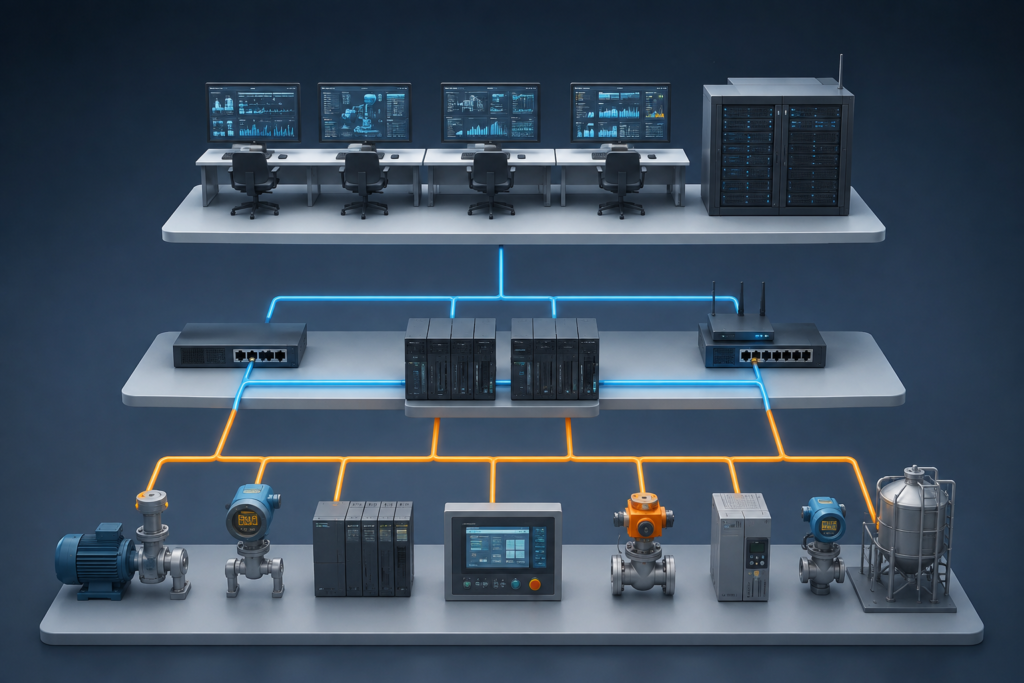
SCADA Architecture defines how industrial devices, controllers, communication networks, servers, databases, and operator interfaces work together to monitor and control industrial processes. Modern industrial facilities use SCADA systems to collect real-time information from machines and field devices, process that information through control systems, and present useful data to operators through graphical interfaces.
SCADA stands for Supervisory Control and Data Acquisition. It is widely used in manufacturing plants, water treatment facilities, power systems, oil and gas operations, food processing, chemical industries, building automation, and many other industrial environments. Although SCADA systems can differ significantly in size and design, their primary purpose remains the same: collect process data, provide visibility, support supervisory control, and help operators make informed decisions.
Understanding SCADA Architecture is important because a SCADA system is not simply software installed on a computer. Instead, it is a complete industrial communication and control environment made up of several interconnected layers. Field sensors collect information from the physical process, PLCs or RTUs process control signals, communication networks transfer data, SCADA servers manage information, and operator workstations display the process in an understandable format.
Furthermore, each layer has a specific responsibility. However, the layers must communicate reliably for the complete system to operate effectively. This guide explains how SCADA Architecture works, its major components, different architecture types, communication methods, cybersecurity considerations, and the role of PLCs, HMIs, servers, databases, and industrial networks.
What Is SCADA Architecture?
SCADA Architecture is the structural design that defines how the different components of a supervisory control and data acquisition system communicate and exchange information.
At the field level, sensors and actuators interact directly with the physical process. Sensors may measure temperature, pressure, flow, level, speed, or other process variables. Actuators such as motors, valves, pumps, and drives perform physical actions based on control commands.
PLCs and RTUs are normally positioned between the physical process and higher-level SCADA systems. They receive signals from field devices, execute programmed control logic, and communicate process information to SCADA servers.
The communication network connects these devices and allows process data to move between different parts of the system. Depending on the application, communication may use Ethernet, fiber optic networks, wireless technologies, serial communication, or industrial protocols.
At the supervisory level, SCADA servers collect and manage process information. Operator workstations provide graphical displays that allow personnel to monitor equipment, view alarms, analyze trends, and perform authorized supervisory actions.
This layered structure makes SCADA systems scalable and easier to manage because each level performs a specific function.
How SCADA Architecture Works
A typical SCADA Architecture begins with the physical process. Industrial equipment continuously produces information that must be measured and monitored. Sensors connected to machines and processes convert physical conditions into electrical or digital signals.
For example, a water treatment plant may use level sensors to determine the amount of water in a tank. Flow meters can measure water movement through pipes, while pressure transmitters can monitor pressure in different sections of the system.
These signals are received by a PLC or RTU. The controller processes the signals according to its programmed logic. As a result, it may determine whether a pump should start, whether a valve should open, or whether an alarm condition exists.
The controller then communicates relevant information to the SCADA system through an industrial communication network. The SCADA server receives values such as temperature, pressure, motor status, tank level, and alarm conditions.
The server makes this information available to operator workstations. Operators can see the current process state through graphical displays and can respond to abnormal conditions when necessary.
Consequently, the complete process can be understood as a continuous information cycle. Field devices generate data, controllers process it, communication networks transport it, SCADA servers manage it, and operator interfaces present it.
Main Layers of SCADA Architecture
A modern SCADA Architecture is commonly organized into multiple functional layers. Each layer has a specific responsibility; however, all layers work together as one integrated automation environment.
Field Level in SCADA Architecture
The field level is the closest layer to the physical industrial process. It contains sensors, transmitters, switches, actuators, motors, valves, pumps, drives, and other field equipment.
Sensors measure physical conditions and send signals to controllers. For example, a temperature transmitter can provide a continuous temperature measurement, while a proximity sensor may indicate whether an object is present.
Actuators receive commands and create physical changes. A motor can rotate a conveyor, a valve can regulate fluid flow, and a variable frequency drive can control motor speed.
Therefore, the field level is essential because the complete SCADA system ultimately depends on accurate information from the physical process.
Control Level in SCADA Architecture
The control level normally contains PLCs, RTUs, PACs, and similar industrial controllers. These devices collect field signals and execute control programs.
A PLC can operate independently of the SCADA server. This is an important characteristic of industrial automation because critical machine control should not depend entirely on a supervisory computer.
For example, a PLC controlling a pump station may continuously monitor tank level and motor status. If the tank reaches a programmed high level, the PLC can stop a pump according to its control logic even if the SCADA workstation is temporarily unavailable.
As a result, SCADA provides supervisory visibility and control, while the PLC or RTU generally handles the real-time control logic.
Communication Level in SCADA Architecture
The communication level connects controllers, servers, workstations, gateways, and other devices.
Industrial communication networks can use copper Ethernet, fiber optic connections, wireless links, serial connections, or specialized industrial networking technologies.
The network must provide reliable communication because SCADA systems often depend on continuous data exchange. In addition, network architecture affects system performance, redundancy, cybersecurity, and scalability.
Supervisory Level in SCADA Architecture
The supervisory level contains SCADA servers, operator workstations, engineering stations, alarm systems, historians, and related software.
This level provides centralized visibility into industrial operations. Operators can monitor equipment status, view trends, acknowledge alarms, and perform authorized supervisory commands.
Moreover, SCADA software can store historical information, allowing engineers and operators to analyze process behavior over time. Consequently, the supervisory level becomes an important source of operational information.
Enterprise and Data Level
Large industrial environments may connect SCADA data with higher-level business and information systems. Manufacturing execution systems, reporting platforms, analytics applications, and enterprise software may consume selected industrial data.
This connection allows organizations to use production information for reporting, maintenance planning, performance analysis, and operational decision-making.
However, enterprise integration should be carefully designed because connecting business networks directly to industrial control environments can introduce additional cybersecurity risks. Therefore, appropriate security boundaries should be established between operational technology and enterprise systems.
SCADA Architecture Components
A complete SCADA Architecture contains several important components that work together. Although each component performs a different task, reliable communication between them is essential for effective operation.
Sensors and Field Instruments
Sensors are responsible for measuring physical process conditions. Depending on the application, instruments can measure temperature, pressure, flow, level, vibration, speed, position, and other variables.
The quality of the information entering the system has a direct effect on the quality of monitoring and control. For this reason, incorrect sensor calibration or faulty instruments can result in misleading SCADA data.
PLCs in SCADA Architecture
PLCs are among the most common controllers used in industrial SCADA environments. A PLC receives input signals, executes programmed logic, and controls output devices.
For example, a PLC can receive a tank-level signal and use that information to control a pump. At the same time, the PLC can send the tank level, pump status, and alarm information to the SCADA system.
Siemens S7-1200, S7-1500, Allen-Bradley ControlLogix, CompactLogix, Mitsubishi, Omron, and Schneider Electric controllers are examples of PLC platforms commonly used in industrial automation.
RTUs in SCADA Architecture
Remote Terminal Units are commonly used in geographically distributed applications. They are particularly useful when field equipment is located far away from a central control facility.
For example, water distribution systems, electrical substations, pipelines, and remote pumping stations can contain equipment spread across large geographical areas. RTUs can collect field information and communicate it to central SCADA systems.
SCADA Servers
SCADA servers manage communication between the supervisory software and industrial controllers. Depending on the system design, multiple servers may be used for different functions.
A server may manage real-time data acquisition, alarm processing, user sessions, historical data, or communication with external systems.
Furthermore, redundant server configurations can improve availability by allowing a backup server to take over when the primary server experiences a failure.
SCADA Architecture Communication Network
The communication network is one of the most important parts of SCADA Architecture because it allows devices at different levels to exchange information.
A small SCADA installation may use a simple Ethernet network connecting several PLCs and a server. On the other hand, a large industrial system may contain multiple network segments, redundant switches, fiber connections, firewalls, gateways, and separate security zones.
Network design depends on the required response time, physical distance, number of devices, reliability requirements, and cybersecurity architecture.
Industrial Ethernet has become increasingly common because it provides high-speed communication and supports many modern industrial protocols. In addition, fiber optic communication can be useful when long-distance communication, electrical isolation, or resistance to electromagnetic interference is important.
Wireless communication can also be useful for remote installations where installing physical cables is difficult or expensive. However, wireless systems should be designed with reliability and cybersecurity requirements in mind.
Centralized SCADA Architecture
Centralized SCADA Architecture places major supervisory functions in a central location.
In this design, field controllers communicate with a central SCADA server, and operators monitor the system through centralized workstations.
This approach can be suitable for smaller facilities where the number of devices and geographical coverage is limited.
Centralized systems can be easier to manage because important supervisory functions are concentrated in one environment. However, system availability can become a concern if critical components do not have redundancy.
Modern centralized systems often address this issue by implementing redundant servers, network equipment, power supplies, and communication paths. Therefore, redundancy should be considered when continuous operation is important.
Distributed SCADA Architecture
Distributed SCADA Architecture divides supervisory functions across multiple computers or servers.
Different servers may handle communication, alarms, historical data, operator interfaces, or other responsibilities. As a result, the system becomes less dependent on a single computer and can provide better scalability.
Distributed architecture is particularly useful for larger industrial facilities where many controllers and operator stations need to communicate with the supervisory system.
In addition, it provides flexibility because additional servers or workstations can be added as the system expands.
Networked SCADA Architecture
Networked SCADA Architecture uses modern communication networks to connect controllers, servers, workstations, and other devices.
Instead of relying on a single physical communication path, larger systems can use multiple network segments and managed industrial switches.
Network segmentation is particularly important for cybersecurity. Critical control devices should not automatically be exposed to every device connected to the broader organization network.
Therefore, firewalls, access controls, secure remote access, monitoring, and properly designed network zones can help reduce unnecessary exposure.
Modern SCADA Architecture and Industry 4.0
Industry 4.0 has changed how industrial data is collected, processed, and analyzed. Consequently, modern SCADA Architecture is increasingly connected with advanced digital technologies.
Traditional SCADA systems primarily focused on monitoring and supervisory control. However, modern architectures increasingly integrate industrial data with analytics platforms, cloud services, edge computing, IIoT devices, and advanced visualization systems.
Edge computing can process selected information closer to the physical equipment rather than sending every piece of raw data to a remote platform. This can reduce unnecessary data transfer and support faster local analysis.
Industrial IoT devices can also provide additional information from machines that previously had limited connectivity.
However, modern connectivity should not mean connecting every industrial device directly to the internet. Instead, industrial systems require carefully designed security controls and controlled communication pathways.
SCADA Architecture and PLC Integration
PLC integration is a fundamental part of many SCADA Architecture designs.
A PLC performs control operations while SCADA provides supervisory monitoring and visualization. The PLC may control motors, valves, conveyors, pumps, heating systems, or other equipment.
SCADA can read PLC tags such as motor running status, motor fault status, temperature, pressure, speed, and process values.
Depending on system design and authorization, SCADA may also write selected commands to the PLC. For example, an operator may issue a start or stop command from an SCADA interface.
However, the PLC should still contain the essential machine safety and control logic. SCADA should not be treated as a replacement for the controller's real-time control program.
SCADA Architecture and HMI
SCADA and HMI are closely related but serve different purposes.
An HMI is primarily designed to provide an interface between an operator and a machine or control system. It is often installed near the equipment and provides local control and visualization.
SCADA generally provides broader supervisory monitoring across multiple machines, controllers, processes, or facilities.
For example, a large industrial system may contain multiple local HMIs connected to PLCs while a centralized SCADA system provides a broader view of the complete operation.
Therefore, understanding the difference between HMI and SCADA helps engineers design appropriate operator interfaces and control environments.
See ISA-101 standards for guidance on effective HMI design.
SCADA Architecture Redundancy
Industrial processes may require high availability because downtime can result in production losses, equipment damage, or operational problems.
SCADA redundancy can be implemented at several levels. Server redundancy allows a secondary server to continue supervisory functions when the primary server becomes unavailable.
Similarly, network redundancy provides alternative communication paths, while power redundancy can protect critical equipment from electrical interruptions.
Storage redundancy can help protect historical data, while redundant controllers may be used in applications where controller availability is especially important.
Ultimately, the appropriate redundancy strategy depends on the criticality of the process and the cost associated with downtime.
SCADA Architecture: Alarms and Events
Alarm management is an important part of SCADA Architecture.
An alarm should identify a condition that requires operator attention. Examples include high tank level, high temperature, low pressure, motor failure, communication loss, or equipment overload.
Poor alarm design can create excessive notifications and make it difficult for operators to identify important events. Therefore, alarm systems should be carefully configured.
A properly designed SCADA system should distinguish between meaningful alarms and ordinary process information. In addition, alarm priorities should reflect the potential impact of the condition.
Historical event records can also help engineers investigate incidents and understand what happened before, during, and after a process abnormality.
SCADA Architecture: Historical Data and Trends
Historical data allows industrial teams to understand how processes behave over time.
Trend displays can show variables such as temperature, pressure, flow, production rate, energy consumption, and tank level.
For example, if a motor repeatedly experiences overheating, historical trends may help engineers determine whether the problem occurs under specific operating conditions.
Moreover, historical SCADA data can support preventive maintenance, production optimization, quality analysis, and performance monitoring.
As a result, historical data becomes an important part of modern SCADA Architecture because it allows teams to compare current conditions with previous operating behavior.
Cybersecurity in SCADA Architecture
Cybersecurity is a critical consideration when designing modern SCADA Architecture.
Industrial control systems can become targets for unauthorized access because they control real-world processes. A cybersecurity incident can potentially affect production, equipment, safety, and operational continuity.
SCADA networks should therefore be designed with appropriate security boundaries. Firewalls can control communication between network zones, while authentication mechanisms can restrict access to authorized personnel.
Furthermore, user accounts should have only the permissions required for their responsibilities. Remote access should also be carefully controlled, monitored, and protected.
Software and firmware should be maintained according to a controlled patch-management strategy that considers the operational requirements of the industrial environment.
In addition, security monitoring, backups, network segmentation, strong authentication, and incident-response procedures can improve the resilience of a SCADA system.
SCADA Architecture Example
A practical SCADA Architecture example can be seen in an automated water pumping station. In this SCADA Architecture, field devices, PLCs, communication networks, SCADA servers, operator workstations, and historical databases work together to monitor and control the pumping process.
Several level sensors measure the water level in storage tanks. Pressure sensors monitor the pipeline, while flow meters measure water movement. These field devices form the field layer of the SCADA Architecture and continuously provide process information to the control system.
The sensors send their signals to a PLC. The PLC processes these signals according to its programmed logic and controls pumps and valves. Therefore, the PLC acts as an important control component within the SCADA Architecture.
Next, the PLC communicates with the SCADA server through an industrial network. The SCADA server collects tank levels, pressure readings, flow values, pump status, and alarm information. This communication layer allows different components of the SCADA Architecture to exchange real-time process data.
An operator workstation then displays the complete pumping process through graphical screens. Operators can monitor equipment status, process values, and alarms from the SCADA interface. If a tank level becomes too high, the SCADA system can generate an alarm while the PLC executes its programmed control response.
Historical data can also be stored in a historian for later analysis. Consequently, engineers can review pump operating hours, flow trends, pressure changes, and alarm history. This historical information makes the SCADA Architecture more useful for troubleshooting, maintenance, and process optimization.
Overall, this SCADA Architecture example shows how sensors, PLCs, communication networks, SCADA servers, operator interfaces, and databases work together as a complete industrial automation system. Each layer has a specific role, while reliable communication connects the entire SCADA Architecture into one coordinated monitoring and control environment.
Benefits of a Well-Designed SCADA Architecture
A properly designed SCADA Architecture can provide better visibility into industrial processes and make operational information easier to understand. A well-planned SCADA Architecture connects field devices, PLCs, communication networks, servers, databases, and operator workstations into a coordinated industrial automation environment.
A major benefit of SCADA Architecture is improved real-time monitoring. By collecting information from distributed equipment, the SCADA system allows operators to observe process conditions from a centralized interface. As a result, operators can identify abnormal conditions more quickly and respond to alarms before they develop into larger operational problems.
Furthermore, SCADA Architecture makes centralized data collection possible. Engineers can review current process values as well as historical information from multiple devices. Therefore, troubleshooting can become easier because engineers have access to more information when investigating equipment or process issues.
Another advantage of a scalable SCADA Architecture is easier system expansion. Industrial facilities can add new PLCs, sensors, operator stations, or other automation equipment without completely redesigning the existing infrastructure. Consequently, a properly planned architecture can support future growth.
In addition, SCADA Architecture can improve operational decision-making. When reliable process information is available, engineering and operations teams can identify trends, evaluate equipment performance, investigate recurring problems, and make better decisions based on actual process data.
Challenges in SCADA Architecture
Designing SCADA Architecture can involve several technical challenges. Although modern SCADA technologies provide powerful monitoring and communication capabilities, the architecture must be carefully planned to meet the requirements of the industrial process.
Large SCADA Architecture systems may contain equipment from different manufacturers, each using different communication methods and data structures. Therefore, integration can require gateways, drivers, middleware, or standardized communication technologies to allow different devices and software platforms to exchange information.
Network reliability is another important challenge in SCADA Architecture. Communication failures can prevent operators from receiving current process information. For this reason, critical SCADA systems may require redundant network paths, reliable industrial switches, and appropriate communication infrastructure.
In addition, cybersecurity is increasingly important in modern SCADA Architecture. As industrial systems become more connected, unauthorized access and poorly protected communication pathways can increase security risks. Therefore, network segmentation, authentication, access control, monitoring, and secure remote access should be considered during the architecture design.
System maintenance must also be carefully planned. Changes to SCADA software, PLC programs, communication settings, or network infrastructure can affect production. Consequently, maintenance activities should follow controlled procedures and should be properly documented.
Finally, SCADA Architecture must be designed according to the actual process requirements. A small machine may not need the same architecture as a geographically distributed utility network. Therefore, engineers should select components, communication methods, redundancy levels, and security controls according to the size and criticality of the application.
SCADA Architecture Best Practices
A good SCADA Architecture begins with a clear understanding of the industrial process and its operational requirements. Before selecting hardware and software, engineers should understand what equipment needs to be monitored, what information operators require, and which control functions must remain available during communication failures.
Controllers should handle critical real-time control functions, while SCADA should provide supervisory monitoring and authorized control. This separation makes the SCADA Architecture more reliable because the industrial process does not depend entirely on the SCADA workstation for real-time control.
Communication networks should also be structured and documented. Engineers should be able to identify devices, connections, addresses, communication paths, and network segments. As a result, troubleshooting and future system expansion become easier.
Moreover, network segmentation should be considered from the beginning rather than added later as an afterthought. A properly segmented SCADA Architecture can separate critical industrial devices from less trusted networks and reduce unnecessary communication between different system areas.
Redundancy should be applied where downtime would have significant operational consequences. Depending on the application, SCADA Architecture may use redundant servers, network connections, power supplies, storage systems, or controllers.
Operator interfaces should focus on clarity and usability. Important process information should be easy to identify, while unnecessary visual complexity should be avoided. In this way, the SCADA Architecture can provide operators with useful information without creating unnecessary confusion.
Historical data should also be stored according to actual operational requirements. A properly designed SCADA Architecture should define appropriate data retention, backup, and recovery strategies so important process information remains available when needed.
Finally, cybersecurity should be integrated into SCADA Architecture from the design stage. This includes access control, authentication, network security, monitoring, backups, controlled remote access, and appropriate security boundaries between industrial and enterprise networks.
Future of SCADA Architecture
SCADA Architecture will continue to evolve as industrial automation becomes more connected and data-driven. Modern industrial facilities are increasingly combining traditional automation systems with IIoT, edge computing, advanced analytics, and other digital technologies.
Edge computing can become an important part of future SCADA Architecture because it allows selected process information to be analyzed closer to the physical equipment. As a result, some data-processing tasks can be performed locally instead of sending every piece of raw information to a remote platform.
Industrial IoT can also expand the amount of information available from machines and equipment. Consequently, modern SCADA Architecture can provide organizations with greater visibility into equipment condition, energy consumption, production performance, and operational trends.
Advanced analytics and machine learning may further improve how industrial data is used. For example, historical information collected through SCADA Architecture can help identify unusual equipment behavior and support predictive maintenance strategies.
However, increased connectivity should not mean connecting every industrial device directly to the internet. Instead, future SCADA Architecture must continue to prioritize cybersecurity, reliability, controlled communication, and system availability.
Therefore, although technologies will continue to change, the fundamental purpose of SCADA Architecture will remain focused on reliable data acquisition, supervisory monitoring, secure communication, and dependable industrial operations.
Frequently Asked Questions About SCADA Architecture
What is SCADA Architecture?
SCADA Architecture is the structure that defines how field devices, PLCs, RTUs, communication networks, SCADA servers, databases, and operator workstations communicate within an industrial control system.
What are the main components of SCADA Architecture?
The main components of SCADA Architecture generally include field sensors and actuators, PLCs or RTUs, communication networks, SCADA servers, operator workstations, engineering stations, historians, and related security infrastructure.
What is the role of a PLC in SCADA Architecture?
A PLC performs real-time control tasks within SCADA Architecture and communicates process information to the SCADA system. It can monitor inputs, execute control logic, and operate outputs independently of the supervisory interface.
What communication protocols are used in SCADA Architecture?
SCADA Architecture can use protocols such as Modbus, Modbus TCP, OPC UA, DNP3, IEC 60870-5-101, IEC 60870-5-104, MQTT, and vendor-specific protocols. The appropriate choice depends on the equipment, network, application, and security requirements.
Is SCADA the same as HMI?
No. HMI usually provides local machine or process visualization, while SCADA generally provides broader supervisory monitoring and control across multiple devices or processes. Both can work together within a larger SCADA Architecture.
Why is cybersecurity important in SCADA Architecture?
Cybersecurity is important because SCADA Architecture interacts with real industrial processes. Unauthorized access or malicious changes can potentially affect equipment, production, safety, and operational continuity.
Can SCADA work without a PLC?
Some SCADA systems can communicate directly with certain devices. However, PLCs and RTUs are widely used in SCADA Architecture because they provide reliable real-time control and data acquisition at the field level.
What is SCADA redundancy?
SCADA redundancy uses backup components such as servers, networks, power systems, or controllers to reduce the impact of hardware or communication failures. Therefore, redundancy can improve the availability of critical SCADA Architecture systems.
Conclusion
SCADA Architecture provides the foundation for connecting industrial field devices, controllers, communication networks, supervisory servers, operator interfaces, and historical databases into a coordinated automation environment.
The architecture determines how process data moves through the system, how operators interact with industrial equipment, and how information is stored and analyzed. Therefore, a well-designed SCADA Architecture separates real-time control from supervisory functions while providing reliable communication, useful visualization, historical information, and appropriate security.
As industrial automation continues moving toward Industry 4.0, SCADA Architecture is becoming more connected with IIoT, edge computing, analytics, and other digital technologies. Nevertheless, the core principles remain the same: reliable data acquisition, dependable control, clear visualization, secure communication, and high system availability.
For engineers, technicians, students, and industrial automation professionals, understanding SCADA Architecture is an important step toward designing, troubleshooting, and maintaining modern industrial control systems. A well-planned SCADA Architecture can therefore provide a strong foundation for reliable, scalable, and secure industrial automation.