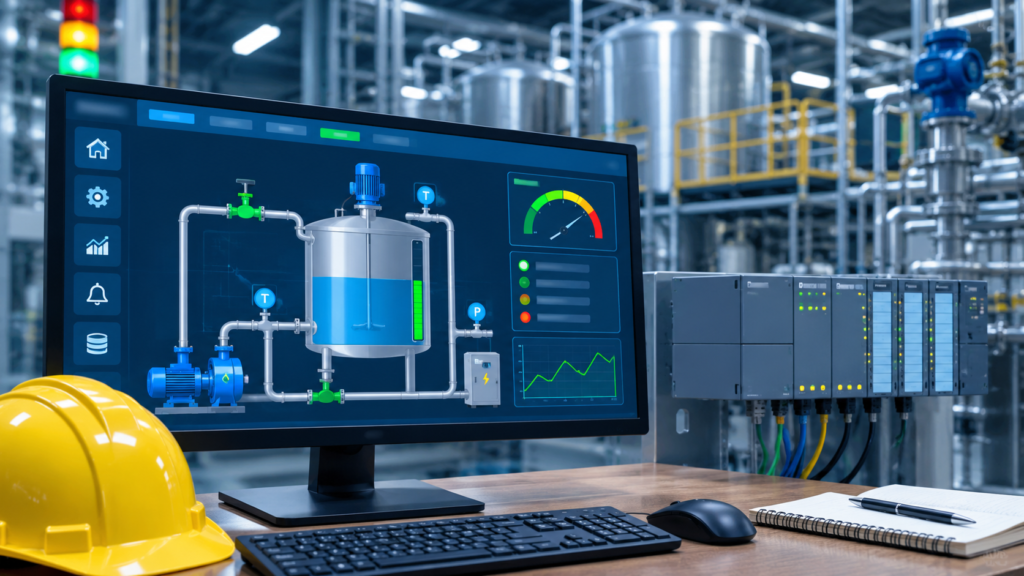
How Does SCADA Work is a common question for anyone beginning to learn industrial automation. SCADA systems help factories, power facilities, water plants, manufacturing lines, and other industrial operations monitor equipment and processes from a central location. Instead of checking every machine manually, operators can view important information through a centralized monitoring system.
So, how does SCADA work in an actual industrial environment? The process starts with field devices. Sensors measure conditions such as temperature, pressure, flow, level, speed, and position. PLCs or RTUs collect those signals and perform local control tasks. The communication network then transfers selected information to the SCADA platform.
The SCADA system processes this information and presents it through graphical operator screens. Operators can monitor equipment, view trends, respond to alarms, review historical data, and perform authorized supervisory actions.
Understanding how does SCADA work becomes easier when you follow the complete data path from the physical process to the operator screen. This guide explains that process step by step and covers SCADA components, communication, monitoring, control, alarms, historical data, applications, security, benefits, limitations, and practical examples.
What Is SCADA and How Does SCADA Work?
SCADA stands for Supervisory Control and Data Acquisition. It describes a system that collects industrial information and allows operators to supervise processes from a centralized interface.
To understand how does SCADA work, imagine a large manufacturing facility containing hundreds of motors, sensors, pumps, valves, and controllers. An operator cannot stand beside every device at the same time. SCADA solves this visibility problem by bringing important process information into one monitoring environment.
A SCADA system normally works with PLCs, RTUs, sensors, communication networks, servers, databases, and operator interfaces. Each component performs a specific function.
The sensors observe the physical process. PLCs and RTUs process field signals. Communication networks move information between devices. SCADA servers manage supervisory data and services. Operator workstations display the process in a visual format.
This arrangement allows industrial teams to monitor complex operations without manually inspecting every piece of equipment.
How Does SCADA Work From Field Devices to the Operator?
How Does SCADA Work can be understood as a continuous flow of information.
A field sensor first detects a physical condition. For example, a level transmitter may measure the amount of liquid inside a storage tank. The transmitter sends its measurement to a PLC or RTU.
The controller reads the signal and processes it according to its programmed logic. If the process requires an automatic response, the PLC can control an output. It might start a pump when the tank level falls below a configured limit.
At the same time, the PLC can make the tank-level value available to the SCADA system. The communication network transfers that value to the SCADA server.
The SCADA software receives the information and updates the associated data point. The operator interface then displays the current tank level, pump status, alarms, and other relevant information.
If an authorized operator sends a supervisory command, the command travels in the opposite direction. SCADA sends the request through the communication system to the appropriate controller. The PLC or RTU then handles the command according to its programmed logic and operating conditions.
This two-way flow explains the basic principle behind how does SCADA work.
How Does SCADA Work Step by Step?
How Does SCADA Work at the Field Level?
The first stage in how does SCADA work takes place at the field level. This is where sensors, transmitters, switches, meters, and actuators interact with the physical process.
A temperature transmitter can measure the temperature of a machine or process fluid. A pressure transmitter can monitor pressure inside a pipeline. A flow meter can measure the movement of liquid or gas. A proximity sensor can detect the position of an object.
These devices convert physical conditions into electrical or digital signals. The automation controller receives those signals and uses them for monitoring or control.
Reliable field information is essential. If a sensor produces incorrect data, the SCADA system may display an inaccurate process condition. For this reason, engineers must select suitable instruments and configure them correctly.
How Does SCADA Work With PLCs?
PLCs play a major role in how does SCADA work because they handle local automation tasks.
A Programmable Logic Controller continuously reads input signals, executes its control program, and updates output devices. A PLC can control motors, pumps, valves, conveyors, drives, and many other industrial machines.
For example, a PLC may receive a low-level signal from a tank sensor. Its program can determine whether the pump should start. The PLC performs this decision locally rather than depending on the SCADA workstation for every control action.
SCADA can monitor the PLC's status and display its information to operators. It can also send authorized supervisory commands when the application allows it.
This division of responsibility makes the automation system more practical. The PLC handles local control, while SCADA provides centralized supervision and visibility.
How Does SCADA Work With RTUs?
RTUs, or Remote Terminal Units, are another important part of how does SCADA work. Industries often use RTUs when equipment exists across large or remote areas.
Water distribution networks, pipelines, electrical substations, and remote pumping stations can contain equipment located many kilometers apart. An RTU can collect information from those locations and communicate it to a central SCADA system.
An RTU can monitor measurements, detect equipment states, and perform selected control functions. The SCADA platform can then bring information from multiple remote locations into a centralized interface.
This architecture allows operators to monitor geographically distributed infrastructure without visiting every site.
How Does SCADA Work Through Communication Networks?
Communication networks make how does SCADA work possible across connected industrial devices.
The network provides a path between PLCs, RTUs, SCADA servers, engineering workstations, operator stations, and other systems. Depending on the application, engineers may use industrial Ethernet, fiber optics, serial communication, radio, cellular connections, or other technologies.
The communication method depends on several factors. Distance, bandwidth, reliability, latency, environmental conditions, existing infrastructure, and cybersecurity requirements all influence network design.
Industrial protocols define how devices exchange information. Common examples include Modbus RTU, Modbus TCP, OPC UA, PROFINET, EtherNet/IP, DNP3, and MQTT in suitable applications.
A properly designed network allows SCADA to receive process information reliably and deliver authorized commands to the correct devices.
How Does SCADA Work With the SCADA Server?
The SCADA server provides important services in how does SCADA work.
It communicates with controllers and manages supervisory information. Depending on the platform, the server may handle data acquisition, tag management, alarms, user authentication, historical records, communication services, and other functions.
SCADA systems organize process information through tags or data points. Each tag can represent a specific value or condition.
For example, a tag could represent the current temperature of an industrial oven. Another tag might represent whether a conveyor motor is running. A third tag could represent the level inside a storage tank.
The SCADA server receives current values and makes them available to operator interfaces and other authorized applications.
How Does SCADA Work With HMI Screens?
The HMI or operator interface provides the visual side of how does SCADA work.
Instead of viewing raw numerical values from a controller, operators can see graphical representations of the process. A well-designed screen can show tanks, pumps, valves, motors, pipelines, production counters, trends, and alarm conditions.
For example, an operator may see a tank graphic with a changing liquid level. A pump symbol can indicate whether the pump is running or stopped. Pressure and temperature values can appear beside the relevant equipment.
Operators can also use these screens to perform authorized supervisory actions.
Good HMI design matters because operators often need to understand a process quickly. Clear layouts, consistent symbols, useful colors, readable values, and meaningful alarms can improve situational awareness.
How Does SCADA Work With Data Collection?
Data acquisition forms the foundation of how does SCADA work.
SCADA continuously receives selected information from connected controllers and field systems. The platform can collect analog values, digital states, counters, equipment statuses, alarms, and other process information.
Consider a production line with several motors. The SCADA system could collect motor running status, speed, current, temperature, fault conditions, and production counts.
The system does not necessarily need to collect every available signal. Engineers normally select information that supports monitoring, troubleshooting, reporting, maintenance, or operational decisions.
Effective data collection gives operators a clearer picture of what is happening across the facility.
How Does SCADA Work With Historical Data?
Historical data explains another important aspect of how does SCADA work.
A SCADA platform can store selected process values in a database or historian. This information creates a record of how the process behaved over time.
For example, an engineer can review the temperature of a machine over several days. The engineer may notice that the temperature gradually increased before a fault occurred.
Historical information can also help teams analyze production performance, energy consumption, equipment operation, alarm frequency, and process stability.
Trends make this information easier to understand. Instead of looking at individual numbers, an operator can view how a value changed over minutes, hours, days, or longer periods.
This capability makes SCADA useful not only for real-time monitoring but also for investigation and process improvement.
How Does SCADA Work With Alarms?
Alarm management is an important part of how does SCADA work because operators need to know when a process enters an abnormal condition.
A SCADA system can generate an alarm when a monitored value crosses a defined limit. For example, a high-pressure condition may trigger an alarm. A motor fault, communication failure, high temperature, or low tank level can also generate notifications.
Good alarm design focuses on useful information. If a system generates too many unnecessary alarms, operators may struggle to identify the conditions that require immediate attention.
Alarm priorities can help distinguish between different levels of importance. Alarm history can also record when an event occurred and when the operator acknowledged it.
A carefully designed alarm system helps operators respond to abnormal situations more effectively.
How Does SCADA Work With Control Commands?
Although monitoring remains a major function, how does SCADA work can also include supervisory control.
An authorized operator may use the SCADA interface to request an action. For example, the operator could request a pump start, change a setpoint, or open a valve.
The command travels through the communication system to the relevant PLC or RTU. The controller then processes the request according to its programmed conditions.
This distinction is important. SCADA can provide supervisory commands, but local controllers usually handle the detailed machine logic.
For example, an operator may request a pump start. The PLC can still check permissives, interlocks, equipment status, and other conditions before activating the pump.
This approach provides an additional layer of control and helps keep critical machine logic within the appropriate controller.
How Does SCADA Work in a Water Treatment Plant?
A water treatment plant provides a clear example of how does SCADA work in practice.
Imagine a facility with raw-water pumps, storage tanks, filtration equipment, flow meters, pressure transmitters, valves, and treatment systems.
Sensors continuously measure process conditions. PLCs collect these measurements and control connected equipment. The SCADA system receives selected information from the PLCs and presents it through operator screens.
An operator can view tank levels, pump states, flow rates, pressure values, and active alarms from a central workstation.
Suppose the water level in a storage tank starts falling. The PLC can automatically control the associated pump according to its programmed sequence. Meanwhile, SCADA displays the changing level and pump condition.
If the process reaches an abnormal condition, the SCADA system can generate an alarm. Historical records can later help engineers review what happened.
This example shows how does SCADA work by connecting field instruments, controllers, communication, visualization, alarms, and historical data.
How Does SCADA Work in Manufacturing?
Manufacturing facilities often contain many machines operating at the same time. This makes how does SCADA work especially useful for centralized supervision.
A production line may include conveyors, motors, variable frequency drives, sensors, robots, PLCs, and inspection equipment.
SCADA can collect selected information from the automation controllers and display it through centralized screens. Operators may monitor production counts, machine states, operating speeds, temperatures, faults, and downtime.
Historical records can provide additional insight into production performance.
For example, an engineering team may compare machine downtime across different shifts. The team can then investigate recurring faults and identify opportunities for improvement.
SCADA therefore provides more than a visual representation of machines. It creates a centralized information layer for the production process.
How Does SCADA Work Compared With PLC Control?
Understanding the difference between SCADA and PLCs makes how does SCADA work much easier.
A PLC primarily performs local control. It reads inputs, executes logic, and controls outputs. It must respond quickly to changes in the machine or process.
SCADA focuses on supervisory functions. It collects information, displays process conditions, manages alarms, stores historical data, and provides authorized supervisory controls.
Consider a tank-level application. The PLC can automatically start and stop a pump based on the tank level. SCADA can display the tank level, show pump status, record historical values, and notify the operator about abnormal conditions.
Both technologies therefore serve different purposes while working together as part of the same automation architecture.
How Does SCADA Work With Industrial Protocols?
Industrial communication protocols define how connected systems exchange information. They are therefore essential to how does SCADA work.
Modbus RTU commonly uses serial communication, while Modbus TCP uses Ethernet networks. OPC UA provides structured communication between compatible industrial systems.
PROFINET supports industrial Ethernet communication and is widely used with automation equipment. DNP3 appears in many utility and remote-monitoring applications.
MQTT can support lightweight messaging and can appear in architectures that connect industrial data with IIoT platforms.
The correct protocol depends on the devices, application requirements, network design, interoperability needs, performance expectations, and security considerations.
Engineers should select protocols based on actual system requirements rather than choosing a protocol simply because it is popular.
How Does SCADA Work When Communication Fails?
Communication failures are an important consideration in how does SCADA work.
A SCADA workstation may temporarily lose communication with a PLC because of a network fault, damaged cable, device failure, configuration problem, or server issue.
In a well-designed system, the PLC can often continue executing its local control program. The machine does not necessarily stop simply because the supervisory workstation temporarily loses communication.
The SCADA interface can indicate the communication failure and show the status of the affected connection. Engineers can then investigate the network, controller, switches, cables, protocol settings, and server services.
This architecture demonstrates why local control should not depend entirely on the SCADA workstation.
How Does SCADA Work With Cybersecurity?
Cybersecurity is now a critical consideration in how does SCADA work.
Industrial control systems can contain important operational information and control functions. Unauthorized access could affect equipment, production, or safety.
A secure SCADA architecture can use network segmentation, strong authentication, appropriate user permissions, controlled remote access, system monitoring, secure configuration practices, regular backups, and timely security updates.
Organizations should also carefully control connections between industrial networks and business or public networks.
Security should not be treated as an afterthought. Engineers should consider cybersecurity during system architecture, deployment, maintenance, and future upgrades.
How Does SCADA Work in Power Systems?
Power generation and distribution provide another important example of how does SCADA work.
Electrical facilities can contain substations, breakers, transformers, meters, protection equipment, and remote devices. Operators need centralized visibility into equipment status and electrical measurements.
SCADA can collect information from field devices and present voltage, current, breaker status, alarms, and other operational data.
Remote locations can communicate with a central control facility through suitable communication networks. This arrangement helps operators monitor distributed infrastructure from a central location.
The exact architecture depends on the utility, equipment, communication system, and operational requirements.
How Does SCADA Work in Oil and Gas?
Oil and gas operations can involve equipment spread across large geographic areas. This makes how does SCADA work particularly valuable for remote monitoring.
Pipelines, pumping stations, storage facilities, and processing equipment can contain sensors, RTUs, PLCs, and communication devices.
SCADA can collect information such as pressure, flow, temperature, valve status, and equipment condition. Operators can view this information centrally and respond to alarms or abnormal conditions.
Remote monitoring can reduce unnecessary site visits while giving operations teams better visibility into distributed equipment.
What Are the Benefits of How Does SCADA Work?
The practical benefits of how does SCADA work come from centralized monitoring and organized industrial data.
Operators gain a clearer view of equipment and processes. Real-time information can help teams identify abnormal conditions sooner.
Historical data supports troubleshooting and trend analysis. Alarm management helps operators recognize important events. Remote monitoring can provide visibility into equipment located far from the main control room.
SCADA can also help organizations improve operational awareness by bringing information from different systems into one interface.
However, the quality of these benefits depends on system design. Poor data configuration, weak communication, confusing screens, or excessive alarms can reduce the value of the platform.
What Are the Limitations of How Does SCADA Work?
Although how does SCADA work provides many advantages, SCADA systems also introduce technical challenges.
Large systems can become complicated as the number of controllers, tags, alarms, users, and historical records increases. Engineers need clear documentation and consistent configuration practices to manage this complexity.
Communication problems can affect data availability. Incorrect tag mapping can cause misleading information. Poorly designed operator screens can make important information difficult to recognize.
Cybersecurity also requires continuous attention. Organizations must protect systems while maintaining the availability required by industrial operations.
SCADA should therefore be designed as part of a complete automation strategy rather than treated as an isolated software installation.
How Does SCADA Work With Good System Design?
Good engineering practices can make how does SCADA work more reliable and easier to maintain.
A clear architecture should define the role of every major component. Engineers should document controllers, communication paths, servers, operator stations, network devices, and important data points.
Tag names should follow a consistent naming convention. Operators should see meaningful descriptions rather than confusing identifiers.
Alarm priorities should reflect operational importance. Screens should present critical information clearly and avoid unnecessary visual complexity.
Network architecture should match the reliability requirements of the application. Where the process requires high availability, engineers can consider suitable redundancy options.
Regular backups and controlled configuration changes can also make maintenance safer and more predictable.
Frequently Asked Questions About How Does SCADA Work?
How Does SCADA Work With a PLC?
How Does SCADA Work with a PLC through an industrial communication connection. The PLC collects field signals and performs local control logic. SCADA receives selected PLC information, displays it to operators, manages alarms, stores historical data, and can send authorized supervisory commands.
How Does SCADA Work Without a PLC?
How Does SCADA Work without a PLC depends on the architecture. An RTU or another compatible industrial controller can collect field information and perform control functions. The appropriate solution depends on the application and equipment.
How Does SCADA Work in Real Time?
How Does SCADA Work in near real time by continuously exchanging information between field controllers and supervisory software. The actual update rate depends on the communication network, controller configuration, server performance, and SCADA architecture.
How Does SCADA Work With Sensors?
How Does SCADA Work with sensors through PLCs, RTUs, or other compatible devices. Sensors measure physical conditions, while controllers collect and process those signals before sending useful information to the SCADA platform.
How Does SCADA Work for Remote Monitoring?
How Does SCADA Work for remote monitoring by connecting distributed controllers and field devices to a central supervisory system. Suitable communication technologies allow authorized users to monitor remote equipment.
How Does SCADA Work With Historical Data?
How Does SCADA Work with historical data through databases or historian systems. The platform can store selected process values, alarms, events, and equipment information for later analysis.
How Does SCADA Work During a Network Failure?
How Does SCADA Work during a network failure depends on the system architecture. Local PLC or RTU control can often continue operating while SCADA reports the communication problem. Engineers can then investigate and restore the affected connection.
Conclusion
How Does SCADA Work can be summarized as a continuous process of collecting, communicating, presenting, analyzing, and supervising industrial information.
Sensors first observe the physical process. PLCs and RTUs receive those signals and perform local control. Communication networks transfer selected information to the SCADA platform. SCADA servers process the information and make it available to operator interfaces, alarms, trends, and historical systems.
When an operator needs to take an authorized action, SCADA can send a supervisory command back toward the relevant controller. The controller then evaluates that request according to its programmed logic and operating conditions.
This architecture gives industrial teams a centralized view of complex processes. It can improve monitoring, support troubleshooting, provide historical insight, and help operators respond to abnormal conditions.
Once you understand how does SCADA work, it becomes much easier to understand related technologies such as PLC programming, HMI systems, industrial communication protocols, data historians, IIoT, and Industry 4.0.
A well-engineered SCADA system is more than a collection of graphical screens. It is a complete supervisory layer that connects industrial data with the people responsible for monitoring and managing the process.