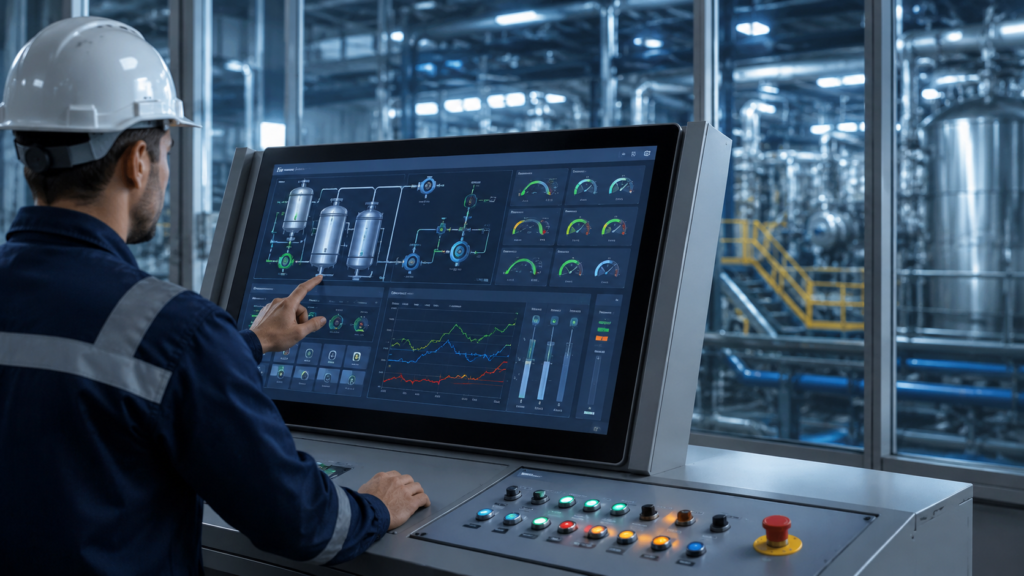
Industrial automation continues to evolve as factories become smarter, faster, and more connected. Modern production facilities depend on Human Machine Interfaces (HMIs) to display machine status, monitor processes, visualize production data, and help operators make informed decisions. An HMI acts as the bridge between people and industrial equipment, making complex systems easier to understand and control.
As manufacturing systems grow more advanced, simply installing an HMI is no longer enough. Poorly designed screens, inconsistent layouts, excessive alarms, and confusing navigation can reduce productivity, increase operator stress, and create safety risks. Many industrial accidents and production losses occur because operators cannot quickly identify or respond to important information.
This challenge has encouraged industries worldwide to adopt Industrial HMI Standards. These standards provide practical guidelines for designing clear, consistent, and efficient operator interfaces that improve usability and reduce human error. Instead of relying on personal design preferences, engineers follow proven principles that support faster decision-making and safer plant operations.
Two of the most widely recognized standards are ISA-101 and IEC 62682. ISA-101 focuses on creating effective Human Machine Interface systems with better screen design, navigation, color usage, and information hierarchy. IEC 62682 complements these principles by defining best practices for alarm management, helping operators respond to critical events without becoming overwhelmed by unnecessary notifications.
Organizations that implement these standards often experience better operator performance, reduced downtime, improved maintenance efficiency, and higher production reliability. Standardized interfaces also simplify operator training because employees interact with familiar screen layouts throughout the facility.
This guide explains the purpose of Industrial HMI Standards, explores the key principles behind ISA-101 and IEC 62682, highlights their benefits, and shares practical recommendations for designing modern HMI systems that support safe, efficient, and reliable industrial automation.
What Are Industrial HMI Standards?
Industrial HMI Standards are structured guidelines that help engineers design Human Machine Interfaces that are consistent, intuitive, and easy to operate. Rather than focusing only on appearance, these standards emphasize how information should be presented so operators can understand system conditions quickly and respond appropriately.
A well-designed HMI communicates the right information at the right time. It highlights abnormal conditions without distracting operators with unnecessary graphics or excessive alarms. This approach supports faster decision-making and improves operational awareness across the production environment.
Industrial HMI Standards also encourage consistency. Similar equipment should use similar screen layouts, navigation methods, color schemes, symbols, and alarm behavior. Consistency reduces learning time, minimizes confusion, and improves confidence during normal operation and emergency situations.
Whether an HMI controls a single machine or an entire production plant, standardized design principles help create safer and more efficient industrial systems.
Why HMI Standards Matter
Modern production facilities generate enormous amounts of operational data every second. Operators must monitor equipment status, alarms, trends, production values, and process conditions while maintaining product quality and plant safety.
Without standardized interface design, important information can become difficult to identify. Bright colors, inconsistent graphics, unnecessary animations, and overloaded screens increase cognitive workload instead of improving operator awareness.
Industrial HMI Standards solve these challenges by promoting designs that prioritize clarity over decoration.
Organizations that follow these standards can achieve several operational improvements.
Improved Operator Awareness
Operators can identify process changes more quickly because important information stands out naturally. Clear visualization reduces the time required to recognize developing problems.
Faster Decision-Making
Logical screen organization allows operators to locate relevant information without searching through multiple windows. Faster access supports quicker responses during abnormal conditions.
Reduced Human Error
Consistent navigation, standardized symbols, and predictable screen behavior reduce the likelihood of selecting incorrect controls or misunderstanding process information.
Better Safety
Proper alarm prioritization helps operators focus on critical events instead of responding to hundreds of unnecessary notifications.
Lower Training Requirements
New operators become productive sooner because standardized interfaces remain familiar across different machines and production lines.
Higher Productivity
Operators spend less time searching for information and more time optimizing production performance.
Improved Maintenance
Maintenance engineers can troubleshoot equipment more efficiently when every screen follows consistent design principles.
Industrial HMI Standards: HMI Lifecycle According to ISA-101
The success of Industrial HMI Standards does not depend only on attractive screen design. Instead, it depends on a structured lifecycle that guides every stage of HMI development. ISA-101 introduces this lifecycle because industrial systems continue to evolve throughout their operational life. As production requirements change, HMI systems must also improve to remain effective and reliable.
First, engineers identify operational objectives before creating any screen layouts. During this stage, they analyze production processes, operator responsibilities, equipment behavior, and business goals. As a result, the HMI supports real operational needs rather than personal design preferences.
Next, designers create interface concepts that reflect the principles of Industrial HMI Standards. They organize information logically, simplify navigation, and reduce unnecessary visual elements. Moreover, they ensure that operators can locate important information without wasting valuable time.
After the design phase, developers implement the HMI using industrial software platforms. However, implementation alone does not guarantee success. Engineers must verify that every screen behaves correctly under normal and abnormal operating conditions.
Testing plays an equally important role because even a small design mistake can confuse operators during critical situations. Therefore, organizations should perform functional testing, usability testing, and operator validation before deploying the system in a live production environment.
Once the HMI becomes operational, the lifecycle continues. Engineers regularly collect feedback from operators because real production environments often reveal opportunities for improvement. Consequently, organizations can refine navigation, simplify graphics, improve alarm visibility, and increase overall usability without redesigning the complete system.
This continuous improvement process allows Industrial HMI Standards to remain valuable throughout the lifetime of an automation project.
Industrial HMI Standards and IEC 62682
Although ISA-101 focuses on HMI design, Industrial HMI Standards also include effective alarm management. Therefore, IEC 62682 complements ISA-101 by establishing internationally recognized guidance for alarm systems used in industrial facilities.
Industrial operators often monitor hundreds or even thousands of process variables simultaneously. However, an excessive number of alarms can overwhelm operators instead of helping them. When every notification appears equally important, critical alarms become difficult to identify.
IEC 62682 addresses this challenge by defining structured alarm management practices. Instead of generating unnecessary alerts, the standard encourages organizations to present only meaningful alarms that require operator action. As a result, operators can focus on the events that truly affect plant safety and production.
Furthermore, IEC 62682 recommends documenting every alarm, defining its purpose, assigning an appropriate priority, and reviewing its effectiveness over time. Because production environments constantly change, alarm systems should evolve as well.
When organizations combine ISA-101 with IEC 62682, they create Human Machine Interface systems that display information clearly while managing alarms intelligently. Consequently, operators experience less stress, faster decision-making, and greater confidence during plant operation.
Why Industrial HMI Standards Improve Alarm Management
Alarm management remains one of the most important aspects of modern industrial automation. Every alarm should communicate useful information because unnecessary notifications reduce operator awareness instead of improving it.
For example, imagine an operator supervising a chemical processing plant. If hundreds of alarms appear within a few minutes, identifying the actual problem becomes extremely difficult. However, when alarms follow Industrial HMI Standards, only significant events demand immediate attention.
ISA-101 encourages designers to display alarms clearly without overwhelming the interface. Meanwhile, IEC 62682 defines how alarms should be created, prioritized, reviewed, and maintained. Together, these standards improve situational awareness and reduce operational risk.
In addition, properly designed alarm systems shorten troubleshooting time because operators immediately understand the severity of each event. Consequently, maintenance teams can respond more efficiently while minimizing production downtime.
Industrial HMI Standards for Screen Hierarchy
One of the most valuable concepts introduced by Industrial HMI Standards is screen hierarchy. Instead of displaying every detail on one page, the interface presents information in multiple logical levels. Therefore, operators receive the right amount of information at the right time.
The highest level provides an overview of the entire production process. At this level, operators quickly determine whether production remains stable or whether abnormal conditions require investigation.
The next level focuses on specific production areas. Because the operator already understands the overall plant status, finding the affected process becomes much easier.
Finally, detailed equipment screens provide maintenance information, device diagnostics, configuration parameters, and process values. However, operators access these detailed pages only when necessary. As a result, the main interface remains clean and easy to understand.
This structured hierarchy improves efficiency because operators spend less time searching for information and more time responding to actual process conditions.
How Industrial HMI Standards Reduce Human Error
Human error remains one of the leading causes of industrial incidents. Fortunately, Industrial HMI Standards help reduce these mistakes by presenting information consistently and logically.
When every production line follows similar navigation methods, operators quickly become familiar with the interface. Consequently, they spend less time learning new systems and more time monitoring production effectively.
Similarly, standardized colors reduce confusion. Neutral backgrounds allow alarms and warnings to stand out naturally. However, excessive use of bright colors creates visual noise that makes abnormal conditions harder to recognize.
Furthermore, consistent symbols, terminology, and layouts improve operator confidence because every screen behaves predictably. During emergency situations, this familiarity allows operators to react faster without unnecessary hesitation.
As industrial facilities continue adopting digital transformation, standardized HMI design becomes even more important. Therefore, organizations that invest in Industrial HMI Standards create safer, more reliable, and more productive automation environments.
Industrial HMI Standards for High-Performance HMI Design
Modern manufacturing facilities generate thousands of data points every second. Therefore, operators need interfaces that transform complex information into meaningful insights instead of displaying endless numbers and graphics. This requirement has made high-performance HMI design an essential part of Industrial HMI Standards.
A high-performance HMI does not rely on attractive colors or decorative animations. Instead, it focuses on helping operators understand the current condition of a process within seconds. When important information remains visible and organized, operators can identify abnormal situations before they develop into major production problems.
One of the primary objectives of Industrial HMI Standards is to improve situational awareness. Rather than forcing operators to search through multiple screens, an effective interface presents the most important process information in a logical sequence. Consequently, operators spend less time navigating the system and more time monitoring plant performance.
Another important principle involves visual simplicity. Many older HMI systems used colorful backgrounds, flashing objects, and animated graphics because they appeared modern. However, these visual effects often distracted operators during critical situations. As a result, many organizations discovered that attractive graphics did not necessarily improve operational performance.
Modern HMI standards recommend neutral backgrounds because they reduce visual fatigue during long operating shifts. Furthermore, important alarms and abnormal conditions become much easier to recognize when the screen does not compete for the operator's attention. This approach allows colors to communicate meaningful information instead of serving only decorative purposes.
Data organization also plays an important role in high-performance design. Operators should immediately recognize process status without reading every numerical value. Therefore, process graphics, trends, status indicators, and equipment summaries should appear in a logical arrangement that supports quick understanding. When every element has a clear purpose, the interface becomes easier to use and significantly more efficient.
Industrial facilities also benefit from standardized navigation. Similar equipment should display similar screen layouts because consistency reduces confusion. Moreover, operators who already understand one production line can quickly adapt to another without extensive retraining. This consistency improves productivity while reducing operational risk.
High-performance HMI design also encourages engineers to eliminate unnecessary information. Although every process generates valuable data, operators do not need to view everything simultaneously. Instead, the interface should display only the information required for safe and efficient operation. Detailed diagnostics can remain available on secondary screens whenever additional investigation becomes necessary.
As industrial automation continues evolving, organizations increasingly recognize that better interface design directly improves operational performance. Therefore, implementing Industrial HMI Standards becomes an investment in productivity, safety, and long-term reliability rather than simply a design preference.
Industrial HMI Standards Best Practices
Organizations achieve the greatest value from Industrial HMI Standards when they apply proven design practices throughout every automation project. These recommendations improve usability while supporting consistent operation across different production facilities.
Successful projects always begin with understanding operator requirements. Before creating any interface, engineers should observe how operators interact with equipment during normal production and emergency situations. Because operators use the system every day, their feedback provides valuable insight that improves the final design.
Screen layouts should remain simple and predictable. For example, process overviews should appear before detailed equipment information because operators first need to understand the overall condition of the plant. After identifying the affected area, they can investigate specific equipment in greater detail. Consequently, troubleshooting becomes faster and more organized.
Navigation should remain consistent throughout the entire HMI application. Buttons, menus, symbols, and screen transitions should behave similarly regardless of which production area the operator accesses. As a result, users develop confidence because every screen responds in a familiar manner.
Engineers should also maintain consistent terminology across all displays. Equipment names, process descriptions, and alarm messages should match official plant documentation. Otherwise, inconsistent naming can create unnecessary confusion during maintenance activities or emergency response.
Color selection requires careful planning. Neutral colors should represent normal operating conditions, while brighter colors should indicate abnormal situations requiring operator attention. However, excessive color usage reduces the effectiveness of visual warnings because every object begins competing for attention.
Trend displays provide another valuable feature when implemented correctly. Historical process data allows operators to recognize developing problems before production quality begins declining. Furthermore, maintenance teams can analyze trends to identify recurring issues and improve equipment reliability.
Performance monitoring should continue even after deployment. Operators often discover practical improvements during daily operation that designers may not anticipate. Therefore, organizations should regularly evaluate interface performance and implement refinements whenever necessary. Continuous improvement ensures that Industrial HMI Standards continue supporting operational excellence throughout the life of the automation system.
Common Mistakes That Industrial HMI Standards Help Prevent
Many industrial facilities experience similar HMI design problems because interfaces often evolve over many years without following consistent standards. Fortunately, Industrial HMI Standards address these weaknesses through structured design principles.
One of the most common mistakes involves overcrowded screens. Designers sometimes attempt to display every available process value on a single page. However, excessive information makes important details difficult to locate. Consequently, operators require more time to identify developing problems.
Another frequent issue involves inconsistent navigation. Different production areas may use different button locations, symbols, or menu structures. As a result, operators hesitate while searching for familiar controls, particularly during stressful situations.
Poor alarm management creates another significant challenge. Some facilities generate hundreds of alarms within a short period because every minor event triggers a notification. However, alarm flooding reduces operator awareness instead of improving it. Critical events become buried among less important messages, increasing operational risk.
Inconsistent color usage also causes confusion. For example, one screen may use green to indicate normal operation, while another uses the same color for a completely different purpose. Therefore, operators may misinterpret important process conditions when moving between production areas.
Complex graphics represent another common design mistake. Three-dimensional equipment models, decorative backgrounds, and unnecessary animations may appear impressive during demonstrations. However, these features rarely improve operational performance. Instead, they distract operators from critical information and increase mental workload.
Some organizations also neglect user testing before deploying new interfaces. Although a design may appear technically correct, practical testing often reveals navigation problems, confusing terminology, or missing information. Consequently, operator feedback should always become part of the development process.
Another mistake involves ignoring future expansion. Production facilities regularly add new equipment, modify production lines, and integrate additional automation technologies. Therefore, HMI systems should remain flexible enough to accommodate future growth without requiring complete redesign.
Organizations that follow Industrial HMI Standards avoid these common problems because every design decision supports usability, consistency, and operational efficiency. As a result, operators work more confidently while production systems become safer and more reliable.
Real-World Applications of Industrial HMI Standards
Manufacturing companies around the world rely on Industrial HMI Standards to improve operational efficiency, reduce human error, and strengthen plant safety. These standards support industries of every size because they create consistent interfaces that help operators make faster and more accurate decisions.
In the automotive industry, operators supervise robotic assembly lines, welding stations, and conveyor systems through centralized HMI screens. Because every production stage depends on precise coordination, standardized interfaces allow operators to monitor equipment status quickly and identify abnormal conditions before they interrupt production. As a result, manufacturers reduce downtime while maintaining consistent product quality.
Food and beverage processing facilities also benefit from Industrial HMI Standards. Production lines often include mixing systems, filling machines, packaging equipment, and quality inspection stations. Since hygiene and product consistency remain essential, operators need clear process visualization throughout the manufacturing cycle. Standardized HMIs simplify monitoring and help maintain stable operating conditions during continuous production.
Water and wastewater treatment plants represent another excellent example. Operators supervise pumps, filters, reservoirs, valves, and chemical dosing systems from centralized control rooms. Therefore, clear navigation and well-organized process graphics allow operators to respond quickly whenever system conditions change. Better visibility also supports regulatory compliance and reliable public services.
Chemical manufacturing facilities operate under demanding safety requirements. Even minor process deviations can affect product quality or create hazardous situations. Consequently, engineers implement Industrial HMI Standards to improve situational awareness and present critical alarms with greater clarity. Operators receive the right information at the right time, allowing them to respond confidently during abnormal operating conditions.
Power generation facilities also depend heavily on standardized HMI systems. Engineers monitor turbines, generators, transformers, cooling systems, and electrical distribution equipment through integrated control interfaces. Because uninterrupted operation remains essential, consistent screen layouts reduce confusion while supporting rapid troubleshooting.
Similarly, pharmaceutical manufacturers use standardized HMIs to maintain strict production accuracy. Operators supervise temperature, pressure, humidity, mixing processes, and batch records through reliable interfaces that support product quality and regulatory requirements.
Across every industry, organizations continue adopting Industrial HMI Standards because standardized interfaces improve safety, simplify training, and create more reliable production environments.
Future of Industrial HMI Standards
As industrial automation continues to evolve, cybersecurity will become an even greater priority. Modern production facilities rely on connected devices, cloud platforms, and industrial communication networks. Therefore, protecting critical systems from cyber threats is no longer optional. Future HMI systems will incorporate stronger authentication methods, encrypted communication protocols, multi-layer access control, and continuous security monitoring. As a result, organizations will strengthen system security while maintaining reliable and uninterrupted operations.
At the same time, digital twin technology will play a significant role in the future of Industrial HMI Standards. Digital twins create virtual replicas of industrial machines, production lines, and entire facilities. Engineers can evaluate process changes, test control strategies, and identify potential issues in a virtual environment before applying modifications to actual equipment. Consequently, organizations can improve operational efficiency, reduce commissioning time, minimize production risks, and make better engineering decisions.
Artificial Intelligence and Industrial Internet of Things (IIoT) technologies will further transform Human Machine Interface systems. Smart analytics will help operators recognize abnormal process conditions earlier, while predictive insights will support faster maintenance planning and better operational decisions. Moreover, remote monitoring capabilities will allow engineering teams to supervise multiple production sites through secure and standardized HMI platforms.
Although technology continues advancing, one principle remains unchanged. Every successful HMI should place the operator at the center of the design process. Clear visualization, logical navigation, and consistent screen layouts will always support safer and more efficient industrial operations. Therefore, Industrial HMI Standards will continue guiding manufacturers toward smarter, more reliable, and future-ready automation systems.
Frequently Asked Questions About Industrial HMI Standards
What Are Industrial HMI Standards?
Industrial HMI Standards are internationally recognized guidelines that help engineers design Human Machine Interfaces that are clear, consistent, user-friendly, and safe to operate. These standards improve usability, reduce operator errors, and support efficient industrial automation.
What Is ISA-101?
ISA-101 is an international standard that defines best practices for designing, implementing, operating, and maintaining Human Machine Interface systems. It focuses on improving operator performance through consistent screen design, intuitive navigation, and effective information presentation.
What Is IEC 62682?
IEC 62682 is an international standard for industrial alarm management. It provides structured guidance for creating, prioritizing, monitoring, and maintaining alarms so operators can recognize critical events quickly and respond effectively during abnormal operating conditions.
Why Are Industrial HMI Standards Important?
Organizations implement Industrial HMI Standards because they improve operational awareness, reduce training time, minimize human error, strengthen workplace safety, increase production efficiency, and create more consistent operator experiences across industrial facilities.
Can Small Manufacturing Companies Benefit from Industrial HMI Standards?
Yes. Small and medium-sized manufacturers can gain significant advantages from Industrial HMI Standards. Standardized HMI design simplifies machine operation, improves troubleshooting, reduces training requirements, and supports future automation expansion as production grows.
Do Industrial HMI Standards Apply Only to Large Factories?
No. Industrial HMI Standards apply to automation projects of every size. They support standalone machines, packaging systems, water treatment plants, food and beverage processing, pharmaceutical manufacturing, energy facilities, chemical processing, and large-scale industrial production.
How Often Should HMI Systems Be Reviewed?
Organizations should evaluate HMI systems regularly, particularly after equipment upgrades, software updates, process improvements, or operator feedback. Continuous review helps maintain system performance, improve usability, and ensure long-term compliance with modern industrial requirements.
Conclusion
Modern manufacturing depends on accurate information, reliable control systems, and effective operator interaction. Therefore, Industrial HMI Standards have become an essential foundation for successful industrial automation projects. Rather than focusing only on visual appearance, these standards establish practical design principles that improve usability, strengthen operational safety, reduce human error, and increase overall production efficiency.
ISA-101 provides a structured framework for designing clear, consistent, and operator-focused Human Machine Interfaces. Meanwhile, IEC 62682 complements these guidelines by introducing proven alarm management practices that reduce alarm fatigue and improve operator response during critical situations. Together, these internationally recognized standards create intelligent HMI systems that support faster decision-making, greater situational awareness, and more reliable industrial operations.
Organizations that adopt Industrial HMI Standards often experience measurable improvements in productivity, maintenance efficiency, operator confidence, and equipment reliability. Furthermore, standardized interfaces simplify employee training because operators interact with familiar layouts, navigation methods, and visual elements across multiple production areas. As Artificial Intelligence, Industrial Internet of Things (IIoT), cloud connectivity, remote monitoring, and digital transformation continue shaping modern manufacturing, the value of standardized HMI design will become even more significant.
Ultimately, successful automation depends not only on advanced hardware and powerful software but also on the quality of the interface connecting people with industrial processes. By implementing Industrial HMI Standards, organizations can build reliable, scalable, secure, and future-ready automation systems that support sustainable growth, operational excellence, and long-term business success.