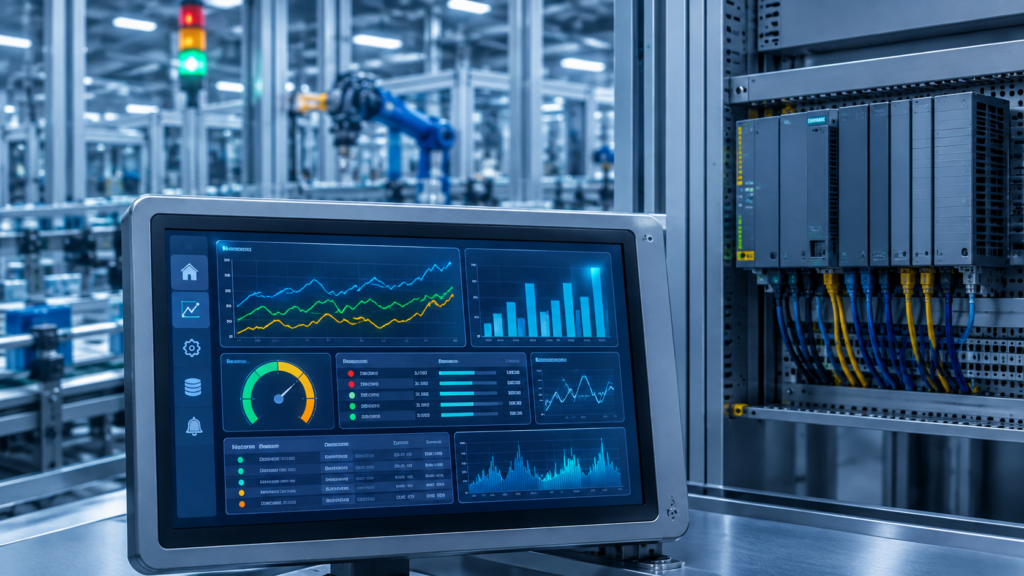
HMI Data Logging is a fundamental part of modern industrial automation that enables manufacturers to collect, store, and analyze historical process data with accuracy. By recording important machine values over time, HMI Data Logging helps engineers monitor equipment performance, identify operational trends, reduce unexpected downtime, and improve production efficiency. Moreover, reliable historical data supports informed decision-making, preventive maintenance, and consistent product quality, making data logging an essential feature in today's smart manufacturing environments.
Industrial companies today rely on accurate information rather than assumptions. Therefore, data collected from machines is no longer considered optional. It has become an essential resource for improving productivity and maintaining reliable operations. Operators can review historical records, compare machine performance, and investigate unexpected events without depending on manual notes. Consequently, businesses reduce downtime while increasing overall efficiency.
Modern Human Machine Interface systems are designed to do much more than display machine status. They also record process values over time. This capability allows operators to monitor equipment performance, verify production quality, and generate reports whenever required. Furthermore, managers can review historical process information to understand long-term operational patterns and support better business decisions.
Whether you operate a small automation project or a large industrial facility, implementing HMI Data Logging creates a reliable history of process information. This historical data becomes extremely valuable during maintenance, troubleshooting, production planning, quality control, and regulatory compliance. In this guide, you will learn how HMI data logging works, why it is important, how to configure it properly, and which best practices produce the most reliable results.
What Is HMI Data Logging?
HMI Data Logging is the process of automatically recording operational information from industrial equipment through a Human Machine Interface. Instead of displaying only live values, the HMI continuously stores selected process variables so they can be reviewed later.
These recorded values may include temperatures, pressures, motor speeds, production counts, flow rates, tank levels, alarms, energy consumption, equipment status, and many other process parameters. Because the information is collected automatically, the possibility of human error is significantly reduced.
Unlike manual record keeping, automated logging provides continuous monitoring throughout production. Every important process change is captured according to predefined rules. Consequently, operators always have accurate historical information available whenever they need to investigate a process.
Most modern HMI platforms support multiple storage methods. Some systems save information directly inside the HMI device. Others transfer records to industrial computers, local servers, SQL databases, cloud storage, or SCADA systems. Therefore, organizations can choose a storage solution that matches their operational requirements.
The primary purpose of HMI data logging is not simply collecting information. Instead, it transforms raw machine data into meaningful operational knowledge that helps improve production efficiency, maintenance planning, and product quality.
Why HMI Data Logging Is Important
Industrial automation depends on reliable information. Machines continuously generate thousands of values every second. However, these values have little long-term value unless they are stored properly.
Data logging creates a complete operational history. Therefore, engineers can compare present conditions with previous production cycles. This comparison often reveals hidden performance issues that cannot be identified through live monitoring alone.
Suppose a production machine occasionally overheats during the night shift. Operators may notice the problem after it occurs, but they cannot determine exactly when the temperature started increasing. Historical trend data solves this problem because every recorded value remains available for analysis. As a result, maintenance teams can identify the exact sequence of events before the failure happened.
Another major advantage involves product quality. Many industries must maintain strict production standards. Consequently, manufacturers often need historical process records to verify that products were manufactured within acceptable operating limits.
Energy management also benefits from historical logging. Machines rarely consume identical amounts of electricity throughout the day. Instead, consumption changes according to production demand. By reviewing stored information, companies can identify unnecessary energy usage and improve operational efficiency.
In addition, maintenance departments use historical data to predict equipment failures before they become serious problems. Instead of waiting for a machine to stop unexpectedly, technicians can recognize gradual performance changes and schedule maintenance at a convenient time.
How HMI Data Logging Works
Understanding the overall workflow makes implementation much easier. Although software platforms differ slightly, the basic operating principle remains almost identical across most industrial systems.
The process begins inside the PLC. Sensors installed throughout the production system continuously measure physical conditions such as temperature, pressure, flow, level, speed, or vibration. These sensor values are processed by the PLC and updated repeatedly during every scan cycle.
The HMI communicates with the PLC using industrial communication protocols. As new process values become available, the HMI reads selected variables according to its configured update rate.
Instead of simply displaying live information, the HMI stores selected values inside a logging database. Depending on the configuration, data may be recorded every second, every minute, after specific events, or whenever process values change beyond a defined limit.
Once stored, the information becomes available through historical trend graphs, reports, tables, dashboards, and analysis tools. Operators can search previous records, compare production batches, and review equipment performance over extended periods.
Some organizations also synchronize this information with SCADA systems or cloud platforms. Consequently, engineers can access production history remotely while maintaining centralized records across multiple facilities.
Types of Data Collected in HMI Systems
Industrial automation systems monitor many different process variables. However, not every value requires permanent storage. Choosing meaningful variables improves performance while reducing unnecessary storage requirements.
Process measurements represent one of the largest categories of logged information. These values include temperature, pressure, humidity, liquid level, motor current, flow rate, voltage, frequency, and production speed.
Equipment status information is equally important. Machines frequently switch between operating, standby, maintenance, and fault conditions. Recording these changes helps engineers understand equipment utilization over time.
Alarm history provides another valuable source of operational information. Every warning, emergency stop, communication failure, or equipment fault is automatically recorded together with the corresponding timestamp. Therefore, maintenance personnel can investigate recurring problems more efficiently.
Production information is also commonly stored. Manufacturers often record completed units, rejected products, production rates, machine operating hours, and batch information. These records support quality assurance and production planning.
User activity may also be logged. Modern HMI software records operator logins, configuration changes, password usage, and manual process adjustments. Consequently, organizations maintain better accountability while meeting industrial security requirements.
Components Required for HMI Data Logging
A successful logging system depends on several hardware and software components working together. Each component plays an important role in ensuring accurate and reliable information collection.
The Human Machine Interface acts as the central visualization platform. Besides displaying live machine information, it manages historical storage, trend generation, alarm history, and report creation.
The PLC serves as the primary controller. It receives information from field devices, executes control logic, and provides updated process values to the HMI.
Data storage is another critical component. Small applications may use local HMI memory, whereas larger facilities generally rely on industrial computers, SQL databases, network storage, or cloud infrastructure.
Engineering software allows automation engineers to configure logging intervals, select process variables, design historical trends, generate reports, and manage long-term storage.
When these components operate together correctly, the entire production process becomes transparent. Historical information remains available for future analysis whenever required.
Common Storage Methods Used in HMI Data Logging
The method used to store historical information depends on project size, available hardware, and operational requirements.
Local storage is the simplest solution. In this approach, the HMI saves records inside its internal memory or an external memory card. Small automation projects often use this method because it is easy to configure and requires minimal additional equipment.
Industrial computers provide significantly larger storage capacity. Therefore, medium-sized factories frequently save historical records on dedicated PCs connected to the automation network.
Database storage has become increasingly popular because it supports fast searching, long-term archiving, and advanced reporting. SQL databases allow organizations to manage years of production information without affecting HMI performance.
Cloud storage offers another modern alternative. Historical process information is transferred securely to cloud servers where engineers can review reports remotely from different locations. As industrial connectivity continues to improve, cloud-based monitoring is becoming more common across many industries.
Some organizations combine multiple storage methods. For example, the HMI may temporarily store recent records locally before automatically transferring older information to a central database. This approach balances performance, reliability, and storage capacity while reducing the risk of data loss.
Setting Up HMI Data Logging
Configuring an HMI data logging system is not simply a matter of enabling a recording option. A well-designed configuration ensures that valuable information is collected without creating unnecessary storage requirements or reducing system performance. Every automation project has unique operational needs. Therefore, the setup process should always reflect the goals of the production environment.
The first step is selecting the process variables that truly matter. Although hundreds of PLC tags may be available, only the most meaningful values should be recorded. Engineers usually begin with parameters that directly affect machine performance, product quality, energy consumption, or maintenance activities. This approach keeps historical records organized while reducing storage demands.
After selecting the required variables, the recording interval must be defined. Some applications require updates every second because the process changes rapidly. Other systems, however, only need values every few minutes since the operating conditions remain relatively stable. Choosing an appropriate interval improves efficiency while preserving important information.
The storage location should then be configured. Small automation systems often save records inside the HMI itself. Larger facilities generally use industrial computers, centralized databases, or network servers because they offer greater storage capacity and easier long-term management. Organizations that operate multiple production sites may also synchronize records with cloud platforms for centralized monitoring.
Once the storage destination has been selected, engineers configure historical trends, alarm history, and reporting functions. Finally, the entire system should be tested under normal operating conditions to confirm that every value is being recorded correctly. Careful testing prevents unexpected problems after deployment and ensures reliable historical information from the beginning.
Benefits of HMI Data Logging
Industrial organizations invest in data logging because the long-term advantages extend far beyond simple record keeping. Historical information becomes an essential business resource that supports technical improvements as well as operational decision-making.
One of the greatest advantages is improved troubleshooting. Equipment failures rarely occur without warning. Instead, small changes usually appear long before a complete breakdown happens. Historical trends allow maintenance engineers to identify these gradual changes and understand exactly how the machine behaved before the fault occurred. Consequently, repairs become faster and more accurate.
Production quality also improves significantly. Manufacturers can compare historical process values with quality inspection results to determine whether products were produced within acceptable operating limits. If a quality issue appears, engineers can quickly review the corresponding production records instead of relying on assumptions.
Another major benefit involves predictive maintenance. Historical operating information reveals gradual changes in machine performance over weeks or months. Rising temperatures, increasing vibration levels, or abnormal motor currents often indicate developing mechanical problems. Because these patterns become visible through historical records, maintenance can be scheduled before equipment fails unexpectedly.
Energy efficiency represents another important advantage. Many factories consume more electricity than necessary simply because energy usage is never analyzed carefully. Historical power consumption records reveal inefficient operating periods, unnecessary idle time, and excessive equipment loading. As a result, organizations can reduce operating costs while improving sustainability.
Historical information also supports better production planning. Managers can review previous production cycles, evaluate machine utilization, compare equipment performance, and estimate future production capacity with greater confidence. Decisions become based on measurable facts rather than estimates.
Compliance requirements provide another reason for implementing reliable logging systems. Many industries must maintain complete operational records to satisfy customer expectations or regulatory standards. Accurate historical information simplifies inspections while demonstrating that production processes remained within approved operating conditions.
Best Practices for HMI Data Logging
Successful industrial data logging depends not only on technology but also on proper engineering practices. Following proven methods improves system reliability while making historical information easier to analyze.
Only important variables should be recorded. Collecting unnecessary information increases storage requirements and makes reports more difficult to interpret. Instead, engineers should focus on measurements that directly influence production, maintenance, safety, and quality.
Recording intervals should match the characteristics of the process. Fast production lines require shorter intervals, whereas slow-moving applications can use longer recording periods without losing valuable information. Selecting appropriate intervals reduces storage usage while maintaining accurate process history.
Historical data should always be protected through regular backups. Storage devices can fail unexpectedly. Therefore, backup procedures help prevent permanent information loss and support business continuity.
Storage capacity should be monitored continuously. Historical databases grow larger over time. Consequently, organizations should archive older information periodically while maintaining easy access to important production records.
Common Challenges in HMI Data Logging
Although modern HMI software provides powerful logging capabilities, several practical challenges can affect system performance if they are ignored.
One common issue involves excessive data collection. Recording every available PLC tag may appear beneficial at first. However, unnecessary information quickly consumes storage space and reduces database performance. Careful planning prevents this problem by limiting recording to meaningful process variables.
Communication interruptions can also create gaps in historical records. Network failures, damaged cables, or unstable communication protocols may temporarily prevent the HMI from receiving updated values. Reliable industrial networking and continuous system monitoring reduce the likelihood of missing information.
Storage limitations represent another challenge. Local HMI memory is often sufficient for small applications, yet larger production facilities generate enormous amounts of historical information every day. Without proper storage management, available memory may become exhausted unexpectedly.
Data accuracy must also be considered. Faulty sensors, incorrect PLC programming, or communication errors may introduce inaccurate measurements into historical records. Regular calibration and routine maintenance help maintain reliable information.
Cybersecurity has become increasingly important as industrial systems become more connected. Unauthorized access could allow attackers to modify or delete valuable production records. Therefore, secure passwords, user authentication, encrypted communication, and regular software updates are essential for protecting historical data.
HMI Data Logging vs Real-Time Monitoring
Many people think HMI Data Logging and real-time monitoring perform the same task. However, they serve different purposes and provide different types of value in an industrial automation system.
Real-time monitoring focuses on what is happening at the present moment. Operators watch live process values, machine status, alarms, and equipment performance as production continues. They can react immediately if they notice an abnormal condition. Since the display updates continuously, older values disappear as new information arrives.
In contrast, HMI Data Logging records process information over time and stores it for future use. Engineers can review production history, compare previous operating conditions, investigate equipment faults, and evaluate long-term performance trends. Therefore, historical data supports informed decision-making instead of relying on memory or manual records.
Although these two functions have different roles, they work best together. Real-time monitoring helps operators manage daily operations, while HMI Data Logging provides historical insight for maintenance, quality improvement, production analysis, and performance optimization. Together, they create a complete view of industrial processes and support smarter operational decisions.
Future of HMI Data Logging
Industrial automation continues to advance, and HMI Data Logging is becoming more intelligent and more valuable every year. Modern manufacturing facilities no longer collect historical information only for record keeping. Instead, they use that information to improve productivity, reduce downtime, and support better operational planning.
Artificial intelligence and machine learning now help engineers discover hidden trends within historical process data. These technologies analyze large datasets, identify unusual operating patterns, and provide early warnings before equipment performance begins to decline. As a result, maintenance teams can solve problems before they affect production.
Cloud technology also continues to transform industrial data management. Organizations can securely store production records in centralized cloud platforms and access them from multiple locations. Consequently, engineers, supervisors, and plant managers can review production history without remaining inside the factory.
At the same time, modern HMI dashboards present historical information through interactive charts, trend graphs, reports, and performance indicators. These visual tools make complex production data easier to understand. Therefore, decision-makers can identify improvement opportunities much faster.
As Industry 4.0 continues to expand, HMI Data Logging will play an even greater role in smart manufacturing. Companies that collect, analyze, and manage historical process data effectively will improve efficiency, increase equipment reliability, and make more informed business decisions.
Frequently Asked Questions
What is HMI Data Logging?
HMI Data Logging is the process of automatically recording industrial process data through a Human Machine Interface. HMI Data Logging stores historical machine information so operators and engineers can review previous operating conditions, analyze performance trends, investigate faults, generate reports, and improve overall production efficiency.
Why is HMI Data Logging important?
HMI Data Logging is important because it provides accurate historical records that support troubleshooting, predictive maintenance, production analysis, quality control, energy management, and regulatory compliance. With HMI Data Logging, organizations can make informed decisions using reliable process data instead of assumptions.
What type of information can HMI Data Logging record?
A modern HMI Data Logging system can record temperatures, pressures, flow rates, liquid levels, motor speeds, production counts, alarms, equipment status, energy consumption, operator activities, and many other PLC process variables. These records help engineers evaluate machine performance over time.
Where does HMI Data Logging store historical data?
Depending on the application, HMI Data Logging can store historical information inside the HMI, on an industrial computer, within an SQL database, on a network server, or in a secure cloud platform. The storage method depends on project size, data volume, and operational requirements.
How does HMI Data Logging improve maintenance?
HMI Data Logging helps maintenance teams identify gradual changes in equipment performance before failures occur. Historical process records allow engineers to detect abnormal operating conditions, schedule maintenance earlier, reduce unexpected downtime, and improve equipment reliability.
Is HMI Data Logging suitable for small automation projects?
Yes. HMI Data Logging is valuable for both small and large automation projects. Even small systems benefit because historical process data improves troubleshooting, equipment monitoring, production tracking, maintenance planning, and operational efficiency without requiring expensive infrastructure.
Conclusion
HMI Data Logging has become an essential part of modern industrial automation because it transforms live machine information into valuable historical records. Instead of depending on temporary process values or manual documentation, HMI Data Logging allows organizations to collect, store, and analyze reliable operational data whenever they need it.
A properly configured HMI Data Logging system helps engineers identify equipment problems, improve maintenance planning, optimize production efficiency, strengthen quality control, reduce unexpected downtime, and support continuous process improvement. In addition, HMI Data Logging provides valuable historical information that supports energy management, compliance requirements, and better operational decision-making.
As smart manufacturing and Industry 4.0 continue to evolve, HMI Data Logging will become even more important for industrial facilities. Companies that implement HMI Data Logging using proven engineering practices gain deeper insight into machine performance, improve operational reliability, and build a stronger foundation for future digital transformation initiatives.
Whether you manage a small production line or a large manufacturing plant, HMI Data Logging delivers long-term value by preserving accurate historical data, supporting data-driven decisions, improving equipment performance, and increasing overall industrial productivity. For these reasons, HMI Data Logging remains one of the most important capabilities of every modern HMI system.