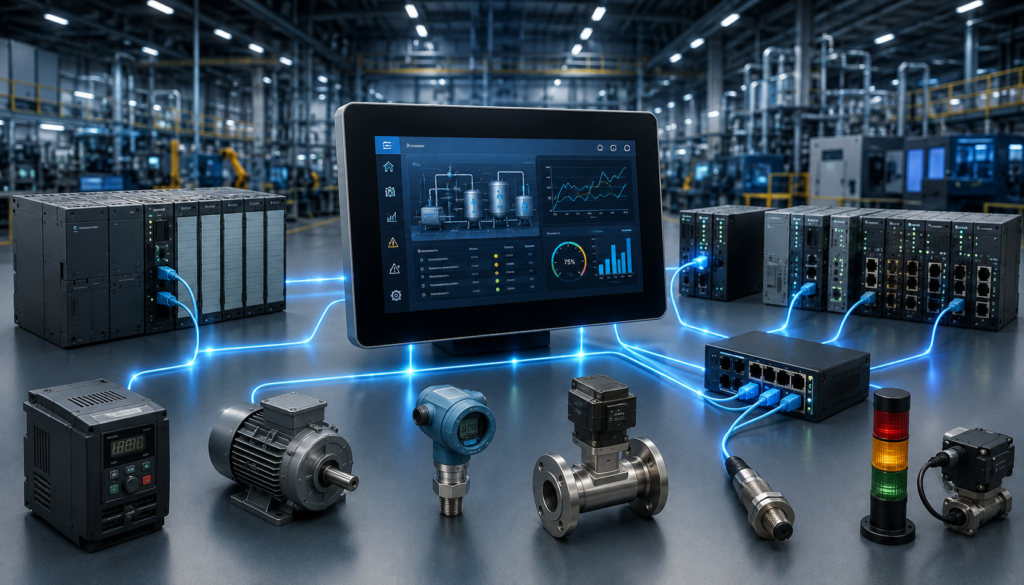
Modern industrial automation depends on fast, reliable, and secure communication between machines. Every production line, packaging system, water treatment plant, manufacturing facility, and energy plant relies on continuous data exchange to keep operations running smoothly. At the center of this communication is the Human Machine Interface (HMI), which allows operators to monitor equipment, control processes, and respond quickly to changing conditions.
HMI Communication Protocols make this communication possible. They define how an HMI exchanges information with programmable logic controllers (PLCs), sensors, drives, industrial robots, and other automation devices. Without these protocols, industrial equipment would struggle to share data accurately, making automation inefficient and difficult to manage.
As industrial systems continue to become more connected, choosing the right communication protocol is more important than ever. Different protocols offer different advantages in terms of speed, compatibility, scalability, and security. Therefore, engineers and system integrators must understand how these protocols work before designing or upgrading an automation system.
This guide explains HMI communication protocols in simple language. It covers their purpose, working principles, benefits, and practical applications. Whether you are a student, automation engineer, maintenance technician, or business owner, this article will help you understand how industrial devices communicate in today's smart factories.
What Are HMI Communication Protocols?
HMI Communication Protocols are standardized communication methods that allow a Human Machine Interface to exchange data with industrial automation equipment. These rules define how information is transmitted, received, interpreted, and verified between different devices.
The HMI itself does not directly control industrial equipment. Instead, it communicates with a PLC or another industrial controller. The PLC collects information from field devices, processes the control logic, and sends updated values back to the HMI. Consequently, operators can view real-time information and interact with the automation system through a graphical interface.
Every communication protocol follows specific standards. These standards ensure that devices from different manufacturers can communicate correctly when they support the same protocol. As a result, factories can integrate equipment without replacing every component.
For example, an HMI may display motor speed, tank level, production count, temperature, pressure, or alarm status. All of this information reaches the display through a communication protocol that transfers data safely and accurately.
Modern communication protocols also support advanced features such as remote monitoring, diagnostics, historical data collection, cloud connectivity, and cybersecurity. Therefore, they have become an essential part of Industry 4.0 and smart manufacturing environments.
Why HMI Communication Protocols Are Important
Industrial automation requires constant communication between many different devices. A production line may include PLCs, sensors, variable frequency drives, barcode scanners, industrial cameras, servo systems, robotic arms, and HMIs. Every device must exchange information quickly to keep the production process stable.
Communication protocols create a common language for these devices. As a result, the entire automation system works as a coordinated network instead of isolated machines.
Reliable communication improves production efficiency because operators receive accurate information without unnecessary delays. If an abnormal condition occurs, the HMI immediately displays alarms and operating data. Consequently, maintenance teams can identify problems before they become major failures.
Communication protocols also improve operational safety. Operators receive instant updates about emergency conditions, equipment faults, and process warnings. Therefore, corrective action can begin without wasting valuable time.
Another important advantage is system flexibility. Manufacturing plants often expand their production capacity over time. Standard communication protocols make it easier to add new equipment while maintaining compatibility with existing systems.
Furthermore, modern communication protocols support remote diagnostics and centralized monitoring. Engineers can monitor multiple production lines from a central control room. In many cases, they can even troubleshoot equipment remotely, reducing maintenance costs and minimizing downtime.
For companies investing in digital transformation, communication protocols provide the foundation for smart manufacturing. They enable data sharing between machines, supervisory software, enterprise systems, and cloud platforms. Consequently, businesses gain better visibility into production performance and equipment health.
How HMI Communicates with PLCs and Industrial Devices
An HMI communicates with industrial equipment through an organized sequence of data exchange. The communication process begins with field devices such as sensors, switches, transmitters, and actuators.
Sensors continuously collect information from the production process. They measure values such as temperature, pressure, flow rate, liquid level, speed, and position. This information is then sent to the PLC through its input modules.
The PLC processes this incoming information according to the programmed control logic. After evaluating the conditions, it updates memory values, executes instructions, and determines the required output actions.
Next, the HMI requests specific data from the PLC using the selected communication protocol. The PLC responds by sending the requested values, alarm conditions, operating status, production data, and system variables.
The HMI converts this technical information into an easy-to-understand graphical display. Operators can view animated graphics, process diagrams, digital values, trend charts, alarm lists, and equipment status in real time.
When an operator presses a button on the HMI, the process works in reverse. The HMI sends the operator's command to the PLC through the same communication protocol. The PLC verifies the command before activating the appropriate output device.
For example, an operator may press the Start button for a conveyor system. The HMI sends this command to the PLC. The PLC checks all safety conditions before energizing the motor starter. If every condition is satisfied, the conveyor begins operating. At the same time, the HMI updates the screen to show the running status.
This continuous exchange happens many times every second. Therefore, operators receive updated information almost instantly while maintaining complete control over the production process.
Components of an HMI Communication Network
An HMI communication network consists of several hardware and software components working together. Each component performs a specific role in transferring information throughout the automation system.
The Human Machine Interface serves as the operator's control station. It displays process information, alarm messages, production statistics, and system status. In addition, it allows operators to enter commands and adjust process settings according to authorized access levels.
The Programmable Logic Controller acts as the central processing unit of the automation system. It collects signals from field devices, executes the control program, and exchanges information with the HMI. Because of its reliability, the PLC remains the primary controller in most industrial applications.
Industrial sensors provide real-time information about machine conditions and production processes. They continuously detect physical changes and convert them into electrical signals that the PLC can process.
Output devices perform physical actions based on PLC instructions. These devices include motors, solenoid valves, contactors, pumps, servo drives, indicator lights, and actuators. As a result, the automation system can control real industrial processes accurately.
Industrial communication cables and network equipment connect every device together. Depending on the selected communication protocol, the network may use serial communication, Ethernet communication, fiber optics, or industrial wireless technology.
Network switches help manage communication traffic in Ethernet-based systems. They improve communication efficiency while allowing multiple devices to exchange data simultaneously. Therefore, large automation systems can maintain reliable performance even under heavy workloads.
Engineering software completes the communication system. It allows engineers to configure communication settings, assign device addresses, define communication tags, and test network performance before commissioning the system.
When all these components operate together, they create a reliable communication infrastructure that supports continuous industrial automation.
How Data Moves Through an HMI Communication System
Understanding the flow of industrial data helps explain why communication protocols are so important. Every piece of information follows a structured path before appearing on the HMI screen.
The process begins when a sensor detects a physical condition inside the machine or production line. It immediately converts that measurement into an electrical signal. Next, the PLC receives this signal through its input modules and processes it according to the control program.
After completing its calculations, the PLC stores the updated values in memory. Meanwhile, the HMI continuously requests these values through the configured communication protocol. The PLC responds with the latest information, and the HMI refreshes its display almost instantly.
If an operator changes a process setting, the HMI sends the new value back to the PLC. The controller validates the command and updates the process only if all operating conditions are safe. Consequently, unauthorized or unsafe actions can be prevented while maintaining reliable system operation.
This constant cycle of reading, processing, transmitting, and updating continues throughout normal production. Because the communication occurs rapidly, operators receive accurate process information with minimal delay. As a result, they can make informed decisions, respond to alarms quickly, and maintain efficient production without interrupting normal operations.
Types of HMI Communication Protocols
Selecting the right communication method is one of the most important decisions in any automation project. Different industrial applications require different levels of speed, reliability, flexibility, and compatibility. Therefore, understanding the most common HMI Communication Protocols helps engineers design systems that perform efficiently for many years.
Some protocols are designed for simple machine communication, while others support large industrial networks with thousands of connected devices. Consequently, every protocol has its own strengths and ideal applications.
The following sections explain the most widely used HMI Communication Protocols found in modern industrial automation.
Modbus Communication Protocol
Modbus is one of the oldest and most widely used industrial communication standards. Despite its age, it remains popular because of its simplicity, reliability, and broad compatibility. Many PLCs, HMIs, sensors, energy meters, and industrial controllers continue to support Modbus.
Originally developed for serial communication, Modbus later evolved into Ethernet-based versions that offer higher communication speeds and easier network integration. Consequently, many modern factories still rely on Modbus for machine communication.
The HMI reads registers from the PLC and displays process values such as temperature, pressure, tank level, motor speed, and alarm status. Likewise, operators can send commands back to the PLC using the same communication channel.
Since Modbus is supported by numerous manufacturers, it reduces compatibility issues when integrating equipment from different vendors. As a result, it remains one of the most flexible HMI Communication Protocols available today.
Industries including water treatment, food processing, packaging, energy management, and manufacturing frequently use Modbus because it is easy to configure and maintain.
Modbus RTU
Modbus RTU operates over serial communication, usually through RS-232 or RS-485 networks. It offers stable communication over long distances while using minimal network resources.
Many existing industrial facilities still depend on Modbus RTU because older PLCs and automation devices continue to operate reliably. Even today, engineers choose it when simple communication is sufficient for the application.
Although serial communication is slower than Ethernet, it performs well in many industrial environments where communication traffic remains relatively low.
Modbus TCP
Modbus TCP is the Ethernet version of Modbus. Instead of serial cables, it uses standard Ethernet networks for communication.
This version provides faster response times and easier installation. Furthermore, Ethernet switches simplify network expansion without major wiring changes.
Many modern HMI systems communicate with PLCs through Modbus TCP because it supports larger industrial networks while maintaining straightforward configuration.
Ethernet/IP Communication Protocol
Ethernet/IP is among the most widely adopted industrial Ethernet technologies. It combines traditional Ethernet communication with industrial control capabilities, making it suitable for demanding automation systems.
Large manufacturing plants often select Ethernet/IP because it delivers high-speed communication between PLCs, HMIs, industrial robots, variable frequency drives, barcode scanners, and intelligent sensors.
One significant advantage is its ability to transfer large amounts of process information quickly. Consequently, operators receive updated production data with very little delay.
Ethernet/IP also supports real-time monitoring, diagnostics, alarm handling, and remote maintenance. Therefore, maintenance engineers can identify equipment problems more efficiently.
Factories with automated assembly lines frequently depend on Ethernet/IP because it provides stable communication even when hundreds of industrial devices share the same network.
As Industry 4.0 continues to grow, Ethernet/IP remains one of the leading HMI Communication Protocols for smart manufacturing environments.
Profinet Communication Protocol
Profinet is an industrial Ethernet protocol designed for high-performance automation systems. It is especially common in factories using Siemens automation products, although many third-party manufacturers also support it.
This protocol enables extremely fast communication between HMIs, PLCs, distributed I/O modules, drives, and intelligent field devices.
Unlike older communication systems, Profinet supports deterministic communication. That means data arrives within predictable time intervals, which is critical for precise industrial control.
High-speed production lines benefit greatly from this capability because synchronized communication improves machine performance and reduces production delays.
Another important advantage is flexible network design. Engineers can easily expand production systems by adding new devices without redesigning the complete communication infrastructure.
Because of its speed and reliability, Profinet has become one of the preferred HMI Communication Protocols for advanced industrial automation projects.
OPC UA Communication Protocol
OPC UA has become one of the most important technologies in modern industrial communication. Unlike traditional protocols that focus mainly on device communication, OPC UA supports secure information exchange across complete industrial systems.
The protocol allows HMIs, PLCs, SCADA software, databases, cloud platforms, and enterprise applications to exchange structured information using standardized communication methods.
Security is one of its strongest features. Built-in encryption, authentication, and user authorization help protect industrial data from unauthorized access. Consequently, companies can build secure automation networks while supporting remote connectivity.
Another advantage is platform independence. Devices from different manufacturers can communicate using standardized data models, making system integration much easier.
Many organizations implementing digital transformation choose OPC UA because it supports cloud analytics, predictive maintenance, production reporting, and Industrial Internet of Things applications.
As factories become increasingly connected, OPC UA continues to play a major role in modern HMI Communication Protocols.
Profibus Communication Protocol
Before industrial Ethernet became common, Profibus served as one of the leading communication standards for factory automation.
Many industrial facilities still use Profibus because their production equipment remains reliable after years of continuous operation.
Profibus connects PLCs, HMIs, remote I/O stations, drives, and field instruments through a dedicated industrial communication network.
Although newer Ethernet technologies provide higher communication speeds, Profibus continues to deliver dependable performance in many existing manufacturing plants.
When upgrading older automation systems, engineers often integrate both Profibus and Ethernet communication. This approach protects previous investments while introducing modern networking capabilities.
For this reason, Profibus remains relevant even as newer HMI Communication Protocols continue to evolve.
MPI Communication Protocol
MPI, or Multi-Point Interface, was developed primarily for Siemens PLC communication. It has been widely used for programming, diagnostics, maintenance, and HMI connectivity in many Siemens automation systems.
Smaller industrial installations often relied on MPI because it provided stable communication without requiring complex network infrastructure.
Although Ethernet-based technologies have largely replaced MPI in new projects, many legacy production lines continue using it successfully.
Maintenance engineers working with older Siemens controllers still encounter MPI during troubleshooting, software updates, and equipment servicing.
Understanding MPI helps automation professionals maintain compatibility with existing industrial equipment while planning future modernization projects.
Comparing Modern HMI Communication Protocols
Industrial communication continues to evolve as factories demand greater speed, higher reliability, and stronger cybersecurity. Consequently, choosing among today's HMI Communication Protocols requires careful evaluation rather than selecting the newest technology automatically.
Facilities that operate older machinery may continue using Modbus RTU or Profibus because these protocols remain dependable for many applications. Meanwhile, newly designed production lines often prefer Ethernet/IP or Profinet because they support higher data transfer rates and easier network expansion.
Organizations pursuing smart manufacturing frequently adopt OPC UA alongside other communication technologies. Instead of replacing every protocol, many factories combine multiple communication standards within a single automation system. This strategy improves compatibility while supporting future upgrades without interrupting production.
Ultimately, the best communication protocol depends on the equipment already installed, the desired system performance, maintenance requirements, and long-term business goals. A carefully planned communication network delivers stable operation, efficient troubleshooting, and better production visibility for years to come.
How to Choose the Right HMI Communication Protocol
Choosing the right communication protocol is one of the most important decisions during automation system design. Every factory has different production requirements, machine configurations, and future expansion plans. Therefore, no single protocol is suitable for every application.
A small packaging machine may only require simple communication between an HMI and a PLC. On the other hand, a large manufacturing plant may include hundreds of devices that exchange information every second. In such situations, communication speed, reliability, and scalability become much more important.
When selecting among different HMI Communication Protocols, engineers should evaluate the complete automation system instead of focusing only on communication speed. Long-term maintenance, compatibility, cybersecurity, and network flexibility should also influence the final decision.
Factors That Influence Protocol Selection
Several factors determine which protocol will perform best in an industrial environment.
The first consideration is hardware compatibility. Every PLC, HMI, sensor, and drive supports specific communication standards. Selecting a protocol already supported by the installed equipment reduces engineering effort and installation costs.
Communication speed is another important factor. High-speed production lines require fast and predictable data exchange. Faster communication helps operators receive real-time process information without noticeable delays.
Network size also plays a significant role. A small machine with only a few devices requires a different communication approach than a complete manufacturing plant with hundreds of networked components.
Future expansion should never be ignored. Factories often add new production lines over time. Selecting scalable HMI Communication Protocols makes future upgrades easier and more cost-effective.
Maintenance requirements also affect protocol selection. Engineers generally prefer communication systems that are simple to configure, diagnose, and repair. Reduced maintenance complexity minimizes production downtime.
Serial Communication vs Ethernet Communication
Industrial communication networks generally fall into two major categories.
Serial communication has been used successfully for many years. Protocols such as Modbus RTU and MPI operate through serial communication interfaces. These systems remain reliable in many industrial applications, especially where communication requirements are relatively simple.
Ethernet communication represents the modern approach to industrial networking. Protocols such as Ethernet/IP, Profinet, Modbus TCP, and OPC UA use Ethernet infrastructure to transfer information quickly and efficiently.
Ethernet networks support higher communication speeds and larger numbers of connected devices. They also simplify remote monitoring, centralized diagnostics, and cloud connectivity.
Although Ethernet has become the preferred solution for new installations, serial communication continues to provide dependable performance in many existing factories.
Communication Speed and System Performance
Communication speed directly affects the responsiveness of an HMI system.
Fast communication allows operators to view process values almost instantly. Alarms appear quickly, machine status updates continuously, and production information remains accurate throughout the operating cycle.
However, maximum speed is not always necessary. Many industrial applications perform perfectly with moderate communication rates because process variables change slowly.
A water treatment plant, for example, does not require the same communication speed as a robotic assembly line. Consequently, engineers should match communication performance to the actual production process instead of selecting the fastest protocol by default.
Efficient HMI Communication Protocols balance communication speed with network stability and system reliability.
Network Reliability in Industrial Environments
Industrial facilities present challenging operating conditions.
Electrical noise, vibration, dust, humidity, temperature variations, and heavy machinery can interfere with communication networks if they are not properly designed.
Reliable communication minimizes data loss and prevents unexpected interruptions during production.
Good network design includes proper cable routing, industrial-grade switches, shielded communication cables, and quality connectors. These practices reduce communication errors while improving long-term system stability.
Redundant communication paths are also common in critical industries. If one network path fails, another path automatically maintains communication without stopping production.
As a result, reliable HMI Communication Protocols contribute directly to higher equipment availability and improved operational efficiency.
HMI Communication Security
Cybersecurity has become an essential part of industrial automation.
Modern factories exchange information across local networks, remote maintenance systems, cloud platforms, and enterprise software. Without proper protection, unauthorized users may attempt to access sensitive industrial data.
Modern HMI Communication Protocols include security features that help protect communication between automation devices.
Strong user authentication limits access to authorized personnel. Secure passwords reduce the risk of unauthorized operation. Data encryption protects information while it travels across industrial networks.
Network segmentation also improves security. Separating production networks from office networks reduces exposure to external threats.
Regular software updates strengthen communication security by correcting known vulnerabilities before they can be exploited.
Employee awareness is equally important. Well-trained operators are less likely to introduce security risks through unsafe practices.
Common HMI Communication Problems
Even well-designed automation systems may occasionally experience communication issues.
Cable damage remains one of the most common causes of communication failure. Physical wear, loose connectors, or improper installation can interrupt data exchange.
Incorrect network configuration may also prevent devices from communicating correctly. An invalid IP address, duplicate network address, or incorrect communication parameter can stop information from reaching the HMI.
Device firmware differences sometimes create compatibility problems. Updating firmware often restores normal communication.
Network congestion may appear in large automation systems where excessive communication traffic reduces response time.
Power supply instability can also interrupt industrial communication. Maintaining stable electrical power improves overall network performance.
Fortunately, most communication problems can be identified through systematic troubleshooting.
How to Troubleshoot HMI Communication Issues
Successful troubleshooting begins with a structured approach.
Engineers should first confirm that every device receives stable power. Afterward, communication cables and connectors should be inspected for visible damage.
The next step involves verifying communication settings. Device addresses, baud rates, IP addresses, subnet masks, and protocol configurations must match the system design.
Diagnostic software provides valuable information during troubleshooting. Many HMIs and PLCs include built-in communication diagnostics that identify network errors quickly.
If communication remains unavailable, testing individual network segments helps isolate the faulty component.
Documentation also plays an important role. Accurate network diagrams allow maintenance teams to locate communication devices more efficiently.
Following a logical troubleshooting sequence reduces repair time while minimizing production downtime.
Best Practices for Reliable HMI Communication
Successful industrial communication depends on good engineering practices.
Using high-quality industrial networking components improves long-term reliability. Industrial switches, certified communication cables, and properly rated connectors perform better under demanding operating conditions.
Communication addresses should follow a consistent naming strategy. Organized device identification simplifies maintenance and future expansion.
Regular backups protect HMI and PLC communication settings from accidental loss. If equipment must be replaced, restored configurations reduce recovery time.
Preventive maintenance should include periodic inspection of communication hardware. Early detection of damaged cables or loose connectors prevents unexpected failures.
Documentation should always remain current. Updated network drawings make troubleshooting faster and reduce engineering errors.
Finally, communication performance should be monitored continuously. Small communication delays often indicate developing problems that can be corrected before production is affected.
Industrial Applications of HMI Communication Protocols
Modern industries rely on HMI Communication Protocols every day to coordinate machines, monitor production, and improve operational efficiency.
Manufacturing plants use communication protocols to connect production equipment, robotic systems, quality inspection stations, and conveyor lines. Operators receive live production data while maintaining complete visibility of the manufacturing process.
Water and wastewater treatment facilities depend on HMI communication to monitor pumps, valves, reservoirs, chemical dosing systems, and filtration equipment. Continuous communication helps maintain safe and efficient plant operation.
Food and beverage manufacturers use industrial communication to supervise mixing systems, packaging equipment, temperature control, and production tracking. Accurate communication supports consistent product quality.
Oil and gas facilities monitor pipelines, storage tanks, pressure systems, compressors, and safety equipment through reliable industrial communication networks.
Power generation plants exchange operational information between turbines, generators, substations, and control rooms. Stable communication improves system reliability and supports continuous energy production.
Pharmaceutical manufacturers also rely on secure communication to maintain strict production standards, monitor environmental conditions, and ensure regulatory compliance.
Across every industry, dependable HMI Communication Protocols help operators make informed decisions, improve equipment performance, reduce downtime, and support safer industrial operations.
Future Trends in HMI Communication Protocols
Industrial automation continues to evolve rapidly. As factories become smarter, HMI Communication Protocols will support even faster communication, stronger cybersecurity, and better connectivity with cloud platforms. Artificial intelligence, predictive maintenance, and Industrial Internet of Things (IIoT) technologies are already changing how industrial systems exchange information.
Future communication networks will focus on lower latency, higher reliability, and easier integration between machines from different manufacturers. At the same time, secure communication standards such as OPC UA will continue to gain popularity because they protect sensitive industrial data while supporting remote monitoring and advanced analytics.
Companies investing in modern automation should choose communication solutions that can adapt to future technologies without requiring complete system replacement.
Frequently Asked Questions (FAQs)
What are HMI Communication Protocols?
HMI Communication Protocols are standardized methods that allow an HMI to exchange data with PLCs, sensors, drives, and other industrial automation devices. They ensure reliable and accurate communication throughout an automation system.
Which HMI communication protocol is most commonly used?
There is no single protocol that fits every application. However, Modbus, Modbus TCP, Ethernet/IP, Profinet, and OPC UA are among the most widely used communication protocols in modern industrial automation.
What is the difference between Modbus RTU and Modbus TCP?
Modbus RTU uses serial communication through RS-232 or RS-485 networks, while Modbus TCP operates over Ethernet. Modbus TCP generally provides faster communication and easier network expansion.
Why is OPC UA becoming more popular?
OPC UA offers secure communication, platform independence, and excellent compatibility with Industry 4.0 technologies. It also supports cloud connectivity and advanced data exchange between different industrial systems.
Can one HMI communicate with multiple PLCs?
Yes. Many modern HMI systems support communication with multiple PLCs simultaneously, provided they are configured correctly and the supported communication protocols are available.
How can communication problems be prevented?
Using quality industrial hardware, correct network configuration, regular maintenance, updated firmware, and proper cybersecurity practices significantly reduces communication issues.
Conclusion
Reliable communication is the foundation of every successful automation system. Choosing the right HMI Communication Protocols improves data accuracy, machine performance, and overall production efficiency. Whether you are working with Modbus, Ethernet/IP, Profinet, OPC UA, or another industrial protocol, understanding their strengths helps you build stable and scalable automation solutions.
As industrial technology continues to advance, communication networks will become even more intelligent, secure, and connected. Therefore, learning these protocols today will help engineers, technicians, and students prepare for the future of smart manufacturing.
By selecting the appropriate communication protocol, following industry best practices, and maintaining a well-designed network, businesses can reduce downtime, simplify maintenance, and improve long-term operational performance.