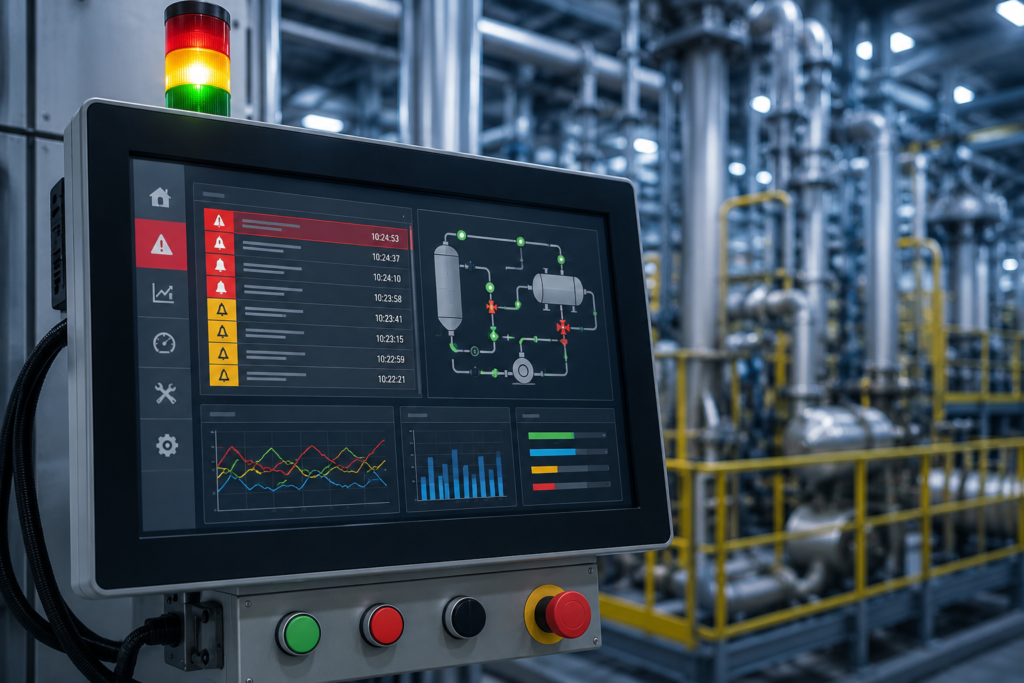
HMI Alarm Management plays a critical role in every modern industrial automation system. Whether you operate a manufacturing plant, water treatment facility, food processing line, or energy production site, an effective alarm management strategy helps operators identify problems quickly, respond with confidence, and keep production running safely. Instead of overwhelming operators with unnecessary notifications, a well-designed alarm system delivers the right information at the right time.
Industrial processes rely on accurate data, reliable communication, and fast decision-making. During normal operation, an HMI continuously displays machine status, process values, and equipment performance. However, when a process moves outside its safe operating limits, the HMI must immediately alert the operator. This is where HMI Alarm Management becomes essential. A properly configured alarm system reduces response time, prevents costly downtime, improves equipment reliability, and supports a safer working environment.
Many facilities struggle because they generate too many alarms, use confusing alarm priorities, or display messages that provide little useful information. As a result, operators may ignore important alerts or spend valuable time searching for the actual problem. An organized alarm management strategy eliminates these issues by presenting clear, meaningful, and actionable information.
This guide explains how HMI Alarm Management works, why it matters in industrial automation, and which best practices help create safer, more efficient, and more reliable HMI systems.
What Is HMI Alarm Management?
HMI Alarm Management is the process of designing, organizing, displaying, and controlling alarms within a Human Machine Interface. Its primary purpose is to notify operators whenever equipment or a process requires attention. Every alarm should communicate meaningful information instead of simply indicating that something has changed.
An alarm differs from an ordinary notification. Normal status messages provide information about machine operation, while alarms indicate conditions that require operator action. For example, a motor running normally does not generate an alarm because everything operates as expected. However, if the motor overheats or unexpectedly stops, the HMI immediately displays an alarm so the operator can investigate the issue before it becomes more serious.
A well-designed HMI does more than flash warning lights or play sounds. It presents relevant details such as the affected equipment, alarm priority, event time, current process values, and recommended operator actions. These details allow operators to understand the situation without wasting valuable time searching through different screens.
Modern industrial facilities often monitor hundreds or even thousands of process variables. Without effective HMI Alarm Management, operators could receive an overwhelming number of alerts every hour. Instead of improving safety, excessive alarms increase confusion and slow response times. Intelligent alarm management organizes events, removes unnecessary alarms, and highlights the most critical situations first.
As industrial systems become more connected through PLCs, SCADA platforms, and Industrial Internet of Things technologies, alarm management continues to grow in importance. A structured alarm strategy helps operators maintain stable production while reducing operational risks.
Why HMI Alarm Management Is Important
Every industrial process depends on timely decisions. Operators cannot respond to problems they never see, and they cannot react efficiently if important alarms become buried among hundreds of unnecessary notifications. HMI Alarm Management ensures that critical information always receives immediate attention.
Consider a production line where cooling water pressure suddenly drops. If the HMI generates a clear, high-priority alarm, the operator can stop the affected equipment before overheating damages expensive machinery. Without an effective alarm system, the pressure loss may go unnoticed until significant equipment failure occurs.
Alarm management also improves production quality. Many manufacturing processes require precise temperature, pressure, speed, and flow control. Small deviations may not immediately stop production, but they can reduce product quality over time. Early alarms help operators correct these conditions before they affect the final product.
Safety remains another major benefit. Industrial environments often involve high temperatures, rotating machinery, electrical equipment, chemicals, and pressurized systems. Reliable alarms warn operators about dangerous conditions before they become accidents. Faster responses protect employees, equipment, and surrounding facilities.
Maintenance teams also benefit from organized alarm systems. Instead of troubleshooting unexpected equipment failures, technicians can investigate warning alarms that indicate developing problems. This proactive approach reduces emergency repairs, extends equipment life, and lowers maintenance costs.
Beyond operational improvements, alarm management supports better decision-making. Historical alarm records reveal recurring equipment issues, process bottlenecks, and maintenance trends. Engineers use this information to improve system performance and optimize production over time.
How HMI Alarm Management Works
An effective HMI Alarm Management system follows a logical sequence from problem detection to operator response. Every stage helps ensure that important events receive appropriate attention while avoiding unnecessary distractions.
The process begins with field devices such as sensors, transmitters, switches, and measuring instruments. These devices continuously monitor process conditions including temperature, pressure, liquid level, motor current, vibration, and flow rate. The collected information travels to the PLC, where the control program compares each value with predefined operating limits.
Whenever a measured value exceeds its configured limit, the PLC identifies an alarm condition. Instead of simply changing an output, it sends the alarm information to the HMI. The HMI immediately displays the event using colors, icons, sounds, or alarm banners depending on its configured priority.
Operators review the alarm details directly from the HMI screen. A well-designed interface clearly identifies the affected equipment, explains the alarm condition, records the exact time of occurrence, and provides useful guidance whenever possible. Rather than guessing what happened, operators receive the information needed to take appropriate action.
Once operators correct the problem, they acknowledge the alarm through the HMI. The system records both the occurrence and acknowledgment times for future analysis. Engineers later review alarm history to identify recurring issues and improve overall system performance.
This complete workflow allows industrial facilities to respond consistently while maintaining accurate records for troubleshooting, maintenance planning, and process optimization.
The Main Objectives of HMI Alarm Management
Every alarm should serve a clear operational purpose. HMI Alarm Management is not designed to generate as many alarms as possible. Instead, it focuses on delivering meaningful information that supports safe and efficient plant operation.
One important objective is reducing operator workload. Operators already monitor multiple machines, production values, and process trends throughout their shifts. An organized alarm system highlights only the events that truly require attention instead of creating unnecessary distractions.
Another objective involves improving response speed. Clear alarm messages help operators identify problems immediately, reducing the time needed to understand what happened and where corrective action is required.
Consistency also plays a significant role. When every alarm follows similar naming conventions, color standards, priorities, and display formats, operators become familiar with the system more quickly. Consistent alarm presentation reduces confusion during stressful situations.
Reliable alarm management also supports continuous improvement. Engineers analyze alarm history to discover frequently occurring events, eliminate nuisance alarms, and optimize control strategies. These improvements gradually create a more stable and efficient production environment.
Ultimately, the goal of HMI Alarm Management is simple. Every alarm should provide useful information, require meaningful action, and help operators maintain safe, reliable, and productive industrial operations.
Understanding the Different Types of HMI Alarm Management
HMI Alarm Management becomes much more effective when every alarm has a clear purpose. Industrial systems monitor hundreds of process variables at the same time, but not every event deserves the same level of attention. Grouping alarms into meaningful categories helps operators understand the situation quickly and respond with confidence.
Some alarms indicate that a process has reached an unsafe operating condition, while others warn that equipment performance is slowly changing. Certain alarms require immediate action, whereas others simply inform operators about maintenance needs or communication issues. A structured alarm strategy ensures that every notification provides value instead of creating unnecessary distractions.
When alarms are organized correctly, operators spend less time searching for information and more time solving real process problems. This approach improves production efficiency while reducing the risk of overlooking a critical event.
Process Alarms in HMI Alarm Management
Process alarms monitor the operating conditions of an industrial process. They continuously compare real-time values with predefined limits inside the PLC or control system. Whenever a value exceeds its acceptable range, the HMI immediately informs the operator.
Temperature, pressure, flow rate, liquid level, and motor speed are common examples of process variables. If a boiler temperature rises beyond its safe limit, the HMI generates an alarm so operators can investigate before equipment suffers damage. Likewise, an unexpected pressure drop inside a hydraulic system may indicate a leaking pipe or a failing pump.
Effective HMI Alarm Management presents these alarms clearly and provides enough information for operators to understand the situation without opening multiple screens. The objective is not simply to display an alarm but to help operators make faster and better decisions.
Equipment Alarms in HMI Alarm Management
Industrial machines contain numerous components that require continuous monitoring. Motors, pumps, compressors, conveyors, fans, valves, and robotic systems all generate valuable diagnostic information during operation.
Equipment alarms notify operators whenever a machine develops a fault or operates outside its normal condition. An overloaded motor, a failed cooling fan, excessive vibration, or abnormal bearing temperature may all trigger alarms that require immediate attention.
A properly designed HMI Alarm Management system allows maintenance personnel to detect developing problems before complete equipment failure occurs. Instead of waiting for an unexpected shutdown, technicians can schedule repairs during planned maintenance periods. This proactive approach reduces downtime and lowers maintenance costs.
Communication Alarms in HMI Alarm Management
Modern industrial facilities depend on reliable communication between PLCs, HMIs, sensors, drives, and SCADA systems. Any interruption can reduce visibility and affect process control.
Communication alarms appear whenever devices stop exchanging data correctly. Network failures, damaged communication cables, incorrect IP addresses, switch failures, or protocol errors may all trigger communication alarms.
An effective HMI Alarm Management strategy immediately informs operators about communication problems without creating unnecessary panic. The HMI should clearly identify which device has lost communication so engineers can locate the fault quickly.
Reliable communication remains essential because operators can only make informed decisions when accurate process data is available.
Safety Alarms in HMI Alarm Management
Safety alarms protect both people and equipment. These alarms receive the highest level of attention because they indicate conditions that could result in injury, equipment damage, or environmental hazards.
Emergency stop activation, gas leakage, fire detection, excessive machine temperature, high-pressure conditions, and safety door openings are common examples of safety alarms.
Every HMI Alarm Management system should display safety alarms using highly visible indicators that operators can recognize instantly. Clear alarm messages reduce confusion during emergency situations and help personnel respond according to established safety procedures.
Fast recognition often makes the difference between a controlled incident and a costly emergency.
Warning Alarms and Critical Alarms
Not every alarm represents the same level of urgency. A warning alarm usually indicates that a process is moving toward an undesirable condition, while a critical alarm shows that immediate action is necessary.
For example, a motor operating slightly above its normal temperature may generate a warning alarm. If the temperature continues rising beyond the maximum safe limit, the HMI changes the event into a critical alarm.
This layered approach allows operators to correct small issues before they develop into serious failures. As a result, HMI Alarm Management supports preventive action instead of emergency response.
How Alarm Priorities Improve HMI Alarm Management
Alarm priorities help operators focus on the most important events first. Without priorities, every alarm appears equally important, making it difficult to determine which situation requires immediate attention.
A well-designed priority system ensures that life-threatening situations receive the highest visibility, while less urgent notifications remain available without interrupting critical operations.
Consistent priorities reduce stress inside control rooms because operators immediately recognize the seriousness of each alarm. Instead of evaluating every notification individually, they can concentrate on solving the highest-risk problems first.
Strong HMI Alarm Management always combines alarm priorities with clear visual indicators and meaningful descriptions.
Alarm Colors and Their Role in HMI Alarm Management
Color selection influences how quickly operators recognize alarm conditions. Effective color usage improves readability while reducing confusion during busy production periods.
Bright colors should remain reserved for situations requiring immediate attention. Neutral colors work better for normal operating conditions because they reduce visual fatigue during long shifts.
Modern HMI Alarm Management follows consistent color standards across every screen. When operators move from one display to another, they immediately understand the meaning of each alarm without relearning the interface.
Consistency improves reaction time and supports safer plant operation.
Alarm Messages Should Be Clear and Actionable
One of the biggest mistakes in industrial automation is displaying alarm messages that provide very little useful information. Messages such as "Error 15" or "Fault Detected" leave operators guessing about the actual problem.
An effective HMI Alarm Management system explains what happened, where it happened, and why the operator should pay attention. Clear messages reduce troubleshooting time because operators understand the situation immediately.
Well-written alarm descriptions also improve communication between production teams and maintenance engineers. Everyone interprets the same message consistently, leading to faster problem resolution.
Avoiding Alarm Flooding in HMI Alarm Management
Alarm flooding occurs when the HMI generates too many alarms within a short period. Instead of helping operators, excessive notifications create confusion and increase the chance that important alarms will be overlooked.
Alarm flooding often happens after equipment failures, communication interruptions, or poorly configured alarm settings. A single process disturbance can trigger dozens or even hundreds of unnecessary notifications.
Effective HMI Alarm Management reduces alarm flooding by removing duplicate alarms, filtering unnecessary events, and displaying only meaningful information. Engineers also review alarm history to identify recurring nuisance alarms and eliminate their root causes.
Reducing alarm overload allows operators to focus on solving the real problem instead of dismissing endless notifications.
Why Alarm Rationalization Matters
Alarm rationalization is the process of evaluating every alarm before it becomes part of the control system. Each alarm should answer one simple question: does the operator need to take action?
If an alarm never requires operator intervention, it probably does not belong in the active alarm list.
Strong HMI Alarm Management encourages engineers to review alarm settings regularly instead of adding new alarms whenever a process changes. This disciplined approach keeps the alarm database clean, meaningful, and easier to manage.
Facilities that perform regular alarm rationalization usually experience fewer nuisance alarms, faster operator responses, and better overall production performance.
Why Alarm Rationalization Matters
The alarm screen often becomes the most frequently used page during abnormal operating conditions. For that reason, its design should support quick understanding instead of adding unnecessary complexity.
A clean interface allows operators to locate active alarms without searching through multiple windows. Important information remains visible at all times, while secondary details become available whenever additional investigation is necessary.
An organized layout also reduces mental workload during stressful situations. Operators can identify affected equipment, review recent events, and begin corrective actions without unnecessary delays.
Well-designed screens are one of the strongest foundations of successful HMI Alarm Management because they transform raw process data into information that supports confident decision-making.
Alarm Acknowledgement in HMI Alarm Management
One of the most important features of HMI Alarm Management is alarm acknowledgement. An alarm should never disappear simply because an operator has noticed it. Acknowledgement only confirms that someone has seen the alarm and understands that action is required. The actual process condition must return to a safe operating state before the alarm clears completely.
Many new operators believe that acknowledging an alarm automatically fixes the problem. In reality, acknowledgement is only the beginning of the response process. The operator must still investigate the equipment, identify the root cause, and restore normal operation.
For example, imagine that a cooling pump suddenly stops working. The HMI immediately displays an alarm, and the operator acknowledges it. Although the notification changes its status, the pump remains stopped until maintenance personnel repair the fault or the operator restarts the equipment according to the approved operating procedure.
A well-designed HMI Alarm Management system clearly separates active alarms, acknowledged alarms, and cleared alarms. This distinction helps every operator understand the current condition of the process without confusion.
Alarm History and Event Logging
Industrial facilities generate valuable operational data every day. Every alarm tells a story about how the process behaved at a particular moment. Storing this information allows engineers to improve equipment reliability and identify recurring issues.
An alarm history records the exact time an alarm appeared, when an operator acknowledged it, when the fault disappeared, and how long the event remained active. These records become extremely useful during troubleshooting because engineers can compare historical events with current operating conditions.
Suppose a conveyor motor produces the same overload alarm every Monday morning. Without historical records, this pattern may go unnoticed. After reviewing alarm history, engineers may discover that production starts with an unusually heavy load each week. Once they identify the real cause, they can modify the startup sequence and eliminate the recurring alarm.
Effective HMI Alarm Management transforms historical alarm data into valuable information that supports better maintenance planning and continuous process improvement.
Using Alarm Trends to Improve Performance
Modern HMI software provides much more than simple alarm notifications. Many systems include trend analysis that helps engineers understand how process values changed before an alarm occurred.
Trend graphs allow operators to review temperature, pressure, flow, or motor current over time. Instead of seeing only the final alarm condition, they can observe how the process gradually moved toward an unsafe operating point.
For example, a compressor temperature may slowly increase throughout the day before reaching its alarm limit. The trend clearly shows the gradual change, making it easier to investigate cooling performance instead of assuming a sudden equipment failure.
When operators combine alarm history with process trends, HMI Alarm Management becomes a powerful diagnostic tool rather than a simple warning system.
Common Mistakes in HMI Alarm Management
Many industrial facilities install advanced HMI software but fail to achieve its full potential because of poor alarm design. The technology itself rarely causes the problem. Most issues result from inconsistent engineering practices and lack of regular system reviews.
One common mistake involves creating too many alarms. Engineers sometimes configure every changing process value as an alarm, even when operators cannot take meaningful action. As the number of unnecessary notifications increases, operators gradually begin to ignore them.
Another frequent problem appears when alarm descriptions remain unclear. Messages that provide little information force operators to search different screens before understanding the actual issue. Valuable response time disappears while production conditions continue to worsen.
Some facilities also assign identical priorities to every alarm. Without clear priorities, operators struggle to decide which event requires immediate attention.
Ignoring regular alarm reviews creates another challenge. Industrial processes change over time, yet many alarm databases remain unchanged for years. Equipment upgrades, production modifications, and new control strategies often require alarm settings to be updated as well.
Strong HMI Alarm Management avoids these problems by focusing on quality instead of quantity. Every alarm should have a clear purpose and support a specific operator action.
Best Practices for Effective HMI Alarm Management
Successful alarm management begins long before the first alarm appears on the HMI screen. Engineers should design alarm strategies during system development instead of adding alarms whenever new equipment is installed.
Every alarm should describe a genuine abnormal condition that requires operator attention. Clear wording allows operators to understand the situation immediately without guessing what happened.
Consistent naming conventions also improve system usability. Similar equipment should follow similar alarm formats throughout the entire plant. When operators move between production areas, they should recognize alarm messages without additional training.
Regular alarm reviews help maintain long-term performance. Engineers should analyze alarm history, remove nuisance alarms, adjust priorities when necessary, and verify that every alarm continues to provide operational value.
Testing remains equally important. Alarm functions should be verified before production begins to ensure that every notification appears correctly, follows the intended priority, and communicates accurate information.
Training operators completes the process. Even the most advanced HMI Alarm Management system cannot improve plant performance if operators do not understand how alarms behave or how they should respond.
HMI Alarm Management and Industrial Safety
Industrial safety depends on rapid recognition and timely action. Delayed responses increase the likelihood of equipment damage, production losses, and workplace accidents.
An organized alarm system supports safe operations by directing operator attention toward developing hazards before they become emergencies. Instead of reacting after equipment fails, operators receive early warnings that encourage preventive action.
Safety improves further when alarm messages remain simple, consistent, and easy to understand. Operators should never waste valuable time interpreting confusing messages during critical situations.
Reliable HMI Alarm Management also supports emergency procedures by helping operators identify affected equipment quickly. Faster identification allows maintenance teams and supervisors to coordinate their response more effectively.
As industrial automation continues to advance, alarm management remains one of the strongest contributors to operational safety.
The Future of HMI Alarm Management
Industrial automation continues to evolve with smarter software, faster communication networks, and more connected production systems. These advancements are changing how alarms are generated, analyzed, and presented to operators.
Modern HMI platforms increasingly combine alarm management with predictive maintenance, condition monitoring, and real-time analytics. Instead of waiting until equipment reaches a failure point, intelligent systems can recognize abnormal operating patterns much earlier.
Artificial intelligence and machine learning are also beginning to support HMI Alarm Management by identifying repetitive alarm patterns and recommending improvements based on historical operating data.
Cloud connectivity allows engineers to review alarm history from secure remote locations, while mobile notifications help authorized personnel respond quickly when critical events occur outside normal working hours.
Despite these technological improvements, the fundamental objective remains unchanged. Every alarm should deliver accurate information that helps operators make safe and informed decisions.
Frequently Asked Questions (FAQs)
What is HMI Alarm Management?
HMI Alarm Management is the process of monitoring, displaying, prioritizing, and managing industrial alarms through a Human Machine Interface. It helps operators identify abnormal conditions and respond before they become serious problems.
Why is HMI Alarm Management important?
It improves operator awareness, reduces downtime, enhances workplace safety, protects equipment, and supports faster troubleshooting during abnormal process conditions.
What is the difference between an alarm and a notification?
An alarm indicates a condition that requires operator action, while a notification simply provides information about system status without requiring an immediate response.
What causes alarm flooding?
Alarm flooding usually occurs because of poor alarm configuration, communication failures, equipment faults, or unnecessary duplicate alarms that appear within a short period.
How often should alarm systems be reviewed?
Engineers should review alarm performance regularly, especially after equipment upgrades, process changes, or recurring operational issues, to ensure every alarm remains useful and relevant.
Which industries use HMI Alarm Management?
Manufacturing, oil and gas, water treatment, pharmaceuticals, food and beverage, power generation, mining, chemical processing, and many other industrial sectors rely on HMI Alarm Management to improve operational safety and efficiency.
Conclusion
HMI Alarm Management is far more than a collection of warning messages on an operator screen. It is an essential part of every industrial automation system that helps protect equipment, improve safety, reduce downtime, and support consistent production.
A successful alarm strategy focuses on meaningful information rather than excessive notifications. Clear alarm messages, logical priorities, organized screen layouts, accurate event history, and regular system reviews allow operators to respond quickly and confidently whenever abnormal conditions appear.
Industrial facilities that invest time in improving HMI Alarm Management often experience better equipment reliability, higher production efficiency, lower maintenance costs, and a safer working environment. These benefits continue long after the system is commissioned because effective alarm management supports continuous improvement throughout the entire lifecycle of the plant.
Whether you are designing a new HMI application or optimizing an existing control system, building a structured and well-organized alarm strategy is one of the most valuable decisions you can make. By following proven alarm management practices and keeping operator usability at the center of every design decision, you create an HMI that does more than display information—it helps people make faster, smarter, and safer decisions every day.