
Table of Contents
ToggleIntroduction
A PLC Commissioning Checklist is one of the most important tools in every industrial automation project. It helps engineers verify that the PLC system is ready before production begins. A proper commissioning process reduces unexpected downtime, improves safety, and ensures that every connected device works as planned. Whether you are installing a new production line or upgrading an existing control system, following a structured checklist makes the startup process smoother and more reliable.
Modern factories depend on Programmable Logic Controllers (PLCs) to control machines, monitor equipment, and automate production. These systems perform thousands of operations every second. Even a small wiring mistake or an incorrect software setting can cause equipment failure or costly production delays. Therefore, engineers always complete detailed commissioning checks before allowing a system to operate under normal conditions.
Many people think commissioning simply means turning on the PLC and checking whether it runs. In reality, the process involves much more than powering up the controller. Engineers inspect electrical wiring, confirm hardware installation, validate the PLC program, test communication networks, verify safety devices, and perform functional testing before the system enters service. Every step builds confidence that the automation system can operate safely and consistently.
A well-planned PLC Commissioning Checklist also helps maintenance teams solve problems faster. When every inspection and test receives proper documentation, technicians can compare future system performance with the original startup conditions. As a result, troubleshooting becomes easier, maintenance costs decrease, and equipment reliability improves over time.
Industrial facilities such as manufacturing plants, water treatment stations, power generation facilities, food processing factories, pharmaceutical plants, and oil and gas installations all rely on proper PLC commissioning. Although these industries use different machines, they share one common goal. They want automation systems that operate safely, accurately, and continuously without unnecessary interruptions.
Skipping commissioning may save a few hours during installation, but it often creates expensive problems later. Loose terminals, incorrect input signals, communication failures, or programming errors may remain hidden until production begins. At that point, repairs become more difficult because the entire production process depends on the automation system. A careful commissioning procedure helps prevent these avoidable issues before they affect operations.
This guide explains every stage of the PLC Commissioning Checklist in clear and simple language. You will learn how engineers prepare equipment, inspect hardware, verify electrical connections, test PLC functions, and confirm safe operation before startup. By following these practical steps, you can improve system reliability while reducing commissioning time and operational risks.
What Is a PLC Commissioning Checklist?
A PLC Commissioning Checklist is a structured verification process that confirms an industrial automation system is ready for safe operation. Engineers use this checklist before they place a PLC-controlled machine into production. Instead of relying on assumptions, they inspect every important component and verify that it performs exactly as expected.
The commissioning process begins after the installation team completes the mechanical and electrical work. At this stage, engineers examine the control panel, PLC hardware, sensors, actuators, communication devices, and power distribution equipment. They compare every connection with the approved electrical drawings to confirm that the installation matches the design.
Software verification is equally important during commissioning. Engineers load the approved PLC program, confirm the hardware configuration, and review system parameters. They also check communication with Human Machine Interfaces (HMIs), SCADA systems, remote I/O stations, variable frequency drives, and other industrial devices. Every successful test increases confidence that the complete automation system will perform correctly under real operating conditions.
A professional PLC Commissioning Checklist does more than identify installation mistakes. It also verifies system performance before production starts. Engineers simulate machine operations, observe controller responses, monitor alarms, and validate process sequences. These activities reveal hidden issues while the system remains under controlled conditions. Consequently, operators face fewer unexpected failures after startup.
Documentation forms another essential part of commissioning. Every completed inspection, measurement, and test result becomes part of the project records. These documents provide valuable reference information for future maintenance, troubleshooting, equipment upgrades, and safety audits. Well-maintained commissioning records often save many hours during future service work.
Without a proper commissioning process, even high-quality PLC equipment cannot guarantee reliable operation. Correct installation, accurate programming, thorough testing, and detailed verification work together to create a dependable industrial automation system that supports safe and efficient production for many years.
Why the PLC Commissioning Checklist Matters Before Startup
Every industrial automation project aims to achieve one important result. The system must operate safely from the first day of production. A detailed PLC Commissioning Checklist helps achieve this goal by identifying problems before they become expensive failures.
Industrial machines operate continuously under demanding conditions. Electrical noise, vibration, temperature changes, and heavy mechanical loads place constant stress on automation equipment. Therefore, engineers must verify that every component performs correctly before operators start normal production.
Reliable commissioning protects both equipment and people. Emergency stop circuits, safety interlocks, overload protection, and alarm systems require careful testing before machines become operational. These protective systems reduce the risk of accidents and equipment damage when unexpected situations occur.
Commissioning also improves production efficiency. When engineers verify inputs, outputs, communication networks, and control logic before startup, operators experience fewer interruptions during the first production runs. As a result, factories reduce downtime, increase productivity, and improve product quality without unnecessary delays.
Another important benefit involves maintenance planning. A fully documented PLC Commissioning Checklist establishes a performance baseline for the entire automation system. Maintenance engineers can compare future inspection results with the original commissioning data. This comparison helps identify developing problems before they cause unexpected equipment failures.
Modern industrial facilities invest significant resources in automation technology. Protecting that investment requires more than purchasing reliable hardware. Successful operation depends on careful planning, accurate installation, systematic testing, and complete verification before production begins. A professional commissioning process brings all these elements together and creates a solid foundation for long-term system reliability.
PLC Commissioning Checklist: Preparing for a Successful Startup
Every successful startup begins long before anyone switches on the PLC. Preparation is the foundation of commissioning. Engineers who spend enough time verifying equipment usually complete the startup with fewer delays and fewer unexpected problems. In contrast, rushing through the preparation stage often creates faults that become difficult to trace once the production line starts operating.
A professional PLC Commissioning Checklist begins with planning instead of testing. The commissioning team reviews every document, confirms the installation status, and ensures that all required resources are available. This organized approach reduces confusion and allows engineers to focus on technical verification instead of solving avoidable issues during startup.
Good preparation also improves communication between electricians, automation engineers, mechanical technicians, and production supervisors. Everyone understands their responsibilities before the first test begins. Consequently, the commissioning process becomes faster, safer, and more efficient.
Reviewing Project Documentation Before Commissioning
The first task involves reviewing every technical document related to the automation system. Accurate documentation helps engineers compare the physical installation with the original design. Even a minor difference between the drawing and the installed equipment can create operational problems later.
The commissioning team carefully studies electrical schematics, PLC I/O lists, wiring diagrams, cable schedules, network layouts, and control philosophy documents. These references explain how the complete system should operate. They also provide valuable information when engineers verify wiring connections and troubleshoot unexpected behavior.
Software documentation deserves equal attention. Engineers confirm that they have the latest approved PLC program, HMI project files, SCADA configuration, communication settings, and backup copies. Working with outdated software may cause unexpected errors even when the hardware installation is perfect.
During this review, engineers also verify equipment specifications. They compare PLC CPU models, digital input modules, analog output cards, communication processors, power supplies, and field devices with the approved bill of materials. Every installed component should match the project requirements before commissioning continues.
Documentation may seem less exciting than hardware testing, but experienced engineers know its importance. Clear records reduce mistakes, improve communication, and make troubleshooting much easier throughout the life of the automation system.
Inspecting the PLC Control Panel
The PLC control panel is the heart of an industrial automation system. Every controller, relay, power supply, communication module, and terminal connection works together inside this enclosure. Therefore, engineers inspect the panel carefully before applying power.
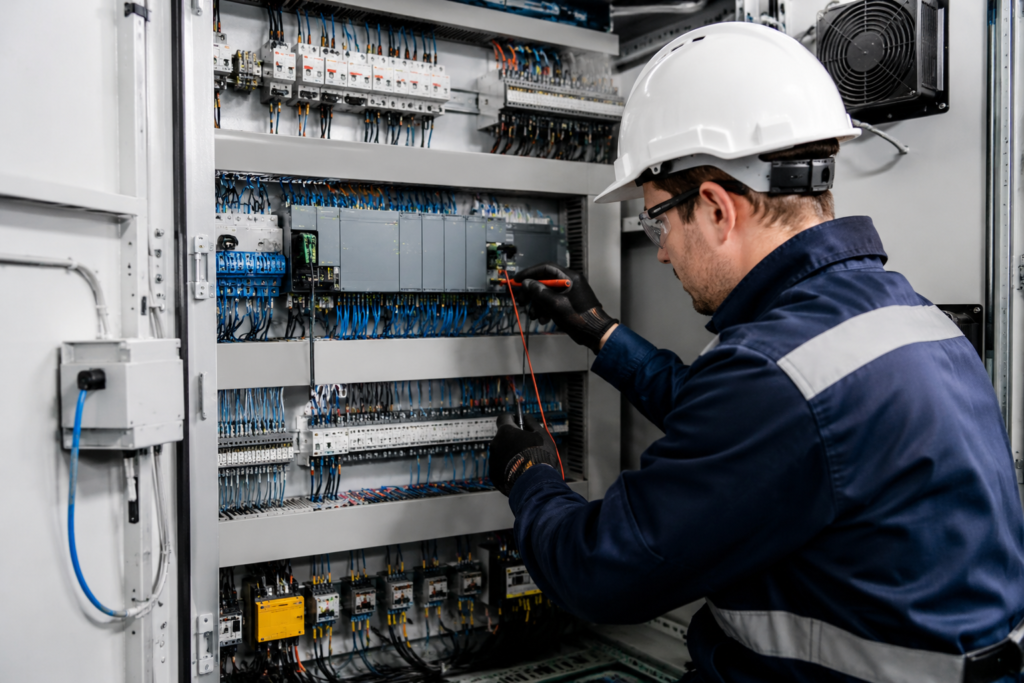
A visual inspection often reveals problems that electrical testing cannot detect immediately. Engineers look for loose terminal screws, damaged cables, missing identification labels, poor cable routing, broken wire insulation, and signs of physical damage. Correcting these simple issues early prevents much larger failures during startup.
Cable organization also plays an important role. Properly routed cables improve airflow inside the cabinet and make future maintenance easier. Organized wiring reduces electrical interference while helping technicians locate connections quickly during troubleshooting.
Engineers also verify grounding connections throughout the control panel. Proper grounding protects sensitive PLC electronics from electrical noise and voltage surges. Without effective grounding, communication errors and random PLC faults may occur even though the controller appears to operate normally.
Ventilation receives careful attention as well. PLC components generate heat during operation. Cooling fans, ventilation filters, and cabinet air conditioning systems must operate correctly to maintain safe operating temperatures. Excessive heat shortens the lifespan of electronic equipment and reduces system reliability.
A clean, organized, and properly wired control panel reflects high installation quality. It also creates confidence that the remaining commissioning stages will proceed smoothly.
Verifying Power Supply Stability
Reliable power forms the backbone of every PLC system. Even the most advanced controller cannot perform correctly if the incoming electrical supply remains unstable. Therefore, engineers dedicate considerable time to verifying power quality before energizing the automation system.
The commissioning team measures supply voltage and compares it with the equipment specifications. Voltage fluctuations outside acceptable limits may damage electronic components or cause unexpected controller resets. Stable voltage improves long-term reliability and protects valuable automation equipment.
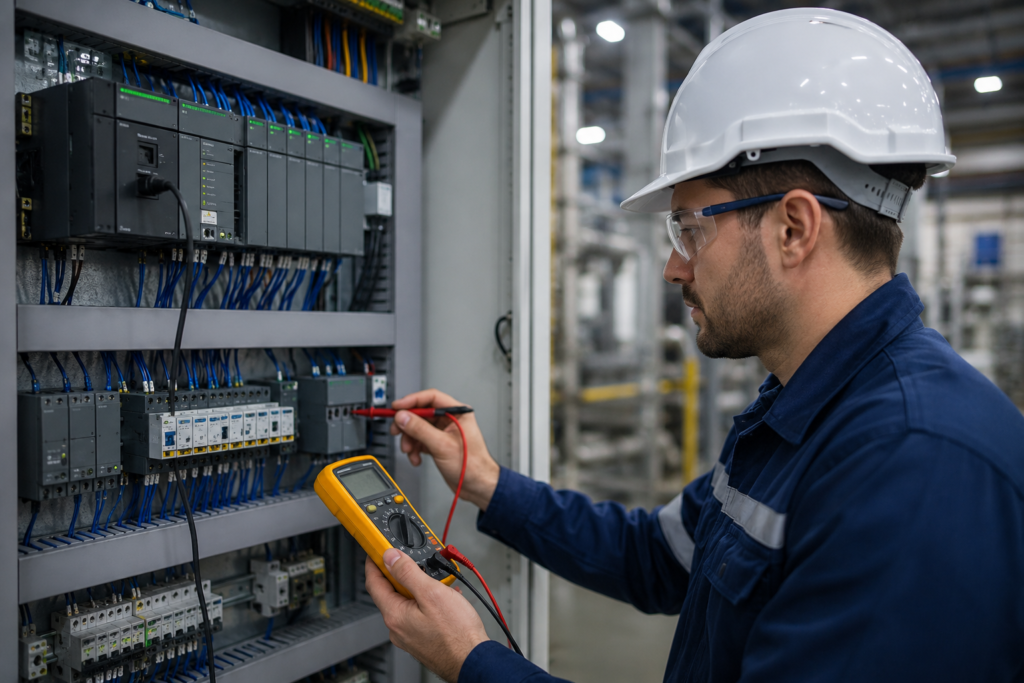
Power supply polarity also requires confirmation. Incorrect polarity may prevent modules from operating correctly or permanently damage sensitive devices. Engineers use calibrated test instruments to verify every connection before applying full system power.
Backup power systems deserve attention during commissioning. Many industrial facilities use UPS units or redundant power supplies to maintain controller operation during electrical disturbances. Engineers verify that these backup systems switch correctly and provide uninterrupted power whenever the primary supply fails.
Power distribution inside the control cabinet also receives inspection. Circuit breakers, fuses, surge protection devices, and terminal blocks must match the approved design. Every protective device should operate correctly because these components protect both personnel and expensive automation equipment.
When engineers complete this stage successfully, they establish a stable electrical foundation for every remaining commissioning activity.
Confirming PLC Hardware Configuration
Modern PLC systems consist of much more than a single processor. A complete automation system may include digital I/O modules, analog cards, communication processors, remote I/O stations, high-speed counters, motion control modules, and safety controllers. Every component must match the engineering design.
Engineers compare each installed module with the project documentation. They verify part numbers, slot positions, firmware versions, and communication addresses. Even a correctly installed module can create system faults if it occupies the wrong position inside the PLC rack.
Firmware compatibility receives careful attention during this stage. Manufacturers regularly release firmware updates that improve stability and introduce new features. However, incompatible firmware versions may prevent communication between hardware modules. Engineers confirm compatibility before proceeding with software downloads.
Expansion racks also require inspection. Large industrial applications often distribute PLC hardware across multiple cabinets. Engineers verify communication cables, rack addressing, synchronization settings, and power connections throughout the complete system.
Every hardware verification step reduces the possibility of unexpected startup failures. A correctly configured PLC platform provides a reliable base for software validation and functional testing.
Checking Field Devices Before System Startup
Field devices create the connection between the PLC and the real industrial process. Sensors collect information from the plant, while actuators perform physical actions according to PLC commands. Accurate communication between these devices determines the overall performance of the automation system.
Commissioning engineers inspect every sensor before startup. They verify installation position, mounting condition, cable termination, and signal quality. Limit switches, proximity sensors, pressure transmitters, temperature sensors, flow meters, and level instruments all require careful verification before normal operation begins.
Output devices receive equal attention. Engineers inspect motor starters, solenoid valves, pneumatic actuators, hydraulic cylinders, control valves, warning lights, and alarm systems. Each device should respond correctly without excessive delay or abnormal operation.
Mechanical movement also requires observation during commissioning. Moving equipment should travel freely without excessive vibration, unusual noise, or mechanical obstruction. Smooth movement confirms that both electrical and mechanical installations meet project requirements.
Device labeling represents another important inspection area. Every cable, sensor, and actuator should carry clear identification that matches the engineering drawings. Proper labeling simplifies maintenance and significantly reduces troubleshooting time in the future.
Reliable field devices allow the PLC to make accurate control decisions. Therefore, engineers never overlook this important stage of the PLC Commissioning Checklist.
Building a Safe Commissioning Environment
Safety remains the highest priority throughout the commissioning process. Industrial machines contain moving equipment, electrical energy, compressed air, hydraulic pressure, and high temperatures. These hazards require careful control before functional testing begins.
The commissioning team establishes safe work procedures before energizing any equipment. Access to hazardous areas remains restricted while engineers perform electrical testing. Warning signs, protective barriers, and communication procedures help reduce unnecessary risks.
Every person involved in commissioning understands emergency shutdown procedures before testing begins. Engineers verify emergency stop buttons, lockout devices, alarm systems, and safety interlocks before operating production equipment.
Personal protective equipment also plays a vital role. Safety helmets, insulated gloves, eye protection, protective footwear, and flame-resistant clothing provide additional protection while engineers work around energized electrical equipment.
A safe working environment improves more than accident prevention. Engineers who work confidently can focus completely on technical verification without unnecessary distractions. This professional approach increases both safety and commissioning quality.
Why Preparation Determines Commissioning Success
Many startup problems do not originate from faulty PLC programs. Instead, they result from incomplete preparation. Missing documentation, loose wiring, unstable power supplies, incorrectly installed hardware, or damaged field devices often create delays that engineers could have prevented with proper planning.
A detailed PLC Commissioning Checklist transforms preparation into a structured engineering process. Every completed verification step reduces uncertainty and builds confidence before functional testing begins. Instead of reacting to failures, engineers prevent them through careful inspection and systematic validation.
As the PLC Commissioning Checklist moves into the next phase, preparation turns into practical testing. Engineers begin verifying the PLC software, checking every input and output signal, testing communication networks, and confirming that each system responds correctly under real operating conditions. These tests ensure that the entire automation system performs safely, reliably, and exactly as intended before production officially starts.
PLC Commissioning Checklist for PLC Software Verification
Software verification is one of the most critical stages of a PLC Commissioning Checklist. Even when the hardware installation looks perfect, an incorrect PLC program can stop production within seconds. Therefore, engineers always verify the software before they allow the machine to operate under normal conditions.
The first step involves confirming that the correct PLC program has been loaded into the controller. Engineers compare the installed program with the latest approved project version. Loading an outdated backup may introduce incorrect control logic, missing safety functions, or communication errors. This simple verification prevents many startup problems.
After confirming the software version, engineers review the hardware configuration inside the programming software. Every digital input, analog output, communication module, and expansion rack should match the physical installation. A mismatch between software and hardware often causes unexpected diagnostic alarms.
Configuration parameters also require careful attention. Analog scaling values, timer settings, communication addresses, PID parameters, alarm thresholds, and operating limits must follow the approved engineering design. Even a small configuration error may affect the entire production process.
The commissioning team also checks memory utilization and processor diagnostics. A healthy PLC should run without memory overflow, watchdog faults, or unexpected CPU errors. Stable processor performance provides confidence that the controller can support continuous industrial operation.
Software verification does not end after downloading the program. Engineers observe the controller during operation and monitor system diagnostics while different machine conditions occur. Continuous observation helps identify hidden software issues before production officially begins.
PLC Commissioning Checklist for Input Signal Testing
Input testing confirms that the PLC receives accurate information from every field device. Since the controller makes decisions based on these signals, reliable input data directly affects machine performance and operational safety.
Commissioning engineers activate every sensor individually while monitoring the PLC program online. They verify that each input changes state immediately after the physical device operates. This simple test confirms correct wiring, addressing, and signal integrity.
Digital inputs receive detailed verification. Push buttons, emergency stop switches, selector switches, proximity sensors, photoelectric sensors, and limit switches should all respond without delay. Engineers compare the physical operation with the PLC status to confirm proper functionality.
Analog inputs require additional attention because they continuously measure process values. Temperature transmitters, pressure sensors, flow meters, and level instruments should display stable and realistic readings. Engineers compare these values with calibrated measuring instruments whenever possible.
Noise and signal fluctuations may appear during commissioning. Instead of ignoring unstable readings, engineers investigate the root cause immediately. Poor grounding, damaged shielding, incorrect cable routing, or faulty transmitters often create unreliable analog signals.
Every successful input test increases confidence that the PLC receives accurate process information. Reliable input signals allow the controller to make correct decisions under every operating condition.
PLC Commissioning Checklist for Output Signal Testing
Once engineers verify the inputs, they begin testing every PLC output. Output verification ensures that the controller sends the correct commands to motors, valves, alarms, relays, and other industrial equipment.
Each output operates individually during commissioning. Engineers activate the output through the PLC program and observe the connected device carefully. Every device should respond immediately without abnormal vibration, unusual noise, or delayed movement.
Motor starters receive special attention because they directly control valuable production equipment. Engineers verify motor rotation direction, overload protection, contactor operation, and current consumption before allowing continuous operation.
Control valves also require careful observation. Valves should open and close smoothly while following PLC commands accurately. Unexpected movement may indicate wiring problems, incorrect calibration, or pneumatic supply issues.
Visual indicators such as stack lights, alarm lamps, and warning sirens also become part of the testing process. Although these devices appear simple, they play an important role during machine operation by providing clear information to operators.
The commissioning team records every completed output test. These records provide valuable maintenance information and simplify troubleshooting long after the startup process finishes.
PLC Commissioning Checklist for Communication Network Testing
Modern automation systems rarely operate with a single PLC. Instead, controllers communicate continuously with HMIs, SCADA systems, remote I/O stations, variable frequency drives, intelligent sensors, and industrial robots. Reliable communication therefore becomes an essential part of every PLC Commissioning Checklist.
Engineers begin by checking network cables, connectors, switches, and communication modules. Physical damage or loose connections often create intermittent communication failures that become difficult to diagnose after production starts.
Next, engineers verify communication parameters such as IP addresses, node numbers, baud rates, device names, and network protocols. Every connected device must use the correct settings to exchange data successfully.
Communication diagnostics provide valuable information during commissioning. Engineers monitor network traffic, response times, diagnostic messages, and communication errors while different devices exchange data under normal operating conditions.
HMI communication receives special attention because operators depend on graphical displays to monitor production. Every button, alarm, trend, recipe, and process value should update correctly without noticeable delay.
SCADA integration also requires complete verification. Historical logging, alarm reporting, remote monitoring, and process visualization should all operate as designed before production begins.
Reliable industrial communication improves productivity, supports preventive maintenance, and provides operators with accurate information throughout daily operation.
PLC Commissioning Checklist for Functional Testing
Functional testing combines every verified component into one complete automation system. Instead of checking individual devices, engineers now observe how the entire process operates together.
The commissioning team begins with manual operation. They activate individual machine functions while observing PLC logic, mechanical movement, electrical performance, and operator interface responses. This controlled approach allows engineers to identify unexpected behavior without exposing equipment to unnecessary risk.
Once manual testing succeeds, engineers perform automatic sequence testing. Machines complete their programmed operating cycles while engineers monitor every stage carefully. Conveyor systems, production lines, packaging machines, pumping stations, and processing equipment should follow the programmed sequence without interruption.
Process interlocks receive detailed verification during this stage. Safety conditions, operating limits, and machine dependencies should prevent unsafe operation automatically. Correct interlock performance protects both personnel and valuable equipment.
Alarm functions also become part of functional testing. Engineers intentionally create controlled fault conditions to confirm that alarms appear correctly on HMIs and SCADA systems. Every alarm should provide clear information that helps operators identify the problem quickly.
Functional testing represents one of the most rewarding stages of commissioning. After days of preparation and verification, engineers finally observe the complete automation system performing exactly as designed. This successful operation demonstrates that the commissioning process has achieved its primary objective.
PLC Commissioning Checklist for Safety Verification
Safety verification stands at the center of every PLC Commissioning Checklist. A machine that performs efficiently but operates without proper safety protection creates unnecessary risks for both people and equipment. Therefore, engineers never complete commissioning until they confirm that every safety function works exactly as designed.
The verification process begins with emergency stop circuits. Engineers activate every emergency stop button one at a time while observing the machine response. The equipment should stop immediately without creating additional hazards. At the same time, the PLC should detect the safety event correctly and display the appropriate alarm on the HMI or SCADA system.
Safety interlocks receive equal attention during commissioning. Many industrial machines depend on door switches, safety light curtains, pressure switches, overload protection, and guard monitoring devices. Engineers intentionally trigger these safety devices to confirm that the PLC prevents unsafe machine operation. If any protective device fails to respond correctly, the commissioning team investigates the problem before continuing.
Engineers also verify restart behavior after a safety event. A machine should never restart automatically after an emergency stop unless the control philosophy specifically allows it. Instead, operators should acknowledge alarms, inspect the equipment, and restart the process through the approved operating procedure.
Modern industrial facilities often use Safety PLCs alongside standard controllers. During commissioning, engineers verify communication between these systems while confirming that safety logic remains independent whenever required. This approach improves system integrity and supports safe operation throughout the equipment lifecycle.
A successful safety verification provides confidence that the automation system can protect operators while maintaining reliable production. More importantly, it demonstrates that safety remains the highest priority during every stage of commissioning.
Common PLC Commissioning Mistakes to Avoid
Even experienced engineers occasionally encounter commissioning challenges. Most problems do not result from complex software faults. Instead, they develop because someone overlooked a basic verification step during installation or testing.
One common mistake involves skipping documentation review. Engineers sometimes assume that the installed equipment matches the drawings without confirming every detail. Later, they discover incorrect cable numbers, missing devices, or outdated PLC programs. Careful documentation review prevents these unnecessary delays.
Another frequent mistake occurs when engineers test only selected inputs and outputs instead of verifying the complete system. Although partial testing saves time initially, hidden faults often appear after production starts. Comprehensive testing requires more effort, but it greatly improves long-term reliability.
Poor communication between project teams also creates commissioning problems. Electricians, automation engineers, mechanical technicians, and production personnel should exchange information throughout the startup process. When teams work independently without regular updates, misunderstandings often slow project completion.
Ignoring diagnostic alarms represents another avoidable mistake. Some alarms appear minor during commissioning, yet they often indicate wiring errors, communication instability, or configuration problems. Engineers should investigate every alarm instead of assuming that it will disappear later.
Incomplete documentation creates difficulties long after commissioning finishes. Future maintenance engineers rely on startup records to understand system behavior and troubleshoot faults efficiently. Accurate documentation therefore becomes just as valuable as successful testing.
Learning from these common mistakes helps commissioning teams complete projects faster while delivering safer and more reliable automation systems.
PLC Commissioning Best Practices for Long-Term Reliability
A successful PLC Commissioning Checklist does more than prepare a machine for its first startup. It establishes good engineering practices that improve system reliability for many years.
Engineers should always follow an organized sequence during commissioning. Starting with documentation, continuing through hardware inspection, software verification, communication testing, and finally functional testing creates a logical workflow that reduces confusion and minimizes unnecessary troubleshooting.
Version control also plays an important role. Every PLC program, HMI project, and configuration file should carry a clear version number and backup copy. If future modifications become necessary, engineers can restore the approved configuration quickly without losing valuable project information.
Calibration improves overall system accuracy. Analog transmitters, pressure sensors, temperature instruments, and flow meters should receive proper calibration before final commissioning. Accurate measurements allow the PLC to make better control decisions throughout normal production.
Regular communication with machine operators also benefits the commissioning process. Operators understand daily production requirements and often notice practical issues that engineers may overlook. Their feedback helps improve machine usability before production officially begins.
Finally, engineers should never rush the startup process simply to meet a deadline. A few additional hours spent on careful verification can prevent days of unexpected downtime later. Thorough commissioning always delivers better long-term results than a hurried startup.
Frequently Asked Questions (FAQs)
What is a PLC Commissioning Checklist?
A PLC Commissioning Checklist is a structured process that verifies the installation, programming, wiring, communication, and safety of a PLC system before production starts.
Why is PLC commissioning important?
Commissioning identifies installation and programming issues before they affect production. It improves safety, reduces downtime, and increases system reliability.
When should PLC commissioning take place?
Commissioning should begin after the mechanical and electrical installation is complete but before the machine enters normal production.
Who performs PLC commissioning?
Automation engineers, PLC programmers, electrical engineers, instrumentation technicians, and commissioning specialists usually work together during the commissioning process.
What happens if PLC commissioning is skipped?
Skipping commissioning increases the risk of wiring faults, communication failures, software errors, unexpected downtime, equipment damage, and safety hazards.
How long does PLC commissioning take?
The duration depends on system complexity. Small automation systems may require one day, while large industrial plants often need several days or even weeks.
Does every PLC system require commissioning?
Yes. Even small PLC applications benefit from proper commissioning because it confirms that every component operates safely and correctly before startup.
What is the difference between testing and commissioning?
Testing verifies individual components, while commissioning confirms that the complete automation system works together safely and according to the project requirements.
Pingback: VFD Overvoltage Fault: Causes, Diagnosis & Solutions