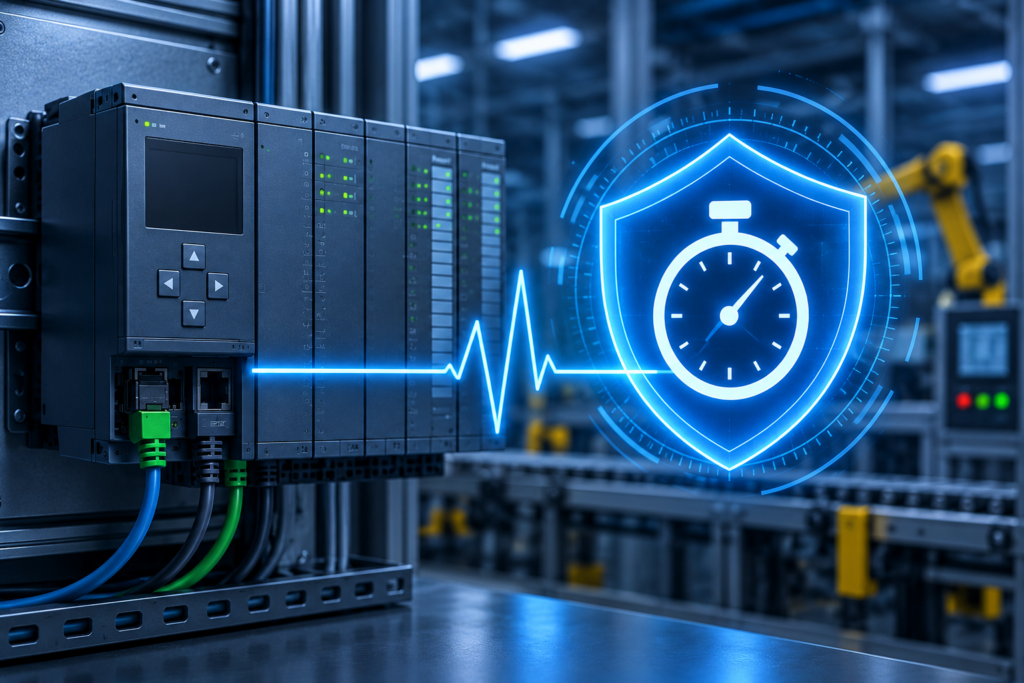
A PLC Watchdog Timer is an important safety and reliability feature found in many programmable logic controllers. It continuously checks whether the PLC is executing its program within the expected time. If the controller takes too long to complete its operation, the watchdog timer can detect the problem and trigger a fault response. As a result, it helps prevent a stalled or malfunctioning PLC from continuing to control industrial equipment in an unsafe or unpredictable way.
In modern industrial automation, PLCs often control motors, pumps, conveyors, valves, sensors, robotic equipment, and production processes. Therefore, even a small software or hardware problem can affect an entire machine. A PLC Watchdog Timer provides an additional layer of protection by monitoring the controller's execution behavior.
A PLC Watchdog Timer helps detect this kind of abnormal behavior.
Instead of controlling a motor, reading a sensor, or operating a valve directly, the watchdog monitors the controller itself. Its job is to identify when program execution takes too long or fails to progress as expected.
This makes the watchdog an important diagnostic and reliability feature in modern PLC systems. Moreover, understanding how it works can help programmers design better applications and troubleshoot controller faults more effectively.
What Is a PLC Watchdog Timer?
A PLC Watchdog Timer is a monitoring mechanism built into a programmable logic controller. It is used to detect abnormal delays in the execution of the controller's operating tasks.
A normal PLC continually processes its program. During this process, the controller performs input processing, program execution, output handling, communication, diagnostics, and several internal operating functions.
Under normal conditions, these tasks are completed within an expected period.
The watchdog observes this execution from a supervisory level. If the controller exceeds the permitted execution time, the watchdog condition can be triggered.
The exact behavior depends on the PLC manufacturer. For example, a controller may create a diagnostic fault, switch to a defined operating state, or stop normal processing.
Therefore, the watchdog should not be confused with an ordinary timer instruction used inside a PLC program. A programmer may use timer instructions to control machine sequences, while the watchdog is primarily concerned with the health and execution of the controller itself.
Why Does a PLC Need a Watchdog Timer?
A PLC normally performs thousands or even millions of processing operations during its lifetime. Most of these operations happen without any problem. Nevertheless, software errors, hardware problems, communication issues, and unexpected program conditions can occasionally interfere with normal execution.
For example, imagine a PLC controlling a conveyor system. The program should continuously scan sensors, calculate logic conditions, and control the conveyor motor. If a programming error creates an endless loop, the controller may stop reaching the instructions responsible for updating outputs.
Without a suitable monitoring mechanism, the PLC could remain in that abnormal state for longer than expected.
A watchdog timer helps identify this situation.
Furthermore, industrial machines often operate continuously for long periods. Operators cannot manually monitor every internal PLC operation. Therefore, automatic monitoring becomes extremely valuable.
The watchdog mechanism can detect abnormal execution much faster than a person could notice the underlying problem. Consequently, it can help reduce the risk of uncontrolled machine behavior and unnecessary downtime.
How Does a PLC Watchdog Timer Work?
To understand the PLC Watchdog Timer properly, it helps to understand the basic PLC scan cycle first.
A PLC repeatedly performs a sequence of internal operations. Although the exact process depends on the PLC manufacturer and CPU architecture, a simplified scan normally involves reading input information, executing the user program, updating outputs, and handling internal tasks.
The PLC repeats this cycle continuously.
For example, suppose a controller completes one scan in 5 milliseconds. It then starts another scan, processes the program again, and continues this pattern.
The scan time can change slightly from one cycle to another. A simple program may require very little processing time, while a larger program with complex calculations, communication tasks, data processing, and motion functions may require more time.
The watchdog timer establishes an upper limit for acceptable execution time.
Suppose a PLC has a watchdog limit of 100 milliseconds. If the controller normally completes its scan in 8 milliseconds, there is a comfortable margin between normal operation and the watchdog threshold.
However, if a programming problem causes the scan to continue for more than 100 milliseconds, the watchdog can detect that condition.
At that point, the PLC may enter a fault state, stop normal execution, generate a diagnostic message, or perform another manufacturer-defined response.
The exact reaction depends on the PLC platform and its configuration. Therefore, engineers should always check the documentation for the specific PLC model they use.
PLC Watchdog Timer and the PLC Scan Cycle
The relationship between the PLC Watchdog Timer and the scan cycle is one of the most important concepts to understand.
A PLC does not simply execute its program once and stop. Instead, it continuously repeats the program according to its operating cycle.
During a normal scan, the controller moves through its programmed instructions. When the scan finishes, the PLC begins the next cycle.
As a result, scan time becomes an important indicator of controller performance.
A small change in scan time usually does not indicate a problem. For instance, a program might require 6 milliseconds during one scan and 7 milliseconds during another. Such variations can occur because different instructions execute under different conditions.
However, a sudden and significant increase deserves attention.
For example, consider a machine whose PLC normally operates with a scan time between 4 and 6 milliseconds. If the scan suddenly rises to 40 milliseconds, the engineer should investigate the reason.
The increase could come from a large calculation, communication activity, excessive program complexity, an unexpected loop, or another processing condition.
Therefore, monitoring scan behavior can help engineers identify potential problems before they become serious.
What Happens When the Watchdog Timer Expires?
When the PLC exceeds its permitted execution time, the watchdog timer can expire. Engineers often refer to this condition as a watchdog timeout or watchdog fault.
The exact response varies between PLC families. Nevertheless, the controller generally recognizes that its program execution has exceeded the safe or configured time limit.
Depending on the system, the PLC may stop normal program execution and place the CPU into a fault condition. It may also record diagnostic information that helps the engineer identify the problem.
This response serves an important purpose.
A PLC that has become stuck in an abnormal processing state should not continue operating as though everything were normal. If it did, the controller might fail to update outputs correctly or respond to important input changes.
For that reason, the watchdog timer acts as a protective boundary around normal program execution.
However, a watchdog timeout does not automatically mean that the PLC hardware has failed.
In many cases, the hardware works correctly while the user program contains an issue. Therefore, engineers should investigate the software logic, scan time, communication tasks, and recent program changes before replacing the controller.
Common Causes of a PLC Watchdog Timer Fault
A watchdog fault can originate from several different sources. Therefore, troubleshooting should begin with the actual conditions surrounding the fault rather than assuming that one particular component has failed.
One common cause involves an unintended infinite loop.
A loop can become problematic when the program repeatedly executes the same instructions without reaching the condition that allows it to exit. Consequently, the PLC spends excessive processing time inside that section of logic.
Another possible cause involves an unexpectedly complex program operation.
Large mathematical calculations, extensive data processing, advanced motion functions, or intensive communication tasks can increase execution time. If the program grows considerably without proper optimization, the normal scan period may also increase.
Communication activity can create another source of delay.
A PLC may exchange data with HMIs, SCADA systems, drives, remote I/O stations, industrial networks, or other controllers. Under certain conditions, communication processing can consume additional CPU resources.
Furthermore, programming changes can introduce unexpected execution paths.
For instance, an engineer may add a new routine that works correctly under normal conditions but becomes extremely time-consuming when a particular machine state occurs. The problem might remain unnoticed during testing and appear only after the system reaches that specific condition.
Hardware-related issues can also contribute to abnormal PLC behavior. However, engineers should not immediately blame the CPU. A proper diagnostic process should first examine the available fault information and program behavior.
PLC Watchdog Timer vs Normal Scan Time
It is important to understand that normal scan time and watchdog time are not the same thing.
The scan time represents how long the PLC takes to complete its processing cycle under a particular operating condition. The watchdog setting, in contrast, represents the maximum execution period allowed before the controller considers the situation abnormal.
For example, imagine a PLC normally completes its scan in approximately 10 milliseconds while its watchdog limit is 100 milliseconds.
The 10-millisecond value represents normal execution behavior. The 100-millisecond value represents the upper monitoring boundary.
Therefore, engineers should not treat the watchdog setting as the expected scan time.
Instead, the system should normally operate well below the watchdog threshold. This margin gives the PLC enough room to handle temporary increases in processing demand without immediately triggering a fault.
Nevertheless, an excessively large watchdog setting does not automatically solve a performance problem.
If a program normally requires 15 milliseconds but occasionally jumps to 90 milliseconds, simply increasing the watchdog limit may hide the underlying issue. Consequently, engineers should investigate why the execution time increases rather than relying only on a larger timeout value.
Why the PLC Watchdog Timer Matters in Industrial Automation
Industrial automation depends heavily on predictable controller behavior. Machines need to respond to sensors, commands, alarms, and process conditions at the right time.
A PLC Watchdog Timer supports that predictability by detecting abnormal program execution.
Consider a production line where several machines depend on one PLC. If the controller stops processing correctly, motors may not receive expected commands, valves may remain in their previous state, or sensor information may not reach the appropriate logic.
Such situations can lead to production interruptions and potentially unsafe machine conditions.
The watchdog mechanism therefore provides an important layer of protection.
Moreover, it helps maintenance engineers identify abnormal controller behavior. Instead of silently remaining stuck, the PLC can report a fault condition that directs attention toward the controller or its program execution.
This makes troubleshooting more structured.
Instead of asking why a machine suddenly stopped without any information, an engineer may find a specific CPU diagnostic or watchdog-related fault. From there, the engineer can inspect the program, recent modifications, scan time, and system conditions.
As a result, the watchdog timer contributes not only to reliability but also to easier fault diagnosis.
Protecting Against Unexpected Program Behavior
PLC programs normally follow carefully designed sequences. Nevertheless, programming mistakes can sometimes create conditions that the original design did not anticipate. A routine might repeatedly process data, wait for an unavailable condition, or follow an execution path that consumes far more CPU time than expected.
The PLC Watchdog Timer can recognize the resulting delay when program execution exceeds its permitted limit. This creates an important boundary between normal operation and abnormal processing.
For example, imagine a packaging machine that normally completes its control operations quickly. A software modification introduces a condition that causes a processing routine to consume significantly more time whenever several products arrive simultaneously. The machine may continue operating for a short period, but its controller now has less processing margin. If the condition becomes severe enough, watchdog monitoring can identify the abnormal execution.
This response gives engineers a clear indication that something inside the control process requires investigation.
Supporting Predictable Machine Operation
Predictability is extremely important in industrial environments. A machine may need to start a motor after receiving a sensor signal, close a valve after reaching a process limit, or activate an alarm when a particular condition occurs.
These actions depend on the controller processing its logic consistently.
If the PLC becomes heavily occupied with an unexpected task, the timing of other operations may also change. As a result, the machine could respond differently from its intended sequence.
A PLC Watchdog Timer does not make the program faster. Instead, it helps identify when controller execution has become abnormal. This distinction matters because engineers can then investigate the cause rather than allowing an abnormal condition to remain unnoticed.
In addition, watchdog monitoring can support more predictable maintenance procedures. When a controller reports an execution-related fault, technicians have a specific event to investigate instead of relying only on symptoms observed at the machine.
PLC Watchdog Timer and Controller Behavior
A PLC manages many activities while controlling an industrial machine. Besides application logic, the controller may handle diagnostics, communication, data processing, system services, and other background operations. Consequently, an unexpected increase in processing demand can affect how quickly the controller moves through its tasks.
The PLC Watchdog Timer helps identify when this behavior reaches an unacceptable level. For example, if a controller becomes occupied with an unexpected processing condition, the watchdog can recognize that the execution period has exceeded its configured boundary.
This does not mean that the watchdog makes the PLC operate faster. Instead, it provides a monitoring mechanism that distinguishes expected controller behavior from a potentially abnormal condition.
Furthermore, this distinction helps maintenance personnel approach a problem with better information. Rather than treating every machine interruption as a hardware failure, they can examine the controller's diagnostic information and determine what actually happened.
PLC Watchdog Timer for Reducing Uncontrolled Operation Risks
Industrial machines can react quickly to PLC commands, so abnormal controller behavior deserves careful attention. If the PLC cannot continue processing its application as expected, some outputs may not receive new instructions at the intended time.
For example, a filling machine may depend on level sensors, timing conditions, and valve commands. If controller execution becomes severely abnormal, the normal sequence may no longer progress as designed.
The PLC Watchdog Timer provides a mechanism for recognizing excessive execution time. Depending on the PLC platform, the controller may generate a diagnostic condition, enter a fault state, or perform another defined response.
However, it is important to understand the limits of this feature. A watchdog is not a substitute for a certified machine safety system. Safety-related applications may require dedicated safety controllers, emergency-stop circuits, protective equipment, risk assessment, and other measures appropriate to the machine.
Therefore, the PLC Watchdog Timer should be considered one reliability and diagnostic feature within the complete automation architecture.
PLC Watchdog Timer for Better Fault Diagnosis
When a controller experiences an execution-related problem, finding the cause quickly becomes important. The PLC Watchdog Timer can provide a valuable diagnostic clue because its activation indicates that the controller encountered an execution condition outside its permitted range.
Once the event appears, engineers can examine the PLC's available diagnostic records. They can also review recent software modifications, communication activity, machine conditions, and controller performance.
For instance, suppose a packaging line suddenly reports an execution fault after a software update. Instead of immediately replacing the CPU, an engineer can compare the current application with the previous working version. This comparison may reveal a newly added routine or processing task that requires further investigation.
Moreover, recording the time and operating condition of repeated faults can reveal useful patterns. If the problem appears only during a particular production sequence, that sequence becomes a stronger candidate for investigation.
Consequently, watchdog information can turn a vague machine problem into a more focused engineering investigation.
PLC Watchdog Timer and Efficient Maintenance
Efficient maintenance depends on accurate information. When technicians know what type of controller event occurred, they can choose a more appropriate troubleshooting path.
The PLC Watchdog Timer contributes to this process by identifying abnormal execution behavior. After such an event, technicians can review diagnostic messages and determine whether the problem relates to application logic, processing demand, communication activity, configuration, or another system condition.
Additionally, maintenance teams can compare the timing of the fault with recent changes to the machine. A new software function, network device, HMI feature, or production requirement may have changed the controller's workload.
This approach is more efficient than replacing PLC components without evidence. Hardware replacement can be expensive, and it may introduce another problem if the original controller was not actually defective.
Therefore, diagnostic information should guide maintenance decisions whenever possible.
PLC Watchdog Timer During Automation System Expansion
Automation systems rarely remain unchanged throughout their entire service life. Over time, engineers may add sensors, drives, HMIs, remote I/O, data collection functions, communication networks, or additional machine sequences.
Each new feature can introduce additional processing requirements.
The PLC Watchdog Timer becomes especially useful as an automation project grows because it provides a boundary for controller execution. Engineers can observe how the PLC behaves after major software or hardware additions and determine whether the controller still has sufficient processing capacity.
For example, an application that runs comfortably with ten sensors may behave differently after several additional devices and data-processing functions are introduced. The machine might continue working, but the controller's execution characteristics could change.
Therefore, system expansion should include performance testing rather than focusing only on whether the new functionality works.
By monitoring controller behavior during realistic operating conditions, engineers can identify performance concerns earlier and plan upgrades when necessary.
PLC Watchdog Timer and Reliable Software Design
Reliable PLC software requires more than making the machine perform its intended sequence. Engineers must also consider how efficiently the application uses controller resources.
The PLC Watchdog Timer provides monitoring, but good programming practices remain the first line of defense against unnecessary processing problems. Developers should organize routines clearly, avoid needless calculations, and design program structures that remain understandable during future maintenance.
For example, a control routine should not repeatedly perform an expensive operation when the result has not changed. Similarly, background data processing should not unnecessarily interfere with time-sensitive machine operations.
Furthermore, meaningful variable names and clear program organization make troubleshooting easier. When engineers can quickly understand what each routine does, they can investigate abnormal behavior more efficiently.
Good documentation also matters because industrial PLC applications often remain active for many years. The person maintaining the system in the future may not be the original programmer.
Consequently, clean software design and watchdog monitoring work together to support long-term controller reliability.
PLC Watchdog Timer in Preventive Maintenance
Preventive maintenance aims to identify developing problems before they cause serious production interruptions. Although the PLC Watchdog Timer primarily responds to abnormal execution, its diagnostic behavior can also provide useful information for maintenance planning.
For example, repeated execution-related warnings may indicate that the controller is operating with less processing margin than before. Even if the PLC has not reached a watchdog timeout, the change deserves attention.
Engineers can investigate what caused the increased workload and determine whether recent software changes or new system functions contributed to it.
Moreover, addressing these conditions early can make future upgrades easier. A controller with limited processing capacity may struggle when engineers add more features later.
PLC Watchdog Timer Beyond Simple Fault Status
Simply checking whether a watchdog fault has occurred does not provide a complete picture of PLC performance. A controller may operate normally while its processing workload gradually increases.
The PLC Watchdog Timer should therefore be considered alongside other available performance information. Depending on the PLC platform, engineers may examine execution timing, CPU loading, memory conditions, communication activity, diagnostic events, and application behavior.
For instance, if execution time begins increasing after a software modification, the change provides an important clue. Similarly, if the increase appears only when a particular machine sequence runs, engineers can focus their investigation on the logic associated with that sequence.
As a result, the watchdog becomes more valuable when engineers combine its information with other diagnostic indicators.
This broader approach allows maintenance teams to identify trends instead of waiting for a complete controller fault.
PLC Watchdog Timer and Overall Industrial Reliability
Industrial reliability depends on several engineering practices working together. Proper PLC selection, stable power, suitable networking, well-designed I/O, organized software, correct commissioning, and effective maintenance all contribute to dependable machine operation.
Within this larger system, the PLC Watchdog Timer provides another layer of controller monitoring.
Its purpose is relatively focused, but its diagnostic value can be significant. When the controller encounters an execution condition outside its permitted range, the watchdog can help bring attention to the problem.
Furthermore, the feature encourages engineers to treat abnormal execution as something worth investigating rather than allowing unusual controller behavior to continue unnoticed.
Consequently, watchdog monitoring can contribute to a more disciplined approach to PLC reliability.
PLC Watchdog Timer Practical Example in a Water Pump System
Consider a PLC-controlled water pumping system that monitors tank-level sensors and controls a pump according to the process requirements. An HMI also communicates with the controller so operators can view operating information.
Consider a PLC-controlled water pumping system that monitors tank-level sensors and controls a pump according to the process requirements. An HMI also communicates with the controller so operators can view operating information.
Initially, the application performs its control tasks without difficulty. Later, however, an engineer adds a data-processing function that collects and calculates additional production information.
Under light operating conditions, the new function may have little visible effect. During a demanding operating sequence, however, it may require considerably more processing resources.
The PLC Watchdog Timer can become relevant if the controller's execution period eventually exceeds its permitted boundary. The resulting diagnostic information gives engineers a useful starting point for investigation.
Instead of assuming that the PLC CPU has failed, the engineering team can examine the newly added function, review controller diagnostics, and compare execution behavior before and after the modification.
This example illustrates how watchdog monitoring can support practical troubleshooting in a real automation application.
PLC Watchdog Timer in Modern Connected Automation
Today's industrial systems increasingly connect PLCs with HMIs, SCADA platforms, drives, robots, remote I/O, industrial networks, and data systems. These technologies improve visibility and control, but they also introduce additional processing responsibilities.
As a result, controller performance deserves greater attention as automation systems become more connected.
The PLC Watchdog Timer provides a straightforward way to recognize when controller execution moves beyond its acceptable operating boundary. At the same time, diagnostic information can help engineering teams understand whether system growth has affected controller performance.
Furthermore, historical fault information can support future design decisions. Engineers can use previous events to review software architecture, estimate controller capacity, and determine whether a future upgrade may require a more capable CPU.
Thus, watchdog monitoring remains useful even in highly connected and modern automation environments.
PLC Watchdog Timer and Long-Term System Confidence
Long-term confidence in an industrial control system comes from knowing how the controller behaves under normal and abnormal conditions. The PLC Watchdog Timer contributes to this confidence by providing a defined monitoring mechanism for execution behavior.
When engineers understand the watchdog's purpose and interpret its diagnostic information correctly, they can respond to abnormal conditions more systematically.
However, the feature should always work alongside sound engineering practices. Proper program design, appropriate hardware selection, machine safety measures, testing, documentation, and maintenance remain essential.
Ultimately, the PLC Watchdog Timer is valuable because it gives the control system another way to recognize unusual controller behavior. It does not replace good engineering; instead, it strengthens the overall monitoring strategy.
For industrial automation professionals, understanding this feature is therefore useful when designing PLC applications, troubleshooting controller faults, expanding existing systems, and maintaining reliable machine operation.
Frequently Asked Questions About PLC Watchdog Timer
What is a PLC Watchdog Timer?
A PLC Watchdog Timer is a monitoring function that checks whether the controller completes its processing within an acceptable time. If execution takes longer than the configured limit, the PLC can recognize the condition and generate an appropriate diagnostic response.
Why is a PLC Watchdog Timer important?
A PLC Watchdog Timer is important because it helps detect abnormal controller execution. In industrial automation, unexpected processing delays can affect machine behavior, so identifying such conditions gives engineers an opportunity to investigate the underlying problem.
What can cause a PLC Watchdog Timer fault?
Several conditions can contribute to a watchdog fault. These may include inefficient program logic, unintended execution paths, excessive calculations, heavy communication activity, or unexpected system workload. The actual cause depends on the PLC platform and the application.
Does a PLC Watchdog Timer improve PLC speed?
No. A PLC Watchdog Timer does not increase the processing speed of a PLC. Instead, it monitors execution time and identifies situations where the controller takes longer than the permitted period.
Can a watchdog fault damage a PLC?
A watchdog fault does not normally mean that the PLC has suffered physical damage. In many cases, the event indicates an execution or software-related problem. Therefore, engineers should examine diagnostic information before assuming that the CPU requires replacement.
Should I increase the watchdog time after a fault?
Increasing the watchdog limit should not be the first response. First, engineers should determine why execution time increased. If the application genuinely requires a different limit, the setting can then be reviewed according to the PLC manufacturer's specifications and the machine requirements.
Does every PLC use the same watchdog settings?
No. Watchdog behavior, terminology, limits, and configuration methods can vary between PLC manufacturers and CPU models. Therefore, engineers should always follow the documentation for the specific controller they are using.
Conclusion
The PLC Watchdog Timer is a small but valuable part of modern PLC-based automation. Its primary role is to monitor controller execution and identify conditions where processing takes longer than the permitted limit. Although the feature does not prevent every PLC problem, it provides an important indication when controller behavior moves outside its expected operating range.
Moreover, watchdog monitoring can support better troubleshooting. When an execution-related fault appears, engineers can examine the program, controller diagnostics, communication activity, recent modifications, and operating conditions instead of immediately replacing hardware. This approach can save troubleshooting time and help maintenance teams find the actual source of a problem.
A reliable automation system also requires good programming practices. Clear program structure, sensible processing methods, appropriate hardware, proper testing, and regular maintenance all contribute to dependable machine operation. Therefore, the PLC Watchdog Timer should work as part of a broader reliability strategy rather than as a standalone solution.
Ultimately, understanding the PLC Watchdog Timer helps PLC programmers, automation engineers, and maintenance technicians make better decisions when designing, commissioning, and troubleshooting industrial control systems. When used correctly, it provides an additional layer of monitoring that can contribute to more predictable and maintainable automation.