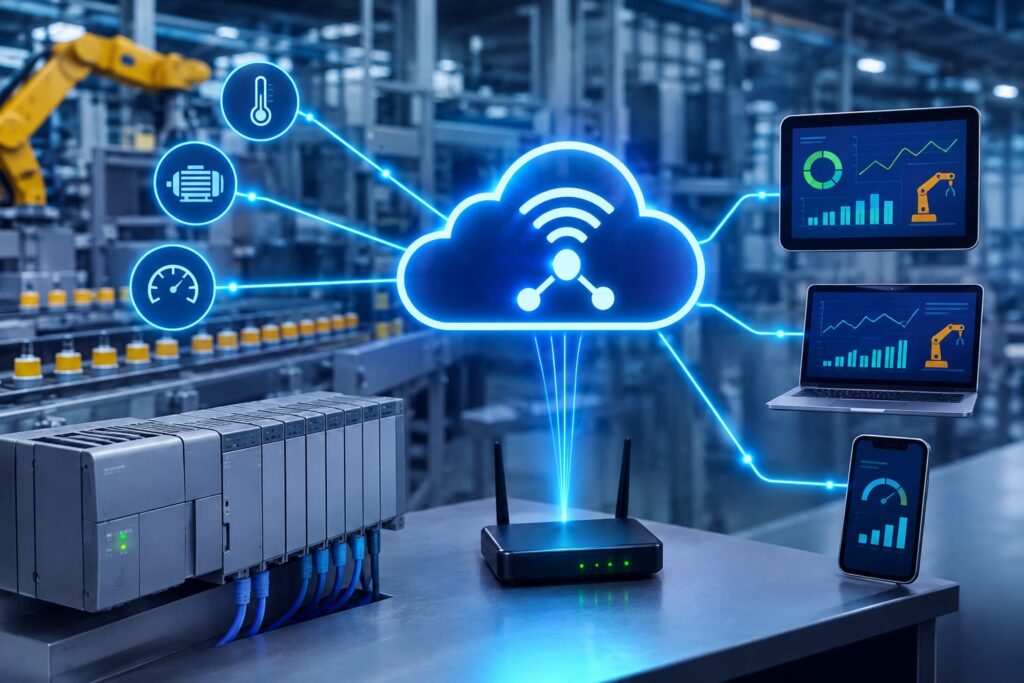
MQTT in Industrial IoT has become an important communication approach for connected factories, machines, sensors, and monitoring systems. As industrial environments become more connected, a large number of devices are expected to exchange data continuously without creating unnecessary network traffic. Therefore, a lightweight messaging protocol such as MQTT can be used to move industrial data efficiently between field devices, gateways, applications, and cloud platforms.
In a traditional automation environment, a PLC may primarily control machines according to programmed logic. However, modern Industrial IoT systems require more than control alone. Data from PLCs, sensors, meters, drives, and other equipment can also be collected, processed, monitored, and shared with higher-level software. As a result, communication has become just as important as control.
MQTT provides a practical way to handle this communication. Instead of requiring every industrial device to communicate directly with every other device, MQTT introduces a messaging architecture in which devices publish information and other systems subscribe to the information they need. Because of this approach, industrial data can be distributed in a flexible and organized manner.
In this complete beginner’s guide, we will explore how MQTT works in Industrial IoT, why it is useful, how its architecture is structured, and where it fits into modern industrial communication systems.
What Is MQTT?
MQTT stands for Message Queuing Telemetry Transport. It is a lightweight messaging protocol designed for situations where devices need to exchange information efficiently over a network.
The protocol uses a publish-subscribe communication model rather than a direct request-and-response model. Consequently, the device generating data does not need to know exactly which application will receive it. Instead, the message is sent through an MQTT broker, which manages the distribution of that information.
This method can be especially useful in Industrial IoT because factories often contain many devices operating simultaneously. Sensors may generate temperature readings, PLCs may expose machine states, and gateways may forward production information to higher-level systems. Meanwhile, dashboards or software applications may only need a small portion of that data.
MQTT helps separate the producer of information from the consumer of information. Therefore, a system can be expanded more easily when additional monitoring devices or applications are introduced.
Why Is MQTT Important in Industrial IoT?
Modern factories are gradually moving toward connected operations. Machines are no longer treated as isolated assets. Instead, useful operational data can be collected and made available across different layers of a production environment.
For example, a motor controller may provide running status, current values, temperature, or fault information. A local PLC may process this information for machine control. At the same time, an edge gateway can collect selected values and publish them through MQTT so that a monitoring application can use them.
This architecture offers several practical advantages.
First, communication can be kept lightweight. Industrial networks may contain devices with limited processing capability or environments where bandwidth should be used carefully. MQTT is designed to work with relatively small messages, so it can be suitable for frequent telemetry.
Second, communication can be decoupled. A sensor does not have to maintain a separate connection with every application that wants its data. Instead, the broker handles message distribution.
Third, additional consumers can be introduced without redesigning the entire data path. For instance, production monitoring software, a maintenance application, and a reporting system could subscribe to different industrial data streams.
As industrial systems continue to connect operational technology with digital platforms, this flexibility becomes increasingly valuable.
How the MQTT Communication Flow Works
Suppose a temperature sensor is installed near an industrial motor. The sensor itself may not communicate directly with a monitoring dashboard.
First, the sensor data is collected by an industrial gateway or controller. The gateway then publishes the temperature value to the MQTT broker under a specific topic.
Next, the broker receives that message and checks which subscribers are interested in that topic. A monitoring application that has subscribed to the relevant topic can then receive the updated value.
As a result, the same information can potentially be delivered to multiple authorized applications without requiring the original device to send separate messages to each one.
This mechanism can make industrial data distribution more organized, especially when the number of connected devices increases.
What Is an MQTT Broker?
The MQTT broker is the central communication component in an MQTT-based system. It receives messages from publishers and forwards them to the appropriate subscribers.
The broker is therefore responsible for managing the messaging environment. Connections, subscriptions, message routing, and communication rules can be handled through the broker.
In an Industrial IoT deployment, the broker may run on an industrial computer, edge server, virtual machine, or cloud infrastructure, depending on the system design.
For example, a factory may have several machine gateways publishing production information to a local broker. Monitoring applications can then subscribe to selected data streams. In another architecture, an edge broker may handle local communication while selected data is forwarded to a cloud-based platform.
Because of this flexibility, the broker can become an important part of the overall communication architecture.
Why MQTT Topics Matter in MQTT in Industrial IoT
Topics play a central role in MQTT in Industrial IoT because modern factories can generate a huge amount of operational data. A single production facility may contain PLCs, sensors, drives, meters, gateways, and software platforms. Therefore, engineers need a practical method to organize all that information.
A clear topic structure helps teams find the right data quickly. For example, a maintenance application may only need fault information, while a production dashboard may need machine status and production counts.
Because each application can subscribe to the topics it needs, the system avoids unnecessary data distribution. As a result, MQTT in Industrial IoT can support cleaner communication between different parts of a connected factory.
MQTT Topics and Industrial IoT Data Organization
A strong topic hierarchy gives MQTT in Industrial IoT a consistent data structure. Engineers can create topics that reflect the physical and logical organization of a plant.
For example:
plant1/packaging/machine4/speed
plant1/packaging/machine4/count
plant1/packaging/machine4/alarm
Here, the topic identifies the plant, production area, machine, and information type. Therefore, developers and automation engineers can understand the source of the data without opening the message itself.
Moreover, a consistent hierarchy helps when a factory adds more machines. Instead of inventing a completely new naming system, engineers can follow the same pattern for every additional asset.
MQTT in Industrial IoT and Publisher-Subscriber Communication
MQTT in Industrial IoT uses a publish-subscribe model. The publisher sends information, while the subscriber receives information from the topics it follows. Meanwhile, the MQTT broker manages the communication between them.
Consider an industrial temperature sensor. A gateway can collect its reading and publish the value to:
factory1/process/motor2/temperature
The broker receives the message and checks which clients subscribed to that topic. Consequently, an authorized monitoring application can receive the value without creating a direct connection with the sensor.
For example, a dashboard can display the temperature while another application stores the same data for analysis. In addition, a maintenance application can use the value to support equipment monitoring.
MQTT in Industrial IoT for PLC Data
MQTT in Industrial IoT can work alongside PLC systems by providing a practical path for selected machine data. The PLC can continue handling control logic, while an edge gateway or communication layer collects the values that IoT applications need.
For example, a PLC may provide:
Machine status
Motor speed
Production count
Process temperature
Fault status
The gateway can then publish these values through MQTT topics such as:
factory1/line1/plc1/status
factory1/line1/plc1/speed
factory1/line1/plc1/temperature
This approach keeps control responsibilities inside the automation layer while the MQTT layer handles data distribution. Therefore, MQTT in Industrial IoT can complement PLC communication without replacing the PLC's core control functions.
MQTT in Industrial IoT for Machine Data
Machine-level information can become much easier to manage when engineers place related values under a common topic hierarchy. In MQTT in Industrial IoT, this approach helps applications locate data from specific machines without searching through unrelated information.
For example, a motor could publish:
factory1/line2/motor3/status
factory1/line2/motor3/current
factory1/line2/motor3/temperature
factory1/line2/motor3/fault
A maintenance application can then subscribe to the fault and temperature topics. Meanwhile, a production dashboard can subscribe to status and speed information.
As a result, different applications can use the same industrial data while keeping their own requirements separate.
MQTT in Industrial IoT for SCADA Monitoring
MQTT in Industrial IoT can also support modern monitoring architectures that exchange selected machine information with supervisory applications.
For example, an edge gateway can collect approved values from industrial equipment and publish them through MQTT. A monitoring application can then subscribe to the relevant topics and display those values.
A typical topic structure might look like:
factory2/production/machine5/status
factory2/production/machine5/alarm
factory2/production/machine5/temperature
This approach gives applications a structured way to consume industrial data. Moreover, the factory can place the MQTT broker on a local server or edge system, depending on the network architecture and operational requirements.
How to Design MQTT Topics in Industrial IoT
Good topic design makes MQTT in Industrial IoT easier to scale and maintain. Engineers should choose names that remain understandable as the number of connected machines increases.
A practical structure can follow:
site/area/machine/data
For example:
factory2/assembly/robot5/status
This naming pattern immediately shows where the information comes from. In addition, engineers can create consistent structures across multiple production lines.
For instance:
factory2/assembly/robot1/status
factory2/assembly/robot2/status
factory2/assembly/robot3/status
Because all three topics follow the same structure, software applications can work with them more efficiently.
MQTT in Industrial IoT and Topic Naming Rules
A good naming strategy should remain simple and predictable. In MQTT in Industrial IoT, inconsistent naming can create confusion and increase maintenance work.
For example, one machine might use:
motor/status
while another uses:
motor_state
Although both names describe similar information, the difference can make software logic harder to maintain.
Therefore, teams should define naming conventions before deploying the MQTT system. They should also document machine names, production areas, data categories, and topic levels.
Moreover, teams should avoid unnecessary changes after deployment. Once dashboards and applications depend on specific topics, changing the structure can require additional configuration and testing.
MQTT in Industrial IoT for Real-World Factory Data
Consider a bottling line that contains several machines, sensors, and PLC-controlled processes. An edge gateway can collect selected values and publish them through MQTT.
A production dashboard can subscribe to status and speed. Meanwhile, a maintenance application can monitor temperature and fault-related information.
Because the broker distributes the messages, the gateway does not need to create separate communication paths for every application. As a result, MQTT in Industrial IoT can simplify the distribution of operational information across multiple systems.
Common MQTT Topic Design Mistakes in Industrial IoT
Poor topic design can reduce the benefits of MQTT in Industrial IoT. Therefore, engineers should plan the hierarchy before connecting large numbers of devices.
One common mistake involves inconsistent naming. Another problem occurs when topic names contain unnecessary complexity. On the other hand, extremely short names may fail to provide enough context.
Engineers should also avoid creating a hierarchy that does not match the actual factory structure. If the topic hierarchy looks completely different from the physical production environment, technicians may struggle to find the required information.
Furthermore, teams should document their naming rules and apply them consistently. This simple step can make future expansion much easier.
MQTT in Industrial IoT and Scalable Topic Architecture
As a factory grows, its MQTT deployment may also expand. MQTT in Industrial IoT can support this growth when engineers design the topic hierarchy with scalability in mind.
For example, a small factory may start with:
factory1/line1/machine1/status
Later, the same structure can support additional machines:
factory1/line1/machine2/status
factory1/line1/machine3/status
The hierarchy remains familiar even as the number of assets increases. Consequently, applications can continue using predictable topic patterns.
This consistency becomes especially useful when companies operate multiple production lines or multiple facilities.
Why MQTT Topic Planning Matters in Industrial IoT
Topic planning should happen before production deployment. In MQTT in Industrial IoT, a clear topic strategy can reduce integration problems and make future expansion easier.
Before deployment, teams should define the site structure, machine identifiers, data categories, wildcard rules, and access requirements.
Moreover, documentation can help automation engineers, developers, and maintenance teams understand the messaging system. When everyone follows the same conventions, troubleshooting becomes simpler and system changes become easier to manage.
Therefore, careful topic planning provides a strong foundation for a reliable MQTT implementation.
MQTT in Industrial IoT: Practical Example
Imagine a packaging machine that sends status, speed, temperature, and fault information through an edge gateway.
The gateway publishes:
factory1/packaging/machine2/status
factory1/packaging/machine2/speed
factory1/packaging/machine2/temperature
factory1/packaging/machine2/fault
A monitoring dashboard subscribes to status and speed. Meanwhile, the maintenance system subscribes to temperature and fault information.
Because both applications use the same MQTT infrastructure, the gateway can publish each message once and let the broker distribute it to the required subscribers.
As a result, MQTT in Industrial IoT provides a simple foundation for sharing machine information between different software systems.
MQTT Quality of Service in Industrial IoT
MQTT in Industrial IoT provides three Quality of Service levels that control how reliably a message reaches its destination. These levels are called QoS 0, QoS 1, and QoS 2. Therefore, engineers can select a delivery method according to the importance of the industrial data.
QoS 0 uses the simplest delivery method. The sender publishes the message without requiring confirmation from the receiver. As a result, this option creates very little communication overhead. For example, a system that sends frequently updated temperature readings may use QoS 0 when losing an occasional reading does not affect the process.
QoS 1 provides stronger delivery assurance because the receiver confirms the message. However, the protocol may deliver the same message more than once in certain situations. Therefore, the receiving application should handle duplicate messages correctly. This level can work well when the data is important and the system can tolerate occasional duplicates.
QoS 2 provides the highest delivery assurance among the three levels. It uses an additional exchange between the communicating parties to ensure that the message reaches the receiver without duplication. Consequently, QoS 2 can suit more sensitive messaging scenarios, although it creates more communication overhead than QoS 0 or QoS 1.
Choosing the Right MQTT QoS for Industrial Data
The correct QoS level depends on the type of information and the consequences of losing a message. In MQTT in Industrial IoT, engineers should not automatically choose the highest QoS for every message.
For example, a frequently updated machine temperature value may not need QoS 2 because the next reading will arrive shortly. On the other hand, an important event or business-related message may require stronger delivery assurance.
Therefore, the best approach is to match QoS with the operational requirement. This keeps communication efficient while still protecting important information.
Retained Messages in MQTT in Industrial IoT
A retained message allows the MQTT broker to keep the latest message for a topic. When a new subscriber joins that topic, the broker can immediately provide the most recent retained value.
This feature can be useful in MQTT in Industrial IoT when applications need the latest known state instead of waiting for the next update.
For example, a monitoring dashboard may subscribe to:
factory1/line1/machine2/status
If the latest status is retained, the dashboard can receive the current known state shortly after connecting. As a result, the application does not have to wait for the machine to publish another status message.
However, retained messages require careful planning. Teams should define which topics genuinely need retained values because not every industrial message needs this behavior.
Last Will and Testament
MQTT also includes a feature known as the Last Will and Testament, often called the LWT. It helps other clients detect an unexpected connection failure.
For example, a gateway can publish a normal online status while it remains connected. If the connection ends unexpectedly, the broker can publish the predefined will message on a chosen topic.
In MQTT in Industrial IoT, this feature can help monitoring applications identify communication failures. Consequently, a dashboard may show that a gateway or connected device has become unavailable.
This mechanism does not replace complete industrial diagnostics. Nevertheless, it provides a useful communication-status signal for connected systems.
MQTT Sessions and Persistent Communication
MQTT clients can maintain session information depending on their configuration. This behavior can matter when devices temporarily lose network connectivity.
For example, an industrial gateway may disconnect because of a network interruption. After it reconnects, the system can restore relevant session information according to the MQTT configuration and broker capabilities.
Therefore, MQTT in Industrial IoT can support applications that experience temporary connectivity problems. However, engineers still need to design suitable buffering, retry, and recovery strategies for critical industrial data.
MQTT Security in Industrial IoT
Security should remain a fundamental part of MQTT in Industrial IoT. A working MQTT connection does not automatically mean that the communication environment is secure.
For example, MQTT deployments can use TLS to protect data while it travels across the network. In addition, authentication can control which clients are allowed to connect to the broker.
Authorization is equally important because an authenticated device should not automatically receive access to every topic. Therefore, the broker should apply suitable permissions so that clients can publish or subscribe only to the topics required for their role.
Furthermore, teams should use strong credentials, secure certificates where appropriate, software updates, and carefully managed remote access. As a result, the MQTT system becomes a more reliable part of the wider industrial security architecture.
MQTT and Edge Computing
Edge computing can complement MQTT in Industrial IoT by processing information closer to machines. Instead of sending every raw value to a remote platform, an edge system can collect data, filter it, perform calculations, and publish only useful information.
For example, an edge gateway may collect several sensor readings every second but publish an average value at a lower frequency. Meanwhile, important fault events can receive immediate attention.
This approach can reduce unnecessary bandwidth usage. Moreover, it can improve responsiveness because some processing happens near the industrial equipment rather than at a distant cloud service.
MQTT and Cloud Connectivity
MQTT can also provide a communication path between industrial environments and cloud applications. A gateway can publish selected machine data to an MQTT broker, while an authorized cloud application subscribes to the required topics.
Consequently, production data can become available for remote dashboards, analytics, reporting, or other digital services.
However, industrial teams should decide carefully which information should leave the local environment. Not every machine value needs cloud connectivity. Therefore, filtering and security policies should guide the data flow.
MQTT in Industrial IoT for Predictive Maintenance
Predictive maintenance systems need useful equipment data over time. MQTT in Industrial IoT can help transport information such as temperature, vibration measurements, operating states, current values, and fault events to systems that analyze equipment behavior.
For example, an edge device can publish motor temperature and operating information through MQTT. An analytics platform can then examine changes in those values over time.
As a result, maintenance teams may detect unusual behavior earlier and investigate potential issues before they develop into larger production problems. MQTT itself does not perform predictive maintenance, but it can provide a practical communication path for the data that these systems require.
MQTT in Industrial IoT for Production Monitoring
Production monitoring systems can use MQTT to collect information from different machines and production areas. For example, a packaging line may publish machine status, running speed, production count, and fault information.
A monitoring application can subscribe to the required topics and display the information on a centralized dashboard. Meanwhile, another application can use the same data for reporting or performance analysis.
Because the publisher does not need a separate connection with every application, this architecture can simplify data distribution. Therefore, MQTT in Industrial IoT can support connected production environments where multiple systems consume the same operational information.
MQTT vs HTTP for Industrial IoT
MQTT and HTTP serve different communication purposes. HTTP commonly works through a request-and-response pattern, while MQTT uses publish-subscribe messaging.
In MQTT in Industrial IoT, the publish-subscribe approach can reduce the need for applications to repeatedly request the same data. Instead, the broker distributes messages when publishers send them.
Moreover, MQTT messages can remain lightweight, which can help environments with limited bandwidth or many connected devices. HTTP still has an important role in web services, APIs, and application-to-application communication. Therefore, the two technologies can coexist rather than replacing one another.
MQTT Limitations in Industrial IoT
Although MQTT in Industrial IoT offers many advantages, it does not solve every industrial communication requirement.
For example, MQTT is not designed to replace deterministic fieldbus communication or real-time machine control. PLC control loops and safety-critical functions often require communication methods and architectures designed specifically for those purposes.
In addition, MQTT depends on a broker, so the broker becomes an important infrastructure component. Therefore, engineers should consider redundancy, availability, authentication, monitoring, and recovery when designing larger deployments.
Finally, poor topic design or weak security practices can reduce the benefits of an otherwise well-designed MQTT system. For this reason, protocol selection should always remain part of a wider industrial architecture plan.
Best Practices for MQTT in Industrial IoT
A reliable MQTT in Industrial IoT implementation starts with a clear architecture. Engineers should define the roles of publishers, subscribers, brokers, gateways, and applications before deployment.
Next, they should create a consistent topic hierarchy and choose QoS levels according to the importance of each data type. Moreover, security controls should protect broker access, client identities, and topic permissions.
It is also useful to monitor broker performance, connection status, message rates, and abnormal communication behavior. Furthermore, teams should document the topic structure so that future engineers can understand the system without reverse-engineering it.
Finally, MQTT should complement the existing automation architecture rather than replace technologies that already perform critical control functions.
Practical MQTT in Industrial IoT Architecture
A simple Industrial IoT architecture can connect machines to applications through an edge gateway and MQTT broker.
The PLC continues to control the machine. Then, the gateway reads selected operational values and publishes them to the MQTT broker. Next, monitoring applications subscribe to the relevant topics. Finally, selected information can move toward local analytics or cloud services.
For example, the architecture can follow this general path:
Machine Sensors → PLC → Edge Gateway → MQTT Broker → Monitoring / Analytics / Cloud
This design keeps responsibilities separated. Consequently, the control system can focus on machine operation while the IoT layer focuses on data distribution and digital services.
Frequently Asked Questions About MQTT in Industrial IoT
Is MQTT suitable for Industrial IoT?
Yes. MQTT in Industrial IoT can work well for lightweight telemetry, machine-data distribution, monitoring, and communication between gateways and software applications. However, it should not replace dedicated real-time control or safety communication where those technologies are required.
Can MQTT connect directly to a PLC?
It depends on the PLC and its available communication features. Some controllers or industrial gateways can support MQTT directly, while others use an edge gateway or communication software to collect PLC data and publish it through MQTT.
Is MQTT better than HTTP for Industrial IoT?
Neither protocol is universally better. MQTT suits publish-subscribe messaging and lightweight device communication, while HTTP works well for web APIs and request-response applications. Therefore, the correct choice depends on the system requirements.
Is MQTT secure enough for industrial networks?
MQTT can support secure deployments through technologies such as TLS, authentication, authorization, and controlled network access. However, security depends on the complete implementation rather than the protocol alone.
What is the role of an MQTT broker?
The MQTT broker receives published messages and distributes them to clients that subscribe to the relevant topics. Therefore, it acts as the central messaging component in many MQTT in Industrial IoT architectures.
Which MQTT QoS should industrial systems use?
The answer depends on the data. QoS 0 can suit frequently updated information where an occasional lost message has little impact. QoS 1 provides stronger delivery assurance, while QoS 2 offers the highest delivery assurance with additional communication overhead.
Conclusion
MQTT in Industrial IoT provides a flexible way to move information between connected machines, PLC-related systems, edge gateways, monitoring applications, and cloud platforms. Its publish-subscribe architecture separates data producers from data consumers, which can make large connected environments easier to expand.
Moreover, features such as MQTT topics, QoS levels, retained messages, Last Will and Testament, and security options give engineers several ways to design communication according to operational needs. At the same time, MQTT should remain part of a broader industrial architecture because it does not replace PLC control, deterministic communication, or safety systems.
Ultimately, the value of MQTT in Industrial IoT comes from using it in the right place. With a clear topic structure, appropriate QoS, strong security, and a well-designed edge architecture, MQTT can become a useful communication layer for modern connected factories.