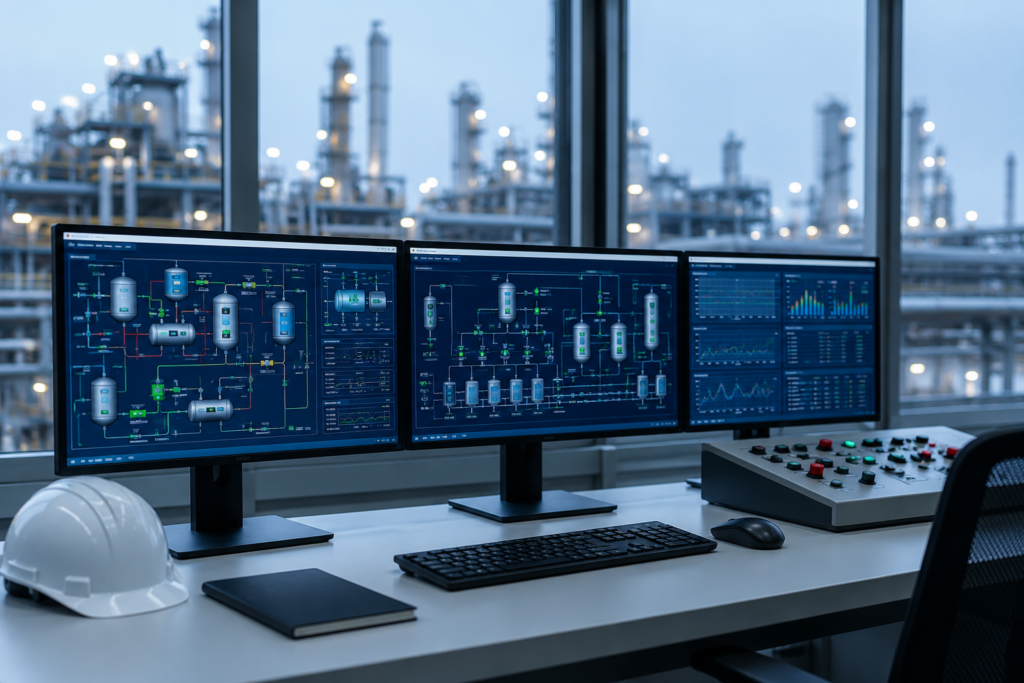
What Is SCADA? SCADA stands for Supervisory Control and Data Acquisition. It is a technology that helps industries monitor, control, and manage industrial processes in real time. Today, many factories, power plants, water treatment facilities, and manufacturing units use SCADA systems to improve efficiency and reduce downtime.
Industrial automation continues to grow around the world. Therefore, understanding SCADA has become important for students, engineers, and business owners. In addition, SCADA allows operators to view important data, identify problems quickly, and make better decisions. This guide explains what SCADA is, how it works, its main components, benefits, and applications in modern industries.
What Is SCADA?
SCADA is a combination of software and hardware that helps organizations monitor and control industrial operations. The system collects data from sensors, machines, and controllers. It then displays that information through a central interface where operators can view and manage the process.
In simple terms, SCADA acts as the eyes and ears of an industrial facility. Instead of manually checking every machine, operators can monitor the entire system from a central location. As a result, companies save time and improve operational efficiency.
SCADA systems are commonly used in industries where continuous monitoring is important. For example, power generation plants, water treatment facilities, and manufacturing factories often rely on SCADA technology.
How Does SCADA Work?
A SCADA system works by collecting information from different devices and presenting that information in a user-friendly format.
The process begins with sensors installed on machines and equipment. These sensors measure values such as temperature, pressure, flow rate, level, and voltage. Next, the collected data moves to controllers such as PLCs or RTUs.
The controllers process the information and send it to the SCADA software. The software then displays the data on computer screens known as Human Machine Interfaces (HMIs). Operators can monitor system performance and respond to alarms when necessary.
Furthermore, operators can send commands back to the equipment through the SCADA system. This feature allows remote control of industrial processes without direct physical interaction.
Main Components of a SCADA System
A SCADA system contains several important components that work together.
1. Sensors and Field Devices
Sensors collect information from industrial equipment. They measure process variables such as temperature, pressure, speed, and flow.
For example, a temperature sensor may monitor the heat level inside a manufacturing machine. The sensor continuously sends information to the control system.
2. PLCs (Programmable Logic Controllers)
PLCs play a major role in industrial automation. They receive data from sensors and execute control actions based on programmed logic.
In many industrial facilities, PLCs serve as the primary control devices. They communicate directly with machinery and equipment.
3. RTUs (Remote Terminal Units)
RTUs perform functions similar to PLCs. However, industries often use RTUs in remote locations where equipment is spread across large areas.
For instance, oil and gas pipelines may use RTUs to monitor operations across long distances.
4. Communication Network
The communication network transfers data between field devices and the SCADA software.
Modern SCADA systems use different communication methods, including Ethernet, fiber optics, wireless networks, and industrial communication protocols.
Reliable communication is essential because it ensures accurate and timely data transmission.
5. Human Machine Interface (HMI)
The HMI provides a graphical view of the industrial process.
Operators use HMIs to monitor equipment, view alarms, analyze trends, and control operations. In addition, HMIs make complex industrial systems easier to understand.
6. SCADA Software
The software serves as the central platform for monitoring and control.
It collects information from controllers, stores historical data, generates reports, and displays real-time system performance.
Benefits of SCADA Systems
SCADA systems provide many advantages for industrial organizations.
Improved Monitoring
SCADA allows operators to monitor multiple processes from one location. Therefore, companies can manage large facilities more efficiently.
Faster Problem Detection
The system generates alarms when unusual conditions occur. As a result, operators can identify and resolve issues before they become serious.
Increased Productivity
Real-time monitoring helps improve operational performance. In addition, automation reduces manual work and increases productivity.
Better Decision-Making
SCADA systems store historical data for analysis. Therefore, managers can make informed decisions based on actual performance trends.
Enhanced Safety
Industrial safety is a top priority. SCADA helps detect abnormal conditions early and reduces the risk of accidents.
Lower Operating Costs
By improving efficiency and reducing downtime, SCADA systems help organizations lower maintenance and operational costs.
Applications of SCADA
SCADA technology supports a wide range of industries.
Manufacturing Industry
Manufacturing facilities use SCADA to monitor production lines, machines, and automated processes.
Furthermore, managers can track production performance and identify areas for improvement.
Power Generation and Distribution
Power plants use SCADA to monitor generators, transformers, and electrical networks.
The system helps maintain stable operations and improve energy management.
Water Treatment Plants
Water treatment facilities use SCADA to monitor pumps, tanks, valves, and filtration systems.
As a result, operators can ensure efficient and reliable water distribution.
Oil and Gas Industry
Oil and gas companies use SCADA to monitor pipelines, storage facilities, and production equipment.
Remote monitoring helps improve operational efficiency and safety.
Building Automation
Large commercial buildings use SCADA systems to manage heating, ventilation, air conditioning, lighting, and energy consumption.
SCADA vs PLC
Many beginners confuse SCADA and PLC systems. However, they perform different functions.
A PLC controls machines and executes programmed logic. On the other hand, SCADA focuses on monitoring, visualization, and data management.
In simple words, PLCs perform the control actions, while SCADA provides the interface that allows operators to view and manage the process.
Both technologies work together to create efficient industrial automation systems.
Future of SCADA
SCADA technology continues to evolve. Today, industries are integrating SCADA with cloud computing, Industrial Internet of Things (IIoT), and advanced analytics.
As technology advances, SCADA systems become more powerful and easier to access. In addition, remote monitoring capabilities continue to improve.
Many organizations now use mobile devices and web-based dashboards to access SCADA information from almost anywhere.
Therefore, SCADA will remain an important part of industrial automation for many years.
Conclusion
What Is SCADA? SCADA is a powerful technology that helps industries monitor, control, and optimize industrial processes. It collects real-time data, improves efficiency, increases safety, and supports better decision-making.
From manufacturing plants to power stations and water treatment facilities, SCADA plays a critical role in modern industrial automation. Moreover, advancements in digital technology continue to expand its capabilities.
For anyone interested in automation, understanding SCADA is an important step toward learning how modern industries operate and manage complex systems.