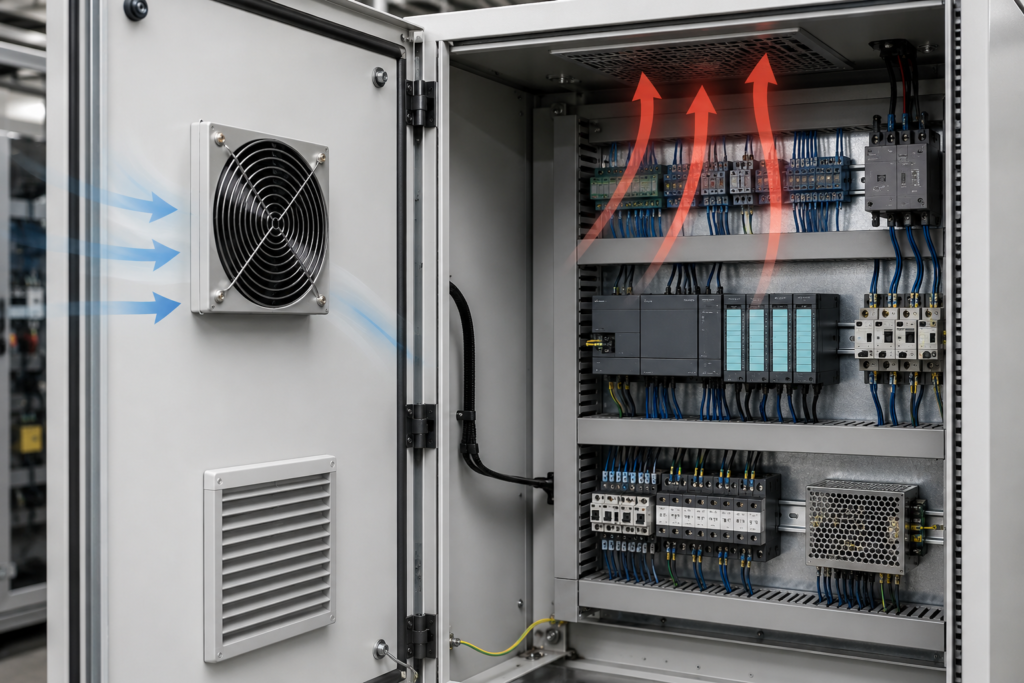
PLC Panel Cooling plays an important role in keeping industrial control panels stable, reliable, and safe. A control panel may contain a PLC, power supply, relays, contactors, circuit breakers, drives, communication modules, and other electrical components. All of these devices produce some amount of heat during operation. When that heat is not removed properly, the temperature inside the enclosure can rise beyond safe operating limits.
At first, excessive heat may appear as a minor issue. However, continuous exposure to high temperature can reduce component life, increase unexpected faults, and affect machine reliability. Therefore, proper ventilation and cooling should be considered during the panel design stage rather than added only after a problem appears.
A well-designed cooling system allows fresh air to enter where needed and helps warm air leave the enclosure. At the same time, the enclosure must still provide suitable protection against dust, moisture, and other environmental conditions. This balance makes panel thermal management an important part of industrial automation design.
Why PLC Panel Cooling Matters
PLC Panel Cooling helps electronic components operate within their recommended temperature range. Excessive heat can place additional stress on power supplies, communication modules, drives, and other sensitive equipment. Over time, continuous thermal stress can reduce component reliability and increase maintenance requirements.
Temperature problems do not always appear immediately. A panel may start normally and then develop faults after several hours of operation. This situation can make troubleshooting more difficult because the equipment may work correctly when the cabinet is cool. Proper thermal management reduces the chance of such temperature-related problems.
How Heat Builds Up Inside a PLC Panel
PLC Panel Cooling begins with understanding how heat develops inside an enclosure. Electrical components release heat as they consume and convert electrical energy. Power supplies, contactors, relays, drives, transformers, and other devices can all contribute to the total thermal load.
The enclosure can also absorb heat from its surroundings. A cabinet installed near a furnace, motor, compressor, or other hot equipment may receive additional thermal energy. Outdoor panels can face another challenge because direct sunlight can raise the enclosure temperature significantly.
As heat continues to accumulate, the air inside the cabinet becomes warmer. Without enough heat removal, this warm air can remain around critical components and create localized hot spots.
Common Heat Sources in PLC Panel Cooling
PLC Panel Cooling requires attention to every major heat-producing device, not just the PLC itself. A power supply may generate continuous heat during voltage conversion. Contactors and relays can also contribute thermal energy when their coils remain energized for long periods.
Variable frequency drives often create a much larger thermal load because their power electronics handle substantial electrical energy. Servo drives, braking resistors, transformers, and other power components can add even more heat to a crowded enclosure.
For that reason, the total heat generated by the complete panel should guide the cooling design. Looking at only one device can produce an inaccurate estimate of the actual thermal requirement.
How High Temperature Affects PLC Components
PLC Panel Cooling becomes especially important when sensitive electronic equipment operates in a warm environment. High temperature can increase component stress and may shorten the useful service life of some electronic parts.
Power supplies can become less stable at excessive temperatures. Communication equipment may also experience unreliable operation under severe thermal conditions. Drives and other power electronics can trigger protective functions when their internal temperature becomes too high.
Repeated temperature changes can create another issue. Expansion and contraction of materials can place mechanical stress on electronic connections over time. Therefore, controlling temperature helps support both reliability and long-term equipment performance.
PLC Panel Cooling and Component Layout
PLC Panel Cooling should be considered during panel layout rather than after installation. Components need enough space around them to allow heat to move away. A tightly packed enclosure can restrict natural airflow and create areas where warm air becomes trapped.
Heat-producing devices should also have suitable separation from sensitive electronic equipment. For example, placing a high-power drive directly below a communication module may expose the upper device to rising warm air.
Cable ducts and wiring arrangements matter as well. Poorly positioned ducts can block air movement and reduce the effectiveness of ventilation. A clean and organized layout makes it easier for heat to travel toward the intended exhaust path.
Airflow Basics for PLC Panel Cooling
PLC Panel Cooling works more effectively when air follows a planned path through the enclosure. In many designs, cooler air enters through a lower opening while warmer air leaves through a higher opening.
This arrangement supports natural convection because warm air tends to rise. However, the airflow path should remain clear. Components, cables, filters, and other objects should not unnecessarily block the movement of air.
Fan position also matters. A poorly positioned intake fan may push air toward the exhaust without properly cooling the main heat sources. Therefore, the airflow route should be considered before installing ventilation hardware.
Natural Ventilation for PLC Panel Cooling
PLC Panel Cooling can sometimes rely on natural ventilation when the internal heat load remains low. This method uses temperature differences and natural air movement to transfer heat away from the enclosure.
Natural ventilation can suit simple panels installed in relatively cool environments. It does not require moving parts, so maintenance requirements can remain low. However, its performance depends heavily on ambient temperature and enclosure design.
When the surrounding environment becomes hot, natural ventilation may no longer provide enough cooling. A larger heat load can also exceed the ability of passive airflow to remove excess heat. In such cases, forced ventilation may offer a more practical solution.
Forced Air PLC Panel Cooling
PLC Panel Cooling through forced air uses fans to move air through the enclosure. An intake fan can bring cooler outside air into the cabinet, while an exhaust fan can remove warmer internal air.
This method works well for many moderate-heat applications. However, the fan should match the enclosure requirements and operating environment. A fan that moves air without a suitable airflow path may provide limited results.
Dust also needs attention. Industrial air can contain particles that collect on filters and reduce airflow. Regular inspection keeps the ventilation system working effectively and helps maintain consistent cooling performance.
The Role of Filters in PLC Panel Cooling
PLC Panel Cooling systems that use outside air should normally account for dust and contaminants. A filter can reduce the amount of airborne material entering the enclosure and help protect internal components.
Over time, however, the filter can become clogged. As resistance increases, the fan may move less air through the cabinet. The cooling system can then lose efficiency even though the fan continues to run.
For this reason, filters should form part of the maintenance plan. Their condition should be checked according to the environmental conditions and operating schedule of the installation.
Temperature Monitoring for PLC Panel Cooling
PLC Panel Cooling becomes easier to evaluate when the actual enclosure temperature is monitored. A temperature sensor can provide useful information about conditions near the PLC, drive section, power supply, or another important area.
Monitoring becomes especially valuable when the production load changes during the day. A panel may remain cool during light operation but become significantly warmer under full load.
Recorded temperature data can help technicians identify unusual trends. Therefore, monitoring can support both preventive maintenance and cooling system improvement.
Key Design Considerations for PLC Panel Cooling
PLC Panel Cooling should match the real operating conditions of the control cabinet. Before selecting a cooling method, engineers should consider the total heat generated by installed equipment, the ambient temperature, enclosure dimensions, airflow path, and environmental conditions.
The panel layout should support good air circulation. Ventilation openings should remain unobstructed, and heat-producing components should receive enough space for heat dissipation. In addition, filters and fans should remain accessible for maintenance.
A well-planned approach can reduce unnecessary temperature rise and improve overall equipment reliability. Most importantly, the cooling method should reflect the actual application instead of relying on a one-size-fits-all solution.
Understanding the Cooling Requirement
PLC Panel Cooling should begin with a clear understanding of the enclosure and its operating conditions. Every control panel has a different thermal requirement. A small automation cabinet with a PLC and a few relays may produce limited heat. In contrast, a larger cabinet with variable frequency drives, power supplies, transformers, and braking components can create a much higher heat load.
Therefore, designers should assess the complete panel before choosing a cooling method. The enclosure size, component count, ambient temperature, installation location, and operating hours all influence the final design.
A practical cooling solution should also account for the worst operating condition. For example, a panel may remain comfortable during a light production cycle but become much hotter when several motors operate at full load.
PLC Panel Cooling and Heat Load Calculation
PLC Panel Cooling becomes easier to plan when the approximate internal heat load is known. Electrical equipment normally provides heat-loss information in its technical documentation. Engineers can use these values to estimate the total heat generated inside the enclosure.
The basic idea is simple. Add the heat losses of the major components, then consider the heat entering from the surrounding environment. The resulting value provides a starting point for selecting ventilation or another cooling method.
For example, imagine a cabinet containing several devices that together release 500 watts of heat. That heat must eventually leave the enclosure. A suitable cooling method should therefore provide enough thermal capacity to handle the expected load.
This estimate does not need to be unnecessarily complicated for every project. However, a realistic heat assessment can prevent both under-sized and over-sized cooling systems.
Choosing the Right Fan for PLC Panel Cooling
PLC Panel Cooling often relies on fans when the enclosure has a moderate heat load. However, fan selection should not depend only on the fan's maximum airflow rating.
The actual airflow through an enclosure depends on resistance. Filters, louvers, grills, and internal components can restrict air movement. As resistance increases, the effective airflow can become lower than the value shown on the fan label.
Therefore, the fan should have suitable airflow capacity under the expected system resistance. The enclosure's dimensions and heat load should also guide the selection.
A reliable design should leave some operating margin. This approach allows the cooling system to handle variations in load and environmental temperature more effectively.
Intake and Exhaust Fan Arrangement
PLC Panel Cooling works best when intake and exhaust locations create a useful airflow path. A common arrangement places the air intake near the lower section of the enclosure and the exhaust near the upper section.
Cooler air enters from the lower side and moves through the cabinet. As the internal air becomes warmer, it rises toward the upper region. The exhaust then removes the warm air.
This layout supports both forced airflow and natural convection. Moreover, it can reduce the chance of warm air circulating repeatedly inside the cabinet.
The exact arrangement should still match the equipment layout. A fan should move air across the main heat sources rather than simply creating a short path between two openings.
Filter Selection for PLC Panel Cooling
PLC Panel Cooling in dusty environments requires proper filtration. Industrial areas can contain dust, fibers, oil particles, and other airborne contaminants. Without filtration, the ventilation system may pull these materials directly into the enclosure.
A filter reduces the amount of contamination entering the cabinet. However, every filter creates some airflow resistance. A heavily clogged filter can restrict airflow and reduce cooling performance.
For this reason, designers should select a filter that matches the required airflow and environmental conditions. Maintenance personnel should also have easy access to the filter.
Regular cleaning or replacement can help maintain consistent airflow. As a result, a simple maintenance task can make a noticeable difference to cooling performance.
PLC Panel Cooling in Dusty Industrial Environments
PLC Panel Cooling becomes more challenging when a cabinet operates in a harsh industrial area. Dust can accumulate around ventilation openings, while oil mist and moisture may create additional problems.
A conventional filtered fan may not always provide sufficient protection in such conditions. In some applications, a closed-loop cooling method can offer better protection because outside air does not need to pass directly through the enclosure.
The correct choice depends on the environment. A clean indoor automation room may need simple ventilation. A dusty production area may require a more controlled cooling system.
Therefore, the environment should always form part of the cooling decision.
When to Use a Panel Air Conditioner
PLC Panel Cooling may require an enclosure air conditioner when the heat load is high or the surrounding environment is already hot. Unlike simple ventilation, an air conditioner can remove heat without relying on cooler outside air.
This feature becomes valuable when ambient air cannot provide enough cooling. It can also help maintain a more controlled internal temperature.
However, an enclosure air conditioner requires more planning. Electrical consumption, mounting space, drainage considerations, filter maintenance, and cabinet construction all need attention.
An air conditioner may also make sense when the enclosure must remain sealed against dust or moisture. In such cases, closed-loop cooling can protect the electronics while removing internal heat.
Heat Exchangers for Industrial Control Panels
A heat exchanger works well when the cabinet needs to stay sealed. It transfers heat from the internal air to the outside environment without mixing both air streams.
This method helps protect sensitive electronics from dust, moisture, and other contaminants. However, performance depends on the temperature difference between the cabinet and its surroundings.
When outdoor temperatures become too high, a heat exchanger may not provide enough cooling. Therefore, the expected operating conditions should be checked before selecting this option.
Outdoor Control Panel Cooling
Outdoor cabinets face extra thermal challenges. Direct sunlight can increase enclosure temperature even when the surrounding air seems moderate.
Panel location, sunlight exposure, insulation, and enclosure construction all affect heat levels. A cabinet placed in direct sunlight may need more cooling than a similar indoor installation.
The enclosure should also provide suitable protection against rain, moisture, and airborne contaminants. Proper sealing improves protection, but it can also require a dedicated cooling method.
Preventing Hot Spots
Average cabinet temperature does not always tell the full story. High-power devices can create localized hot spots around drives, power supplies, transformers, and braking components.
Good component spacing helps distribute heat more effectively. Sensitive electronics should also remain away from major heat sources whenever practical.
For larger systems, airflow testing can provide additional insight. Smaller cabinets can often benefit from careful layout and temperature measurements.
Cable Management and Airflow
Cable routing can influence internal airflow. Large cable bundles and crowded wiring ducts may block air from reaching important components.
Keeping ventilation paths clear allows air to move more freely through the enclosure. At the same time, organized wiring makes inspection and maintenance easier.
A clean layout therefore supports both thermal performance and serviceability.
Common Cooling Mistakes
One common mistake involves selecting a fan only by its maximum airflow rating. Actual airflow can decrease because of filters, vents, and internal resistance.
Another problem occurs when intake and exhaust openings sit too close together. Air may leave the cabinet without properly passing over the main heat sources.
Dirty filters can create a similar issue. Even when a fan continues running, restricted airflow can reduce cooling performance.
Finally, operating temperature should not be assumed. Measurements under normal and high-load conditions provide a much better picture of actual performance.
Testing the Cooling System
After installation, the cabinet should be checked under realistic operating conditions. Temperature readings during startup, normal production, and heavy loads can reveal thermal changes.
Technicians should also inspect fans, filters, vents, airflow direction, and possible hot spots. These checks can identify problems before they cause repeated equipment faults.
Testing provides practical evidence that the selected cooling method can handle the actual operating conditions.
Maintenance for Reliable Cooling
Regular maintenance keeps fans, filters, vents, and cooling equipment working properly. Dust can restrict airflow, while worn fans may gradually lose performance.
Maintenance frequency should match the installation environment. Dusty industrial areas usually require more frequent inspection than clean control rooms.
Technicians should watch for unusual fan noise, reduced airflow, blocked vents, and unexpected temperature increases. Early attention can prevent larger thermal problems.
Frequently Asked Questions
What is PLC Panel Cooling?
PLC Panel Cooling is the process of controlling and removing excess heat from an industrial control enclosure. It helps maintain a suitable internal temperature for PLCs, power supplies, drives, relays, and other electrical components.
Why is PLC Panel Cooling important?
PLC Panel Cooling helps reduce thermal stress on electronic components. When a control cabinet becomes too hot, equipment can become less reliable and may require more frequent maintenance. Proper cooling supports stable operation and longer component life.
How do I choose a PLC Panel Cooling method?
The right PLC Panel Cooling method depends on heat load, ambient temperature, enclosure size, installation environment, and contamination levels. Simple panels may use filtered fans, while high-heat or sealed cabinets may need air conditioners or heat exchangers.
Can a PLC panel use natural ventilation?
Yes. Natural airflow can work for panels with a low heat load and a suitable surrounding temperature. However, PLC Panel Cooling through natural ventilation may not provide enough heat removal when the enclosure contains several high-power devices or operates in a hot environment.
How can I maintain PLC Panel Cooling performance?
Regular maintenance helps keep PLC Panel Cooling effective. Check filters, fans, vents, and airflow paths for dust or blockage. Temperature readings during normal and high-load operation can also help identify developing cooling problems.
Conclusion
PLC Panel Cooling is an important part of reliable industrial control panel design. Excessive heat can affect electronic components, reduce system stability, and increase maintenance needs. Therefore, cooling should be considered during the early stages of panel design.
The right solution depends on the panel’s heat load, enclosure size, ambient temperature, airflow, and operating environment. Simple applications may work with natural or filtered ventilation, while high-heat systems may need air conditioners or heat exchangers.
Most importantly, proper component spacing, clear airflow paths, regular filter maintenance, and temperature monitoring can make a significant difference. By managing heat effectively, engineers can create control panels that operate more reliably and maintain stable performance over time.