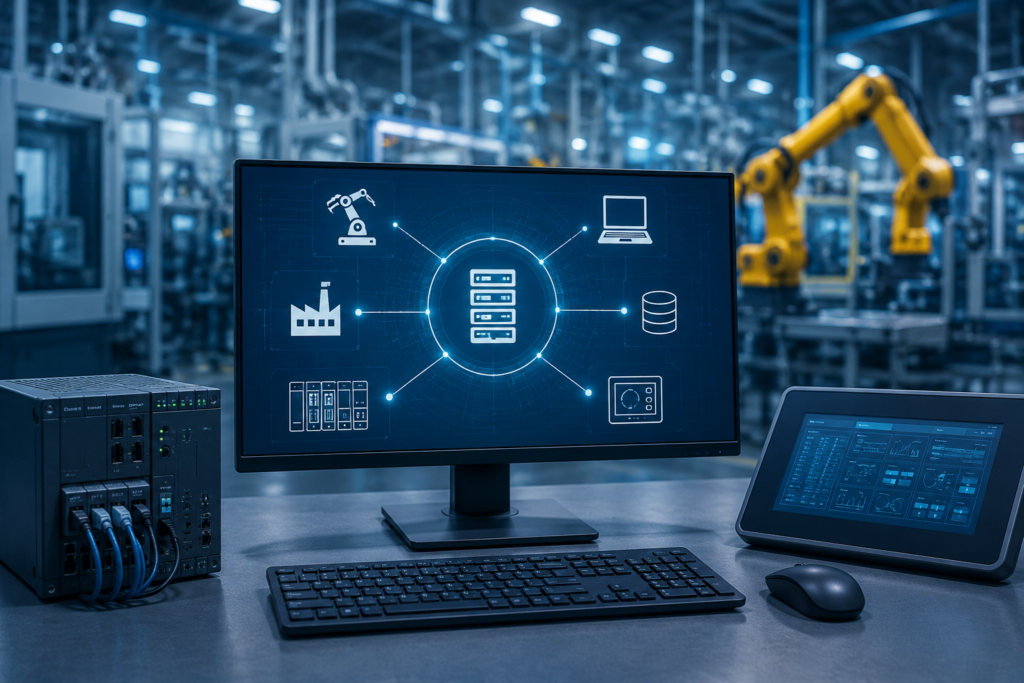
Industrial automation is becoming more connected, intelligent, and data-driven every year. Modern factories need reliable communication between PLCs, SCADA systems, HMIs, industrial computers, sensors, machines, and higher-level software. This is where OPC UA in Industrial Automation becomes highly important. OPC UA provides a standardized way for industrial devices and software applications to exchange information securely and efficiently.
Traditional automation systems often depended on proprietary communication methods. These methods could work well inside a particular environment, but connecting equipment from different manufacturers could become complicated. OPC UA helps solve this problem by providing a flexible communication architecture designed specifically for industrial environments.
For manufacturers, system integrators, automation engineers, and plant operators, understanding OPC UA can make it easier to build connected automation systems. It can also support modern Industry 4.0 applications where machines need to share reliable data with SCADA platforms, databases, cloud services, analytics systems, and enterprise applications.
What Is OPC UA?
OPC UA stands for Open Platform Communications Unified Architecture. It is a communication standard designed to allow industrial systems and software applications to exchange structured information.
Unlike a simple data-transfer protocol that only moves values from one device to another, OPC UA can represent information in a structured and meaningful way. This makes it useful for industrial environments where understanding the context of data is often just as important as receiving the data itself.
For example, a PLC may provide a temperature value from a production machine. A basic communication system may simply provide the numerical value. OPC UA can provide additional information about that value, including its data type, engineering unit, status, timestamp, and relationship to other industrial objects.
This approach makes industrial data easier for higher-level applications to understand and use.
Why OPC UA Is Important in Industrial Automation
Modern automation systems are no longer isolated control environments. A production line may contain PLCs from different generations, HMIs from another manufacturer, SCADA software, industrial PCs, robots, databases, and cloud-connected applications.
Communication between these systems can become difficult when every device uses a different communication method.
OPC UA in Industrial Automation provides a common communication framework that can help different systems exchange information without requiring every application to understand the internal communication method of every device.
This is particularly valuable in large industrial facilities. A plant may have multiple production areas operating different automation platforms. Instead of creating a completely different integration method for every system, OPC UA can provide a standardized communication layer.
This makes automation architectures easier to expand and integrate.
How Does OPC UA Work?
OPC UA uses a client-server architecture as well as a publish-subscribe communication model.
In a traditional OPC UA client-server setup, an OPC UA server exposes industrial data and services. An OPC UA client connects to the server and requests the information it needs.
For example, a PLC or automation system may provide machine information through an OPC UA server. A SCADA application can operate as an OPC UA client and access the required tags.
The client can read values, monitor changes, and interact with available services depending on the permissions and capabilities of the system.
The communication process begins when an OPC UA client establishes a connection with an OPC UA server. The systems negotiate communication parameters and establish a secure session. After authentication and security checks are completed, the client can access permitted information.
This architecture separates data providers from applications that consume the data.
OPC UA Client and OPC UA Server
Understanding the difference between an OPC UA client and server is important when designing an industrial communication system.
An OPC UA server is responsible for exposing information and services. It may represent PLC variables, machine parameters, production information, alarms, diagnostic information, or other industrial data.
An OPC UA client connects to the server and consumes the information that it requires.
A SCADA system can therefore operate as an OPC UA client while a PLC or industrial gateway provides an OPC UA server. In another architecture, an industrial software platform may act as an OPC UA server while another application works as the client.
The roles depend on the architecture and capabilities of the equipment being used.
OPC UA in PLC Systems
PLCs are at the center of many industrial automation systems. They control motors, valves, pumps, conveyors, sensors, actuators, and production equipment.
When a PLC supports OPC UA, its process information can become easier to integrate with higher-level systems.
For example, a PLC controlling a conveyor system may contain variables representing motor speed, motor status, emergency-stop status, product count, temperature, and fault conditions. An OPC UA interface can make these values available to compatible industrial applications.
This allows SCADA software, industrial PCs, analytics platforms, and other systems to access relevant information without relying on a completely proprietary integration method.
For Siemens-based automation systems, OPC UA can also become part of a larger communication architecture where PLC data is shared with visualization and monitoring systems.
OPC UA and Siemens PLCs
Siemens PLCs are widely used in industrial automation, particularly in manufacturing, process control, water treatment, energy, and machine automation.
Depending on the specific PLC model, firmware version, configuration, and enabled features, OPC UA functionality can be used to expose automation data to compatible applications.
For engineers working with Siemens PLCs, OPC UA can provide an additional communication option when integrating PLC data with SCADA systems, industrial software, databases, and other platforms.
The exact implementation depends on the PLC family and project requirements. Engineers should always verify the supported OPC UA features and configuration options for the specific controller being used.
A well-designed system can use PLC logic for real-time machine control while OPC UA provides a standardized interface for exchanging selected information with higher-level applications.
OPC UA and SCADA Systems
SCADA systems require reliable access to industrial data. They collect information from field devices and controllers and present that information to operators through graphical interfaces.
OPC UA can provide a communication bridge between automation systems and SCADA platforms.
For example, a manufacturing plant may use PLCs to control production equipment while a SCADA application monitors machine states, process values, alarms, and production information.
The SCADA application can obtain these values through OPC UA when the required devices and software support the standard.
This architecture can make the automation system more organized because the SCADA layer does not necessarily need to communicate with every device using a separate proprietary driver.
OPC UA can therefore contribute to a more standardized communication architecture.
OPC UA and HMI Communication
HMIs are commonly used by operators to monitor and control machines. They display process values, machine states, alarms, and operator controls.
Although many HMI systems communicate directly with PLCs using dedicated protocols, OPC UA can also be used in architectures where an HMI or visualization platform needs access to standardized industrial information.
The usefulness of OPC UA depends on the capabilities of the HMI platform and the overall system architecture.
In larger systems, OPC UA can help provide a common communication layer between visualization applications and multiple industrial data sources.
OPC UA Security in Industrial Automation
Industrial cybersecurity has become increasingly important as automation systems become more connected to enterprise networks and external services. Therefore, secure communication is an essential part of modern industrial automation.
Fortunately, OPC UA includes security mechanisms designed to support authentication, encryption, message integrity, and secure communication. For example, digital certificates can help establish trust between communicating applications, while encryption can help protect information from unauthorized interception.
Moreover, message signing can help detect unauthorized changes to information during communication. In addition, authentication and authorization can help determine which users or applications are permitted to access specific resources.
However, using OPC UA does not automatically make an industrial network secure. Instead, security depends on correct configuration, network architecture, access control, certificate management, software updates, and appropriate operational procedures.
For this reason, security should be considered during the design stage of OPC UA in Industrial Automation rather than being added after the system is already deployed. As a result, engineers can create a communication architecture that is easier to protect and maintain.
OPC UA Certificates and Secure Communication
Certificates play an important role in OPC UA security. In particular, they help applications establish trust before secure communication begins.
An OPC UA application can use a digital certificate to identify itself to another application. During the connection process, the systems can verify whether the certificate is trusted and whether the configured security requirements are satisfied.
Furthermore, certificate management becomes increasingly important as an industrial network grows. A small automation system may contain only a few devices; however, a large manufacturing facility can contain many PLCs, servers, clients, gateways, and software applications.
Consequently, managing certificates manually can become difficult.
Expired, invalid, or untrusted certificates can prevent communication even when the physical network connection is working correctly. Therefore, organizations should establish a clear process for certificate creation, approval, renewal, replacement, and monitoring.
For the same reason, certificate planning should be included during the initial design of an OPC UA system. By planning ahead, engineers can reduce unexpected communication failures later.
OPC UA Information Modeling
One of the most useful characteristics of OPC UA is its ability to represent industrial information through structured information models.
Traditional automation systems often represent process information as individual tags. However, modern applications frequently need additional context to understand what those values actually represent.
For example, a production machine may contain a motor, temperature sensor, speed controller, production counter, and alarm system. Instead of treating every value as completely separate information, OPC UA can represent these components as structured objects and relationships.
As a result, software applications can understand industrial information more effectively.
Furthermore, information modeling is particularly useful in Industry 4.0 environments. Different applications may need to use the same industrial information even when those applications were developed by different vendors.
Therefore, structured information can simplify integration and reduce dependence on the internal structure of a particular PLC program.
OPC UA in Industrial Automation and Industry 4.0
Industry 4.0 focuses on connected manufacturing, intelligent machines, digital integration, automation data, and data-driven decision-making. Because of this, reliable communication between industrial systems has become increasingly important.
OPC UA fits naturally into Industry 4.0 environments because it provides a standardized approach for exchanging structured industrial information.
For example, a modern factory may collect production information from PLCs, process that information through industrial software, store selected values in databases, and analyze production trends.
At the same time, maintenance applications may require access to machine conditions, alarms, operating hours, and diagnostic information.
OPC UA can help connect these different layers. Consequently, industrial information can move more efficiently between operational technology and higher-level applications.
Moreover, OPC UA in Industrial Automation can support connected architectures in which machines, SCADA systems, analytics platforms, and enterprise applications exchange useful information through compatible interfaces.
OPC UA and Industrial IoT
Industrial IoT, commonly known as IIoT, focuses on connecting industrial equipment and using operational data for monitoring, analysis, and optimization.
Sensors and controllers can generate large amounts of information. However, raw data has limited value when applications cannot interpret or use it effectively.
OPC UA can provide a structured communication layer for compatible industrial systems.
For example, a factory may collect motor states, production counts, temperature values, energy measurements, and machine alarms. An IIoT platform can then use selected information for monitoring, analytics, predictive maintenance, or production optimization.
Furthermore, structured industrial data can make it easier for different applications to work with the same information.
As a result, OPC UA can serve as a useful communication layer between industrial equipment and modern digital applications.
OPC UA vs OPC Classic
OPC Classic was widely used in earlier industrial automation environments. It provided an important method for connecting industrial applications. However, it was closely associated with Microsoft Windows technologies.
OPC UA was developed as a more modern architecture with broader platform support.
This difference is particularly important today because industrial environments can contain Windows computers, Linux-based systems, embedded devices, industrial gateways, and cloud-connected applications.
Moreover, OPC UA provides security mechanisms and structured information modeling.
Therefore, organizations upgrading older automation systems may consider OPC UA when designing new communication architectures.
The decision should nevertheless be based on the actual requirements of the project, including device compatibility, performance, security, maintenance, and integration requirements.
OPC UA vs MQTT in Industrial Automation
OPC UA and MQTT are both important technologies in modern industrial communication. However, they were designed with different goals.
MQTT is a lightweight publish-subscribe messaging protocol that is widely used in IoT environments. Devices can publish information to a broker, while other applications subscribe to the information they require.
In comparison, OPC UA provides a broader industrial communication architecture that includes information modeling, services, security mechanisms, and different communication patterns.
Nevertheless, these technologies do not necessarily need to compete with each other.
For example, an industrial architecture can use OPC UA near automation equipment while MQTT handles selected data distribution toward another application or cloud-oriented platform.
Therefore, the best choice depends on the application, network architecture, devices, security requirements, and type of information being exchanged.
OPC UA in Industrial Automation for Manufacturing
Manufacturing is one of the major application areas for OPC UA because production machines continuously generate operational information.
For example, PLCs control machines, sensors provide measurements, HMIs display process information, and SCADA systems monitor overall production.
Because these systems perform different functions, reliable communication between them is essential.
OPC UA can provide a standardized interface for exchanging selected information between compatible systems. As a result, higher-level applications can access useful production information without requiring a completely different integration approach for every connection.
For instance, a production-management application may need machine utilization, production counts, downtime information, and alarm conditions.
By making the required information available through OPC UA, the application can obtain the data needed for monitoring and reporting.
Furthermore, this approach can improve production visibility and support better data-driven decisions.
OPC UA in Water Treatment Systems
Water treatment plants rely heavily on PLCs, SCADA systems, sensors, pumps, valves, and process instrumentation.
These components continuously generate information about flow rates, tank levels, pump conditions, valve positions, and alarm states.
Therefore, reliable communication is essential for centralized monitoring and supervision.
OPC UA can help compatible automation equipment exchange process information with supervisory applications.
For example, a SCADA platform can receive tank-level information, pump status, valve positions, and alarm conditions through an OPC UA interface.
Consequently, operators can monitor important process conditions from a centralized system.
Moreover, standardized communication can simplify integration when a facility contains different automation components and software platforms.
OPC UA in Energy Systems
Energy facilities also generate large quantities of operational data. Power-generation systems, energy-management platforms, controllers, monitoring applications, and databases may all need to exchange information.
In such environments, standardized communication can simplify system integration.
OPC UA can help compatible systems exchange equipment status, measurements, alarms, and operating conditions.
For example, a supervisory application may collect information from several systems and present it through a centralized monitoring interface.
Furthermore, structured industrial information can make it easier for different software applications to interpret the same data consistently.
As a result, OPC UA can be valuable in energy environments where automation and information systems need to work together.
OPC UA for Predictive Maintenance
Predictive maintenance depends on collecting and analyzing machine information over time.
A machine may generate data related to temperature, vibration, operating hours, motor current, speed, and fault conditions.
OPC UA can provide access to selected information for compatible analytics applications.
For example, an analytics platform may monitor the temperature of a motor over several months. If the temperature gradually moves outside its normal operating pattern, the analytics system may identify a condition that deserves investigation.
However, OPC UA itself does not perform predictive maintenance.
Instead, it provides a communication path through which maintenance and analytics applications can access useful industrial information.
Therefore, the actual predictive-maintenance process depends on combining reliable machine data with appropriate analytics, maintenance procedures, and engineering knowledge.
Benefits of OPC UA in Industrial Automation
One of the biggest advantages of OPC UA in Industrial Automation is interoperability. Different industrial devices and software applications can communicate through a standardized framework when they support compatible OPC UA functionality.
In addition, OPC UA provides security mechanisms that support authentication, encryption, message integrity, and certificate-based trust.
Scalability is another important characteristic. The technology can be applied in smaller automation systems as well as larger industrial architectures.
Furthermore, structured information modeling can make industrial data easier for software applications to understand and process.
Another advantage is platform flexibility. Modern industrial environments can contain different operating systems, hardware platforms, and software technologies.
Consequently, OPC UA can provide a practical communication foundation for connected automation, IIoT, and Industry 4.0 projects.
Limitations of OPC UA
Although OPC UA provides many useful capabilities, it is not the perfect solution for every industrial communication requirement.
First, implementation can require technical knowledge. Security certificates, authentication, information models, endpoints, and network architecture must be configured correctly.
Furthermore, poor configuration can cause communication failures or unnecessary security risks.
Performance requirements should also be evaluated carefully. Real-time PLC control should generally remain within the appropriate deterministic control architecture instead of depending on higher-level communication for time-critical control decisions.
In addition, compatibility can vary because different vendors may support different OPC UA features.
For these reasons, engineers should evaluate the requirements of the specific project before selecting and implementing an OPC UA architecture.
How to Implement OPC UA in an Industrial System
Implementing OPC UA should begin with a clear understanding of the existing automation architecture.
First, engineers should identify the PLCs, HMIs, SCADA servers, industrial PCs, databases, gateways, and other systems that need to exchange information.
Next, they should determine which devices support OPC UA and define the communication role of each system.
For example, a PLC may provide an OPC UA server while SCADA software operates as an OPC UA client. Meanwhile, an industrial gateway can be used when legacy equipment does not directly support OPC UA.
After that, security requirements should be defined before communication is enabled.
These requirements can include certificate trust, authentication, authorization, encryption, and network segmentation.
Once the configuration is completed, communication should be tested using a controlled set of tags and services.
Finally, the system should be monitored and maintained throughout its operational lifecycle.
As a result, potential configuration problems can be identified before they affect critical production operations.
Common OPC UA Communication Problems in OPC UA in Industrial Automation
When working with OPC UA in Industrial Automation, communication problems can occur for several different reasons. Therefore, understanding the most common problems can make troubleshooting faster and more effective.
First, a network connection problem may prevent an OPC UA client from reaching the OPC UA server. As a result, the OPC UA in Industrial Automation system may appear unavailable even though the server itself is running correctly.
Therefore, basic network connectivity should always be checked before investigating more advanced configuration problems.
Next, an incorrect OPC UA endpoint can prevent a client from establishing a session. For example, the client may be configured with an incorrect address, port, or endpoint security configuration.
Security settings can also cause communication failures. In OPC UA in Industrial Automation, certificates and security policies must be configured correctly on both sides of the connection.
For example, if an OPC UA client does not trust the server certificate, the connection may be rejected. Similarly, incompatible security policies can prevent successful communication.
Authentication can create another problem. If incorrect credentials are entered, or if the configured user does not have sufficient permissions, the application may connect but fail to access the required information.
Furthermore, data-access problems can occur when a client attempts to access OPC UA nodes that are unavailable, incorrectly configured, or restricted by permissions.
For this reason, troubleshooting OPC UA in Industrial Automation should follow a logical sequence. First, check network connectivity. Next, verify the endpoint configuration. After that, examine certificates, security policies, authentication, permissions, and data availability.
By following this approach, engineers can identify communication problems more efficiently and reduce unnecessary downtime.
OPC UA Best Practices for OPC UA in Industrial Automation Projects
A successful OPC UA in Industrial Automation implementation begins with a clearly defined communication architecture.
First, engineers should determine which PLCs, SCADA systems, HMIs, servers, gateways, and applications need to exchange information. This helps prevent unnecessary communication paths and makes the overall architecture easier to manage.
Next, only the industrial data that is actually required should be exposed to higher-level applications. As a result, the OPC UA communication environment can remain more organized and easier to maintain.
Furthermore, certificate management should be included throughout the complete lifecycle of the OPC UA in Industrial Automation system.
For example, engineers should know which certificates are trusted, when they expire, and how they will be renewed or replaced.
Network segmentation should also be considered. If an industrial control network communicates with an enterprise network, appropriate security boundaries can help reduce unnecessary exposure.
Before deployment, the complete OPC UA configuration should be tested in a controlled environment. In addition, engineers should verify that clients, servers, certificates, permissions, endpoints, and required data nodes operate correctly.
Documentation is equally important for long-term OPC UA in Industrial Automation projects. Therefore, endpoints, devices, certificates, users, security settings, information models, and system dependencies should be documented.
As a result, a well-documented OPC UA system becomes easier to troubleshoot, maintain, secure, and expand.
Future of OPC UA in Industrial Automation
The future of OPC UA in Industrial Automation looks increasingly important as factories become more connected and data-driven.
Modern manufacturing facilities are adopting smart machines, IIoT platforms, digital twins, cloud services, artificial intelligence, and advanced analytics. Consequently, these technologies require reliable access to industrial information.
OPC UA can provide a communication and information layer between automation equipment and higher-level applications.
For example, a modern factory may collect information from PLCs, send selected data to SCADA systems, store production information in databases, and analyze machine performance through advanced software.
At the same time, maintenance applications may need access to operating conditions, alarms, diagnostics, and historical information.
Because of this, OPC UA in Industrial Automation can help connect different layers of a modern industrial architecture.
Moreover, structured information modeling can make industrial data easier for different applications to understand. This is particularly useful when equipment and software come from different manufacturers.
As manufacturing systems become more decentralized, interoperability will become increasingly important. Therefore, technologies that allow industrial systems to communicate through standardized architectures can play an important role in future automation projects.
For this reason, OPC UA in Industrial Automation is likely to remain relevant as organizations develop connected factories and Industry 4.0 solutions.
Frequently Asked Questions About OPC UA in Industrial Automation
What does OPC UA mean in Industrial Automation?
OPC UA stands for Open Platform Communications Unified Architecture. In OPC UA in Industrial Automation, the technology provides a standardized architecture for exchanging industrial information between compatible devices and software applications.
Why is OPC UA important in Industrial Automation?
OPC UA is important because it can help different industrial systems exchange information through a standardized communication architecture. As a result, PLCs, SCADA systems, HMIs, industrial computers, and other compatible applications can be integrated more effectively.
Can OPC UA connect PLC and SCADA systems?
Yes. When both systems support compatible OPC UA functionality, an OPC UA server can expose industrial information while a SCADA application operates as an OPC UA client.
Therefore, OPC UA in Industrial Automation can provide a practical communication layer between PLC-based control systems and supervisory applications.
Is OPC UA secure for Industrial Automation?
OPC UA includes security mechanisms such as encryption, authentication, message signing, and certificate-based trust.
However, the security of an OPC UA in Industrial Automation implementation also depends on correct configuration, network architecture, access control, certificate management, and system maintenance.
Can OPC UA be used for remote monitoring?
Yes, OPC UA can be used for remote monitoring when the required devices and software support it and the network is designed securely. For example, a SCADA or monitoring application can access selected industrial information from an OPC UA server.
However, remote access should always use appropriate security controls. Therefore, organizations should carefully configure authentication, encryption, access permissions, and network protection before enabling remote monitoring.
Does OPC UA replace traditional PLC communication?
No. OPC UA in Industrial Automation does not necessarily replace every traditional PLC communication method. Instead, it can complement existing automation networks by providing a standardized way to exchange information with SCADA systems, industrial software, analytics platforms, and other applications.
Therefore, the best communication architecture depends on the control requirements, devices, performance needs, and overall design of the industrial system.
Conclusion
OPC UA in Industrial Automation has become an important communication approach for modern industrial environments. As factories become more connected, PLCs, SCADA systems, HMIs, industrial computers, IIoT platforms, and business applications increasingly need to exchange reliable information.
The main strength of OPC UA in Industrial Automation is its ability to support interoperability between compatible industrial devices and software applications. Moreover, its security features, structured information modeling, and flexible architecture make it suitable for many Industry 4.0 applications.
However, successful implementation requires more than simply enabling OPC UA. Engineers should carefully plan network architecture, certificates, authentication, permissions, endpoints, and data access. Furthermore, regular monitoring and proper documentation can make the system easier to maintain over time.
As a result, OPC UA in Industrial Automation can help organizations build connected systems that are easier to integrate, monitor, and expand. When implemented correctly, it can provide a strong communication foundation for modern manufacturing and industrial automation projects.