
Table of Contents
ToggleIntroduction
Industrial automation has firmly established itself as an absolute cornerstone of contemporary manufacturing and high-throughput process industries across the global market. Within today's hyper-competitive operational landscape, enterprise facilities desperately require robust control frameworks capable of managing exceptionally intricate operations while maintaining peak precision and near-zero downtime. Consequently, sophisticated programmable logic controllers serve as the foundational bedrock for heavy engineering plants worldwide, ensuring that production lines maintain steady momentum under heavy loads.
Among these hardware solutions, the Siemens S7-400 PLC stands tall as one of the most heavy-duty automation controllers ever engineered for large-scale industrial tasks. It is meticulously built to handle mission-critical processes where processing speed, hardware reliability, and continuous uptime are matters of immense financial and operational importance.
Furthermore, this advanced controller is deployed extensively across complex sectors such as electrical power generation, oil and gas extraction refineries, chemical synthesis plants, municipal water treatment facilities, and massive automotive manufacturing plants. Its sprawling processing capacity enables automation engineers to coordinate thousands of discrete and analog inputs simultaneously without experiencing latency or data bottlenecks.
Unlike compact PLC architectures meant for isolated machine automation, the S7-400 platform is explicitly optimized for sprawling, plant-wide control networks. It delivers a deeply flexible modular hardware layout, elite industrial communication options, and comprehensive diagnostic monitoring that empowers facility managers to track every variable in real-time.
Throughout this comprehensive analytical guide, we will break down every vital facet of the Siemens S7-400 PLC. We will examine its underlying architecture, physical module breakdown, operational scan cycles, deployment programming methods, real-world industry applications, core engineering advantages, and enduring relevance in modern industrial ecosystems.
What is Siemens S7-400 PLC?
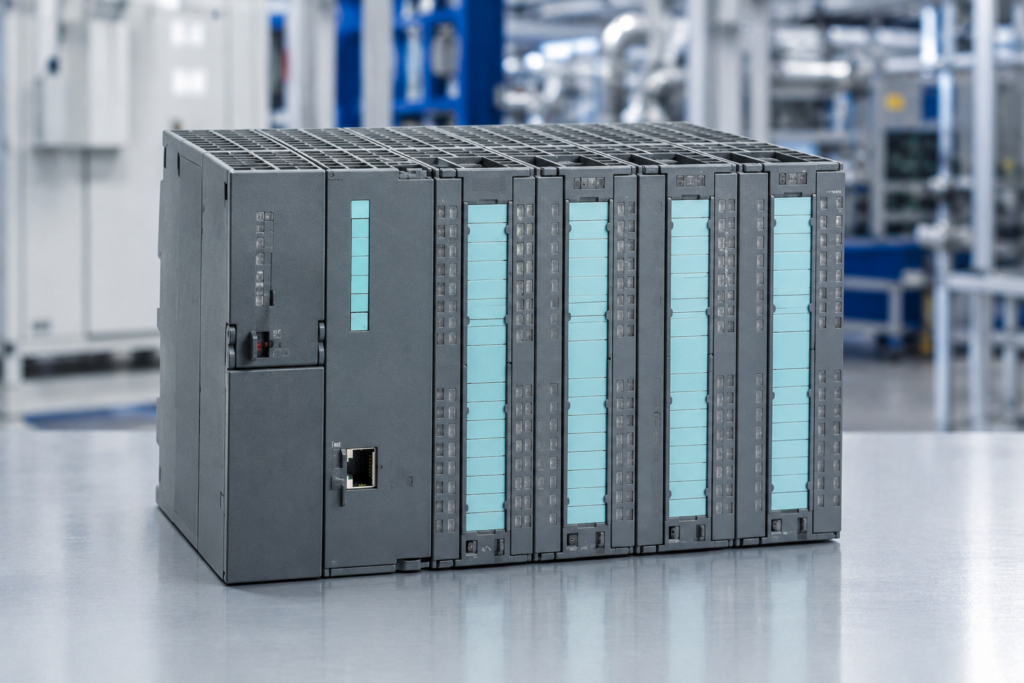
The Siemens S7-400 PLC represents a high-capacity modular programmable logic controller engineered specifically by industrial experts for demanding enterprise automation tasks. Operating as a crown jewel within the legendary SIMATIC S7 family, it is purpose-built for medium-to-large automation networks that demand absolute operational integrity.
Unlike smaller modular variants, this controller excels at orchestrating multifaceted processes involving synchronized multi-machine clusters, redundant communication backbones, and heavy supervisory setups. Its modular construction empowers instrumentation engineers to scale racks, power supplies, and communication processors dynamically to match exact plant criteria without redesigning the entire control panel.
Renowned for its raw processing horsepower and industrial endurance, the S7-400 controller thrives inside harsh environments characterized by extreme temperatures, electromagnetic interference, and continuous mechanical vibration. Furthermore, its hot-swappable module capability ensures that maintenance personnel can replace faulty components without shutting down the entire rack, preserving vital production schedules.
Importance of Siemens S7-400 PLC in Industrial Automation
Modern automated facilities rely heavily on stable control infrastructures because unexpected plant halts trigger catastrophic financial losses. Within this high-stakes context, the Siemens S7-400 PLC delivers uninterrupted execution reliability that keeps modern industries moving forward.
Its vital significance stems from several core operational capacities, starting with orchestrating massive production assembly systems seamlessly across distributed shop floors. Additionally, it excels at managing multiple concurrent closed-loop control loops without latency, ensuring optimal regulation of pressure, temperature, and flow rates. Engineers also depend on it for guaranteeing uncompromising safety standards across hazardous zones where failure is simply not an option. Furthermore, it succeeds in minimizing manual intervention by automating complex sequential logic that would otherwise overwhelm human operators. Finally, it plays a massive role in boosting overall plant productivity and energy efficiency by minimizing idle equipment states.
Because of these robust traits, industry professionals view this controller as a legendary workhorse of mission-critical control architecture.
Key Features of Siemens S7-400 PLC
The Siemens S7-400 PLC is equipped with advanced features that make it suitable for heavy industrial applications:
1. Modular Design
The system is fully modular, allowing easy expansion and customization based on industrial needs.
2. High Processing Speed
It can process complex logic operations quickly, ensuring real-time control of machines.
3. Strong Communication System
The Siemens S7-400 PLC supports industrial communication protocols such as PROFIBUS and PROFINET.
4. High Reliability
It is designed for 24/7 operation in harsh industrial environments without performance issues.
5. Advanced Diagnostics
The system includes built-in diagnostic tools that help detect faults quickly and reduce downtime.
6. Scalability
It can be expanded easily to support larger systems as industrial requirements grow.
These features make the Siemens S7-400 PLC a powerful and future-ready automation solution.
Working Principle of Siemens S7-400 PLC
The Siemens S7-400 PLC operates using a continuous scanning cycle. This cycle ensures real-time control of industrial processes.
The working process includes the following steps:
1. Input Reading
The PLC reads data from input devices such as sensors, switches, and measuring instruments.
2. Program Execution
It executes the user-defined control program stored in memory.
3. Output Update
Based on the program logic, the PLC updates output devices such as motors, valves, and relays.
4. System Diagnostics
It continuously checks system health and detects errors or faults.
This cycle runs repeatedly within milliseconds, ensuring fast and accurate control in industrial automation systems.
Applications of Siemens S7-400 PLC
The Siemens S7-400 PLC is widely used across different industries due to its reliability and performance. Some major applications include:
Manufacturing Industry
Furthermore used for controlling production lines, robotic systems, and assembly processes.
Power Plants
Manages turbines, generators, and energy distribution systems.
Oil and Gas Industry
Controls drilling systems, pipelines, and refinery operations.
Chemical Industry
Used for monitoring and controlling chemical reactions and processes.
Water Treatment Plants
Helps regulate filtration, pumping, and water distribution systems.
Heavy Industrial Automation
Supports complex machinery and large-scale automated systems.
These applications show how the Siemens S7-400 PLC is essential for modern industrial automation systems.
Advantages of Siemens S7-400 PLC
The Siemens S7-400 PLC offers several advantages that make it a preferred choice for engineers and industries:
- High reliability in continuous operations
- Suitable for complex and large systems
- Strong communication capabilities
- Easy integration with other Siemens devices
- Long operational life with low maintenance
- Enhanced safety and fault detection
These advantages help industries achieve higher efficiency and reduced operational costs.
Even with newer PLC models available, the Siemens S7-400 PLC remains widely used in many industries. The main reason is its proven performance, durability, and industrial trust.
Many companies continue using it because:
- It provides stable long-term operation
- It supports large-scale industrial systems
- It has strong compatibility with existing infrastructure
- It is highly reliable in critical environments