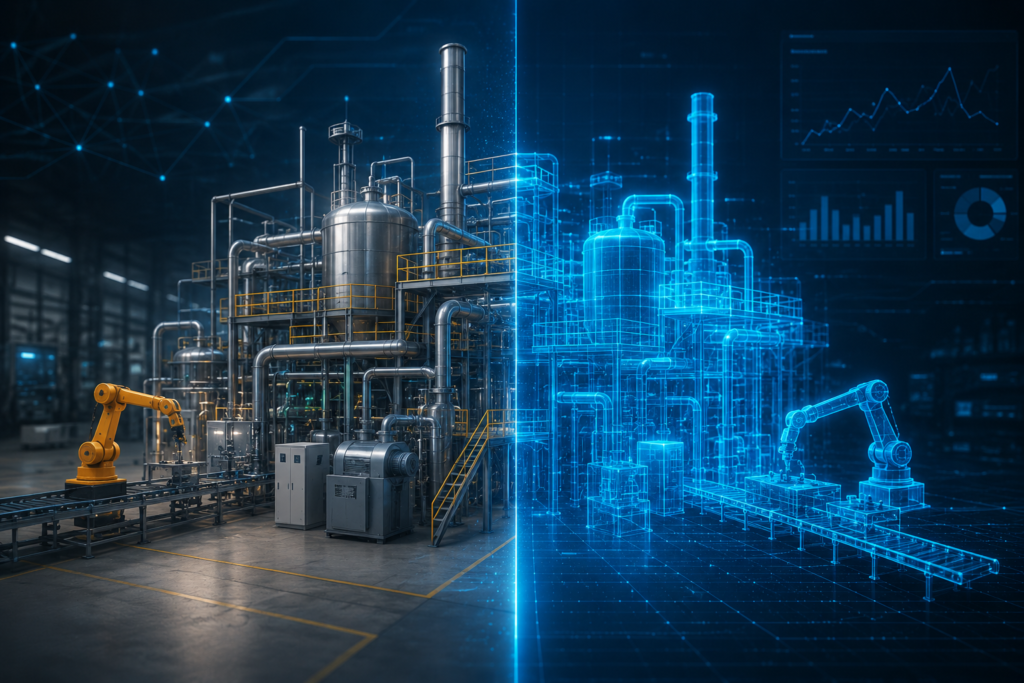
Digital Twin in Industrial Automation is changing how engineers understand, test, monitor, and improve physical industrial systems. Instead of working only with a machine in the real world, engineers can create a digital representation that reflects important characteristics and behavior of that physical system. This approach allows teams to study what is happening inside a process, test possible changes, and understand how a system may respond before making changes to the actual equipment.
However, a Digital Twin is much more than a computer-generated picture or a simple 3D model. A useful twin maintains a meaningful connection between a physical asset and its digital counterpart. As the physical system changes, relevant information can update the digital model as well. Therefore, the value comes from the relationship between the real system, its data, and the virtual representation.
For beginners, this concept can sound complicated at first. In reality, the basic idea is straightforward: create a digital version of a physical industrial system, connect it with useful data, and use that digital version to understand or improve the real one.
What Is a Digital Twin?
A Digital Twin is a digital representation of a physical object, machine, process, or production environment. The digital representation can contain information about the structure, operating conditions, behavior, and current state of the physical system.
For example, imagine a packaging machine used in a factory. Engineers can create a virtual version that represents the machine’s mechanical structure, movement, operating conditions, process timing, and important relationships between its components. When the physical machine changes its operating state, the digital model can be used to study the corresponding behavior.
The important point is that a Digital Twin does not exist only as a static design. Its usefulness increases when it can reflect meaningful information from the physical system.
A traditional engineering drawing may tell you what a machine was designed to look like. A simulation model may show how the machine could behave under selected conditions. A Digital Twin goes a step further by maintaining a connection between the physical system and its digital representation.
That relationship can support engineering decisions throughout the life of the equipment.
Digital Model, Simulation, and Digital Twin Are Not the Same
These three terms often appear together, which creates confusion. Although they are related, they have different purposes.
A digital model represents a physical object or process in digital form. It may contain dimensions, structure, technical properties, or engineering information. The model itself does not necessarily receive live information from the physical system.
A simulation uses a digital representation to study how a system may behave under specific conditions. Engineers can change inputs, test scenarios, and compare outcomes without making the same changes to physical equipment.
A Digital Twin connects the digital representation much more closely to the physical system. It can use data from the real asset or process to keep the virtual representation aligned with relevant operating conditions.
This difference matters because a static model can describe a machine, while a simulation can explore possible behavior. A Digital Twin can help engineers understand the relationship between the machine's current condition and its digital counterpart.
As a result, these technologies should not be treated as interchangeable terms.
How a Digital Twin Works
At its core, a Digital Twin depends on a continuous flow of information between the physical world and the digital environment.
The process starts with a physical asset or process. That asset generates useful information through its operation. Depending on the application, this information may include measurements, operating states, performance values, environmental conditions, or other relevant signals.
The collected information then moves into the digital environment. The Digital Twin processes that information and updates the virtual representation according to the defined model and logic.
Once the virtual representation has meaningful information, engineers can analyze it, visualize conditions, run calculations, compare expected behavior with actual behavior, or test selected scenarios.
The results can then support decisions about the physical system.
This creates a practical cycle:
Physical system → data → digital representation → analysis → decision → physical system
The exact architecture can vary from one industrial application to another. A small machine may require a relatively simple twin, while a large production environment may involve multiple connected models and large volumes of data.
The Main Building Blocks of a Digital Twin
Although implementations differ, most Digital Twin solutions depend on several essential elements.
Physical Asset
The physical asset is the real object, machine, process, or environment being represented. It provides the real-world behavior that the digital twin aims to reflect.
The asset might be a single machine, a production cell, a complete manufacturing line, or even a larger industrial facility. The scope depends on the engineering goal.
Digital Representation
The digital representation contains the information and logic used to represent the physical system.
This representation may include geometry, operating parameters, relationships between components, engineering rules, mathematical models, or behavioral logic.
It does not always need to reproduce every detail of the real asset. Instead, it should contain the level of detail necessary for the intended use.
That is an important design principle. Adding more information does not automatically create a better Digital Twin. The model should remain relevant to the problem engineers want to solve.
Data Connection
The connection between the physical asset and the digital environment gives the twin practical value.
The connection can carry information from the real system into the digital environment. Depending on the design, the digital side may also provide information that supports actions or decisions related to the physical system.
Without a meaningful data connection, the solution may behave more like a conventional digital model than a true operational twin.
Analytical or Behavioral Logic
A Digital Twin also needs a way to interpret information.
This may involve mathematical relationships, engineering rules, calculations, historical comparisons, behavior models, or other analytical methods. The purpose is to turn raw information into something useful.
For instance, the twin may compare current behavior with an expected operating pattern. It could also evaluate how the system might respond to a planned change.
Visualization and User Interaction
Engineers need a practical way to understand the information produced by the twin.
The interface may display the condition of an asset, compare different operating scenarios, show trends, or present model results. The interface does not define the Digital Twin by itself, but it can make the technology much easier to use.
Why Digital Twins Matter in Industrial Automation
The biggest advantage of a Digital Twin is not simply having a digital copy of a machine. The real benefit comes from gaining a better understanding of how the physical system behaves.
Engineers often need to answer questions before changing equipment, modifying production parameters, or introducing a new process. A Digital Twin can provide a controlled digital environment for studying those questions.
For example, an engineering team may want to evaluate a production change without immediately applying it to the live system. The team can examine the proposed change in the digital environment first and look for unexpected behavior.
Similarly, designers can use a digital twin concept earlier in the development process to identify design concerns before physical implementation reaches its final stage.
This can reduce unnecessary trial and error.
Moreover, Digital Twins can support communication between engineering, operations, maintenance, and management teams because the same digital representation can provide a shared view of the system.
A Simple Example
Consider a packaging machine in a factory.
The physical machine performs several coordinated actions during each production cycle. Engineers create a digital representation of the machine that includes its important mechanical relationships and operating behavior.
Now imagine that the engineering team wants to increase the machine's production rate.
Instead of changing the real machine immediately, the team can first examine the proposed operating condition in the digital environment. The twin can help the engineers study cycle timing, movement relationships, and potential constraints.
If the digital analysis shows a problem, the team can investigate it before making the same change on the actual machine.
Later, once the real machine operates under the new condition, relevant operational information can help the digital representation remain aligned with the physical system.
This example shows why a Digital Twin is more powerful than a simple visual model. It supports a connection between what the machine is, how it behaves, and how engineers want to improve it.
Digital Twin Is Not Just a 3D Factory Image
One of the most common misconceptions is that any 3D industrial model automatically qualifies as a Digital Twin.
It does not.
A 3D model mainly represents visual or structural information. A Digital Twin may use 3D visualization, but its purpose extends beyond appearance.
The twin should serve a defined engineering or operational purpose. It should represent meaningful characteristics of the physical system and use relevant information to support analysis, monitoring, simulation, optimization, or decision-making.
Therefore, a beautiful 3D factory model with no meaningful connection to real operating information may look impressive, but it does not provide the same value as a properly designed Digital Twin.
Digital Twin and the Industrial Lifecycle
Another important feature of Digital Twin technology is its usefulness across different stages of an asset's lifecycle.
During the design stage, a digital representation can help engineers explore configurations and identify design issues.
After deployment, the twin can help engineers understand real operating behavior and compare it with expected performance.
Later, during improvement or modification, the digital environment can again support evaluation before changes reach the physical system.
In this way, the Digital Twin concept can remain useful beyond the initial construction of a machine or process.
The Most Important Idea to Remember
The simplest way to understand a Digital Twin is to think of it as a purpose-built digital counterpart of a physical industrial system that uses relevant information to represent and understand that system.
It is not merely a drawing. It is not automatically a 3D model. It is not identical to ordinary simulation.
Instead, it combines a physical system, a digital representation, data, and useful analytical logic into one connected concept.
That connection is what makes the technology valuable for modern industrial engineering.
Different Types of Digital Twins in Industrial Automation
Not every Digital Twin has the same scope. In fact, the size and purpose of the physical system determine how the digital counterpart should be designed.
A component-level twin focuses on a single part of an industrial asset. For instance, an engineering team may create a digital representation of a pump, gearbox, motor, valve, or robotic joint. Such a narrow scope makes it easier to study the behavior of one important component without modeling an entire production system.
A machine-level twin expands that idea to a complete machine. It can represent relationships between several components and help engineers understand how those parts work together during normal operation.
A production-cell twin covers a group of machines that perform a connected manufacturing task. Rather than examining one asset independently, the digital environment considers interactions between equipment, material movement, cycle timing, and process dependencies.
At a broader level, a production-line twin represents an entire manufacturing line. This approach can help teams examine throughput, bottlenecks, resource utilization, and the effect of changing one stage on another.
Finally, a facility-level twin can represent a much larger industrial environment. Such a solution may combine production areas, utilities, equipment, environmental conditions, and other operational elements into a unified digital environment.
Therefore, selecting the right scope is important. A company does not automatically gain more value by creating the largest possible model. The best approach is to match the twin's scope with a clearly defined engineering or operational objective.
What Is the Role of Synchronization?
Synchronization is one of the most important practical concepts in Digital Twin in Industrial Automation.
A digital representation must receive relevant information at the appropriate time. Otherwise, the virtual state may gradually become disconnected from the real asset.
Consider a machine whose operating condition changes several times each second. Sending updated information only once every few minutes may not provide enough detail for an application that depends on rapid changes. On the other hand, a slowly changing asset may not require extremely frequent updates.
Because of this, synchronization frequency should depend on the purpose of the twin.
Some applications may work with near-real-time updates, while others can operate with periodic data refreshes. In addition, not every value needs to update at the same frequency. A temperature measurement might require a different update interval from a maintenance counter or production quantity.
Smart synchronization also reduces unnecessary data traffic. Instead of transferring every available value continuously, the system can prioritize information that actually affects the intended analysis.
As a result, synchronization should be designed around time requirements, data importance, and engineering purpose, rather than simply aiming for the highest possible update rate.
How Data Moves Through a Digital Twin Environment
The usefulness of a Digital Twin depends heavily on the quality and organization of its data.
Information generally begins at the physical asset. Different sources may produce different types of operational information. Some values describe current conditions, while others provide context about equipment state, operating history, or production events.
That information then moves through a communication and processing layer before reaching the digital environment. During this stage, data may need to be filtered, converted, checked, timestamped, or organized.
Once the information reaches the digital representation, the system can associate incoming values with the correct model elements. Analytical logic can then process the information according to the application's purpose.
The final stage involves presenting useful results to people or other systems. Instead of exposing raw data alone, the Digital Twin can transform it into meaningful engineering information.
For example, a large number of raw measurements may be less useful than a calculated operating condition that summarizes what those measurements mean.
Physical information → data acquisition → processing → model synchronization → analysis → useful output
Each stage matters. Poor-quality input can affect every stage that follows, even when the digital model itself is well designed.
Data Quality Matters More Than Data Quantity
Industrial environments can generate huge amounts of information. Nevertheless, having more data does not automatically produce a better Digital Twin.
A model may receive thousands of values, but irrelevant or unreliable information can reduce its usefulness. Missing timestamps, inconsistent units, duplicated values, inaccurate sensors, and unexplained gaps can all create misleading results.
For that reason, data quality should be treated as an engineering requirement.
Engineers should know where each important value comes from, what the measurement represents, what unit it uses, and how often it changes. In addition, unusual values should have a defined interpretation instead of being silently treated as normal conditions.
Data validation can also improve confidence in analytical results. When the twin receives information that falls outside an expected range, the system can flag the value for investigation rather than immediately using it as if it were correct.
Consequently, a smaller set of trustworthy information can often be more useful than a much larger collection of poorly controlled data.
Model Fidelity: How Much Detail Is Really Needed?
Another important design question concerns model fidelity.
Fidelity refers to how closely the digital representation reflects the behavior or characteristics of the real system.
A highly detailed model may capture many physical relationships. Such a model can be useful for advanced engineering studies, but it may require more development effort, computing resources, and maintenance.
A simpler model may run faster and cost less to maintain. However, excessive simplification can remove information that the intended application actually needs.
The right balance depends on the problem.
Suppose engineers only need to compare production scenarios at a high level. A lightweight model may provide enough information. Conversely, a detailed engineering application may require more complex behavior and greater model precision.
Thus, model fidelity should be selected according to the decision the twin must support.
There is little value in spending significant resources on details that never influence an engineering decision.
How Engineers Decide What to Include
Building a useful Digital Twin starts with understanding the question it should answer.
Rather than collecting every possible asset detail, engineers can begin by defining the specific purpose. Perhaps the goal is to compare operating scenarios. Another project may focus on production capacity, asset behavior, energy use, or maintenance planning.
Once the objective becomes clear, the team can identify the physical elements that influence that objective.
For example, a twin designed to study production flow may need detailed information about sequence, cycle time, material movement, and capacity. A model intended for structural analysis may require an entirely different set of characteristics.
This approach keeps the digital environment focused.
Furthermore, it makes future expansion easier. New information can be added when a business or engineering requirement appears instead of creating unnecessary complexity from the beginning.
Digital Twin and Virtual Commissioning
One particularly valuable application is virtual commissioning.
Traditional commissioning takes place when real equipment is available for testing. Engineers and technicians then verify sequences, interactions, and expected behavior on the actual system.
A digital environment can allow many of those checks to begin earlier.
With a properly prepared Digital Twin, engineers can examine how a machine or production process should behave before physical commissioning is complete. Control sequences and system interactions can be evaluated in a virtual setting, which gives the engineering team an opportunity to identify problems earlier.
For example, an incorrect sequence may become visible before it causes delays during physical testing. Similarly, an unexpected interaction between process stages can be investigated without repeatedly changing the live equipment.
This approach does not eliminate the need for physical validation. Instead, it moves part of the engineering effort into an environment where testing can happen earlier and more safely.
As a result, virtual commissioning can improve the quality of preparation before equipment reaches final operational testing.
Virtual commissioning is a practical Digital Twin application.
Using a Digital Twin for What-If Analysis
Industrial engineers frequently need to evaluate hypothetical situations.
What happens if production speed increases? How will a process respond if one stage becomes a bottleneck? Could a planned equipment change affect overall throughput?
A Digital Twin can provide a structured environment for these questions.
Engineers can create a scenario, change selected conditions, and observe how the digital system responds. The goal is not to predict the future perfectly. Instead, the twin helps the team compare possible outcomes under defined assumptions.
This makes what-if analysis particularly useful during planning and improvement projects.
For example, before purchasing additional equipment, a company may evaluate whether the expected capacity increase would actually improve the complete process. The answer may reveal that another stage limits production, making the proposed investment less effective than expected.
Therefore, digital analysis can support better decisions before significant physical changes are made.
Digital Twin for Production Optimization
Production optimization becomes more useful when engineers can evaluate the complete process instead of improving one machine in isolation. Digital Twin in Industrial Automation can support this approach by giving teams a controlled digital environment in which different production conditions can be compared.
For example, a production line may have enough machine capacity but still struggle with delays because of uneven cycle times. In that situation, simply increasing the speed of one machine may not solve the problem. Instead, engineers can use the digital environment to study how timing changes affect the complete process.
Similarly, a proposed production improvement can be examined before it reaches the physical system. This makes it easier to compare different operating scenarios and identify changes that provide a useful overall result.
Because of this broader view, Digital Twin in Industrial Automation can help organizations move from isolated machine improvement toward system-level optimization.
IIoT sensors provide useful data for connected industrial systems.
Digital Twin in Industrial Automation for Predictive Maintenance
Furthermore, Digital Twin in Industrial Automation can support maintenance teams by providing a deeper view of how equipment behaves over time. Instead of relying only on fixed maintenance schedules, engineers can use information about operating conditions and equipment behavior to understand when attention may be required.
For example, a machine that normally operates within a specific performance range may gradually behave differently. A Digital Twin can compare current behavior with expected conditions and help engineers investigate unusual changes.
However, this does not mean that a Digital Twin automatically knows when a machine will fail. The quality of the result depends on the model, available information, operating history, and analytical methods used by the application.
As a result, Digital Twin in Industrial Automation should be treated as a decision-support technology rather than a replacement for engineering judgment.
Digital Twin in Industrial Automation for Energy Analysis
Similarly, Digital Twin in Industrial Automation can help organizations understand how operating conditions influence energy consumption.
Industrial equipment does not always consume the same amount of energy under every condition. Production rate, machine loading, operating cycles, environmental conditions, and equipment settings can all influence energy behavior.
A suitable Digital Twin can represent these relationships and allow engineers to compare different operating scenarios. For instance, a team may examine whether changing a production condition could reduce energy consumption without creating an unwanted effect elsewhere in the process.
Moreover, energy analysis becomes more useful when engineers can compare expected behavior with actual operating information. A difference between the two may provide a reason to investigate the process further.
Therefore, Digital Twin in Industrial Automation can contribute to energy improvement by helping teams understand the relationship between production conditions and resource usage.
Digital Twin in Industrial Automation for Quality Improvement
Quality problems can sometimes develop because several process variables interact with one another. Looking at one variable alone may not explain why a product falls outside the desired specification.
In this situation, Digital Twin in Industrial Automation can provide a broader process perspective.
A digital representation can help engineers examine how changes in process conditions may influence the final result. For example, a manufacturing process may depend on timing, temperature, pressure, speed, material characteristics, or other application-specific variables.
When these relationships are represented digitally, engineers can investigate different scenarios before applying major changes to the physical process.
Additionally, the digital environment can help teams compare expected process behavior with observed results. This comparison may reveal where further investigation is necessary.
Consequently, Digital Twin in Industrial Automation can become a useful engineering tool for improving process consistency and supporting quality-focused decisions.
Digital Twin in Industrial Automation for Asset Lifecycle Management
Another valuable application involves the complete lifecycle of industrial assets.
From initial design to installation, operation, modification, and eventual replacement, an asset can pass through many stages. During this period, information may become scattered across different engineering documents, software systems, and operational records.
A properly maintained Digital Twin in Industrial Automation can provide a structured digital representation that evolves with the asset.
During the design stage, the digital environment can support engineering decisions. Later, operational information can add another layer of understanding. When equipment is modified, the digital representation can also be updated to reflect the new configuration.
As a result, the digital twin can remain useful beyond the original engineering project.
Furthermore, maintaining an accurate digital representation can make future engineering work easier because teams have a clearer reference for understanding the asset and its current configuration.
Digital Twin in Industrial Automation and Change Management
Industrial changes should be evaluated carefully because one modification can affect several connected parts of a process.
For this reason, Digital Twin in Industrial Automation can support change-management activities by allowing engineers to study proposed modifications in a controlled digital environment.
Suppose an organization plans to change a machine's operating parameters or modify part of a production process. Rather than immediately applying the change to the physical environment, engineers can first examine its potential effects within the digital model.
This approach does not guarantee that every real-world outcome will be predicted. Nevertheless, it can expose relationships or conditions that deserve attention before implementation.
Moreover, the digital environment can provide a common reference for discussions between engineering and operations teams. Everyone can examine the same proposed scenario instead of relying only on assumptions.
Therefore, Digital Twin in Industrial Automation can make technical change planning more structured and evidence-based.
Digital Twin in Industrial Automation and Training
Beyond engineering analysis, Digital Twin in Industrial Automation can also support technical training.
Industrial equipment can be expensive, complex, or unsuitable for unrestricted experimentation. A digital environment provides another way for engineers, technicians, and students to understand system behavior without constantly interacting with production equipment.
For example, a training scenario can demonstrate how a process responds when operating conditions change. Learners can examine different situations and observe the consequences within the digital environment.
Additionally, organizations can use realistic digital scenarios to help technical teams become familiar with equipment behavior before working with the physical asset.
However, digital training should complement practical experience rather than completely replace it. Physical equipment introduces conditions that a model may not represent perfectly.
Even so, Digital Twin in Industrial Automation can provide a valuable learning environment when it is designed around realistic engineering objectives.
Common Mistakes When Building Digital Twin Systems
Several mistakes can reduce the value of Digital Twin in Industrial Automation.
One common mistake is starting with technology instead of a clear problem. An organization may purchase advanced software without first deciding what the Digital Twin should actually accomplish.
Another issue is excessive complexity. A highly detailed model can become difficult to maintain if the additional details do not contribute to the intended application.
Poor data quality creates another major problem. Even an advanced digital environment can produce weak results when its inputs are inaccurate, incomplete, or incorrectly interpreted.
In addition, organizations sometimes forget about model maintenance. When the physical system changes but the digital representation remains unchanged, the relationship between the two can weaken.
Finally, some projects attempt to model an entire facility immediately. A smaller and measurable starting point is often easier to validate and improve.
Therefore, successful Digital Twin in Industrial Automation projects should begin with a defined objective, appropriate scope, reliable information, and a realistic maintenance plan.
How to Start a Digital Twin Project
For a company exploring Digital Twin in Industrial Automation, a practical starting point is a clearly defined pilot project.
First, the engineering team should identify one asset or process where better digital analysis could provide measurable value. Next, the team can determine which characteristics and information are actually required.
After that, engineers can develop the initial digital representation and establish the necessary data relationships. The model should then be tested against known operating conditions.
Once the results are considered reliable enough for the intended purpose, the project can move into controlled operational use.
Furthermore, the organization should define measurable success criteria. These might involve engineering time, scenario-analysis capability, process understanding, maintenance planning, energy analysis, or another clearly defined objective.
This approach makes Digital Twin in Industrial Automation a measurable engineering project rather than an open-ended technology experiment.
Future Scope of Digital Twin in Industrial Automation
Looking ahead, Digital Twin in Industrial Automation is likely to become more closely connected with advanced engineering software, industrial analytics, artificial intelligence, and increasingly detailed digital models.
As computing capabilities improve, larger and more complex systems can be represented and analyzed more efficiently. At the same time, better data practices can improve the quality of information available to digital environments.
Artificial intelligence may also help analyze large collections of operational information and identify relationships that are difficult to detect manually. Nevertheless, AI does not remove the need for sound engineering models and trustworthy information.
In addition, digital twins may become more integrated across different stages of an industrial asset's lifecycle. Design information, operational knowledge, engineering changes, and maintenance-related information can potentially contribute to a more complete digital representation.
However, future development should remain focused on practical value. More data, more complexity, or more sophisticated visualization does not automatically mean a better solution.
The strongest Digital Twin in Industrial Automation applications will continue to be those that solve measurable problems and help engineers make better decisions.
Conclusion
Digital Twin in Industrial Automation represents an important step toward more connected and informed industrial engineering. By linking a physical asset with a purposeful digital representation, organizations can examine system behavior, evaluate possible changes, and gain deeper insight into complex processes.
However, the technology should not be treated as a magic solution. Its effectiveness depends on the quality of the model, the relevance of the information, the accuracy of validation, and the clarity of the problem being addressed.
Therefore, the best Digital Twin projects begin with a simple question: What real industrial problem are we trying to understand or improve?
Once that question has a clear answer, engineers can select the appropriate model, information, synchronization approach, and analytical methods.
Ultimately, Digital Twin in Industrial Automation is most valuable when it turns complex industrial information into practical engineering understanding. That purpose-driven approach can help organizations improve planning, testing, optimization, and long-term asset decisions while keeping the digital environment useful, measurable, and maintainable.