Table of Contents
TogglePLC Applications in Industrial Automation
Introduction
PLC Applications are one of the most important parts of modern industrial automation. Today, factories, production plants, and manufacturing facilities use Programmable Logic Controllers (PLCs) to automate machines, improve productivity, and reduce human effort. Instead of relying on manual operations, industries use PLCs to control motors, sensors, conveyors, robotic systems, pumps, and many other industrial processes.
As industries continue to grow, automation has become more important than ever. Therefore, PLC technology plays a major role in increasing production speed, improving product quality, and ensuring workplace safety. Whether you are a student, technician, engineer, or business owner, understanding PLC Applications helps you learn how modern factories operate efficiently.
In this guide, you will explore how PLCs are used across different industries, why they are important, and how they improve industrial operations. You will also learn about real-world examples that demonstrate the power of PLC-based automation.
What Are PLC Applications?
PLC Applications refer to the different ways a Programmable Logic Controller is used to control, monitor, and automate industrial equipment. A PLC receives information from input devices, processes the data according to a programmed logic, and then controls output devices.
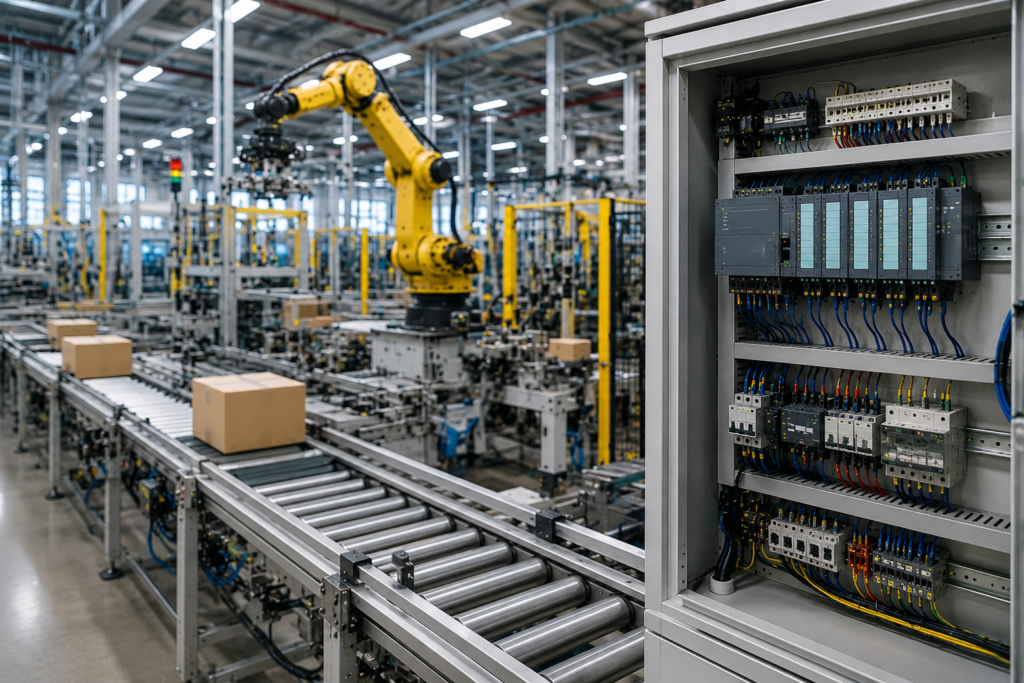
For example, a factory conveyor may use sensors to detect products. The PLC reads the sensor signals, decides what action is needed, and automatically starts or stops the conveyor motor. As a result, production becomes faster, safer, and more accurate.
Today, PLCs are used in thousands of industrial systems because they are reliable, flexible, and easy to maintain.
Why PLC Applications Are Important
Industrial automation depends heavily on PLC systems. Without PLCs, many production processes would require continuous manual operation.
Some important advantages include:
- Faster production cycles
- Better product quality
- Reduced downtime
- Improved worker safety
- Lower operating costs
- Consistent machine performance
- Easy troubleshooting
- Flexible automation
Furthermore, PLCs allow industries to expand their production without making major changes to existing systems.
How PLC Applications Work
Every PLC application follows a simple operating cycle.
- Input devices send signals.
- The PLC processes the information.
- The PLC executes the programmed logic.
- Output devices perform the required action.
For example:
- A sensor detects a product.
- The PLC receives the signal.
- The PLC checks the program.
- The conveyor motor starts automatically.
This process happens continuously within milliseconds. Therefore, machines respond almost instantly.
Main Components Used in PLC Applications
Although PLC systems can become very complex, most applications include similar components.
PLC CPU
The CPU is the brain of the PLC. It executes the program and controls every operation.
Input Devices
Input devices collect information from machines.
Common examples include:
- Push buttons
- Limit switches
- Proximity sensors
- Photoelectric sensors
- Temperature sensors
- Pressure sensors
Output Devices
Outputs perform physical actions.
Examples include:
- Electric motors
- Indicator lights
- Solenoid valves
- Relays
- Buzzers
- Hydraulic actuators
Human Machine Interface (HMI)
Many PLC applications also use HMIs. These screens allow operators to monitor machines, change settings, and view alarms easily.
PLC Applications in Manufacturing Industry
Manufacturing is one of the largest users of PLC technology.
Factories must operate continuously while maintaining high quality standards. Therefore, PLCs control production lines automatically without requiring constant human supervision.
Typical manufacturing applications include:
- Assembly lines
- Product inspection
- Machine synchronization
- Automatic packaging
- Material transport
- Quality control
For example, if one machine stops unexpectedly, the PLC can stop the entire production line to prevent damage.
As a result, manufacturers reduce waste and improve overall efficiency.
PLC Applications in Conveyor Systems
Conveyor systems are widely used in warehouses, factories, airports, and distribution centers.
Instead of manually moving products, conveyors transport materials automatically.
A PLC controls:
- Conveyor start and stop
- Motor speed
- Product counting
- Object detection
- Emergency stop systems
- Direction control
For example, a sensor detects a package arriving at a sorting station. Immediately, the PLC activates another conveyor to move the package toward the correct destination.
Therefore, logistics operations become much faster and more accurate.
PLC Applications in Packaging Industry
Packaging machines require precise timing.
Every package must be filled, sealed, labeled, and inspected correctly.
A PLC coordinates every step.
Typical packaging applications include:
- Bottle filling
- Box sealing
- Label printing
- Product counting
- Weight checking
- Carton forming
Furthermore, PLCs can automatically reject defective products before they leave the production line.
This improves customer satisfaction while reducing production losses.
PLC Applications in Material Handling Systems
Material handling is another important area where PLCs are used.
Factories constantly move raw materials and finished products between different workstations.
PLC-controlled systems include:
- Automated storage systems
- Elevators
- Hoists
- Cranes
- Pallet handling
- Automated guided vehicles (AGVs)
Because these systems operate automatically, companies improve workplace safety and reduce manual labor.
PLC Applications in Automotive Manufacturing
The automotive industry relies heavily on automation.
Modern vehicle production requires hundreds of machines working together.
PLCs coordinate these operations with high precision.
Common automotive applications include:
- Robotic welding
- Paint systems
- Engine assembly
- Conveyor synchronization
- Quality inspection
- Component testing
Moreover, PLCs help manufacturers maintain consistent quality while increasing production speed.
Without PLC technology, producing modern vehicles efficiently would be extremely difficult.
PLC Applications in Food and Beverage Industry
Food processing plants require strict hygiene and quality standards.
Therefore, PLC systems control production while reducing human contact with products.
Examples include:
- Mixing ingredients
- Filling bottles
- Temperature control
- Conveyor systems
- Packaging machines
- Cleaning systems
In addition, PLCs monitor sensors continuously to ensure products meet safety requirements.
This helps manufacturers comply with industry regulations and maintain product consistency.
Benefits of PLC Applications
PLC technology provides several long-term advantages.
Some major benefits include:
- High reliability
- Continuous operation
- Easy maintenance
- Fast processing speed
- Flexible programming
- Reduced production costs
- Improved product quality
- Better worker safety
- Easy integration with HMI and SCADA systems
- Support for future automation upgrades
Because of these advantages, industries around the world continue investing in PLC-based automation systems.
Real-World Example
Imagine a beverage factory producing thousands of bottles every hour.
First, sensors detect empty bottles arriving on the conveyor.
Next, the PLC starts the filling machine.
After filling, another PLC program activates the capping machine.
Then, labels are applied automatically.
Finally, quality sensors inspect every bottle before packaging.
If a defective bottle is detected, the PLC immediately removes it from the production line.
As a result, production remains efficient, safe, and highly accurate while reducing product waste.
If a defective bottle is detected, the PLC immediately removes it from the production line. As a result, the factory reduces waste, improves product quality, and maintains a smooth production process.
PLC Applications in Water Treatment Plants
Water treatment facilities depend on automation to deliver clean and safe water. Therefore, PLC applications play an important role in controlling every stage of the treatment process.
A PLC continuously monitors sensors that measure water level, pressure, temperature, and flow rate. Based on this information, it automatically starts or stops pumps, opens or closes valves, and controls chemical dosing systems.
Common PLC applications in water treatment include:
- Water level monitoring
- Pump control
- Chemical dosing
- Filter automation
- Flow measurement
- Alarm management
Furthermore, PLC systems reduce manual work and improve operational efficiency. Operators can also monitor the complete process through an HMI or SCADA system.
PLC Applications in Oil and Gas Industry
The oil and gas industry operates under challenging conditions where safety is extremely important. Consequently, PLC applications help monitor and control critical equipment in real time.
PLCs manage:
- Pipeline monitoring
- Tank level control
- Pressure regulation
- Compressor systems
- Pump stations
- Emergency shutdown systems
For example, if pipeline pressure exceeds a safe limit, the PLC immediately activates protective actions. As a result, equipment damage and production downtime can be minimized.
PLC Applications in Power Generation
Power plants require accurate monitoring and continuous operation. Therefore, PLC applications help maintain reliable electricity production.
PLCs control:
- Steam turbines
- Cooling systems
- Generator protection
- Boiler automation
- Fuel supply systems
- Electrical switching
Moreover, automation allows operators to monitor multiple systems from one central control room. This improves safety while reducing operating costs.
PLC Applications in Pharmaceutical Industry
The pharmaceutical industry requires precision and strict quality standards. Every production stage must follow exact specifications.
PLC applications support:
- Mixing systems
- Batch processing
- Temperature control
- Cleanroom automation
- Filling machines
- Packaging lines
In addition, PLCs record production data for quality assurance and regulatory compliance. Therefore, manufacturers maintain product consistency while reducing production errors.
PLC Applications in Mining Industry
Mining operations involve heavy equipment working in difficult environments. Consequently, automation improves both productivity and worker safety.
PLC systems control:
- Conveyor belts
- Crushers
- Ore processing
- Water pumps
- Dust suppression systems
Because mining equipment often operates around the clock, PLC automation improves reliability and reduces unexpected failures.
PLC Applications in Robotics
Industrial robots perform repetitive tasks with high accuracy. However, they require precise control systems to operate correctly.
PLC applications coordinate robotic systems for:
- Pick-and-place operations
- Welding
- Painting
- Machine loading
- Material handling
- Assembly operations
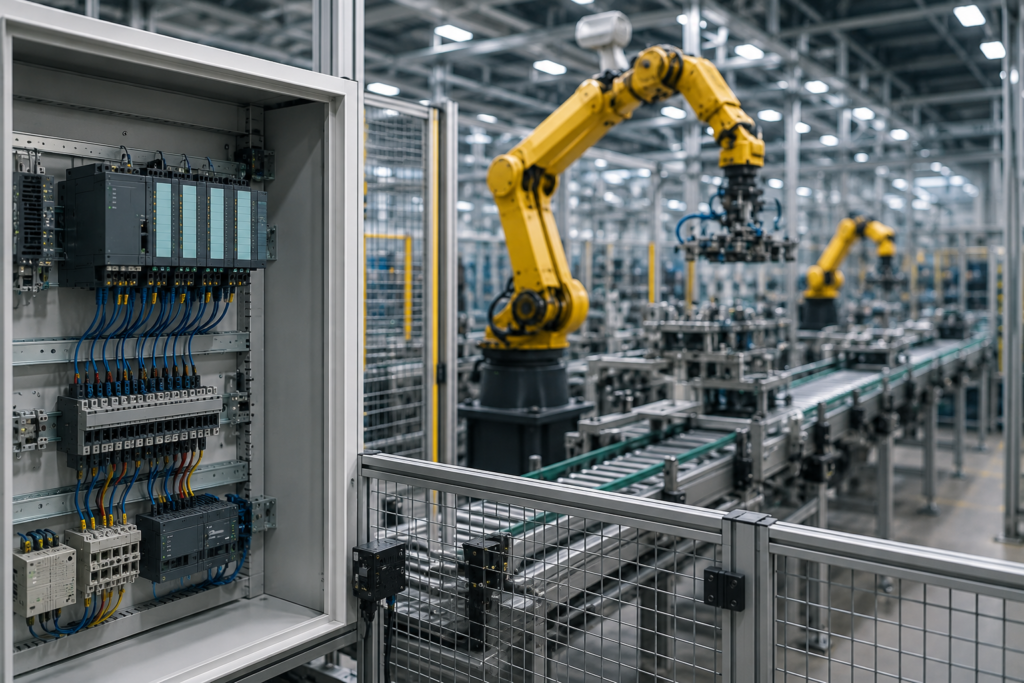
Furthermore, PLCs synchronize robots with conveyors and sensors to maintain smooth production.
PLC Applications in Smart Factories
Modern factories continue moving toward Industry 4.0 technologies. Therefore, PLC applications have become even more advanced.
Today's smart factories combine PLCs with:
- Industrial IoT
- Cloud monitoring
- Artificial Intelligence
- SCADA systems
- Remote diagnostics
- Predictive maintenance
As a result, manufacturers collect real-time production data and make faster business decisions.
Advantages of PLC Applications
PLC applications provide many long-term benefits across different industries.
Some major advantages include:
- Improved production efficiency
- Reduced machine downtime
- Better product quality
- Increased worker safety
- Lower maintenance costs
- Easy troubleshooting
- High reliability
- Flexible programming
- Fast processing speed
- Long equipment life
Moreover, PLC systems can easily expand as production requirements increase.
Challenges of PLC Applications
Although PLC technology offers many advantages, certain challenges should also be considered.
Some common challenges include:
- Initial installation costs
- Programming knowledge requirements
- Regular maintenance
- Software updates
- Cybersecurity concerns
- Hardware replacement over time
Nevertheless, the long-term benefits usually outweigh these challenges for most industries.
Future of PLC Applications
The future of PLC applications looks very promising. As industries adopt digital transformation, PLC systems will continue evolving.
Future developments include:
- AI-assisted automation
- Edge computing
- Industrial IoT integration
- Digital twin technology
- Remote monitoring
- Energy-efficient automation
- Predictive maintenance
- Cloud-based analytics
Therefore, learning PLC technology today can open many career opportunities in industrial automation.
Best Practices for PLC Applications
Following good programming and maintenance practices improves system performance.
Recommended practices include:
- Write clear and organized programs.
- Test programs before deployment.
- Back up PLC projects regularly.
- Label all inputs and outputs correctly.
- Perform preventive maintenance.
- Monitor alarms continuously.
- Document every system modification.
- Keep firmware updated when appropriate.
Furthermore, always follow electrical safety standards before working with industrial equipment.
Frequently Asked Questions
What are PLC Applications?
PLC Applications are the different industrial processes where Programmable Logic Controllers automate machines, monitor equipment, and improve production efficiency.
Why are PLC Applications important?
They improve productivity, reduce downtime, increase safety, and provide reliable machine control.
Which industries use PLC Applications?
Manufacturing, automotive, food processing, pharmaceuticals, mining, oil and gas, water treatment, power generation, logistics, and many other industries use PLC technology.
Which PLC software is commonly used?
Popular software includes Siemens TIA Portal, Studio 5000, GX Works, CX-Programmer, and EcoStruxure Machine Expert.
Do PLC Applications support Industry 4.0?
Yes. Modern PLC systems integrate with Industrial IoT, SCADA, HMI, cloud platforms, and smart factory technologies.