
Table of Contents
ToggleIntroduction
Types of PLC are an important topic in industrial automation. A Programmable Logic Controller (PLC) is a specialized industrial computer that controls machines, processes, and automated systems. Today, industries use PLCs to improve efficiency, reduce manual work, and increase productivity.
Different industries have different automation requirements. Therefore, manufacturers have developed several types of PLCs to meet various operational needs. Some PLCs are suitable for small applications, while others can handle complex industrial systems.
Understanding the different types of PLC is essential for students, engineers, and automation professionals. In this guide, you will learn about the main PLC types, their features, advantages, applications, and selection factors.
What Is a PLC?
A PLC, or Programmable Logic Controller, is an electronic device used to automate industrial processes. It receives information from input devices, processes the data according to programmed instructions, and sends commands to output devices.
PLCs can control motors, pumps, conveyor systems, sensors, valves, and many other industrial components. As a result, they have become one of the most important technologies in modern automation.
Industries prefer PLCs because they are reliable, flexible, and easy to program. In addition, they can operate continuously in harsh industrial environments.
Why Are Different Types of PLC Needed?
Industrial applications vary greatly in size and complexity. Therefore, one PLC design cannot meet every requirement.+
For example, a small packaging machine may only need a few inputs and outputs. However, a large manufacturing plant may require thousands of control points and advanced communication features.
Different PLC types allow industries to choose the most suitable solution for their specific needs. As a result, organizations can improve performance while controlling costs.
Main Types of PLC
Several PLC types are available in industrial automation. Each type offers unique features and advantages.
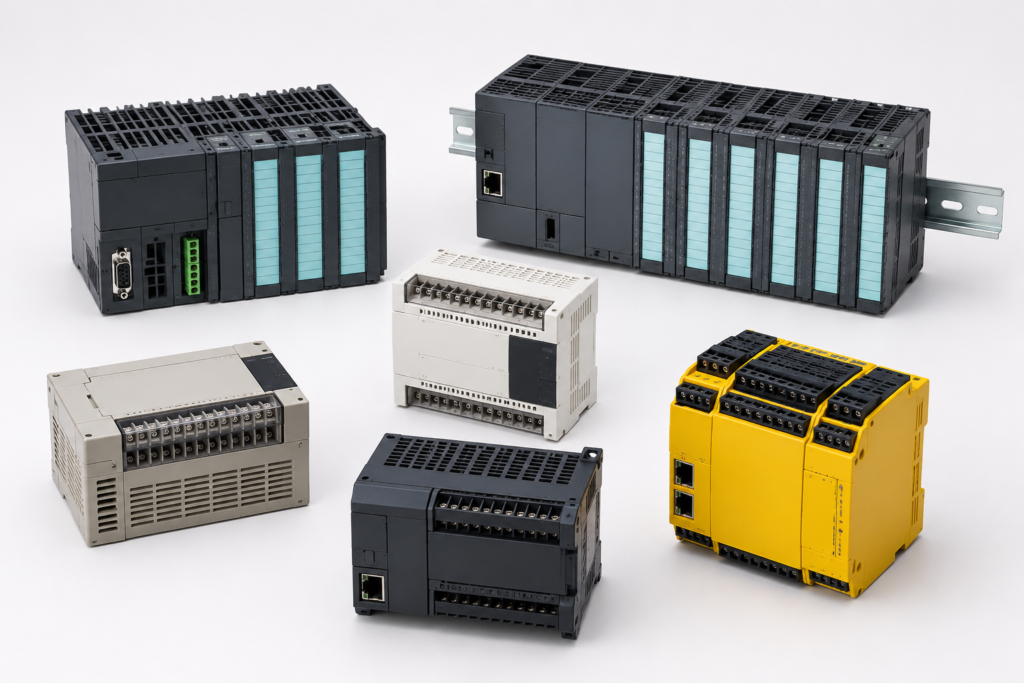
1. Fixed PLC
A Fixed PLC is one of the simplest PLC types. In this design, the CPU, power supply, and input/output modules are integrated into a single unit.
Fixed PLCs are easy to install and operate. Therefore, they are commonly used in small automation projects.
Advantages of Fixed PLC
- Compact design
- Lower cost
- Easy installation
- Simple maintenance
Applications
- Small production machines
- Packaging equipment
- Basic conveyor systems
- Educational automation projects
Although Fixed PLCs are affordable, they offer limited expansion capabilities. Therefore, they may not be suitable for large industrial applications.
2. Modular PLC
A Modular PLC consists of separate modules that can be added or removed as needed.
This design provides greater flexibility because users can customize the system according to application requirements. In addition, expansion becomes easier when production demands increase.
Advantages of Modular PLC
- Flexible configuration
- Easy expansion
- Better scalability
- Suitable for medium and large systems
Applications
- Manufacturing plants
- Assembly lines
- Process industries
- Automated production systems
Many industries prefer Modular PLCs because they can adapt to future growth.
3. Compact PLC
Compact PLCs combine multiple functions in a small package while offering more capabilities than basic Fixed PLCs.
These PLCs provide a balance between performance and affordability. As a result, they are popular in medium-sized automation projects.
Advantages of Compact PLC
- Space-saving design
- Cost-effective solution
- Reliable performance
- Easy installation
Applications
- Food processing equipment
- Material handling systems
- Small manufacturing facilities
- Building automation systems
Compact PLCs are ideal when installation space is limited.
4. Rack-Mounted PLC
Rack-Mounted PLCs are designed for large industrial applications. They use a rack structure where multiple modules are installed in a central frame.
This design supports extensive expansion and advanced functionality.
Advantages of Rack-Mounted PLC
- High processing power
- Large I/O capacity
- Advanced networking capabilities
- Excellent scalability
Applications
- Power plants
- Oil and gas facilities
- Large manufacturing plants
- Water treatment systems
Rack-Mounted PLCs are commonly used in industries that require complex automation and large-scale control.
5. Safety PLC
Safety PLCs are specifically designed for applications where safety is critical.
These controllers include specialized features that help protect personnel, equipment, and industrial processes.
Advantages of Safety PLC
- Improved workplace safety
- Compliance with safety standards
- Reliable emergency control
- Reduced operational risks
Applications
- Robotic systems
- Chemical plants
- Heavy machinery
- Automated production lines