
Table of Contents
ToggleIntroduction
Industrial Automation is changing the way modern industries operate. It uses machines, control systems, and software to perform tasks with less human effort. As a result, companies can improve productivity, reduce errors, and increase safety in the workplace.
Today, Industrial Automation is used in manufacturing plants, power stations, food processing units, and many other industries. Moreover, it helps businesses save time and lower operating costs. Because of these benefits, automation has become an important part of modern production systems.
In this guide, you will learn what Industrial Automation is, how it works, its main components, benefits, types, and real-world applications.
What Is Industrial Automation?
Industrial Automation is the use of technology to control machines and industrial processes automatically. Instead of relying on manual operation, automated systems perform tasks using controllers, sensors, software, and communication networks.
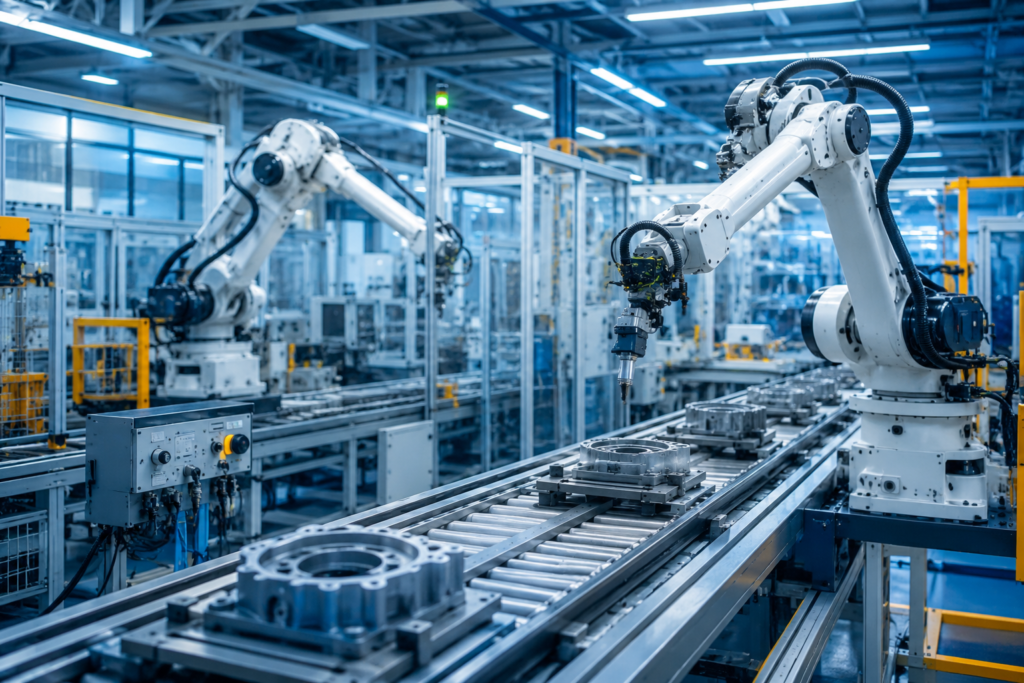
For example, a conveyor belt in a factory can move products automatically. Similarly, robotic arms can assemble products with high accuracy. Therefore, industries can produce more goods in less time.
Automation systems are designed to improve efficiency. In addition, they help reduce downtime and maintain consistent product quality.
How Does Industrial Automation Work?
Industrial Automation works through a combination of hardware and software. Each component plays a specific role in controlling industrial processes.
The basic process is simple:
- Sensors collect data from machines.
- Controllers process the information.
- Control systems make decisions.
- Actuators perform the required action.
- Operators monitor the process through software interfaces.
As a result, machines can operate continuously with minimal human intervention.
Main Components of Industrial Automation
1. PLC (Programmable Logic Controller)
2. Sensors
Sensors detect physical conditions such as temperature, pressure, level, and proximity. Then, they send data to the controller.
3. Actuators
Actuators convert control signals into physical movement. For example, they can open valves or move mechanical parts.
4. HMI (Human Machine Interface)
An HMI allows operators to monitor and control industrial equipment through a graphical display.
5. SCADA Systems
SCADA systems collect and display data from multiple machines. Consequently, operators can monitor large industrial processes from a central location.
Benefits of Industrial Automation
Industrial Automation offers many advantages.
- Increased productivity
- Better product quality
- Improved workplace safety
- Reduced human error
- Lower operating costs
- Faster production cycles
- Consistent performance
Furthermore, automation helps companies stay competitive in a rapidly changing market.
Fixed Automation
Fixed automation is designed for high-volume production. It is commonly used in automotive manufacturing.
Programmable Automation
Programmable automation allows production changes through software modifications. Therefore, it is suitable for batch production.
Flexible Automation
Flexible automation can adapt to different products with minimal changes. As a result, manufacturers can respond quickly to market demands.
Industrial Automation is widely used in different sectors.
- Manufacturing industries
- Power generation plants
- Oil and gas facilities
- Food processing plants
- Pharmaceutical production
- Water treatment systems
- Packaging industries