
Table of Contents
ToggleIntroduction
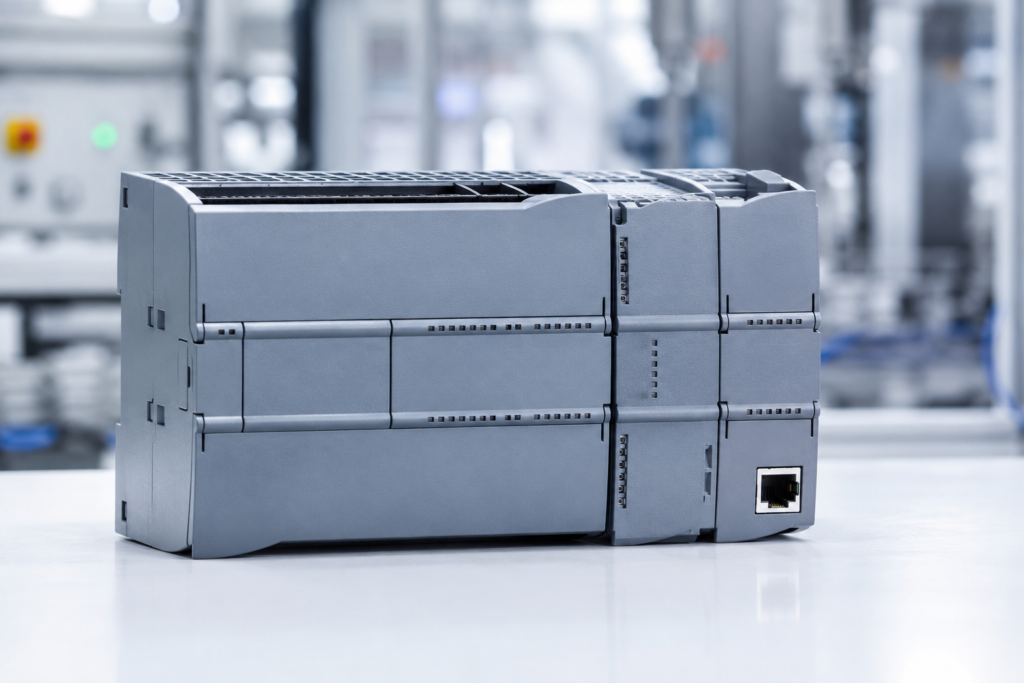
The Siemens S7-1200 PLC is one of the most popular programmable logic controllers used in modern industrial automation. It is designed to provide reliable control, monitoring, and automation for a wide range of industrial processes. Whether you are new to PLC programming or looking to understand industrial control systems, the Siemens S7-1200 offers an excellent starting point due to its user-friendly design and powerful features.
Industries around the world use the Siemens S7-1200 PLC to automate machinery, improve productivity, reduce manual labor, and enhance system efficiency. From manufacturing plants to water treatment facilities, this PLC plays a critical role in ensuring smooth and reliable operations.
This guide will help beginners understand what the Siemens S7-1200 PLC is, how it works, its key features, applications, advantages, and why it has become a preferred choice for industrial automation projects.Introduction
What Is Siemens S7-1200 PLC?
The Siemens S7-1200 PLC is a compact automation controller developed by Siemens for small and medium-sized industrial applications. It belongs to the SIMATIC family of PLCs and is widely recognized for its flexibility, reliability, and ease of use.
A PLC, or Programmable Logic Controller, is an industrial computer designed to control machines and processes. The S7-1200 receives input signals from sensors, processes the information according to a programmed logic, and sends output signals to control devices such as motors, valves, pumps, and actuators.
The Siemens S7-1200 combines advanced control capabilities with integrated communication functions, making it suitable for modern industrial environments.
Key Features of Siemens S7-1200 PLC
Compact Design
One of the major advantages of the Siemens S7-1200 PLC is its compact design. It requires less installation space while delivering powerful performance. This makes it ideal for control panels where space is limited.
Integrated Communication
The S7-1200 includes built-in Ethernet communication, allowing easy connection with other devices, HMIs, SCADA systems, and industrial networks. This simplifies system integration and reduces wiring requirements.
High Processing Performance
The PLC is equipped with a powerful processor capable of handling complex automation tasks efficiently. Fast processing speeds help improve overall system performance and responsiveness.
Scalability
The Siemens S7-1200 can be expanded with additional modules, including digital inputs, digital outputs, analog inputs, analog outputs, and communication modules. This flexibility allows users to customize the system according to project requirements.
Easy Programming
Programming is performed using Siemens TIA Portal software, which provides an intuitive and user-friendly development environment. Beginners can quickly learn how to create, test, and troubleshoot automation programs.
Built-In Safety Features
The S7-1200 offers various security and diagnostic functions that help protect equipment and improve operational reliability.
CPU (Central Processing Unit)
The CPU is the brain of the PLC. It processes inputs, executes the control program, and manages outputs.
Input Modules
Input modules receive signals from field devices such as push buttons, sensors, switches, and limit detectors.
Output Modules
Output modules send commands to devices such as motors, relays, contactors, valves, and indicator lights.
Communication Modules
Communication modules allow the PLC to exchange data with other automation devices and industrial networks.
Power Supply
The power supply provides the necessary electrical power required for PLC operation.
The operation of the Siemens S7-1200 PLC follows a continuous scanning process:
Step 1: Input Reading
The PLC reads signals from connected sensors and input devices.
Step 2: Program Execution
The CPU processes the received signals according to the logic programmed by the engineer.
Step 3: Output Update
The PLC sends commands to output devices based on the program's decision.
Step 4: Repeat Cycle
The scan cycle repeats continuously, allowing real-time monitoring and control of industrial processes.
This rapid execution ensures accurate and reliable automation performance.
The Siemens S7-1200 supports multiple programming languages according to international standards.
Ladder Logic (LAD)
Ladder Logic is the most widely used PLC programming language. It resembles electrical relay diagrams and is easy for beginners to understand.
Function Block Diagram (FBD)
FBD uses graphical blocks to create automation logic and is useful for process control applications.
Structured Text (ST)
Structured Text is a high-level programming language that allows advanced calculations and complex logic development.
These programming options provide flexibility for engineers with different backgrounds and experience levels.
Siemens TIA Portal Software
TIA Portal (Totally Integrated Automation Portal) is the primary software used for configuring and programming the Siemens S7-1200 PLC.
Benefits of TIA Portal
- User-friendly interface
- Easy project management
- Integrated PLC and HMI programming
- Advanced diagnostics tools
- Efficient troubleshooting capabilities
- Comprehensive simulation features