
Table of Contents
TogglePLC Automation Guide for Smart Factory Systems
PLC automation is a key technology used in modern industrial environments. It helps factories run machines in a controlled, safe, and efficient way. In smart factory systems, PLCs (Programmable Logic Controllers) play a central role in managing production processes with accuracy and speed.
This guide explains PLC automation in a simple way. It also covers how it works, where it is used, and why it is important for smart factories.
What is PLC Automation?
PLC automation means using a programmable controller to manage machines and industrial processes. A PLC receives input signals, processes them, and gives output commands to machines.
For example, a PLC can control motors, sensors, conveyor belts, and robotic systems in a factory.
How PLC Works in Smart Factories
In smart factory systems, PLCs connect different machines and devices. They collect data from sensors and make decisions based on programmed logic.
Simple working steps:
- Input signals come from sensors
- PLC processes the data
- Output signals control machines
This process happens very fast, which improves production speed and accuracy.
Benefits of PLC Automation
PLC automation provides many advantages for modern industries:
- Improves production efficiency
- Reduces human errors
- Increases safety in industrial systems
- Supports real-time monitoring
- Easy to upgrade and maintain
These benefits make PLC systems important for smart factories.
PLC systems are used in many industrial areas:
- Manufacturing assembly lines
- Packaging systems
- Conveyor belt control
- Robotic automation
- Machine safety systems
Smart factories depend on PLCs to keep operations smooth and reliable.
PLC Components in Automation Systems
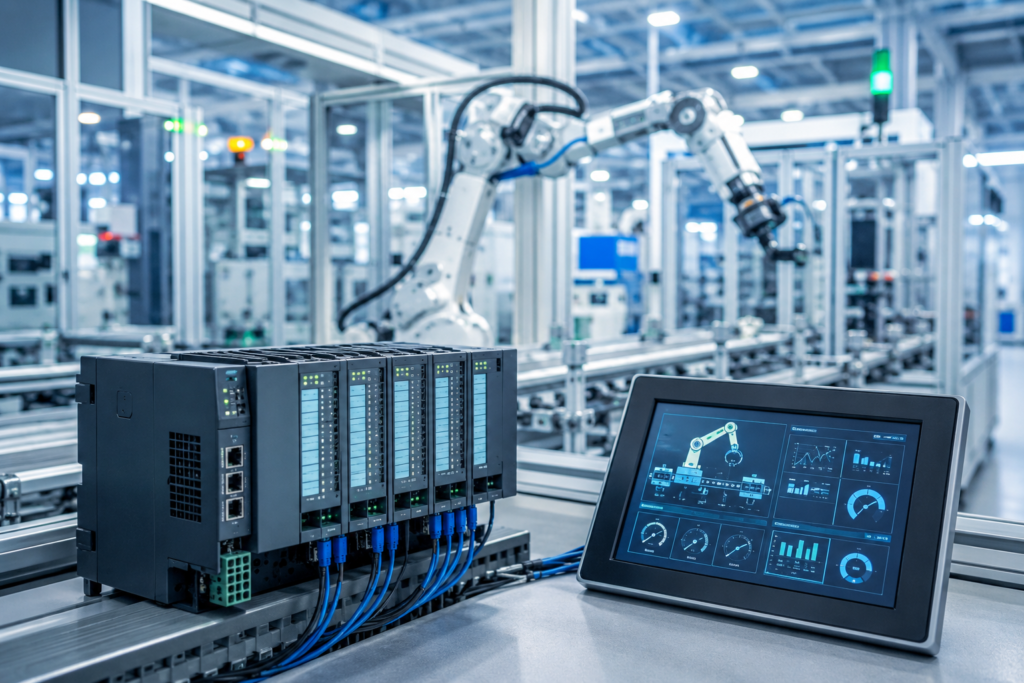
A typical PLC system includes:
- Input modules
- Output modules
- Power supply
- Communication interface
- CPU (Central Processing Unit)