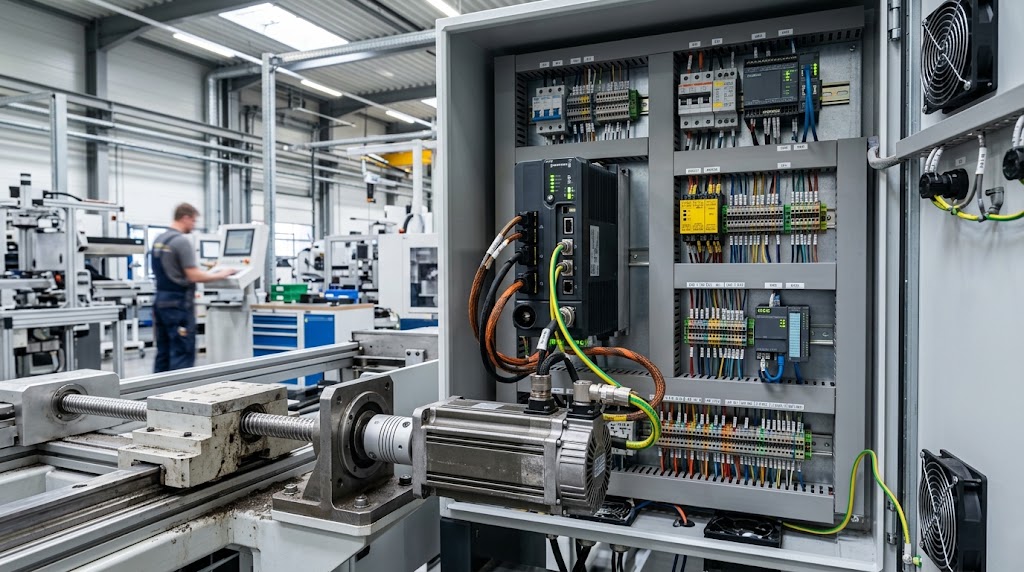
Learning how to start a servo motor requires more than connecting a power supply and pressing a start button. A servo system combines a motor, servo drive, feedback device, and controller to deliver accurate motion in industrial automation. Therefore, engineers must configure these components correctly before operating the motor.
Servo motors play an essential role in CNC machines, packaging equipment, robotic systems, conveyor mechanisms, and automated production lines. Unlike a basic motor installation, a servo setup requires proper feedback configuration, control signals, parameter settings, and safety checks.
This guide explains how to start a servo motor, prepare its drive, establish control communication, and identify common startup problems. It also covers practical considerations that help technicians achieve stable operation and protect connected machinery.
Understanding a Servo Motor System
Before starting a servo motor, you need to understand how its main components work together. Each component contributes to accurate movement, controlled speed, or reliable positioning.
Servo Motor
The servo motor converts electrical energy into controlled mechanical movement. Depending on the application, it can rotate to a specific position, maintain a commanded speed, or produce controlled torque. Industrial servo motors often use permanent magnets and provide rapid acceleration with precise motion control.
Servo Drive
The servo drive supplies controlled electrical power to the motor. It also processes feedback signals and adjusts motor current to follow the controller's commands. Consequently, the drive plays a central role in maintaining stable motion and correcting positioning errors.
Feedback Device
Most industrial servo systems use an encoder or another feedback device to report motor position and speed. The drive compares this feedback with the commanded movement and adjusts its output accordingly. Without compatible feedback, many closed-loop servo systems cannot operate correctly.
Motion Controller or PLC
A programmable logic controller (PLC), motion controller, or compatible host device sends commands to the servo drive. Depending on the system, these commands may use digital inputs, pulse signals, analog references, or an industrial communication network.
Understanding these components helps you identify the correct startup procedure for your particular servo system.
Essential Checks Before Starting a Servo Motor
Before applying power, review the manufacturer's documentation and confirm that the motor, drive, power supply, and controller support one another. Different manufacturers use different terminal layouts, parameter names, and startup procedures. Therefore, never assume that one model follows the same wiring arrangement as another.
Verify Motor and Drive Compatibility
First, check the motor's rated voltage, current, power, and feedback type. Compare these specifications with the servo drive's supported ratings. An incompatible combination can trigger faults or damage electrical components.
Next, confirm that the drive supports the motor's encoder and communication requirements. Some manufacturers require a specific motor-drive combination or a compatible feedback cable. Using the correct components simplifies configuration and reduces startup problems.
Inspect the Power Supply
Check the drive's input voltage and supply type against its nameplate and manual. Some drives operate from single-phase AC, while others require three-phase AC or a DC supply. Never connect a drive to an assumed voltage.
Also, inspect protective devices, grounding, cable condition, and terminal tightness. Qualified personnel should complete electrical connections with the equipment isolated from power. Follow the manufacturer's discharge procedure because DC bus capacitors can retain dangerous voltage after disconnection.
Check Mechanical Installation
Before startup, confirm that the motor mounts securely and that the shaft, coupling, gearbox, and driven machine align correctly. Misalignment can cause vibration, excessive bearing loads, and premature wear.
Additionally, inspect the machine for obstructions and ensure that the motor can move safely during testing. If the motor controls a vertical axis, suspended load, or hazardous mechanism, provide the required mechanical restraint and braking arrangements before enabling the drive.
Confirm Safety Arrangements
Review the emergency stop circuit, protective covers, machine interlocks, and applicable safety functions. Keep personnel clear of moving components and make sure the machine cannot start unexpectedly.
Importantly, a servo drive's ordinary enable input does not automatically provide a safety-rated stopping function. Use the manufacturer's specified safety architecture, including Safe Torque Off (STO) where appropriate, and follow the machine's risk assessment.
Only proceed when the electrical installation, mechanical assembly, and safety arrangements meet the relevant manufacturer instructions.
How to Start a Servo Motor: Wiring and Connections
After completing the initial safety checks, the next step in learning how to start a servo motor is to connect the motor, drive, power supply, and controller correctly. However, every servo system has its own wiring requirements. Therefore, always follow the manufacturer's wiring diagram instead of copying connections from another model.
Connect the Servo Motor to the Servo Drive
First, identify the motor power terminals and the matching output terminals on the servo drive. Depending on the model, these connections may carry three-phase motor power. Next, connect the motor feedback cable to the designated encoder port so the drive can monitor position and speed.
Additionally, connect the protective earth according to the manufacturer's instructions. Keep motor power cables separate from sensitive signal cables where the installation guidelines require it. This arrangement helps reduce electrical interference and improves feedback reliability.
Before applying power, inspect every connection against the official wiring diagram. Incorrect wiring can damage the drive, disrupt feedback signals, or trigger an immediate fault. For that reason, qualified personnel should verify the installation before proceeding.
Connect the Servo Drive to the Controller
Once the motor connections are complete, connect the servo drive to the PLC, motion controller, or other compatible command source. The correct method depends on the control interface supported by your equipment.
For example, some systems use pulse-and-direction signals, while others use analog references or industrial networks such as EtherCAT or PROFINET. Consequently, you must configure the controller and drive for the same control method.
Also, verify the signal voltage, terminal assignments, communication settings, and grounding requirements. If the controller cannot communicate with the drive, check the interface configuration before attempting to enable motor movement.
How to Start a Servo Motor: Configure the Drive
To understand how to start a servo motor correctly, you must configure the servo drive according to the motor specifications and application requirements. Although correct wiring provides the foundation, suitable drive parameters ensure reliable operation. Therefore, begin by checking the manufacturer's instructions before changing any settings. Additionally, verify that the motor, feedback device, controller, and drive support the same configuration.
How to Start a Servo Motor by Setting Motor Parameters
First, open the servo drive's configuration software or operator interface. Then, enter the required motor information, including rated voltage, rated current, motor type, and encoder specifications, where applicable. However, the exact parameters depend on the servo model and its control system.
Some drives automatically identify compatible motors, whereas others require manual configuration. Consequently, check the selected motor model against the connected hardware before proceeding. Otherwise, incorrect motor data may affect torque production, speed regulation, feedback processing, and protective functions.
Next, review the recommended control parameters. Although advanced tuning can improve motion performance, incorrect adjustments may cause vibration or unstable movement. Therefore, start with the manufacturer's recommended values and change them only when the application requires it. In addition, record the original settings so you can restore them if necessary.
How to Start a Servo Motor Using the Correct Control Mode
After configuring the motor parameters, select the appropriate control mode. Most industrial servo drives support position, speed, or torque control; however, the available modes vary by model.
Position control suits CNC machines, robotic axes, and pick-and-place equipment because these applications require accurate movement to specific locations. In contrast, speed control maintains a commanded rotational speed, making it useful for applications that need consistent motion. Meanwhile, torque control regulates motor torque for suitable force-control applications.
Therefore, choose the mode that matches the machine's operating requirements. Also, confirm that the PLC or motion controller sends commands compatible with the selected mode. If the drive and controller use different configurations, the motor may fail to respond correctly. As a result, checking the control mode before startup can prevent unnecessary troubleshooting.
How to Start a Servo Motor Safely With Limits and Protection
Before enabling the motor, configure the relevant current, speed, torque, and travel limits supported by the drive. Additionally, verify that limit switches and machine interlocks work as intended. These settings help keep operation within the machine's designed operating range.
Next, inspect the emergency stop circuit and the required safety functions. If the system uses Safe Torque Off (STO), confirm that qualified personnel have integrated and tested it according to the manufacturer's instructions. However, remember that STO removes the drive's ability to produce torque; it does not necessarily stop a moving load immediately or hold a suspended load safely.
Furthermore, check braking arrangements where gravity or external forces could move the machine unexpectedly. By completing these checks before startup, you can reduce avoidable risks and prepare the servo system for controlled testing.
How to Start a Servo Motor: Enable and Test the System
Once the drive configuration is complete, the next step in learning how to start a servo motor is to verify its status and prepare for the first movement. Nevertheless, do not issue a motion command until the machine area is clear and the required safety measures are ready.
How to Start a Servo Motor by Checking Drive Status
First, apply power using the manufacturer's approved startup sequence. Then, allow the drive to initialize and check its display or configuration software for alarms and status messages. Depending on the model, the drive may also report feedback errors, communication faults, or an incomplete configuration.
If an alarm appears, identify its code and consult the relevant manual. Rather than repeatedly resetting the drive, investigate the underlying cause. For example, a feedback alarm may indicate an encoder connection problem, while a communication fault may point to incorrect network settings or controller configuration.
Next, verify that the drive recognizes the motor feedback device and communicates correctly with the controller. Additionally, confirm the required supply conditions, enable signals, and safety circuit status. Once these checks pass, proceed according to the manufacturer's instructions.
How to Start a Servo Motor by Enabling the Servo System
To understand how to start a servo motor, first confirm that the servo drive is ready and the controller communicates correctly. Additionally, check that all required safety interlocks are satisfied. Then, follow the manufacturer's specified procedure to enable the servo motor.
For example, some servo drives use a digital servo-on input, whereas others accept enable commands through an industrial communication network. Therefore, always follow the wiring diagram and configuration instructions for your specific drive.
Once you enable the servo motor, verify its status before sending a movement command. If the motor does not respond, check the enable signal, active alarms, selected control mode, and command source. Furthermore, confirm that the controller sends a valid motion command because an enabled servo drive does not automatically make the motor rotate.
How to Start a Servo Motor With a Controlled Movement Test
After enabling the drive, the next step in how to start a servo motor is to perform a controlled movement test. First, select a suitable low-speed command or a small movement within the machine's safe operating range. However, always follow the manufacturer's recommendations and consider the connected load.
During the test, observe the servo motor's direction, sound, vibration, and response to the command. If unexpected movement, unusual noise, or an alarm occurs, stop the test using the approved procedure. Then, investigate the cause before attempting another movement.
Finally, compare the motor's feedback position or speed with the commanded values. If both respond as expected, the test indicates that the servo motor, drive, feedback device, and controller are communicating correctly. Nevertheless, complete all remaining commissioning checks before putting the machine into production.
Common Servo Motor Startup Problems
Even after completing the wiring and configuration, a servo system may fail to start because of electrical faults, incorrect parameters, or communication problems. Therefore, understanding how to start a servo motor also requires systematic troubleshooting instead of repeatedly resetting the drive.
Servo Motor Does Not Start
If the motor does not move after you enable the drive, first check its status and identify any active alarms. Next, verify the servo-on signal, controller readiness, and selected operating mode. Additionally, confirm that the controller sends a valid motion command through the configured interface.
When learning how to start a servo motor, remember that an open safety interlock or incomplete enable sequence can prevent operation. Consequently, consult the manufacturer's troubleshooting guide before changing parameters. Never bypass safety circuits to force the motor to start.
Servo Drive Shows an Alarm
A servo drive may report overcurrent, overvoltage, encoder, overheating, or communication faults. However, the meaning of each alarm depends on the specific drive model. Therefore, consult the manufacturer's alarm list and investigate the underlying cause before attempting a reset.
For example, an encoder alarm may indicate a damaged feedback cable, a loose connector, or an incompatible feedback device. Similarly, an overcurrent alarm may result from a mechanical obstruction, unsuitable settings, or an electrical problem. As part of how to start a servo motor safely, correct the cause and follow the approved restart procedure.
Servo Motor Vibrates or Makes Unusual Noise
Excessive vibration may result from incorrect tuning, mechanical misalignment, loose mounting, or an unsuitable load. Furthermore, unstable feedback signals can affect the drive's ability to regulate movement accurately.
To troubleshoot this problem, inspect the mechanical assembly and review the drive's diagnostic information. Then, check the tuning parameters against the manufacturer's recommendations. If vibration continues, stop the machine safely and obtain assistance from a qualified technician rather than making random adjustments.
Best Practices for Reliable Servo Motor Operation
Reliable operation depends on more than the initial startup. In fact, how to start a servo motor correctly also involves maintaining the electrical, mechanical, and control systems throughout their service life.
Follow the Manufacturer's Instructions
Different servo manufacturers use different wiring arrangements, configuration software, parameter names, and commissioning procedures. Therefore, always consult the manual for the exact motor and drive combination. Additionally, document important settings so technicians can review or restore the configuration when necessary.
Inspect Cables and Mechanical Components
Regularly inspect power cables, feedback connectors, grounding connections, motor mounts, and couplings. Meanwhile, monitor the system for unusual heat, vibration, or noise. Early detection can help prevent unexpected downtime and expensive component failures.
However, isolate the equipment and follow the required electrical safety procedures before inspecting or servicing connections. Never handle exposed electrical terminals while the system remains energized.
Monitor Performance After Startup
After commissioning, review drive alarms, operating temperature, movement accuracy, and other available diagnostic information. For example, repeated following errors may indicate excessive load, incorrect tuning, mechanical resistance, or feedback issues.
Consequently, investigate recurring faults instead of treating each alarm as an isolated incident. This approach helps maintain predictable motion and supports effective preventive maintenance. It also reinforces the importance of understanding how to start a servo motor and verify its performance under actual operating conditions.
Frequently Asked Questions
Can a Servo Motor Run Without a PLC?
Yes, some servo systems can operate without a PLC if the drive supports standalone positioning, internal motion sequences, or another compatible command source. However, available functions depend on the drive model and application requirements.
Why Does a Servo Motor Need a Servo Drive?
A servo drive regulates the electrical power supplied to the motor and processes feedback signals. As a result, it can control position, speed, or torque according to the selected operating mode and incoming commands.
How Long Does Servo Motor Startup Take?
The time required depends on the motor, drive, wiring, controller, and application. A previously configured system may start quickly, whereas a new installation can require additional commissioning, parameter verification, and safety testing.
Is It Safe to Start a Servo Motor Immediately After Wiring?
No. Before starting, verify the wiring, motor compatibility, grounding, protective devices, feedback connections, mechanical installation, and safety functions. Moreover, follow the manufacturer's commissioning procedure and ensure that qualified personnel approve the installation.
Conclusion
Learning how to start a servo motor requires a systematic approach to wiring, configuration, safety checks, and controlled testing. First, verify motor and drive compatibility. Next, configure the required parameters and control mode. Then, confirm that the drive and controller communicate correctly before enabling movement.
Furthermore, investigate alarms and unexpected motion before returning the machine to service. By following the manufacturer's instructions and maintaining the system properly, technicians can improve reliability, reduce avoidable faults, and achieve more consistent performance in industrial automation. Ultimately, understanding how to start a servo motor helps technicians commission equipment methodically and identify potential problems before they disrupt production.

Pingback: Servo Motor Tuning: Advanced Guide to Better Performance
Pingback: Multi Axis Servo Control: PLC Electronic Gearing Guide