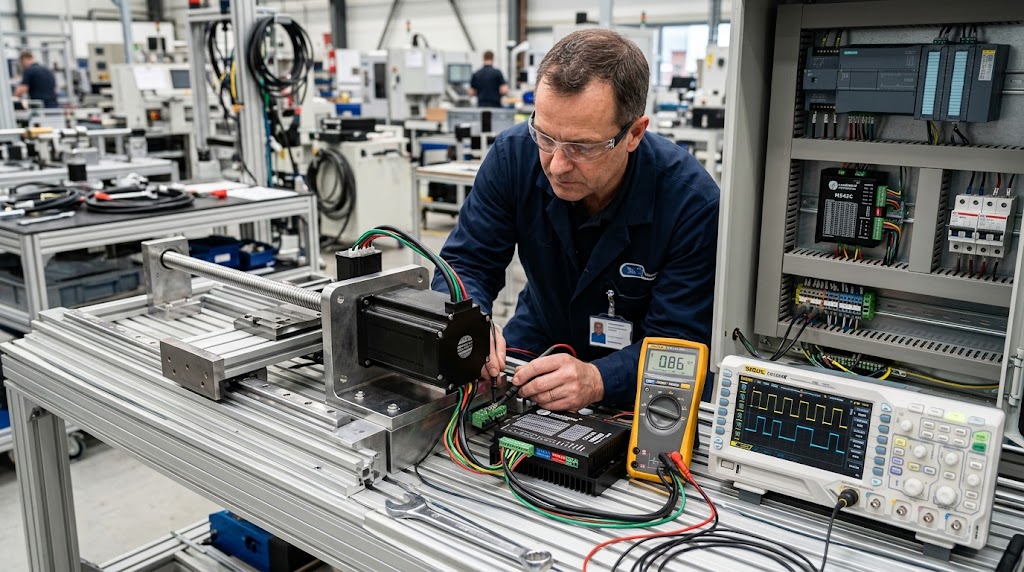
Stepper motors play an important role in industrial automation because they provide controlled movement in packaging machines, CNC equipment, automated inspection systems, and precision positioning applications. However, even a properly selected motor can develop operational problems when electrical signals, mechanical loads, or drive settings do not match the application requirements. These faults can reduce positioning accuracy, interrupt production, and increase maintenance costs.
Stepper motor troubleshooting helps maintenance engineers identify the source of a fault before replacing components unnecessarily. Instead of assuming that the motor has failed, technicians should examine the complete motion system, including the power supply, motor driver, control signals, wiring, mechanical transmission, and operating conditions.
This guide explains how to recognize common stepper motor problems, investigate their causes, and select practical corrective actions. It focuses on systematic fault diagnosis in industrial environments rather than replacing components through trial and error.
Why Stepper Motor Troubleshooting Matters
A stepper motor converts electrical pulses into controlled angular movement. The controller sends commands, while the driver energizes the motor windings in a specific sequence. As a result, the rotor moves in defined steps.
However, commanded movement does not always guarantee that the rotor reaches its intended position. Excessive load, incorrect current settings, unstable power, or unsuitable acceleration can cause missed steps. Similarly, damaged connectors or incorrect control signals may prevent the motor from responding consistently.
Effective troubleshooting helps engineers distinguish between electrical faults, mechanical resistance, control problems, and unsuitable operating parameters. This distinction matters because different faults can produce similar symptoms. For example, a motor that vibrates without rotating may have incorrect phase wiring, but excessive mechanical resistance or an unsuitable pulse frequency can create similar behavior.
Therefore, technicians should confirm the actual cause before changing driver settings or replacing hardware. A structured investigation also creates useful maintenance records that help prevent recurring failures.
Common Stepper Motor Problems and Their Symptoms
Stepper Motor Vibrates but Does Not Rotate
One of the most recognizable faults occurs when a stepper motor produces noise or vibration without completing a rotation. The motor may move slightly in both directions, remain locked in one position, or fail to respond correctly to movement commands.
Incorrect winding connections are a common cause. A stepper motor typically has multiple winding terminals, and connecting the phases incorrectly can prevent the driver from producing the magnetic sequence required for rotation. Loose connectors, damaged cables, and incompatible driver configurations can create similar symptoms.
Begin by checking the motor wiring against the manufacturer's connection diagram. Next, inspect terminal tightness and verify that the motor and driver are compatible. If the electrical connections are correct, disconnect the motor from the driven mechanism only when the equipment is safely isolated and the manufacturer's procedure permits it. A controlled test can help determine whether the resistance originates inside the mechanism or within the motor-control system.
Stepper Motor Misses Steps
Missed steps occur when the motor fails to follow the movement commanded by the controller. This problem can cause a machine axis to lose its reference position, produce inaccurate dimensions, or place a component incorrectly.
Several conditions can contribute to missed steps. Excessive load increases the torque required for movement, while rapid acceleration can demand more torque than the motor can produce. In addition, the available torque generally decreases as stepper motor speed increases. A motor that performs correctly at low speed may therefore lose synchronization at higher speeds.
Mechanical binding is another possible cause. Worn bearings, misaligned couplings, contaminated linear guides, or a poorly adjusted belt can increase resistance. Meanwhile, an incorrectly configured driver may limit the current needed to generate sufficient torque.
To investigate this fault, compare the actual load with the motor's rated capabilities and review the machine's acceleration and speed settings. Check the mechanism for binding and confirm that the driver current follows the motor manufacturer's recommendations. If the application requires faster movement, adjust acceleration gradually and test the system under controlled conditions.
Importantly, do not increase motor current automatically. Excessive current can raise winding and driver temperatures, potentially creating another fault instead of resolving the original problem.
Stepper Motor Overheating
Stepper motors can become warm during normal operation, particularly when they remain energized while holding a position. However, excessive temperature, repeated thermal shutdowns, or an unusual burning smell indicates that the system requires investigation.
Incorrect current settings are a frequent cause of overheating. When the driver supplies more current than the application requires or the motor manufacturer permits, winding losses increase. Poor ventilation, high ambient temperatures, and prolonged operation under heavy loads can also raise motor temperature.
Furthermore, some systems keep the motor energized at full holding current even when the machine remains stationary. Depending on the driver, a suitable idle-current reduction feature may help lower heat generation without compromising the application's holding requirements.
First, compare the configured current with the motor and driver documentation. Then inspect cooling conditions, mounting arrangements, and surrounding equipment for restricted airflow. Review the duty cycle and holding requirements before changing idle-current settings.
Never judge temperature by touch alone, particularly around industrial machinery. Use an appropriate measurement method and compare the readings with the manufacturer's specified operating limits. If the motor repeatedly overheats despite correct settings, investigate mechanical overload, winding damage, and driver compatibility before returning the machine to service.
Stepper Motor Troubleshooting: Motor Stops Unexpectedly
A stepper motor may stop during production even when it starts normally. This problem can interrupt packaging lines, automated assembly systems, and precision manufacturing processes. Therefore, technicians should investigate the power supply, driver status, and control signals before replacing any component.
During Stepper Motor Troubleshooting, begin by checking the motor driver's diagnostic indicators and alarm history. Depending on the model, the driver may report undervoltage, overcurrent, an enable-signal problem, or another protective fault. Next, inspect accessible cables, connectors, fuses, and power terminals for damage or loose connections.
The timing of the failure can also reveal useful information. For example, a motor that stops when other equipment starts may experience a power-quality problem. However, a stop that coincides with a controller alarm may indicate a command or configuration issue.
Record the alarm code before resetting the driver. Then consult the manufacturer's documentation and follow the recommended diagnostic procedure. Always isolate electrical power before handling wiring and follow the site's lockout procedures.
Stepper Motor Troubleshooting: Incorrect Rotation Direction
Incorrect rotation can cause a machine axis to move away from its intended position. In CNC equipment, this may disrupt a machining sequence. Similarly, an automated assembly line may send a component toward the wrong station.
This fault can result from an incorrect direction command, an unsuitable controller parameter, or a wiring arrangement that does not match the manufacturer's diagram. Recent maintenance or a configuration change may also explain the problem.
For effective Stepper Motor Troubleshooting, compare the commanded direction with the actual axis movement. Next, review the controller configuration and motor-driver documentation. Some systems allow software-based direction reversal, while others use different wiring arrangements.
Change only one setting at a time and document the original value. Then perform a low-speed test under safe conditions. Additionally, verify the homing direction and travel limits before returning the equipment to automatic operation. This process helps restore correct movement without introducing unrelated configuration errors.
Stepper Motor Troubleshooting: Driver and Communication Faults
The motor driver regulates winding current and translates control commands into motor movement. Consequently, a motor may fail to respond even when its physical components remain in good condition.
Common causes include a missing enable signal, incorrect input configuration, a damaged communication cable, or a communication timeout. Networked systems may also experience addressing errors or incompatible controller settings.
Start by checking the driver's status indicators and the controller's event log. Then confirm that the enable, pulse, and direction signals match the equipment specifications. If the system uses an industrial communication network, inspect its connection status, device address, and error records.
During Stepper Motor Troubleshooting, capture diagnostic information before resetting the system. This step preserves evidence that may help identify intermittent faults. Also, avoid changing several parameters simultaneously because doing so makes the original cause harder to identify.
Stepper Motor Troubleshooting: Mechanical Inspection
Electrical controls cannot guarantee accurate movement when the machine's transmission has a mechanical defect. A damaged coupling, misaligned lead screw, worn bearing, loose mounting bracket, or contaminated guide rail can interfere with the motion system.
First, isolate the machine and follow the manufacturer's inspection procedure. Examine accessible components for unusual wear, contamination, visible damage, and loose fasteners. For belt-driven systems, check belt condition and tension against the manufacturer's requirements.
If the mechanism shows unusual resistance, investigate its source before restarting the motor. Never force a shaft or move a loaded mechanism without confirming that the procedure is safe. Industrial machinery may contain suspended loads or stored energy that can cause serious injuries.
This stage of Stepper Motor Troubleshooting should focus on the physical transmission and mounting arrangement rather than repeating electrical checks. Once technicians correct an identified mechanical defect, they should verify alignment and movement according to the equipment specifications.
Stepper Motor Troubleshooting: Testing Electrical Signals
After completing the initial inspections, a qualified technician can examine the power supply and control signals using suitable test equipment. Compare measurements with the specifications for the installed motor, driver, and controller.
Check whether the controller sends the expected pulse and direction signals. Then review the driver's current configuration, microstepping settings, and input requirements. Where signal timing matters, an oscilloscope or appropriate signal analyzer can help identify missing pulses, electrical noise, or irregular timing.
Accurate measurements matter because incorrect assumptions can lead to unnecessary component replacements. For instance, replacing a controller will not solve a problem caused by a damaged signal cable.
During Stepper Motor Troubleshooting, record the original settings and measurements before making adjustments. Change a parameter only when test results or manufacturer guidance support the change. Afterwards, repeat the relevant test to confirm whether the adjustment resolved the fault.
Only qualified personnel should perform electrical testing, and they must use appropriate instruments and safe procedures for the equipment involved.
Preventive Maintenance for Reliable Stepper Motor Operation
A planned maintenance routine helps technicians detect developing faults before they disrupt production. However, inspection intervals should reflect the manufacturer's recommendations, operating hours, environmental conditions, and application demands.
Inspect cable insulation, connectors, mounting hardware, and accessible transmission components at scheduled intervals. Keep electrical enclosures clean and maintain adequate airflow around drives and other heat-producing equipment. Additionally, check cable routing for abrasion, sharp edges, and excessive bending.
Maintain a record of alarm codes, configuration changes, inspection results, and replaced components. When a fault returns, these records help technicians identify patterns and compare current behavior with earlier incidents.
Finally, validate the complete motion cycle after maintenance. Confirm the rotation direction, homing behavior, travel limits, and positioning accuracy. Test the equipment under appropriate operating conditions before returning it to production.
Frequently Asked Questions
What Is Stepper Motor Troubleshooting?
Stepper motor troubleshooting is the process of identifying faults in a motor, driver, wiring, or control system. It helps technicians find the root cause of operational problems and choose suitable corrective actions instead of replacing components unnecessarily.
Why Does a Stepper Motor Stop Suddenly?
A stepper motor may stop because of a power supply issue, a driver protection fault, a missing enable signal, or a controller error. During stepper motor troubleshooting, check the driver's alarm indicators, inspect accessible connections safely, and compare the fault code with the manufacturer's documentation.
How Can I Diagnose Stepper Motor Driver Problems?
Effective stepper motor troubleshooting starts with reviewing driver status indicators and controller alarm history. Next, verify the enable, pulse, and direction signals against the equipment specifications. Qualified technicians can use suitable test instruments to investigate electrical problems safely.
How Can I Prevent Recurring Stepper Motor Faults?
Regular inspections, correct driver configuration, clean electrical enclosures, and reliable maintenance records help reduce recurring faults. In addition, document alarm codes and configuration changes so technicians can identify patterns and diagnose future problems more efficiently.
Conclusion
Effective Stepper Motor Troubleshooting depends on systematic diagnosis rather than guesswork. By examining alarm history, control signals, driver settings, and mechanical components, maintenance teams can identify faults more accurately and avoid unnecessary replacements.
Furthermore, reliable maintenance records and controlled testing help prevent recurring problems. With manufacturer-approved procedures and proper safety practices, industrial facilities can improve motion reliability, reduce avoidable downtime, and maintain consistent production performance.