Stepper motors are widely used in industrial automation because they can produce controlled rotational movement without requiring a conventional position feedback system in many applications. However, choosing a motor based only on its rated torque can lead to poor performance. The actual load, operating speed, acceleration, friction, and mechanical transmission all affect whether a stepper motor can move reliably.
Understanding stepper motor torque is therefore essential when designing or selecting a motion-control system. A motor may have enough holding torque when stationary but lose a significant amount of usable torque as speed increases. Similarly, a machine that works correctly under a light load may begin missing steps when acceleration or mechanical resistance increases.
This guide explains the engineering principles behind stepper motor torque, how torque changes during operation, how to calculate the required torque, and how to select an appropriate motor for industrial applications. The goal is to help engineers and technicians make practical sizing decisions rather than relying on a motor's nameplate rating alone.
What Is Stepper Motor Torque?
Torque is the rotational force produced by a motor around its shaft. It is commonly measured in newton-meters (N·m) or ounce-inches (oz-in). In a stepper motor application, torque determines whether the motor can overcome the mechanical resistance of the connected load and maintain controlled movement.
Stepper motor torque is not a single fixed value. Its available torque changes depending on operating conditions. At zero or very low speed, a motor can generally produce substantial torque. As rotational speed increases, available torque usually decreases because the motor winding current has less time to build effectively against the electrical characteristics of the winding.
For this reason, a motor's maximum or holding torque should not automatically be treated as its usable torque during continuous motion.
Holding Torque vs. Running Torque
Holding torque refers to the maximum torque a stepper motor can resist while energized but stationary. It is useful when evaluating whether the motor can hold a load in position.
Running torque, however, describes the torque available while the motor is actually rotating. This value depends strongly on speed, drive voltage, current settings, acceleration, and the motor's electrical characteristics.
For industrial motion systems, running torque is often more important than the headline holding-torque specification. A motor rated at a high holding torque may still be unsuitable if the application requires significant torque at a relatively high operating speed.
Why Torque Matters in Motor Selection
Insufficient torque can cause several problems in a motion-control system. The motor may fail to accelerate the load, lose synchronization, stall, or miss commanded steps. These problems can become especially serious in equipment where position accuracy affects the final manufacturing process.
On the other hand, simply choosing the largest available motor is not always an efficient solution. An oversized motor can increase cost, power requirements, physical dimensions, and system inertia.
The correct approach is to calculate the torque requirement from the actual mechanical load and operating conditions, then provide an appropriate engineering margin.
What Determines the Torque Requirement?
The required stepper motor torque depends on the complete mechanical system, not just the motor itself. Every moving component creates some level of resistance. The motor must overcome that resistance while still maintaining stable and controlled movement.
Load weight is one important factor. A heavier moving assembly generally requires more torque, especially when the motor must accelerate it quickly. However, weight alone does not determine the final requirement. The way the load is connected to the motor also has a major effect.
Mechanical friction is another important consideration. Bearings, slides, gears, belts, and other transmission components can introduce resistance. Poor alignment can increase that resistance even further. As a result, two machines with similar loads may require different motor ratings.
Acceleration also affects the required torque. A system that moves gradually may place less demand on the motor than one that needs rapid starts and stops. During acceleration, the motor has to move the load while also increasing its rotational speed.
For this reason, engineers should consider the complete motion profile before selecting a motor. Looking only at the stationary load can produce an inaccurate estimate.
The Effect of Speed on Available Torque
One of the most important characteristics of a stepper motor is the relationship between speed and available torque.
At low speeds, a stepper motor can generally produce strong torque. As rotational speed increases, the available torque usually falls. This happens because the motor winding has electrical characteristics that limit how quickly current can build as the motor operates faster.
This difference matters in practical applications. A motor may appear suitable when tested at low speed but struggle when the same machine operates at a higher speed.
Therefore, the required stepper motor torque should always be considered at the actual operating speed. A motor's maximum rated torque does not necessarily represent the torque available during the complete operating range.
Motor drivers also influence performance. The supply voltage, current control, and driver characteristics can affect how effectively the motor performs at higher speeds. Consequently, motor and driver selection should be treated as part of the same motion-control system.
Acceleration and Deceleration Requirements
Acceleration is often overlooked during basic motor selection. Yet it can significantly affect the amount of torque required by a machine.
When a motor starts moving a load, it must overcome resistance and increase the speed of the moving system. A faster acceleration requirement creates greater demand on the motor.
Deceleration deserves similar attention. If a machine needs to stop quickly, the motor and mechanical system must handle the change in motion without losing control.
Industrial equipment often uses defined acceleration and deceleration profiles to keep movement smooth. This approach can reduce mechanical stress and help the motor remain within its usable operating range.
For demanding applications, the stepper motor torque requirement should therefore be evaluated across the entire motion cycle rather than at only one operating point.
Mechanical Transmission and Torque Demand
The connection between the motor and the load can greatly influence system performance.
A direct-drive arrangement transfers motor movement directly to the load. In contrast, belts, pulleys, gears, lead screws, and other mechanisms can change the relationship between motor rotation and load movement.
These components can provide useful mechanical advantages, but they also introduce their own losses and limitations. Gear systems, for example, can alter the torque available at the driven output while also adding mechanical complexity.
Lead-screw systems are common in linear positioning equipment. Their efficiency depends on the screw design and operating conditions. Friction in the screw and nut assembly can also affect the amount of torque needed from the motor.
Because of this, selecting a stepper motor without considering the transmission can result in an incorrect motor size.
Why a Safety Margin Matters
A motor should not normally operate continuously at the absolute limit of its available torque. Real machines experience changing loads, friction variations, temperature changes, mechanical wear, and other conditions that can affect performance.
A suitable torque margin provides additional operating headroom. It helps the system handle variations without immediately approaching the motor's maximum capability.
However, an unnecessarily large margin can also lead to an oversized motor. Larger motors may require more space, higher drive capacity, and additional cost.
The objective is to select a motor that comfortably handles the expected operating conditions while remaining appropriate for the machine's physical and electrical requirements.
Practical Factors Engineers Should Consider
A reliable motor selection process should consider more than the motor's catalog rating. The actual application should be examined from several angles.
Consider the moving load, required speed, acceleration profile, duty cycle, mechanical transmission, friction, and environmental conditions. The available power supply and compatible motor driver should also be checked.
Temperature can matter as well. Motor heating increases with operating conditions and current. If a motor operates continuously under demanding conditions, thermal performance can become an important part of the selection process.
In addition, the physical size of the motor must match the available mounting space. Shaft dimensions, mounting pattern, connector arrangement, and overall motor length can affect whether a particular model can be integrated into the machine.
A careful evaluation of these factors makes stepper motor torque selection much more reliable than choosing a motor solely from its advertised maximum rating.
How to Select the Right Motor
After identifying the application's mechanical requirements, the next step is to compare those requirements with the motor's performance characteristics.
Start by identifying the actual operating speed rather than relying on the motor's low-speed rating. Then consider how quickly the load must accelerate and how frequently the machine starts, stops, or changes direction.
Next, examine the mechanical transmission. A motor connected through a lead screw will have different operating requirements from one driving a belt or rotating shaft directly.
The selected motor should provide sufficient stepper motor torque throughout the important portion of the machine's operating range. This is more useful than selecting a motor based only on its highest possible torque value.
Avoid Selecting a Motor by Holding Torque Alone
Holding torque is useful, but it should not be the only specification used during selection.
A motor can have a strong holding torque while providing considerably less torque during high-speed operation. If the machine spends most of its operating time at higher speeds, the running performance becomes much more important.
Engineers should therefore examine the manufacturer's torque-speed information whenever it is available. This information provides a better indication of how the motor will behave under real operating conditions.
This approach also helps prevent a common sizing mistake: selecting a motor that looks powerful on paper but cannot maintain the required performance during actual motion.
Motor Driver Compatibility
The motor and driver must work together correctly. A suitable motor can still deliver poor results when paired with an inappropriate driver.
The driver controls the current supplied to the motor windings. Its current capability, supply voltage range, control method, and thermal performance can influence the final system.
For higher-speed applications, driver and supply characteristics become particularly important because the motor needs effective current control as operating speed increases.
Before final selection, engineers should verify the motor's rated current and voltage requirements against the driver's specifications. Proper compatibility helps the system achieve consistent performance and reduces the risk of overheating or unstable operation.
Application Example: Linear Motion Systems
Linear positioning equipment provides a useful example of why careful motor selection matters.
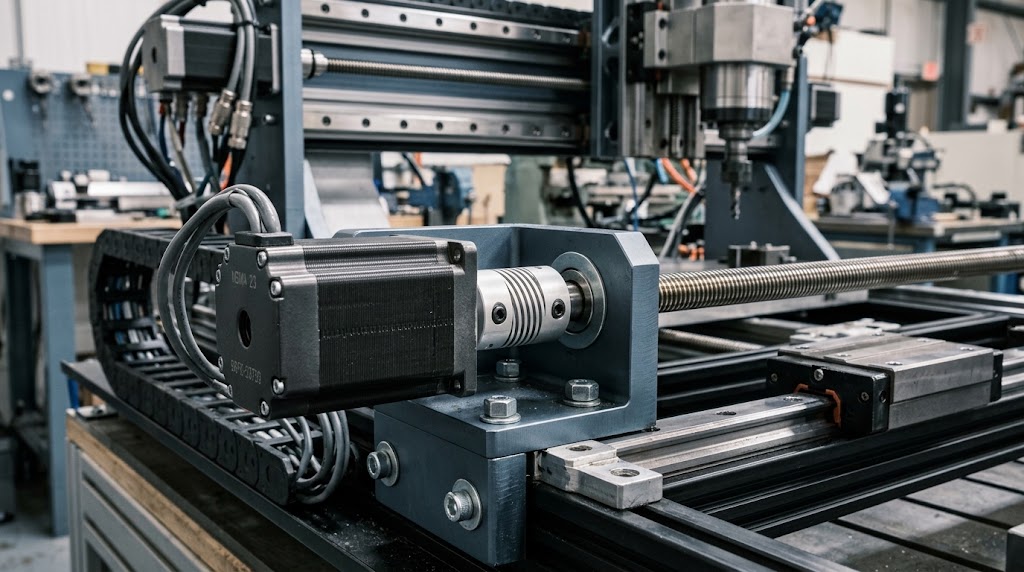
A stepper motor may drive a lead screw that moves a carriage along a rail. The motor must overcome the resistance of the carriage, the screw mechanism, and any external process force.
If the carriage becomes heavier or the required acceleration increases, the torque requirement also changes. The screw's mechanical characteristics can further influence how effectively motor rotation is converted into linear movement.
In such systems, stepper motor torque should be evaluated together with the required travel speed and acceleration. This provides a more realistic picture of the motor's actual workload.
Common Selection Mistakes
One common mistake is choosing a motor solely by its highest torque specification. This ignores the fact that available torque changes with speed.
Another mistake is ignoring acceleration. A machine may require relatively little torque once it reaches constant speed but need considerably more during rapid acceleration.
Ignoring mechanical friction can create another problem. Bearings, screws, belts, and other components may introduce resistance that was not included in the initial estimate.
It is also possible to select a motor that is unnecessarily large. Oversizing does not automatically guarantee better machine performance. The motor, driver, power supply, mounting system, and mechanical transmission should all be considered together.
Finally, engineers should avoid treating laboratory or no-load performance as representative of the complete machine. Real operating conditions should guide the final decision.
Improving Reliability After Selection
Correct motor selection is only one part of achieving reliable motion control. Installation and operating conditions also matter.
Proper mechanical alignment helps reduce unnecessary resistance. Secure mounting prevents unwanted vibration and movement. The driver should also be configured according to the motor manufacturer's specifications.
The machine should then be tested under realistic load conditions. Testing can reveal problems that may not appear during unloaded operation.
If the motor loses position, produces excessive vibration, or becomes unusually hot, the complete system should be examined. The cause may involve motor sizing, acceleration settings, mechanical resistance, driver configuration, or another part of the motion system.
A systematic approach makes troubleshooting more effective and helps maintain consistent machine performance.
Conclusion
Understanding stepper motor torque is essential for selecting a motor that can handle an application reliably. The required torque depends on factors such as load, friction, acceleration, speed, and the mechanical transmission system.
A proper torque calculation helps prevent missed steps, unstable motion, and unnecessary motor heating. However, the motor should not be selected only by its holding torque. The available torque at the required operating speed should also meet the application's needs.
By evaluating the complete load profile and adding an appropriate safety margin, engineers can choose a stepper motor that delivers reliable positioning and consistent performance. Proper motor sizing also supports efficient and dependable operation in industrial automation systems.

Pingback: Stepper Motor Positioning in Industrial Automation