
Table of Contents
ToggleIntroduction
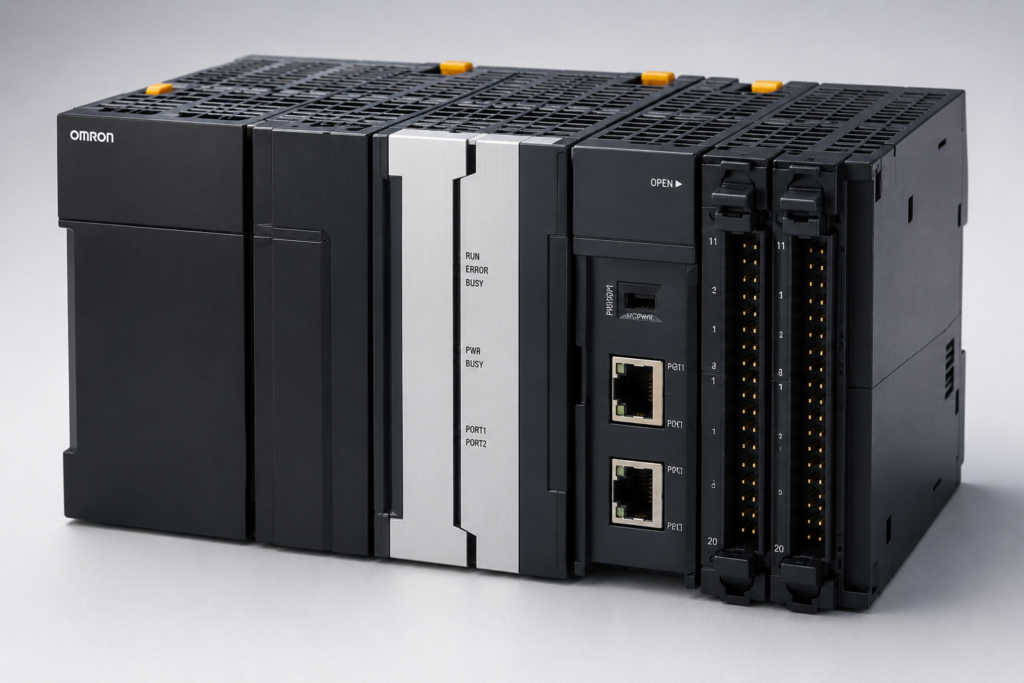
Omron NJ300 PLC is a powerful machine automation controller used in modern industries. It helps control machines with high speed, accuracy, and reliability. Many factories use Omron NJ300 PLC for packaging, assembly, material handling, and production systems. It also supports motion control, networking, and machine communication in one platform.
Today, industries need faster and smarter automation. Therefore, engineers choose controllers that can handle complex tasks without reducing performance. Omron NJ300 PLC meets these requirements. It offers stable operation, flexible expansion, and simple programming. In addition, it works well in both small and large automation projects. This guide explains the controller in simple words so beginners can understand it easily.
This guide explains the features, specifications, working principle, applications, advantages, and limitations of the Omron NJ300 PLC in simple language.
What is Omron NJ300 PLC?
The Omron NJ300 PLC is a machine automation controller developed for advanced industrial applications. Unlike a traditional PLC that mainly performs logic control, this controller combines multiple automation functions into a single platform.
The controller supports Ethernet communication, high-speed processing, and integration with HMIs, servo drives, sensors, and other industrial devices. It is programmed using Omron's Sysmac Studio software, which provides a unified environment for automation development.
Key Features
The Omron NJ300 PLC includes many features that improve machine performance and simplify industrial automation.
High-Speed Processing
The controller executes programs very quickly. As a result, machines respond faster and improve production efficiency.
Integrated Motion Control
The controller manages servo motors with high accuracy. Therefore, many machine builders choose it for synchronized motion applications.
Ethernet Communication
The Omron NJ300 PLC supports industrial Ethernet communication. In addition, it connects easily with HMIs, servo drives, sensors, and remote devices.
Modular Design
Users can add expansion modules whenever they need more inputs or outputs. This makes the controller flexible for future projects.
Reliable Performance
The controller works continuously in industrial environments. Therefore, it helps reduce machine downtime.
Centralized Programming
Sysmac Studio allows users to configure, program, monitor, and troubleshoot the entire automation system from one software platform.
Omron NJ300 PLC Technical Specifications
Although different models provide different capacities, most Omron NJ300 PLC controllers include the following specifications.
- High-speed processor
- Large program memory
- Ethernet communication
- EtherCAT motion network support
- USB programming interface
- Modular I/O expansion
- Multiple communication protocols
- High-speed data processing
- Real-time machine control
- Support for integrated automation systems
These specifications make the controller suitable for modern industrial applications where speed and accuracy are important.
Working Principle
The Omron NJ300 PLC operates using a continuous scan cycle. During each cycle, the controller follows several steps.
Step 1: Read Inputs
The PLC receives signals from sensors, switches, push buttons, and other input devices.
Step 2: Execute Program
The CPU compares the input conditions with the programmed logic stored in memory.
Step 3: Process Logic
The controller performs calculations, timer functions, counter operations, communication tasks, and motion control.
Step 4: Update Outputs
Based on the program results, output devices such as motors, relays, valves, and indicators are activated or deactivated.
Step 5: Repeat the Cycle
This process repeats continuously within milliseconds, allowing the machine to react almost instantly to changing conditions.
Because of this fast processing speed, the controller provides smooth and reliable machine operation.
Omron NJ300 PLC Applications
Packaging Industry
It controls filling machines, sealing equipment, conveyors, and labeling systems.
Food and Beverage Industry
It automates production lines while maintaining stable machine performance.
Automotive Industry
Manufacturers use it for robotic systems, assembly lines, inspection stations, and material movement.
Material Handling
The controller operates conveyor systems, sorting equipment, and automated warehouses.
Pharmaceutical Industry
It controls production machines that require reliable and accurate automation.
Printing Industry
Printing machines need synchronized motion control. Therefore, this controller is a suitable solution.
Textile Industry
It helps control weaving, cutting, and fabric handling machines efficiently.
Omron NJ300 PLC Advantages
The Omron NJ300 PLC provides many important advantages.
- High processing speed
- Stable industrial performance
- Flexible modular expansion
- Easy communication with industrial devices
- Integrated motion control
- Simple programming using Sysmac Studio
- Reliable machine operation
- Better production efficiency
- Reduced downtime
- Long service life
Therefore, many industries select this controller for modern automation projects.
Omron NJ300 PLC Limitations
Like every industrial controller, the Omron NJ300 PLC also has some limitations.
- The initial cost is higher than entry-level PLCs.
- Beginners need time to learn Sysmac Studio.
- Advanced motion applications require proper programming knowledge.
- Additional expansion modules increase project cost.
- Complex automation systems require careful planning.