
Table of Contents
ToggleIntroduction
PLC Working Step by Step is an important topic in industrial automation. A PLC Working Step by Step system is used to control machines and industrial processes automatically. PLC means Programmable Logic Controller. It is an electronic device that replaces traditional relay systems.
In this guide, we will learn PLC Working Step by Step in very simple language. This article is written for beginners who want to understand how a PLC works in real industries.
What is PLC?
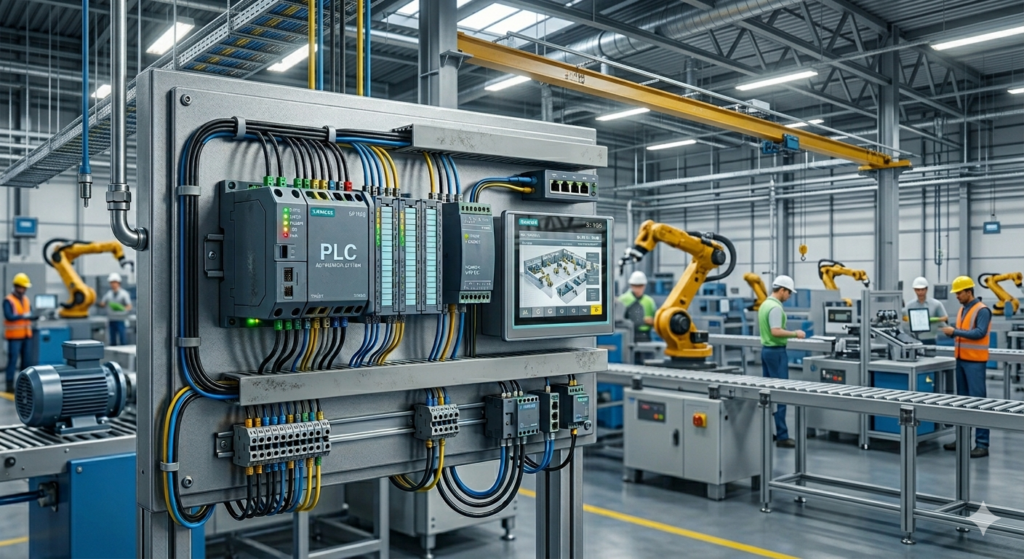
A PLC (Programmable Logic Controller) is a digital control system used in industries. It is designed to control machines automatically.
PLC takes input signals, processes them, and gives output signals. This helps machines work without human control.
Basic Parts of PLC System
1. Input Section
Input devices send signals to PLC. These devices include:
- Sensors
- Switches
- Push buttons
2. CPU (Brain of PLC)
CPU is the main part of PLC. It processes all input signals and runs the program.
3. Output Section
Output devices perform actions. These include:
- Motors
- Lamps
- Valves
4. Power Supply
Power supply gives electricity to the PLC system.
Now we will understand PLC Working Step by Step in detail.
Step 1: Input Signal is Received
In PLC Working Step by Step, the first step is input collection. Sensors and switches send signals to the PLC.
Example: A sensor detects a box on a conveyor belt.
Step 2: Input is Stored
The PLC stores input signals in memory. These signals are converted into digital data.
This helps PLC understand real-world conditions.
Step 3: Program Execution Starts
Now PLC Working Step by Step moves to program execution. The CPU runs the stored program.
This program is written in Ladder Logic or other PLC languages.
Step 4: Logic Processing
The PLC checks all conditions using logic rules like:
- AND
- OR
- NOT
Example: If sensor is ON AND button is pressed, then motor will start.
Step 5: Decision Making
In this step of PLC Working Step by Step, the PLC decides what action should be taken.
It analyzes input conditions and program instructions.
Step 6: Output is Generated
After processing, PLC sends output signals to devices.
Example:
- Motor starts
- Light turns ON
- Alarm activates
Step 7: Action is Performed
Now real machines perform the action. Conveyor belt moves, motors rotate, or valves open.
Step 8: Continuous Scanning Cycle
PLC Working Step by Step does not stop. It repeats the process again and again.
This cycle is called the scan cycle:
- Input scan
- Program scan
- Output scan
This happens very fast (milliseconds).
The scan cycle is the most important part of PLC Working Step by Step.
It ensures:
- Fast response
- Real-time operation
- Accurate control
PLC keeps repeating this cycle continuously.
Advantages of PLC
PLC has many benefits in industries:
- Fast processing speed
- Reliable system
- Easy programming
- Low maintenance
- Flexible design
PLC is used in many industries:
- Manufacturing factories
- Conveyor systems
- Packaging machines
- Water treatment plants
- Automobile industry
Why PLC is Important?
PLC Working Step by Step is important because modern industries depend on automation.
It helps:
- Increase production
- Reduce cost
- Improve safety
- Save time
Future of PLC
PLC technology is improving every year. Now PLC is connected with:
- IoT systems
- SCADA systems
- AI based automation