
Table of Contents
ToggleIntroduction
PLC vs SCADA is one of the most important topics in industrial automation. Beginners often get confused between these two systems. Both are widely used in industries but their functions are completely different.
Both systems work together in factories and plants.
What is PLC?
A PLC (Programmable Logic Controller) is a device used in industries to control machines.
- Reads input signals from sensors
- Controls output devices like motors
- Provides time delays
- Detects faults and errors
Example:
If a sensor detects a product, the PLC can start or stop a conveyor belt.
What is SCADA?
SCADA is a monitoring system used in industries.
SCADA Functions:
- Shows live data on screen
- Monitors machines
- Collects data from PLC
- Helps operators control systems
Example:
A power plant uses SCADA to show voltage and system status on a computer.
How They Work Together
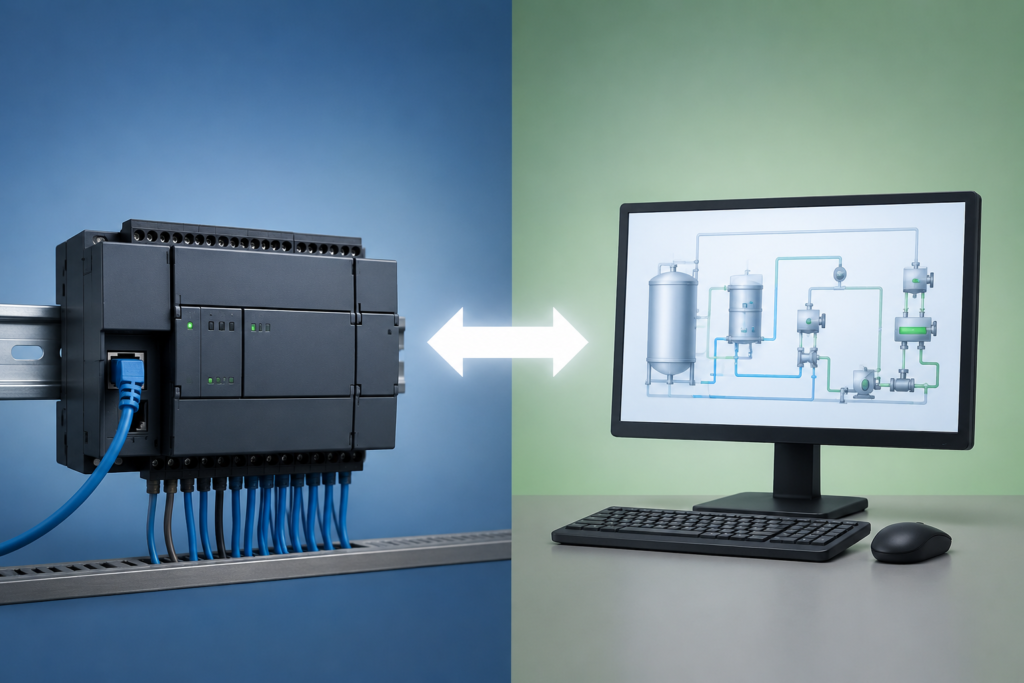
PLC collects data from machines. SCADA shows this data on screens. Both systems are connected in industrial automation.
Advantages of PLC
Programmable Logic Controller systems are widely used in modern industries because they offer many benefits.
One of the biggest advantages of PLC is its reliability. It can work in harsh environments like heat, dust, and vibration without failing. PLC systems are also very fast, which makes them perfect for real-time control of machines.
Another advantage is flexibility. You can easily change PLC programming without changing hardware. This saves time and cost in industries.
PLC also reduces human error. Since most processes are automated, chances of mistakes become very low.
Disadvantages of PLC
Even though PLC is very powerful, it has some limitations.
PLC systems can be expensive for small businesses. The initial setup cost is high.
It also requires skilled programmers. Without proper knowledge, programming PLC can be difficult.
Another limitation is that PLC is mainly used for control, not for advanced data analysis.
Advantages of SCADA
SCADA is very useful for monitoring and controlling large systems.
SCADA allows operators to see real-time data on screens. This helps in quick decision making. It also stores data for future analysis.
Another advantage is remote access. Engineers can monitor systems from far away locations using SCADA.
SCADA improves safety because it gives alerts when something goes wrong in the system.
Disadvantages of SCADA
SCADA also has some drawbacks.
It depends heavily on network communication. If the network fails, monitoring can be affected.
SCADA systems can be complex to install and configure.
Security is also a concern because SCADA systems connected to networks can be targeted by cyber attacks.
Conclusion
PLC vs SCADA are both important systems. PLC controls machines. SCADA monitors systems. Together, they make industrial automation efficient.
Applications of PLC
PLC is used in many industries such as:
- Manufacturing industries
- Conveyor belt systems
- Bottling plants
- Automobile industry
- Textile machines
In all these systems, PLC controls machines automatically and ensures smooth operation.
Applications of SCADA
SCADA is used in large-scale systems like:
- Power plants
- Water treatment plants
- Oil and gas industries
- Electrical grids
- Transportation systems
SCADA helps operators monitor everything from a central control room.
Communication Between PLC and SCADA
In modern automation systems, PLC and SCADA work together using communication protocols.
Some common protocols include:
- Modbus
- Profibus
- Ethernet/IP
- OPC (OLE for Process Control)