Stepper motors play an important role in machines that need controlled and repeatable movement. Unlike a standard motor that mainly focuses on continuous rotation, a stepper motor moves in controlled increments. This makes it useful when a machine must position a component accurately without complicated mechanical feedback.
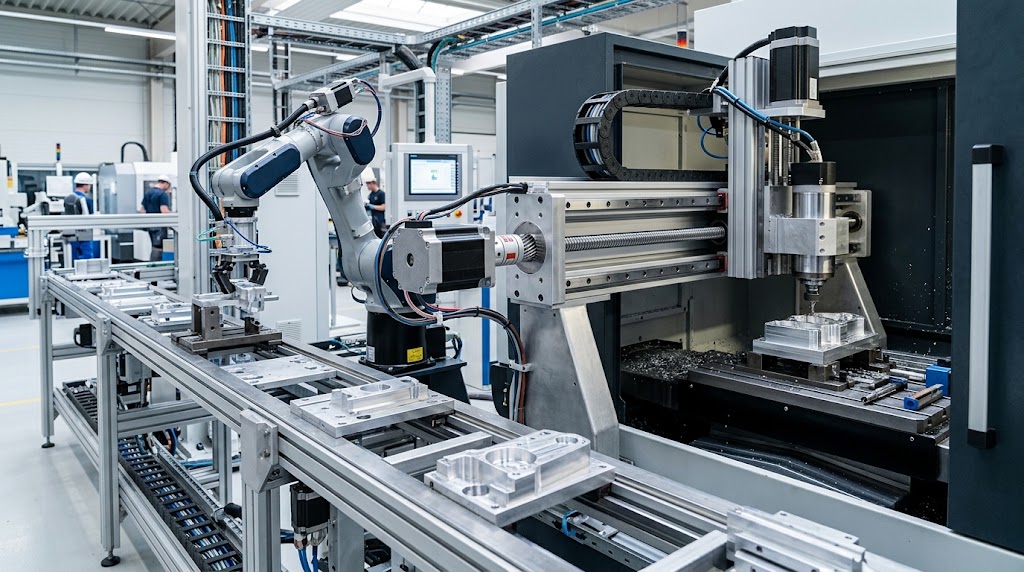
Today, stepper motor applications extend across many industrial systems. CNC machines, packaging equipment, robotics, inspection machines, 3D printers, and automated positioning systems all use stepper motors for different motion tasks.
However, the motor itself is only one part of the system. The driver, controller, mechanical load, operating speed, and required positioning accuracy all affect performance. Choosing a stepper motor simply because it provides high torque can therefore lead to poor results.
What Makes a Stepper Motor Different?
A stepper motor converts electrical pulses into controlled mechanical movement. Each command from the controller causes the motor to move through a defined step. By sending a sequence of pulses, the control system can determine how far and how quickly the motor moves.
This operating principle gives stepper motors an important advantage in automation: predictable positioning.
For example, a machine may need to move a cutting tool to several fixed positions. Instead of running a motor continuously and stopping it at an estimated point, the controller can send a specific number of pulses to the stepper motor. The motor then moves through the required sequence of steps.
This makes stepper motors particularly useful for applications where repeatable movement matters more than extremely high speed.
Why Industries Use Stepper Motors
Industrial machines often perform the same movement thousands of times. A positioning mechanism may move forward, stop, return, and repeat the cycle throughout the working day.
In such systems, engineers need motion that is predictable and easy to control. Stepper motors offer several characteristics that make them attractive for these tasks.
Their control method is relatively straightforward. A controller can command movement by generating electrical pulses, while the driver manages the current supplied to the motor windings.
Moreover, many applications can operate a stepper motor without an encoder. This can reduce system complexity when the load remains within the motor's reliable operating range.
That does not mean feedback is never useful. If a machine cannot tolerate missed movement, an encoder or closed-loop stepper system may provide an additional layer of position monitoring.
Stepper Motor Applications in CNC Machines
CNC equipment is one of the most recognizable areas where stepper motors are used. CNC machines need controlled movement along different axes to position tools and workpieces.
A stepper motor can drive mechanisms such as lead screws or belt-driven axes. The controller sends movement commands, while the motor converts those commands into mechanical motion.
In smaller CNC machines and light-duty equipment, stepper motors can provide a practical balance between control, cost, and performance.
The application becomes especially interesting when multiple axes work together. The controller must coordinate the movement of each motor so the machine follows the intended tool path.
However, CNC performance depends on more than motor resolution. Load, acceleration, mechanical friction, driver settings, and operating speed can all influence whether the motor maintains reliable movement.
Stepper Motors in 3D Printers
3D printers provide another excellent example of controlled stepper motor movement.
Different motors can control the X, Y, and Z axes, while another motor may drive the filament mechanism. Each movement needs to occur in a predictable way because small positioning errors can affect the final printed object.
The Z-axis often requires controlled vertical movement between layers. Meanwhile, the extruder needs consistent filament movement to maintain material flow.
This is where the repeatable stepping behavior of the motor becomes valuable.
Interestingly, the requirements are not identical for every axis. An extruder may need a different torque and speed profile from a horizontal positioning axis. Therefore, selecting the motor should always start with the actual mechanical requirement rather than using the same motor everywhere.
Positioning Systems and Linear Motion
Many automated machines need to move an object from one precise position to another. Stepper motors can handle this task when combined with suitable mechanical components.
A rotary motor can drive a lead screw, ball screw, pulley, or gearbox to produce controlled linear movement. The controller then commands the motor according to the required travel.
This arrangement appears in automated inspection equipment, adjustment mechanisms, laboratory machines, and production systems.
The important point is that the motor does not directly determine the final linear accuracy. Mechanical backlash, screw quality, coupling alignment, vibration, and load characteristics also affect the complete motion system.
Therefore, engineers should evaluate the motor and mechanical transmission as one system.
Why Speed Can Change the Application
Stepper motors are excellent at controlled movement, but their behavior changes as speed increases. Available torque generally decreases at higher operating speeds.
This matters when designing industrial equipment.
A motor that performs well during slow positioning may not deliver the same performance during rapid movement. If the machine requires frequent acceleration and high-speed travel, the engineer must consider the motor's speed-torque characteristics and driver capability.
For this reason, application selection should consider the complete motion profile rather than looking at the motor's holding torque alone.
Stepper Motor Applications in Robotics
Robotics is one of the most interesting areas for stepper motor applications because robots often need controlled movement at several points. A stepper motor can drive a robotic axis, rotary mechanism, gripper, or positioning stage where repeatable movement is important. In smaller robotic systems, stepper motors can provide a practical solution because the control system can command movement through pulses without requiring a complex feedback arrangement for every axis.
However, robot designers must consider the actual movement requirements before selecting a motor. A robotic arm that moves a light component may have very different requirements from a machine that repeatedly handles a heavier load. Acceleration, stopping frequency, mechanical friction, and operating speed can all affect motor performance. Therefore, the best stepper motor applications are usually those where the required movement stays within the motor's reliable operating range.
Stepper Motor Applications in Packaging Machines
Packaging equipment depends heavily on accurate and repeatable movement. Machines may need to position products, feed packaging material, rotate components, or control cutting and sealing mechanisms. These operations often happen repeatedly, so consistent motion is essential for maintaining production quality.
This makes packaging equipment a strong area for stepper motor applications. A stepper motor can move a mechanism to a defined position and then repeat the same movement during the next production cycle. For example, a motor can control a film-feeding mechanism so that a similar amount of material reaches the packaging station during each cycle.
The real advantage appears when several operations must work together. The controller can coordinate motor movement with sensors, cutters, sealers, and other machine components. If the motor is correctly sized and the mechanical system is properly aligned, this coordinated movement can help maintain a stable production process.
Stepper Motor Applications in Automated Conveyors
Conveyors are usually associated with continuous motor rotation, but some conveyor systems require much more controlled movement. Indexing conveyors, for example, move products to specific positions before another operation begins. The conveyor may stop, allow a machine to perform its task, and then move the product to the next station.
These are useful stepper motor applications because controlled positioning can be more important than maximum conveyor speed. The motor can provide repeatable movement while the controller coordinates the conveyor with sensors and other equipment.
This approach is particularly useful in assembly and inspection lines. A product can arrive at a defined location, remain stable while a camera or tool performs its operation, and then move forward when the controller gives the next command. The complete system still requires suitable gearing, mechanical support, and motor sizing, but the stepper motor provides a convenient way to control the movement.
Stepper Motor Applications for Valve and Actuator Control
Industrial processes frequently require valves to move between defined positions. Depending on the design, a stepper motor can operate an actuator that adjusts a valve or another mechanical control element.
In these stepper motor applications, controlled movement can be more useful than simple continuous rotation. The motor can move an actuator through a sequence of positions, allowing the control system to adjust the mechanism according to the process requirement.
However, engineers should carefully evaluate the load and operating environment. Valve mechanisms can introduce resistance, and some processes may require reliable position confirmation. If a missed step could create a serious process problem, an encoder or closed-loop system may be more appropriate than relying only on open-loop positioning.
Stepper Motor Applications in Automated Inspection
Modern production lines often use cameras, sensors, and measurement equipment to inspect components. These inspection systems may need to move a camera, sensor, sample, or test fixture to a precise location.
This creates another valuable area for stepper motor applications. A motor can move the inspection mechanism between predefined positions while the control system synchronizes movement with image capture or measurement.
For example, an inspection machine may need to examine different areas of a component one after another. Instead of manually positioning the inspection head, the automation system can command the stepper motor to move through a predetermined sequence. This improves repeatability and can make automated inspection much more practical.
Precision also depends on the mechanical design. Even a high-resolution motor cannot completely eliminate errors caused by backlash, loose couplings, vibration, or poor alignment. Consequently, the motor, driver, transmission, and mechanical structure must work together.
Stepper Motor Applications in Medical and Laboratory Equipment
Medical and laboratory equipment often contains mechanisms that require controlled movement. Sample handling systems, automated dispensing equipment, analytical instruments, and positioning mechanisms can all benefit from predictable motor control.
In these stepper motor applications, smooth and repeatable movement can help the equipment perform consistent operations. A motor may move a sample holder, adjust a mechanism, or control a small linear stage.
The operating environment also becomes important in such equipment. Designers may need to consider noise, vibration, cleaning requirements, reliability, and the physical size of the motor. A motor that works well in a factory machine may not automatically be the best choice for a laboratory instrument.
This highlights an important engineering principle: application requirements should determine motor selection, not the other way around.
Stepper Motor Applications in Textile Machinery
Textile machinery contains many repetitive mechanical operations where controlled movement can be useful. Depending on the machine design, stepper motors can assist with positioning, feeding, adjustment, and other motion-control functions.
The ability to command repeatable movement makes these stepper motor applications suitable for mechanisms that must maintain consistent positioning during repeated cycles. The controller can coordinate motor movement with other machine operations, helping the production process remain synchronized.
At the same time, textile environments can contain dust, fibers, vibration, and continuous mechanical activity. Motor protection, thermal performance, mounting, and maintenance therefore become important considerations when designing the system.
Choosing the Right Stepper Motor for an Application
Identifying suitable stepper motor applications is only the first stage. The next challenge is selecting a motor that can reliably perform the required task. Engineers should consider the load, required speed, acceleration, duty cycle, available space, mounting arrangement, and environmental conditions.
Holding torque alone should not determine the selection. A motor may have impressive holding torque while performing poorly at the speed required by the machine. Likewise, choosing an unnecessarily large motor can increase system cost, size, and energy requirements without providing a meaningful benefit.
The driver is equally important. The driver controls how electrical power reaches the motor and can influence smoothness, operating performance, and thermal behavior. Microstepping can also improve motion smoothness and reduce vibration in suitable applications, although it should not be treated as a simple guarantee of equivalent mechanical positioning accuracy.
Open-Loop vs Closed-Loop Stepper Motor Applications
Traditional stepper systems often operate in an open-loop configuration. The controller sends commands and assumes that the motor follows them. This arrangement can be simple and cost-effective when the load remains predictable.
However, demanding stepper motor applications may benefit from closed-loop control. An encoder can provide position information so the controller or drive can detect differences between commanded and actual movement.
Closed-loop stepper systems can therefore be useful when the machine needs greater confidence in position under changing loads. They can also help reduce concerns about missed steps in applications where positioning errors could affect production.
The decision depends on the machine's risk, accuracy requirements, operating conditions, and budget. Open-loop control remains highly useful for many systems, while closed-loop technology becomes more attractive as performance requirements increase.
Frequently Asked Questions
What are the main stepper motor applications?
Common stepper motor applications include CNC machines, robotics, 3D printers, packaging equipment, automated inspection systems, conveyors, laboratory equipment, and precision positioning systems. They are especially useful when a machine needs controlled and repeatable movement.
Why are stepper motors used in industrial automation?
Stepper motors provide predictable incremental movement and can be controlled through electrical pulses. This makes them practical for machines that repeatedly move components to defined positions. They can also simplify motion-control systems where an open-loop design is suitable.
Are stepper motors suitable for high-speed applications?
Stepper motors can operate at higher speeds, but their available torque generally decreases as speed increases. Therefore, engineers should evaluate the motor's speed-torque performance rather than selecting a motor based only on its holding torque.
Can a stepper motor operate without an encoder?
Yes. Many stepper motor systems use open-loop control without an encoder. This can work well when the load and operating conditions remain predictable. However, applications that cannot tolerate missed steps may benefit from a closed-loop stepper system.
How do I choose a stepper motor for an application?
Start by evaluating the required load, speed, acceleration, duty cycle, mechanical transmission, available space, and operating environment. The motor and driver should then be selected as part of the complete motion system rather than considering the motor alone.
Are stepper motors good for robotics?
Yes, particularly in robots that require controlled positioning and moderate speeds. They can drive robotic axes, positioning stages, and other mechanisms. For demanding applications with changing loads or strict position requirements, closed-loop control may provide better reliability.
What is the role of a stepper motor driver?
The driver controls the electrical current supplied to the motor windings according to commands from the controller. It directly affects how the motor operates and can influence motion smoothness, vibration, and overall system performance.
What is the biggest advantage of stepper motors?
Their main advantage is precise and repeatable control of incremental movement. This makes them valuable for automation systems where predictable positioning is more important than extremely high speed or continuous rotation.
Conclusion
The wide range of stepper motor applications shows why these motors remain important in modern automation. Their controlled movement makes them useful for CNC equipment, robotics, packaging systems, conveyors, inspection machines, laboratory equipment, and many other positioning tasks.
Still, successful automation depends on more than selecting a motor with a suitable torque rating. Engineers must consider the complete motion system, including the driver, controller, mechanical transmission, load, speed, acceleration, and environment.
When these factors are evaluated together, a stepper motor can provide reliable and repeatable movement without unnecessarily complicated control hardware. That combination of practical control, predictable positioning, and flexible integration continues to make stepper motors valuable in industrial automation.

Pingback: How to Start a Servo Motor: A Practical Guide