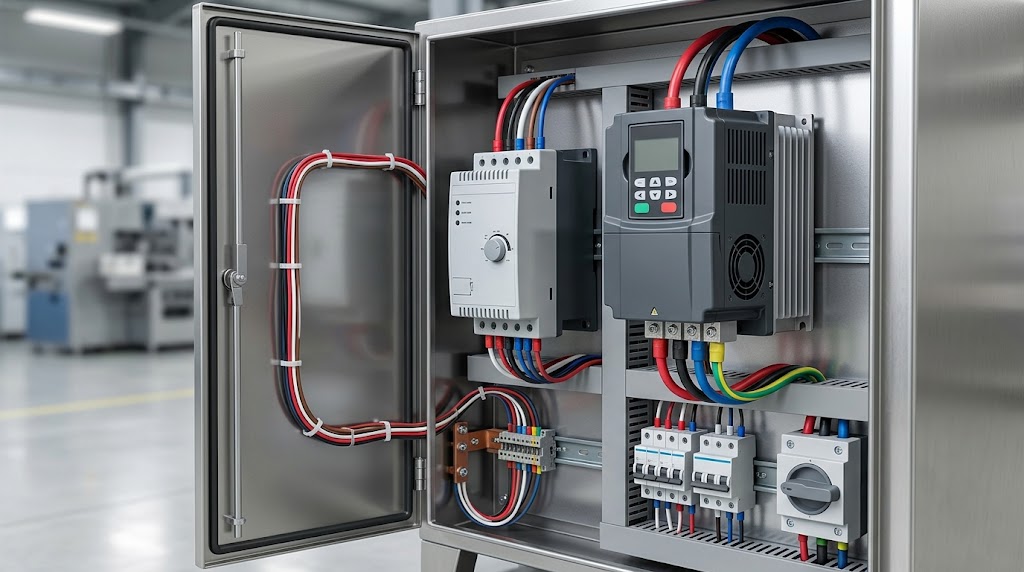
When an electric motor starts, it can draw a high amount of current and place extra stress on mechanical components. For this reason, industrial systems often use motor control devices to achieve a smoother and more controlled startup. Two commonly used solutions are Variable Frequency Drives (VFDs) and soft starters.
Although both devices can reduce the impact of motor starting, they work in different ways and are designed for different applications. Understanding the VFD vs Soft Starter difference can help engineers and technicians choose a suitable motor control solution for a specific industrial system.
A VFD can control both the speed and frequency of an AC motor during operation. In contrast, a soft starter mainly manages the motor's starting and stopping process by gradually increasing or reducing the voltage supplied to the motor.
Therefore, choosing between these technologies depends on factors such as speed control requirements, motor application, starting conditions, energy considerations, and overall system design. In this guide, we will compare VFDs and soft starters, explain their main differences, and discuss where each solution can be used effectively.
How VFDs and Soft Starters Control Motor Starting
The main difference between these two technologies becomes clear when we look at how they handle an electric motor during startup. A motor connected directly to the power supply can experience a sudden increase in current as it begins to rotate. This starting condition can create mechanical stress on connected equipment and may also cause a noticeable voltage drop in some electrical systems. Both VFDs and soft starters address this challenge, but they use different control methods to achieve a smoother motor startup.
A VFD controls the motor by adjusting the frequency and voltage supplied to it. Instead of applying the full electrical supply immediately, the drive can gradually increase the output frequency and voltage according to the configured acceleration profile. As a result, the motor can build up speed progressively rather than moving from a stationary condition to full operating speed in a single step. This controlled acceleration is particularly useful in applications where sudden mechanical movement could affect belts, pumps, fans, conveyors, or other connected equipment.
A soft starter takes a different approach. Rather than controlling the motor's operating frequency, it gradually increases the voltage supplied to the motor during startup. Semiconductor devices inside the soft starter control the voltage waveform, allowing the motor to accelerate more smoothly. Once the motor reaches its normal operating condition, the soft starter can allow the motor to continue running at the supply frequency. Consequently, its primary role is to reduce the electrical and mechanical impact associated with starting and stopping.
The distinction becomes even more important when continuous speed adjustment is required. A VFD can continue controlling motor speed after startup because it changes the output frequency during normal operation. A soft starter, however, is generally intended to manage the starting and stopping process rather than provide continuous speed regulation. Therefore, an application that needs different motor speeds during different stages of production may require a VFD, while a fixed-speed application that mainly needs smoother starting may be suitable for a soft starter.
Another important consideration is the mechanical response of the driven equipment. Gradual acceleration can reduce sudden torque changes and help connected machinery reach operating speed more smoothly. For example, a conveyor system may benefit from controlled acceleration because an abrupt start can cause products to shift or place unnecessary stress on belts and couplings. Similarly, controlled starting can be useful for pump systems where sudden changes in motor operation may contribute to undesirable pressure changes.
However, the choice should not be based on startup performance alone. Motor power, load characteristics, required operating speed, control requirements, installation conditions, and future expansion plans should also be considered. In other words, the VFD vs Soft Starter decision depends on what the motor needs to do throughout its operating cycle, not simply on how it starts.
Understanding this fundamental difference provides a useful starting point for comparing the two technologies. The next section will examine their speed control capabilities, which is one of the most significant differences when selecting a motor control solution.
Speed Control and Motor Operation
One of the most important differences in the VFD vs Soft Starter comparison is the way each device handles motor speed during normal operation. Starting a motor smoothly is only one part of motor control. In many industrial applications, the motor must also operate at different speeds depending on production requirements, material flow, process conditions, or changes in workload. This is where the capabilities of a VFD become significantly different from those of a soft starter.
A VFD can adjust motor speed by changing the frequency of the electrical power supplied to the motor. This allows the motor to operate at a selected speed rather than remaining tied to the fixed frequency of the incoming power supply. For example, a conveyor may need to run slowly while products are being positioned and then operate faster during another stage of production. With suitable control settings, the drive can adjust motor speed according to the requirements of the process. As a result, the same motor can support different operating conditions without relying only on mechanical speed-changing methods.
This type of speed control can also provide greater flexibility when an industrial process does not require the motor to operate at full speed all the time. Pumps and fans are common examples. Their required output can change throughout the day or according to process demand. Instead of keeping the motor at a constant full-speed condition, a VFD can reduce the operating speed when less output is required. Consequently, the motor can respond more closely to the actual requirements of the system, although the overall energy benefit depends on the motor, load characteristics, control strategy, and operating conditions.
A soft starter works differently because it is primarily designed to control the voltage supplied to the motor during starting and stopping. Once the motor has reached its normal operating condition, the soft starter generally does not provide the same continuous frequency-based speed adjustment available from a VFD. Therefore, a motor connected through a soft starter normally continues operating at its standard supply frequency after the starting process has finished. This makes the soft starter useful for applications where the motor only needs to run at a relatively fixed speed but requires a smoother transition during startup.
The difference becomes particularly important when the motor is part of a process that requires frequent speed changes. Consider a production conveyor that moves different materials at different stages of operation. If the process requires precise speed adjustments, a VFD can provide the necessary control while the motor remains in operation. A soft starter, on the other hand, can help the motor start smoothly, but it is not intended to function as a general-purpose speed controller. Therefore, selecting a soft starter for an application that requires continuous speed variation could result in a control system that does not meet the actual process requirements.
Speed control can also affect how operators manage an industrial system. With a VFD, the desired operating speed can be adjusted through the drive's control interface or through an external control system, depending on the installation. This can make the motor easier to integrate into automated processes where speed must change according to sensors, production stages, or programmed conditions. In contrast, a soft starter is generally focused on controlled acceleration and deceleration rather than continuous adjustment of operating speed.
Another factor is the relationship between motor speed and the mechanical equipment connected to it. Changing motor speed can directly influence the output of equipment such as conveyors, fans, pumps, and certain processing machines. However, the effect depends heavily on the type of load. A speed change that works well for one application may not provide the same result for another. For this reason, engineers should consider the complete motor-load combination rather than selecting a control device based only on the motor's rated power.
Ultimately, the choice between these technologies depends on whether the application requires speed control throughout operation or mainly requires controlled starting and stopping. If variable operating speeds form an important part of the process, a VFD provides capabilities that a conventional soft starter does not normally offer. If the motor can operate at a fixed speed once it has started and the main concern is reducing the impact of starting, a soft starter may provide the required control without the additional speed-management functions of a VFD.
Energy Efficiency and Power Consumption
Energy consumption is another important factor when comparing a VFD with a soft starter. Although both technologies can improve the way an electric motor operates, they do not provide the same type of energy management. The actual energy savings depend on the motor, load profile, operating hours, and process requirements. Therefore, it is important to understand how each device affects motor operation rather than assuming that one solution will automatically reduce energy consumption in every application.
A VFD can provide energy-saving opportunities when a motor does not need to operate at full speed continuously. By adjusting the motor speed according to the actual process demand, the drive can reduce the amount of work performed by the motor during periods of lower demand. This can be particularly relevant for variable-torque applications such as centrifugal pumps and fans, where reducing speed can produce a significant reduction in the power required by the system. As a result, applications with changing flow or airflow requirements may benefit from matching motor speed more closely to the process demand.
For example, consider a ventilation system that does not require maximum airflow throughout the entire day. If the motor operates continuously at full speed, the system may produce more airflow than the process actually needs. With an appropriately configured VFD, the motor speed can be reduced when demand falls and increased again when higher airflow is required. Consequently, the system can operate closer to its actual requirements instead of maintaining a constant high-speed condition. The potential benefit, however, depends on the specific fan, motor, system resistance, operating schedule, and control strategy.
A soft starter has a different role in relation to energy consumption. Its main purpose is to control the starting and stopping process rather than continuously adjust motor speed. Once the motor reaches normal operating conditions, the motor generally runs at the supply frequency. Therefore, a soft starter should not be selected simply because it provides a smoother start and then be expected to deliver the same variable-speed energy management available from a VFD.
The starting process can still matter from an electrical and mechanical perspective. A controlled start can reduce the sudden electrical and mechanical impact associated with starting a motor, which may be useful in systems with demanding starting conditions. However, reducing starting stress is not the same as achieving continuous energy savings. The distinction is important because most of the potential energy benefit from a VFD comes from controlling motor speed during operation, especially when the process frequently requires less than full output.
Load type also plays a major role in determining whether speed control can provide meaningful energy benefits. Variable-torque loads often respond differently to speed changes than constant-torque loads. A pump or fan, for instance, may experience substantial changes in power demand when its speed changes. On the other hand, equipment that requires relatively constant torque may not provide the same level of energy-saving potential simply by reducing speed. Therefore, engineers should evaluate the complete application before estimating possible savings.
Operating hours should also be considered. A motor that runs for only a short period each day may offer limited opportunities for energy reduction, even if a VFD can technically control its speed. In contrast, a motor that operates for long periods with varying loads may provide more opportunities to benefit from demand-based speed control. The expected operating schedule, process requirements, motor loading, and electricity costs should all be reviewed before making an investment decision.
Another important point is that efficiency should be evaluated at the system level. The motor, drive or starter, mechanical equipment, control strategy, and process all work together. Improving one component does not necessarily guarantee a proportional improvement in the entire system. For this reason, a proper assessment should consider how the motor is currently being used, whether variable speed is actually required, and how much of the operating time is spent under reduced demand.
In the VFD vs Soft Starter comparison, this means neither technology should be considered solely on the basis of energy savings. A VFD can provide significant advantages when variable-speed operation matches the needs of the process, while a soft starter can be a practical choice when the motor normally runs at a fixed speed and the primary requirement is controlled starting and stopping. The right choice depends on the operating conditions rather than on the device name alone.
In the VFD vs Soft Starter comparison, this means neither technology should be considered solely on the basis of energy savings. A VFD can provide significant advantages when variable-speed operation matches the needs of the process, while a soft starter can be a practical choice when the motor normally runs at a fixed speed and the primary requirement is controlled starting and stopping. The right choice depends on the operating conditions rather than on the device name alone.
Applications and Practical Use Cases
The right motor control solution depends heavily on the application. Different machines place different demands on their motors, so a device that works well in one system may not suit another. The VFD vs Soft Starter decision should therefore begin with the actual operating requirements. Engineers should consider speed requirements, load behavior, production conditions, and the way the motor interacts with connected equipment.
Applications Where VFDs Are Commonly Used
VFDs suit applications that require regular speed adjustment. Industrial conveyors are one common example. A conveyor may need different speeds during loading, processing, and unloading. A VFD allows operators or control systems to adjust motor speed according to these requirements. This flexibility can also help coordinate multiple stages within an automated production line.
Pumps provide another important example. Many pumping systems do not need the same flow rate at all times. A VFD can adjust motor speed when process demand changes. As a result, the pump can respond more closely to the required flow. However, engineers should always consider the pump type, system design, and operating conditions before selecting a drive.
Fans and ventilation systems can also benefit from variable-speed operation. Airflow requirements often change throughout the day. A VFD can increase or reduce motor speed as demand changes. This approach can provide better process control and may also reduce energy consumption in suitable applications.
VFDs also work well in machines that require controlled production speeds. Manufacturing equipment may need one speed during setup and another during normal production. A drive can support these changes without requiring the motor to remain at one fixed speed. Consequently, the control system gains more flexibility.
Applications Where Soft Starters Can Be Suitable
Soft starters can work well when a motor normally runs at a fixed speed. In these applications, the main concern may be the effect of starting the motor rather than controlling its speed during operation. The soft starter can gradually increase motor voltage during startup. This approach can help reduce sudden starting effects on the electrical and mechanical system.
Large pumps can represent a practical soft starter application when the process does not require continuous speed variation. The motor can start gradually and then operate at its normal speed. Similarly, certain fans can use soft starters when they always need to run at a fixed operating speed after startup.
Industrial conveyors may also use soft starters when their operating speed remains constant. A controlled start can reduce sudden movement through the mechanical system. This can help create a smoother transition from a stationary condition to normal operation. However, if the conveyor requires frequent speed changes, a VFD may offer more suitable control.
Compressors and other fixed-speed equipment can also present situations where a soft starter may meet the basic motor control requirement. The exact choice depends on the compressor design and its starting characteristics. Engineers should also review manufacturer requirements before selecting the control equipment.
Choosing Based on the Process
The VFD vs Soft Starter comparison becomes easier when the process requirements are clearly defined. Start by asking whether the motor needs different operating speeds. If the answer is yes, a VFD can provide the required speed control. If the motor normally runs at one speed and the main requirement involves smoother starting, a soft starter may be considered.
The load profile also matters. Some machines experience frequent changes in demand. Others operate under relatively stable conditions. A variable-speed solution can provide greater flexibility when demand changes regularly. On the other hand, a fixed-speed application may not need the additional functions of a VFD.
The control system should also influence the decision. Modern industrial plants often connect motor control equipment with PLCs and other automation systems. A VFD can support applications where the control system needs to adjust motor speed according to process conditions. A soft starter can still fit automated systems when the motor only needs controlled starting and stopping.
Installation conditions deserve attention as well. Available cabinet space, electrical requirements, environmental conditions, motor ratings, and cooling arrangements can affect equipment selection. Therefore, engineers should review the complete installation instead of choosing a device based only on its basic function.
Ultimately, the best approach is to match the motor control device with the job it needs to perform. The VFD vs Soft Starter choice should reflect speed requirements, load behavior, process control, and operating conditions. This practical approach helps avoid unnecessary features while ensuring that the motor receives the control it actually needs.
Cost, Installation, and Maintenance Considerations
Cost plays an important role when selecting motor control equipment. However, the purchase price should not be the only consideration. A VFD and a soft starter serve different purposes. Their required features, installation needs, and operating conditions can therefore affect the total project cost.
A soft starter often has a simpler role in a motor control system. It focuses mainly on controlled starting and stopping. If the motor does not require variable-speed operation, this simpler approach may meet the application requirements. The final cost still depends on motor size, equipment rating, enclosure requirements, protection devices, and installation conditions.
A VFD can require a larger investment when the application needs advanced speed control. The system may also require additional configuration and integration work. However, those features can provide value when the process needs frequent speed changes. Therefore, the higher initial cost may make sense when the application actually uses the drive's control capabilities.
Installation requirements also differ between the two technologies. A VFD can require careful attention to cable selection, grounding, ventilation, and electrical installation practices. Engineers should also consider the environment around the drive. High temperature, dust, moisture, and poor ventilation can affect equipment performance and service life.
Soft starter installations also require proper electrical planning. The installer must select suitable protection equipment and verify the motor's electrical characteristics. The starter should match the motor and the application's starting requirements. Proper connections can help maintain reliable operation and reduce unnecessary electrical problems.
Maintenance requirements depend on the installation and operating environment. A clean and properly ventilated control cabinet can support reliable equipment operation. Regular inspection can also help identify loose connections, excessive heat, dust buildup, or other physical issues before they affect the system.
The application itself should guide maintenance planning. A motor that operates continuously in a demanding environment may require more frequent inspection than equipment with limited operating hours. Temperature, load conditions, ventilation, and surrounding conditions can all influence maintenance needs.
Engineers should also consider future requirements before making a final selection. A machine may operate at a fixed speed today but require variable-speed control after a future production upgrade. In such cases, the VFD vs Soft Starter decision should include the expected development of the system. Planning ahead can prevent an expensive control upgrade later.
However, adding a VFD does not automatically make every motor system better. If the application only requires fixed-speed operation and controlled starting, a soft starter may provide the necessary functionality. Likewise, choosing a soft starter for a process that requires continuous speed adjustment can create limitations.
The most practical approach is to compare the complete system rather than focusing on the equipment price alone. Consider the motor rating, load type, operating hours, speed requirements, installation environment, control requirements, and future expansion plans. This approach can help engineers select equipment that matches the actual application.
The most practical approach is to compare the complete system rather than focusing on the equipment price alone. Consider the motor rating, load type, operating hours, speed requirements, installation environment, control requirements, and future expansion plans. This approach can help engineers select equipment that matches the actual application.
VFD vs Soft Starter: Advantages and Limitations
Both technologies can solve specific motor control requirements. However, they do not offer the same functions. Understanding their strengths and limitations can make the selection process easier. The VFD vs Soft Starter comparison becomes clearer when each option is viewed according to its practical purpose.
VFD Advantages
A major advantage of a VFD is continuous speed control. The drive can change motor speed according to process requirements. This feature can provide greater flexibility in automated equipment. It also allows one motor to operate at different speeds during different production stages.
A VFD can also provide controlled acceleration and deceleration. Operators can adjust these settings according to the application. This control can help machines transition between operating conditions more smoothly. It can also support processes that require specific acceleration profiles.
Another advantage involves process control. A VFD can work with external control signals and automation systems. A PLC can, for example, send a speed reference to the drive. The drive can then adjust motor speed according to that reference. This makes VFDs useful in many automated industrial systems.
VFDs can also support energy management in suitable applications. This benefit becomes more relevant when the motor frequently operates below full speed. Pumps and fans can sometimes achieve meaningful savings through variable-speed operation. However, the actual result depends on the load and operating conditions.
VFD Limitations
A VFD can require more careful installation than a basic motor starter. Engineers must consider grounding, cable selection, ventilation, and electrical compatibility. The surrounding environment also matters. Excessive heat, dust, or moisture can affect equipment performance.
The additional control features can also increase system complexity. Technicians may need to configure operating parameters and control signals correctly. Proper commissioning therefore becomes important. Incorrect settings can prevent the motor from operating as intended.
A VFD can also cost more than a simple soft starter for applications that only need controlled starting. Therefore, its additional features should have a clear purpose. Buying advanced equipment without using its capabilities may increase project costs without providing a practical benefit.
Soft Starter Advantages
A soft starter provides a straightforward solution for controlled motor starting. It gradually increases the voltage supplied to the motor. This process can reduce the sudden impact associated with direct starting.
Soft starters can also suit fixed-speed applications. Once the motor reaches normal operating conditions, it can continue running at the required supply frequency. This makes the technology suitable for equipment that does not need continuous speed adjustment.
Another benefit involves system simplicity. A soft starter generally focuses on a smaller range of motor control functions. As a result, it can be a practical choice when the application has straightforward requirements.
Soft Starter Limitations
The main limitation is the lack of continuous speed control. A soft starter does not normally provide the same variable-frequency operation as a VFD. Therefore, it may not suit machines that require frequent speed changes.
A soft starter also cannot replace every function of a VFD. If a process needs different motor speeds during production, the system may require another method of speed control. This can reduce the suitability of a soft starter for advanced automation applications.
Making a Practical Comparison
The VFD vs Soft Starter decision should always reflect the actual motor application. A VFD provides broader control when speed adjustment forms part of the process. A soft starter can provide a simpler solution when the motor only needs controlled starting and stopping.
Neither option should be selected simply because it offers more features. The correct choice depends on what the machine needs. Motor characteristics, load behavior, speed requirements, control methods, installation conditions, and future plans should all receive attention.
This comparison also shows why there is no universal solution for every motor. Different industrial systems have different requirements. A careful assessment can help avoid unnecessary equipment costs while still providing reliable motor control.
VFD vs Soft Starter: How to Choose the Right Solution
Choosing between a VFD and a soft starter starts with one simple question: what does the motor need to do? If the application requires continuous speed adjustment, a VFD can provide that control. If the motor only needs a smooth start and normally runs at one speed, a soft starter may meet the requirement.
The load type also deserves attention. Pumps, fans, conveyors, and production machines can have very different operating demands. Some loads need variable speed throughout the process. Others can operate efficiently at a fixed speed. Therefore, engineers should evaluate the complete application before selecting motor control equipment.
Operating conditions matter as well. Consider the motor rating, running hours, load changes, electrical supply, installation environment, and available control methods. Future expansion should also be part of the decision. A system that may require variable speed later could benefit from planning for that requirement early.
Cost should support the technical decision rather than determine it alone. A soft starter may provide a practical solution for a fixed-speed motor. A VFD may justify its additional features when the process needs speed control and flexible operation. The goal should be to select equipment that matches the actual requirements of the system.
Conclusion
The VFD vs Soft Starter comparison shows that both technologies have useful roles in industrial motor control. A VFD offers variable-speed operation, flexible control, and useful process-management capabilities. A soft starter focuses more on controlled motor starting and stopping.
Neither technology suits every application. The correct choice depends on the motor, load, process, and control requirements. By reviewing these factors carefully, engineers and technicians can select a solution that provides the required performance without adding unnecessary complexity.
Understanding these differences can also make future system upgrades easier. When the application requirements are clear, motor control equipment can be selected with greater confidence. Ultimately, the best solution is the one that matches the machine's operating needs and supports reliable industrial performance.